
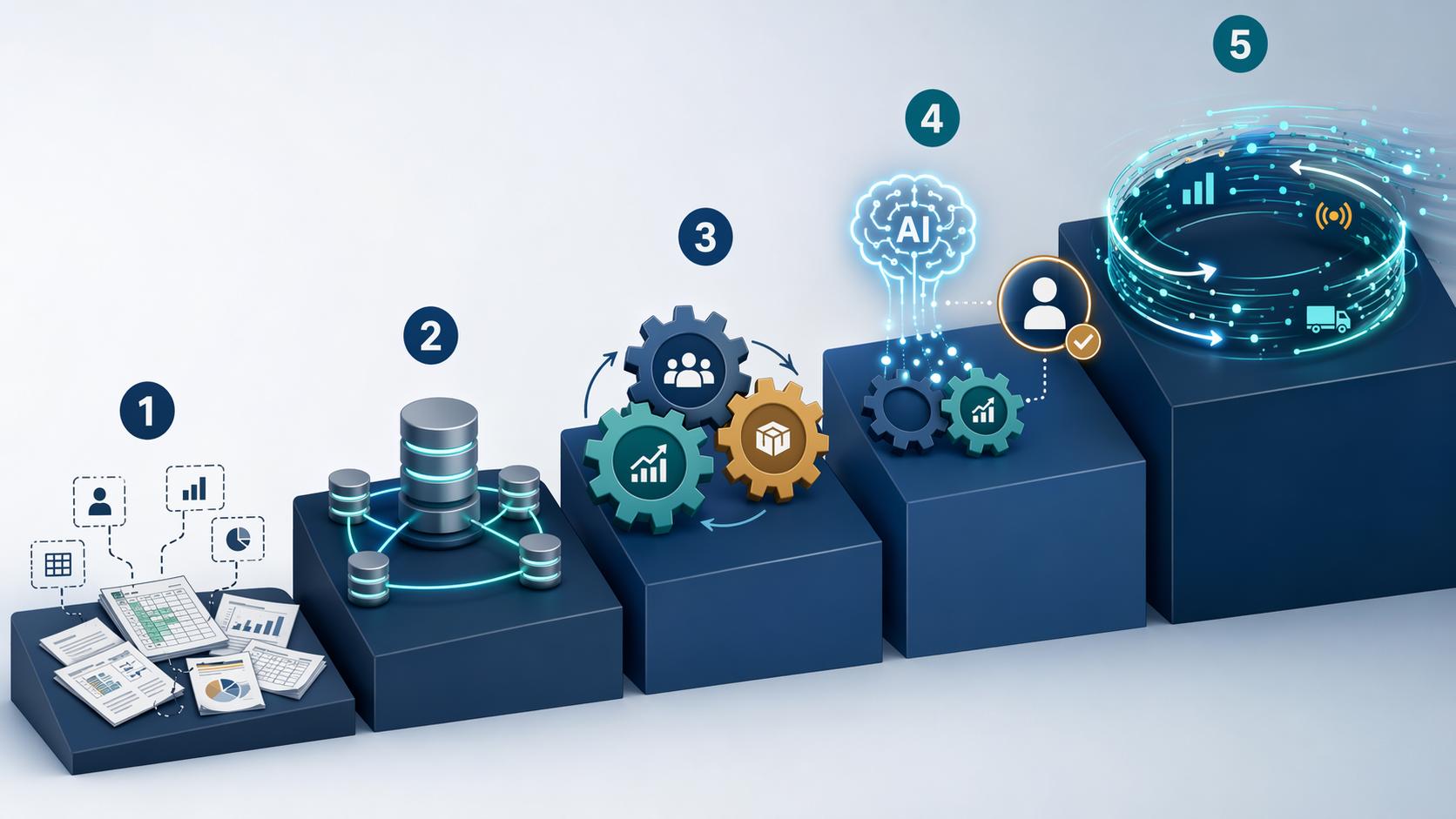
A lot of AI demand planning pilots do one thing well: they produce a forecast that looks cleaner than the old one and then disappear into the same planning meeting. The planner still reconciles customer data by hand, sales still keeps a side spreadsheet for commercial overrides, and the monthly S&OP deck arrives after the recommendation is already stale. That is usually not a model failure. It is an operating-model failure. Per Hong of Kearney has warned that the supply chain operating model is not evolving nearly as quickly as the technology, and that is where many pilots hit their breaking point [1]. The harder question is not whether the algorithm can see demand signals earlier than humans can, but whether the organization can absorb the signal before the next review cycle freezes it.
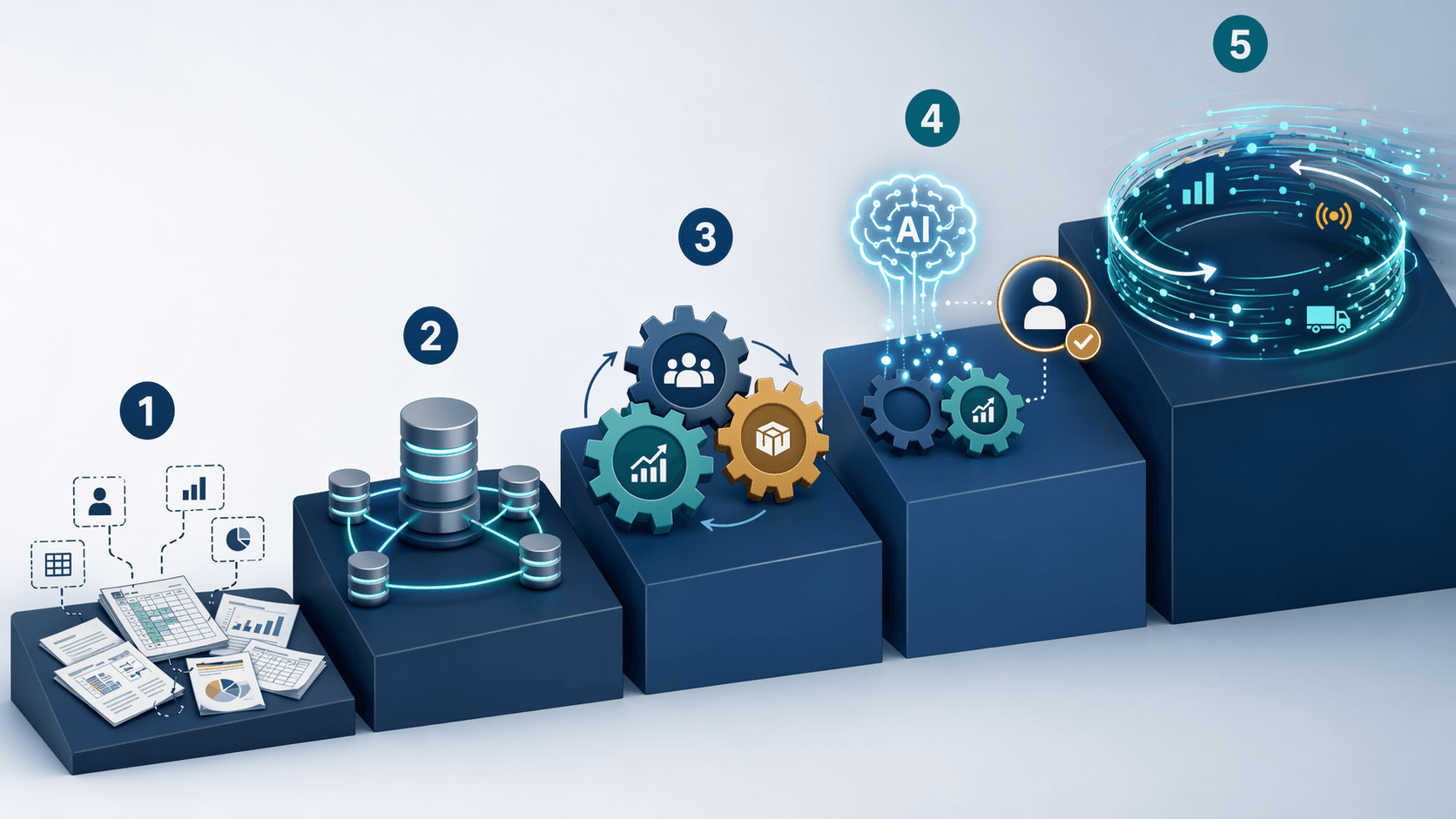
The five stages in one view
The framework below is a synthesis, not a universal standard. o9 Solutions is useful here because it separates demand drivers, structure and process, collaboration, statistical methodology, and organizational capability, which keeps the discussion from collapsing into a purely technical scorecard [2]. Open Sky Group’s summary of 2026 supply chain AI statistics adds another useful constraint: only 23% of organizations report a formal AI strategy, and only 29% say they have built the capabilities needed for future readiness [3].
| Stage | What changes operationally | What usually breaks |
|---|---|---|
| Level 1: Fragmented spreadsheet planning | Forecasting is split across files, extracts, and local judgment. | There is no single version of demand, so every exception becomes a reconciliation task. |
| Level 2: Unified data foundation | ERP, WMS, POS, and eCommerce data are reconciled into one usable view. | Teams can now debate assumptions, but data definitions still need ownership. |
| Level 3: Cross-functionally aligned planning | IBP or S&OP connects sales, supply, and finance around one cadence. | Overrides and trade-offs move into the formal planning process instead of side channels. |
| Level 4: AI-driven forecasting in production | The model generates recommendations inside the planning workflow with human review. | Trust, exception handling, and governance determine how much autonomy the model gets. |
| Level 5: Continuous near-real-time planning | Signals update continuously and the organization responds inside a shorter decision window. | The operating cadence, rights, and data flow must all be fast enough to matter. |
OnePint’s timing guidance makes the sequence feel less theoretical. The data foundation stage typically takes 6 to 9 months, and cross-functional alignment can take another 6 to 12 months before AI deployment is viable, though those ranges are directional and will vary by industry, data complexity, and existing systems maturity [4]. That is why so many pilots stall in the middle: the company bought the model before it built the conditions that let the model matter.
Where the sequence usually stalls
Level 1: fragmented spreadsheet planning
At Level 1, demand planning is still a patchwork of spreadsheets, ERP extracts, and local judgment. The model may exist in a pilot environment, but the people who own exceptions do not live in that environment. If customer data is being cleaned after the fact and the commercial team is revising the forecast in another file, the algorithm is working from a version of reality the organization no longer trusts.
Level 2: unified data foundation
Level 2 is not glamorous, but it changes what the forecast means. ERP, WMS, POS, and eCommerce feeds are reconciled enough that the team can point to one demand view and argue about the assumptions instead of the data. That is the stage where the conversation shifts from "Which file is right?" to "Which signal should we privilege when the data conflict?" If the organization is still here, the next useful stop is the AI Demand Planning Implementation Readiness Assessment Checklist, because the bottleneck is usually not model selection yet; it is whether the data can support a shared planning decision.
Level 3: cross-functional alignment
Unified data is necessary, but it does not change decisions until the company changes the meeting. Level 3 is where IBP or S&OP becomes the place where sales, supply, finance, and customer teams align around one planning cadence. The model can now surface exceptions earlier, but the organization still has to decide who resolves them, who can override them, and what happens when the forecast conflicts with the commercial plan. That is the real transition: from data reconciliation to cross-functional decision rights.
- One forecast calendar replaces the separate monthly and weekly cycles that used to miss one another.
- Forecast overrides move into the formal process instead of a side spreadsheet.
- Exception ownership is named, so the same issue is not renegotiated in every review.
- The planner, sales lead, and finance partner are looking at the same assumptions when the decision is made.
What changes at Level 4 and Level 5
Level 4: AI-driven forecasting in production
This is the first stage that deserves the label AI-driven forecasting in production, but even here the human planner does not disappear. RELEX’s 2026 trust data makes that plain: only 10% of supply chain leaders trust AI to make critical decisions without human review, while 54% prefer a hybrid model in which AI suggests and the planner decides [5]. That is not a failure of adoption; it is the current operating norm. The useful question at Level 4 is not whether the tool can produce a recommendation, but whether the exception process, approval path, and review cadence can keep up with it.
For examples of what this looks like across sectors, see AI Demand Forecasting in Production Across Six Industries. For ROI patterns once the foundation is in place, see C3 AI Demand Forecasting ROI: Evidence from Enterprise Deployments.
Level 5: continuous near-real-time planning
Level 5 is the destination often used in vendor diagrams: continuous, near-real-time planning in which fresh signals flow into the model and the organization reacts quickly enough for the output to matter. The important part is not the sensor count or the speed of the dashboard. It is whether the planning process can move in the same time window as the demand signal. A near-real-time model sitting inside a monthly approval cycle is still a batch process with better graphics.
A diagnostic lens that is more useful than a maturity score
o9’s five categories are useful because they separate what is wrong with the forecast from what is wrong with the operating model [2]. A team can use them to locate the missing prerequisite instead of jumping straight to a bigger algorithm.
- Demand drivers: Which signals are actually missing, and which ones are already being ignored?
- Structure and process: Is there one planning calendar, or multiple cycles that never meet?
- Collaboration: Where do overrides happen, and who has the right to make them?
- Statistical methodology: Does the model improve the exceptions that hurt service, or only the average error?
- Organizational capability: Who owns master data, reconciliation, and exception triage?
If the answers break down in the first two questions, Level 1 or Level 2 work still dominates. If the problem is in the middle two, the organization is in the messy zone where AI output exists but does not yet shape decisions. If the failure sits in the last one, the barrier is governance and adoption, not model selection. That is why the next priority is usually the nearest missing prerequisite, not the most advanced AI feature available.
References
- Supply Chain Dive, 2026 coverage citing Per Hong of Kearney on supply chain operating-model lag
- o9 Solutions, “Demand Planning Maturity Levels and How to Improve Them”
- Open Sky Group, “Supply Chain AI Statistics: 18+ Statistics You Should Know for 2026”
- OnePint.ai, “What Are the Biggest Challenges in Demand Planning?”
- RELEX Solutions, “Supply chain AI in 2026: The numbers behind the hype”
Comments
Join the discussion with an anonymous comment.