

The uncomfortable number in machine learning in logistics planning is not a model-accuracy score. It is the gap between intent and operating discipline: 94% of supply chain companies plan AI adoption within two years, while only 23% have a formal AI strategy in place.[1][2] That spread is wide enough to explain why so many programs sound approved in a steering committee and then stall somewhere between the TMS integration queue, a messy location master, and a finance review that asks when the savings will hit the P&L.
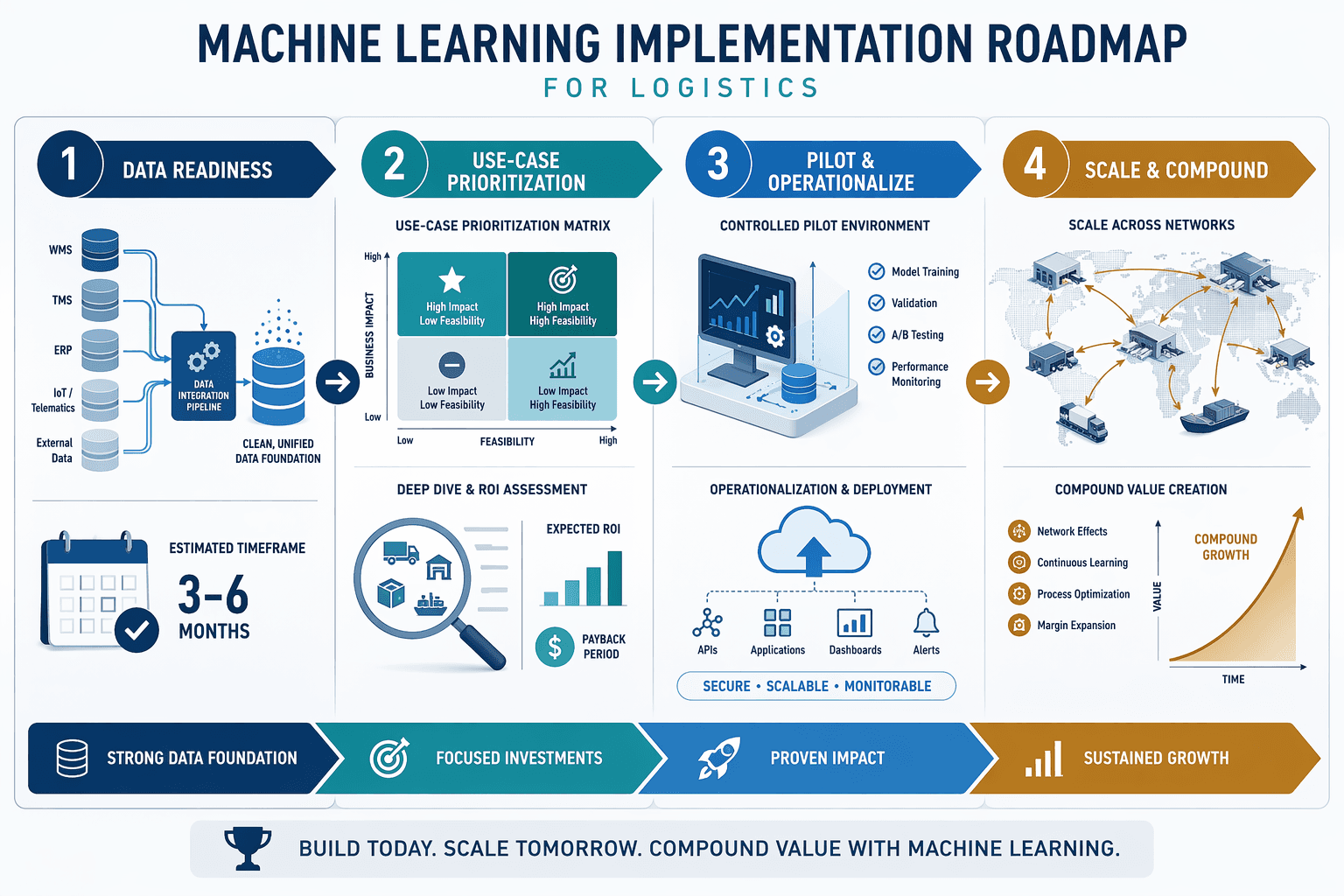
For a deeper diagnosis of that gap, ChainSignal has already covered why AI planning has to precede logistics ROI. This guide picks up from there. The operating answer is not to buy another optimization tool and hope the organization catches up. It is to move through four phases in order: data readiness, use-case prioritization, a controlled pilot that can become production, and scaling with a realistic ROI horizon.

| Phase | Executive question | Main output |
|---|---|---|
| 1. Data readiness | Can the systems, definitions, and ownership model support ML in production? | A prepared data foundation and integration plan |
| 2. Use-case prioritization | Which logistics problem is valuable enough and feasible enough to go first? | A ranked use-case portfolio with one first deployment target |
| 3. Pilot and operationalize | Can the model survive real workflows, exceptions, and accountability? | A production-shaped pilot with operational acceptance criteria |
| 4. Scale and compound | Can the organization fund, govern, and improve the capability over several years? | A scaling roadmap tied to adoption, savings realization, and governance |
Phase 1: Treat data readiness as a workstream, not a cleanup task
The first phase is where optimistic timelines usually lose contact with the actual logistics environment. Machine learning does not enter a clean laboratory. It enters carrier portals, EDI feeds, ERP order tables, warehouse systems, yard events, telematics streams, spreadsheet workarounds, and exception codes that different teams use in different ways.
A realistic plan should reserve time for that work. One market report on machine learning in logistics points to a 3–6 month window for integration and data preparation when ML solutions are connected to legacy logistics systems.[3] That should not be buried as an implementation footnote. It is a planning constraint that affects budget release, pilot timing, vendor selection, and the credibility of the first executive update.
Before modeling begins, the team needs to know which systems will feed the use case, which fields are trusted, which fields are merely available, and who can resolve conflicts. A route optimization model may need order promise dates, stop constraints, equipment types, driver hours, accessorial rules, appointment windows, historical dwell time, and carrier acceptance behavior. If those fields live across several platforms, the work is not just extraction. It is reconciliation.
The readiness review should be practical enough that operations managers recognize their world in it. For each candidate use case, leaders should identify:
- Source systems: TMS, WMS, ERP, fleet-management software, order-management platforms, carrier portals, IoT or telematics feeds, and finance systems that will be needed to measure outcomes.
- Data definitions: what counts as on-time pickup, on-time delivery, empty miles, detention, stockout, inventory reduction, avoidable premium freight, or unplanned downtime.
- History depth and event quality: whether enough past transactions exist, whether timestamps are consistent, and whether exception codes describe reality or just administrative closure.
- Ownership: who can change a master-data rule, approve a new integration, correct a location hierarchy, or decide that a field is no longer fit for decision-making.
- Workflow dependency: where a prediction will land, who reviews it, what action they can take, and what happens when the recommendation conflicts with customer, labor, or carrier constraints.
This is where many logistics ML programs quietly become unrealistic. A team can build a promising demand-to-transport planning model using a cleaned extract, then discover that the production feed arrives too late for the dispatch window. A maintenance signal can look persuasive in a dashboard, then fail to create value because the repair schedule, parts availability, and asset-routing plan are owned by different groups. The issue is not that the data was imperfect. Logistics data is always imperfect. The issue is whether the organization knows which imperfections block deployment and which can be managed operationally.
A strong Phase 1 ends with a short list of usable data products, not a general statement that “data quality is improving.” For example, a transportation lane-performance dataset, a shipment-event dataset, or an asset-maintenance dataset should have named owners, refresh frequency, known exclusions, and a path into the system where people actually work. If that cannot be stated, the organization is still preparing to experiment, not preparing to implement.
Phase 2: Pick the first use case by value, feasibility, and operational control
The second phase is not a brainstorming session about every possible ML application. Most logistics organizations can already name the attractive use cases: route optimization, ETA prediction, load matching, inventory positioning, demand sensing, predictive maintenance, procurement analytics, claims automation, warehouse labor planning. The harder decision is which one deserves to go first.
Broad impact ranges are useful here, as long as they are handled as directional evidence rather than guaranteed business-case numbers. McKinsey has reported potential reductions of 5–20% in logistics costs, 20–30% in inventory, and 5–15% in procurement spend from AI-enabled supply chain applications.[4] Those ranges are large because implementation maturity, data quality, operating model, and starting performance vary widely. They should help rank opportunity areas; they should not be pasted into a budget as promised savings.
For a broader benchmark view across application areas, ChainSignal’s machine learning logistics ROI benchmarks can support the comparison. At this stage, though, the executive decision should be narrower: choose a first deployment target where value is material, the data foundation is close enough, and the operating team can act on the model output.
| Selection lens | What to test before committing |
|---|---|
| Economic value | Is the cost pool large enough, and can savings be measured without arguing over baseline definitions? |
| Data readiness | Are the required events, master data, and historical outcomes available at the timing and quality needed? |
| Decision proximity | Will the prediction reach someone who can change a route, booking, replenishment decision, maintenance plan, or procurement action? |
| Exception load | Are the exceptions manageable, or will every recommendation require manual negotiation? |
| Change burden | How much behavior change is required from planners, dispatchers, warehouse teams, carriers, maintenance teams, or suppliers? |
| Governance fit | Can the organization assign ownership for model performance, process compliance, and financial validation? |
A use case with the largest theoretical value is not always the right first move. Network-wide inventory optimization may have a compelling value pool, but if demand signals are inconsistent, item-location hierarchies are disputed, and commercial teams frequently override allocations, it may be a poor first production candidate. A narrower transportation opportunity, such as improving tendering recommendations on a defined group of lanes, may create a cleaner path to adoption because the decision owner, timing, and savings mechanism are easier to define.
This is also where organizations should separate adoption enthusiasm from implementation readiness. Employee readiness may be better than some executives assume: ActivTrak reported in 2025 that 72% of logistics employees already use AI tools.[5] That matters. People who have already experimented with AI are less likely to treat every model as a foreign object. But informal tool use does not answer whether the model will be trusted in a dispatch sequence, whether supervisors will coach to it, or whether finance will accept the claimed savings.
The first use case should therefore be framed as a managed operating change. Define the decision to be improved, the baseline, the population included, the people affected, and the financial owner before selecting the algorithmic approach. If the organization cannot explain how a prediction becomes an action, it has not yet selected a deployable use case.
Phase 3: Build a pilot that resembles production
A pilot should not be designed to win a demo day. It should be designed to answer whether the model can operate inside the real constraints of the business. That means the test population should include enough normal variation to expose exception handling: late tender responses, missing scans, weather disruptions, customer appointment changes, constrained labor, trailer shortages, maintenance conflicts, and manual overrides.
Cloud deployment can help with speed. The same machine-learning-in-logistics market report found that cloud-based deployment represented 73% of the market in 2025 and described cloud rollout as possible in weeks compared with six months for traditional fixed automation.[3] That is a useful shift. It can shorten the time to provision environments, connect services, and iterate models. It does not remove the slower work of changing planning routines, training supervisors, aligning exception rules, and agreeing how benefits will be booked.
The pilot design should state both model metrics and operational metrics. A demand forecast can improve statistically and still fail to reduce premium freight if planners do not trust it early enough to change capacity decisions. A routing model can improve mileage estimates and still disappoint if warehouse loading windows, driver preferences, or customer access restrictions are not represented. The acceptance criteria should include whether the recommendation was available on time, whether people used it, why they overrode it, and whether the measured business outcome moved against a credible baseline.
Real-world case studies show why the production context matters, but they should be read with the right caution. Uber Freight has reported reducing empty miles from roughly 30% to 10–15% in a company-commissioned case study, and DHL has reported predictive-maintenance work reducing unplanned downtime by up to 35% in a company-commissioned case study.[6][7] These are useful directional signals that ML can affect logistics operations. They are not independent audits, and they should not be treated as transferable guarantees.
A production-shaped pilot usually has fewer moving parts than an executive showcase. It may cover a region, a group of high-volume lanes, a warehouse cluster, a fleet subset, or a category of inventory where the baseline is understood. It should run long enough to observe recurring operational cycles, not just a favorable week. It should also have a named decision owner who can authorize workflow changes during the test instead of leaving the project team to collect feedback without authority.
What the pilot must prove
- The model can receive production-like data at the required frequency.
- The recommendation reaches the right person before the decision window closes.
- Users understand when to follow, question, or override the recommendation.
- Overrides are captured with enough context to improve the model or workflow.
- Finance, operations, and technology agree on the baseline and benefit measurement.
- The support model is clear: who monitors performance, resolves data breaks, and approves changes.
The fastest way to waste a pilot is to prove only that a model can produce an interesting output. The useful question is whether the organization can absorb that output without creating more manual work than it removes.
Phase 4: Scale on a multi-year ROI horizon
Scaling machine learning in logistics is less like flipping a switch and more like adding governed decision capacity across the network. Each additional use case brings new integrations, exception rules, user groups, model monitoring needs, and benefit-measurement questions. The roadmap has to survive quarterly cost pressure without pretending that every benefit will appear in the first year.
Deloitte’s 2025 findings are useful for resetting expectations: 85% of organizations increased AI investment, only 6% saw ROI in under a year, and most organizations required 2–4 years to reach satisfactory ROI.[8] That does not excuse vague programs. It does mean leaders should expect a compounding curve: foundational data work, one or two production use cases, improved trust, stronger governance, and then broader reuse of the same data and operating patterns.
The scaling plan should define which capabilities are reused and which must remain use-case specific. Data pipelines, master-data governance, model-monitoring practices, integration patterns, and financial validation methods should become shared assets. The decision logic for predictive maintenance will still differ from transport planning or inventory optimization, but the organization should not rebuild every surrounding control from scratch.
Scaling also changes the management problem. In a pilot, a small group can manually watch data breaks and user behavior. At scale, someone needs a formal model-performance review, drift monitoring, retraining rules, access controls, incident response, and a process for retiring models that no longer support the operation. Finance needs to distinguish modeled benefit, operationally realized benefit, and audited savings. Operations needs a way to identify when a model is wrong, when the process is wrong, and when the business rule has changed.
Change management should not be reduced to training sessions after the technical work is done. If dispatchers, planners, warehouse supervisors, maintenance coordinators, buyers, or carrier managers are expected to change decisions, they need to be involved while acceptance criteria are being written. The 72% employee AI-use figure suggests the starting point may be curiosity rather than resistance in many logistics teams.[5] The practical task is to convert that familiarity into governed behavior: when to use the tool, when to override it, how to document exceptions, and how feedback improves the system.
The payoff belongs to organizations that complete the operating journey
The case for persistence is strong, but it should be framed accurately. Accenture found that AI-mature supply chains are 23% more profitable and six times as likely to use AI widely.[9] That is not evidence that buying machine-learning software produces a 23% profitability lift. It is evidence that companies able to embed AI across supply chain decisions operate differently from those still running isolated experiments.
That distinction matters in logistics because the model is rarely the whole constraint. A route recommendation must fit loading capacity and service promises. A predictive-maintenance alert must compete with asset utilization and parts availability. A demand signal must reach transport planning early enough to affect carrier commitments. A procurement insight must survive contract terms, supplier capacity, and internal compliance. Value appears when the model, workflow, governance, and measurement system are connected.
Logistics leaders do not need more proof that ML matters. They need a roadmap that protects budget, credibility, and adoption long enough for benefits to accumulate. If the organization cannot name its data-readiness work, prioritized use case, pilot design, and scaling horizon, it does not yet have an ML implementation plan, no matter how strong its AI intent appears.
References
- ABI Research 2025 AI adoption statistic via Open Sky Group, Open Sky Group, 2025, https://www.openskygroup.com/
- Gartner 2025 AI strategy statistic, Gartner, 2025, https://www.gartner.com/
- Machine Learning in Logistics Market Report, Global Market Insights, 2025, https://www.gminsights.com/
- AI-enabled supply chain impact ranges, McKinsey & Company, 2024, https://www.mckinsey.com/
- 2025 employee AI adoption finding for logistics employees, ActivTrak, 2025, https://www.activtrak.com/
- Uber Freight empty miles reduction case study, Uber Freight, https://www.uberfreight.com/
- DHL predictive maintenance downtime reduction case study, DHL, https://www.dhl.com/
- Deloitte 2025 AI investment and ROI timeline finding, Deloitte, 2025, https://www.deloitte.com/
- AI-mature supply chain profitability finding, Accenture, 2024, https://www.accenture.com/
Comments
Join the discussion with an anonymous comment.