

The familiar stall pattern in machine learning supply chain management does not usually begin with a bad demo. It begins after the demo, when the pilot has to survive the Monday morning planning cycle. The forecast looks more sophisticated than the old statistical model, but the planner still has to explain why a recommendation conflicts with a customer commitment. Inventory moves, service drops, or an exception queue doubles, and suddenly nobody is quite sure whether the model, the data, the business rule, or the planner is accountable.
That gap between executive ambition and operating reality is showing up in the broader numbers. A 2025 BCG figure cited by OpenSky Group says 85% of AI initiatives deliver close to zero measurable value, and a McKinsey figure in the same roundup says only about one-third of organizations that report using AI eventually scale it.[1] PwC’s 2026 U.S. operations survey of 767 leaders found that 89% say technology investments have not fully delivered their expected results.[2] These are not arguments against AI. They are evidence that buying or building a model is the easier part.
The supply chain-specific readiness gap is just as important. Gartner figures cited by OpenSky Group indicate that only 23% of supply chain organizations have a formal AI strategy, and only 29% have built the capabilities needed for future readiness.[1] Deloitte data cited in the same source says 84% of organizations have not redesigned jobs or KPIs around AI capabilities.[1] In practice, that means many programs are asking planners, inventory managers, and functional owners to absorb AI outputs into operating models that were never redesigned to use them.
A credible roadmap has to start there. The question is not whether machine learning can improve forecasting, replenishment, allocation, transportation planning, or exception management. In many settings, it can. The implementation question is narrower and more operational: what has to be true before the organization is allowed to move from a bounded ML use case to assistive workflows, then to agentic orchestration, and eventually to autonomous decision-making?
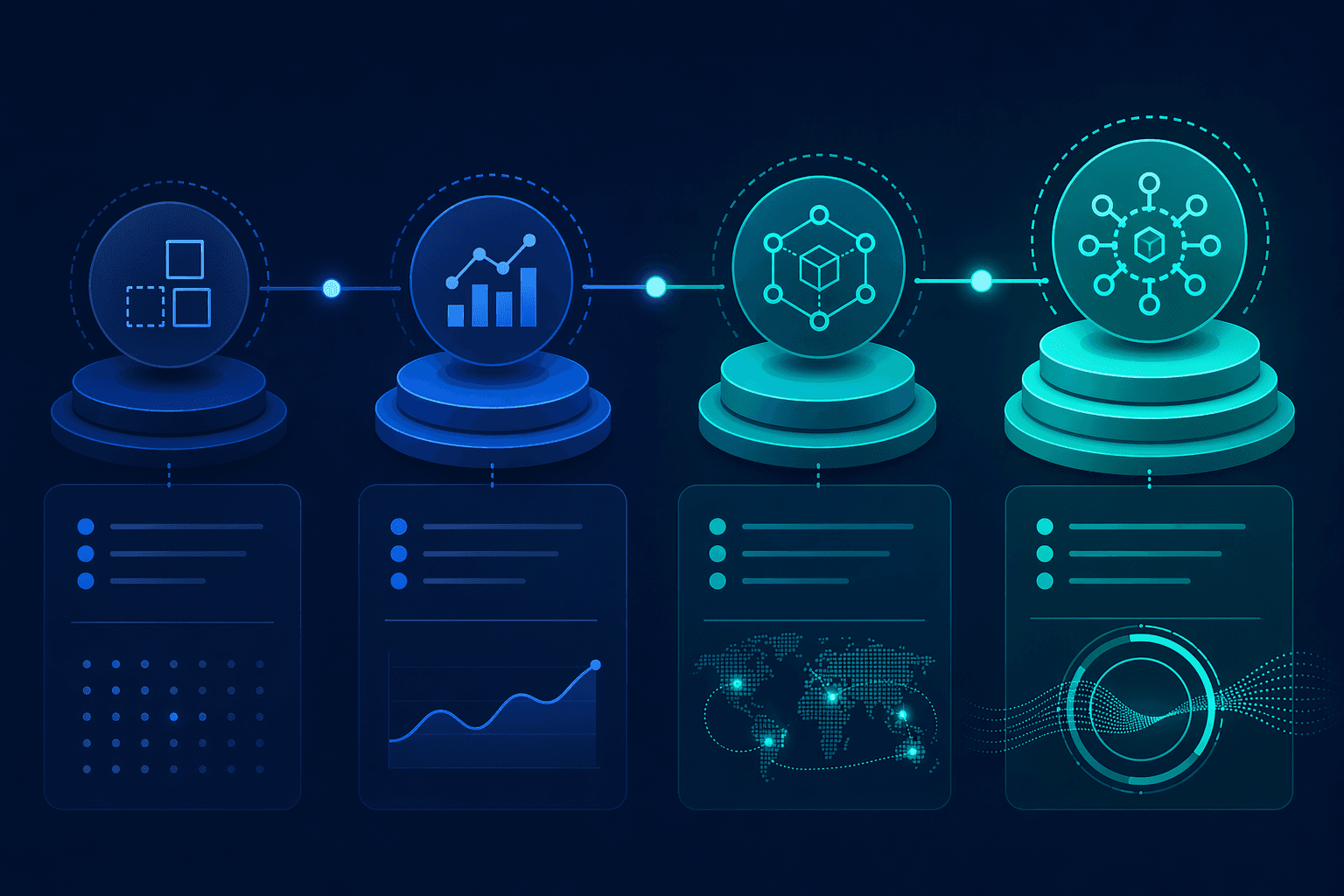
The roadmap at a glance
The following sequence adapts the maturity stages and timing logic published by RELEX Solutions and MLVeda. Both are commercial sources, so their frameworks should be treated as structured implementation scaffolding rather than neutral academic evidence. Their progression is still useful because it lines up with the independent warning signals from Gartner, Deloitte, PwC, BCG, and McKinsey: organizations need readiness, ownership, process change, and value tracking before they ask AI to make more consequential decisions.[3][4]
| Phase | Primary work | Do not advance until |
|---|---|---|
| Phase 0: first 30 days | Assess maturity across data, processes, technology, people, and governance; select two or three use cases; baseline KPIs; assign named ownership. | The use case is bounded, the data gaps are visible, the baseline is agreed, and business, technology, change, and value roles have named owners. |
| Phase 1: next 90 days | Prove value on one high-impact use case, often demand forecasting or replenishment; establish explainability and weekly KPI tracking. | Users can explain the recommendation, compare it with the baseline, and see whether the intervention changes an operating KPI. |
| Phase 2: 12-month horizon | Expand from foundational ML into assistive planning workflows, exception prioritization, scenario support, and planner copilots. | The workflow has changed, not just the screen; planners know when to accept, override, or escalate recommendations. |
| Phase 3: 24-month horizon | Move toward agentic and multi-agent orchestration in bounded domains, with governance, auditability, and decision rights built in. | The organization can prove stable value, data reliability, role redesign, and accountability before reducing human review. |
The 30-day and 90-day markers are directional. They are plausible for organizations with reasonably accessible data, clear process ownership, and an executive sponsor who can remove blockers. If the company is still reconciling basic item-location data across systems or cannot agree on which forecast accuracy measure matters, the readiness phase will take longer. Calling that delay a failure is a mistake. Skipping it is the failure.
Phase 0: assess the operating system before selecting the model
Phase 0 is where an ML roadmap either becomes executable or turns into theater. The work is not glamorous: inspect the planning process, map the data handoffs, name the decision owners, expose the KPI conflicts, and decide which use case has enough business value and enough organizational readiness to deserve a proof of value.
RELEX’s AI maturity model uses five dimensions: data, processes, technology, people, and governance. It also describes four maturity stages: foundational, assistive, agentic, and autonomous.[3] Those dimensions are a practical assessment lens because they force the implementation team to look beyond model capability. A company may have a modern planning platform but poor master data discipline. Another may have good data science talent but no agreed business owner for forecast overrides. A third may have strong executive sponsorship but no KPI design that separates model performance from planner compliance and market noise.
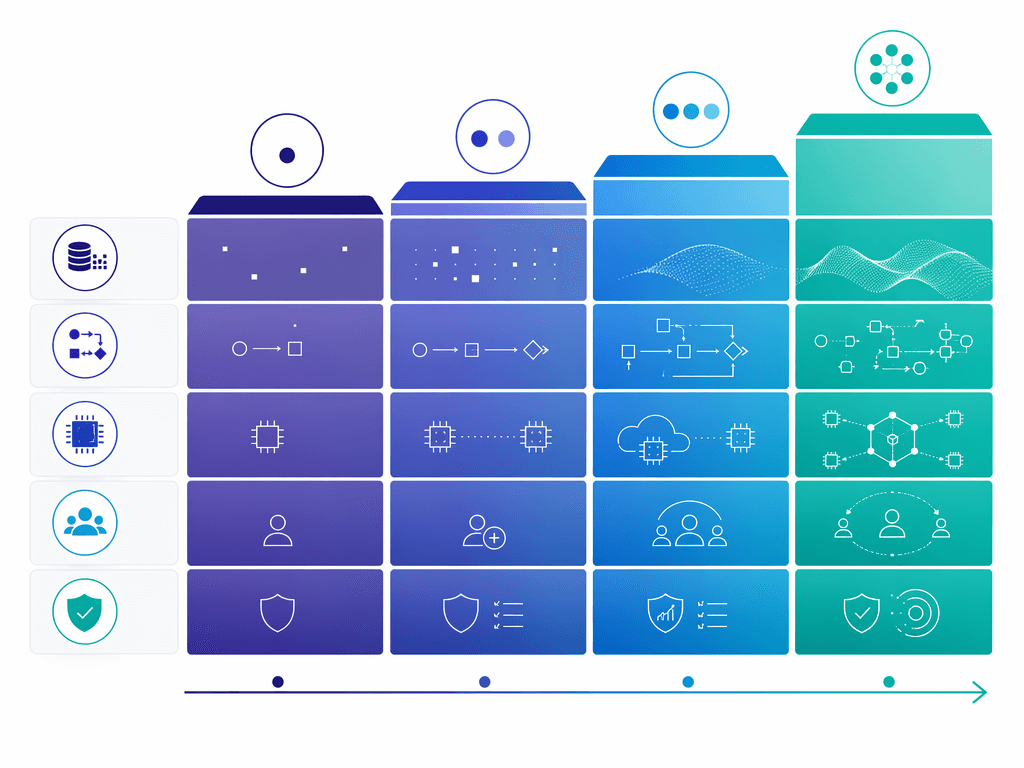
A serious readiness assessment should answer at least these questions:
- Data: Which demand, supply, inventory, lead time, promotion, pricing, calendar, and master data fields are required for the use case? Which fields are missing, late, manually corrected, or contested?
- Processes: Where will the model output enter the planning cycle? Which meeting, workbench, alert queue, or approval step changes because of it?
- Technology: Can the model output be consumed inside the system where planners actually work, or will the program create another extract-and-reconcile routine?
- People: Who will use the recommendation, who can override it, and who has to explain the result when a customer, plant, supplier, or finance leader challenges it?
- Governance: Which decisions are advisory, which are semi-automated, which require approval, and which are out of scope until trust and controls improve?
This is also the point to assign four roles to named individuals, not committees: the business owner, the technology enabler, the change champion, and the value tracker. The role names appear in vendor and consulting guidance, including the RELEX framework and Deloitte-linked implementation themes cited in OpenSky Group’s roundup.[1][3] The distinction matters. A shared inbox cannot decide whether forecast bias is acceptable for a strategic product family. A steering committee cannot notice every time a planner quietly exports the AI recommendation to Excel, modifies it, and uploads a different number.
| Role | What this person owns | Common failure if missing |
|---|---|---|
| Business owner | Decision rights, functional priorities, KPI tradeoffs, and escalation when the model recommendation conflicts with commercial or operational commitments. | The pilot produces outputs but no one changes the planning decision. |
| Technology enabler | Data pipelines, integrations, model deployment, access, monitoring, and fit with existing planning architecture. | The model works in a sandbox but fails inside the live planning process. |
| Change champion | Planner adoption, training, role impacts, communication, and feedback loops from users to the implementation team. | Users comply in workshops and revert to old routines during the weekly cycle. |
| Value tracker | Baseline definition, benefit measurement, KPI cadence, and separation of actual value from one-time noise. | The program claims success from anecdotes but cannot defend scaled investment. |
Phase 0 should also narrow the first use case. Two or three candidates are enough. More than that usually means the team is still trying to satisfy every function rather than prove one operating change. Demand forecasting is often the natural entry point because it is a common machine learning use case in supply chain and because forecast output already touches inventory, service, production, and replenishment decisions.[5] But “demand forecasting” is still too broad for a first proof of value.
A better candidate is bounded by product family, geography, channel, planning frequency, and decision impact. For example, a hypothetical company might choose a volatile product group where forecast error drives expediting and excess stock, but where historical demand, promotion flags, substitutions, and inventory positions are available often enough to support a model. The important point is not that this example is universal. It is that the first use case must be small enough to govern and meaningful enough to matter.
The Phase 0 exit criteria
Do not leave Phase 0 because a sponsor wants to see a model. Leave it when the implementation team can state the selected use case, the current baseline, the target operating decision, the required data, the known gaps, the four named owners, and the weekly review cadence. If those items are not clear, the organization is not ready for a proof of value. It is ready for more diagnosis.
Phase 1: prove value where the workflow can actually change
The first 90 days after readiness should not try to industrialize AI across the supply chain. The goal is to prove that a machine learning recommendation can change a specific planning decision, under real operating conditions, with measurable movement against a baseline. RELEX and MLVeda both describe early roadmap stages that emphasize selecting a small number of high-impact use cases, implementing specialized ML, setting KPI baselines, and tracking value regularly.[3][4]
A useful proof of value has a narrower shape than most pilots. It should include one lead business process, one primary user group, a defined intervention point, and a weekly review of both model performance and business impact. If the use case is demand forecasting, the team should know whether it is testing forecast accuracy, bias reduction, planner override reduction, service improvement, inventory reduction, expediting reduction, or some combination that has been explicitly prioritized. Otherwise, the pilot will have too many ways to claim success and too few ways to force a decision.
Explainability belongs in Phase 1, not as a late adoption feature. Harvard Business Review has argued that machine learning can address shortcomings in traditional supply chain planning systems, but the practical challenge is not only producing a better recommendation; it is making the recommendation usable inside a planning organization.[6] Planners do not need a dissertation on the algorithm. They do need to know which signals are driving the recommendation, when the model is less confident, and what kind of override will be reviewed as learning rather than treated as resistance.
Weekly KPI tracking should be deliberately plain. The value tracker should bring the same small set of measures every week: the agreed baseline, the current result, the adoption or override pattern, the known data issues, and any operational events that distort interpretation. A storm, supplier failure, promotion error, or allocation decision may explain a bad week. It should not erase the week from the record. The team needs to learn whether the system is improving decisions under normal friction, not only under curated conditions.
This is where many initiatives lose credibility. They report model accuracy while planners are still measured on service alone. They celebrate adoption while users are copying recommendations into spreadsheets and changing them before the system of record is updated. They compare results with a weak baseline, then struggle when finance asks whether the benefit is recurring. Phase 1 is not complete until the organization can show that a real decision changed, that the change was measured, and that the users understand enough to keep using the recommendation when the implementation team is not in the room.
A practical 90-day proof-of-value pattern
- Freeze the scope. Confirm the product group, market, planning horizon, decision point, user group, and KPI baseline.
- Deploy the model into the planner’s working rhythm. Avoid a side dashboard unless there is a clear plan to integrate the output into the decision process.
- Show the reason codes or drivers behind recommendations. Make confidence, exceptions, and known data issues visible.
- Review overrides without punishing them by default. Some overrides expose poor adoption; others expose missing data, business rules, or model blind spots.
- Track value weekly. Keep the measure set stable enough that trend, noise, and one-time events can be separated.
- Decide at the end whether to scale, extend, pause, or repair. A proof of value is allowed to reveal that the foundation is not ready.
Phase 2: expand into assistive AI only after the first workflow holds
Once the first ML use case has proven value, the temptation is to multiply models. That is not always wrong, but the better next step is usually to expand the workflow. Foundational ML improves a specific analytical output, such as a forecast or replenishment signal. Assistive AI changes how planners work with that output: prioritizing exceptions, summarizing scenarios, surfacing risks, drafting recommended actions, or helping users compare alternatives before a planning meeting.
The 12-month horizon is a reasonable place for this expansion if the first use case has earned trust and the underlying data pipeline is stable. The work becomes less about proving that machine learning can produce a better signal and more about redesigning the planner’s day. Which alerts should disappear because the model can resolve them? Which exceptions deserve human attention first? Which decisions require scenario review because the tradeoff crosses functions? Which recommendations should be routed to sales, procurement, manufacturing, or finance before execution?
This is also where role and KPI redesign becomes unavoidable. The Deloitte figure that 84% of organizations have not redesigned jobs or KPIs around AI capabilities is not a side note.[1] Assistive AI asks people to stop doing some work, start doing different work, and trust that the performance system will not punish them for following the new process. If planners are still rewarded for manual expediting heroics, they will have little reason to invest in exception discipline and model feedback. If functional owners are measured only inside their silo, they will override recommendations that improve the network but hurt a local metric.
At this stage, the change champion’s work becomes more concrete. Training should move beyond “how to read the screen” into “how the decision right has changed.” A planner may accept low-risk recommendations automatically, review medium-risk recommendations with reason codes, and escalate high-risk recommendations to a cross-functional meeting. A category manager may be asked to supply structured promotion inputs earlier because the model now depends on them. A supply planner may need to record constrained supply decisions in a way that can be learned from later.

Phase 3: agentic workflows need narrower permissions, not looser governance
Agentic AI is where vocabulary can outrun operating discipline. In a supply chain context, an agentic workflow may monitor conditions, evaluate options, trigger tasks, recommend actions, or coordinate across systems with less manual prompting. MLVeda’s AI-native supply chain framework and RELEX’s maturity model both describe progression toward agentic and autonomous stages.[3][4] The useful question is not whether the label sounds advanced. It is what the system is permitted to do, under which conditions, with which audit trail, and with whose accountability.
The 24-month horizon is where some organizations may begin moving from assistive workflows into bounded agentic orchestration. Bounded is the important word. A system might be allowed to reprioritize exception queues, recommend inventory transfers, draft supplier expedite requests, or assemble scenario options before a planning meeting. It should not be treated as ready to make broad autonomous tradeoffs simply because it can call multiple tools or produce a confident recommendation.
The governance design should become stricter as the system becomes more capable. Decision classes need thresholds: value at risk, customer criticality, inventory exposure, supply constraint severity, contractual obligation, regulatory sensitivity, and reversibility. Low-risk, reversible actions can carry more automation. High-risk, cross-functional, or hard-to-reverse decisions should retain human approval until the organization has enough evidence to change the control level.
Multi-agent orchestration raises the bar again. A demand agent, inventory agent, procurement agent, and transportation agent may each optimize locally unless the operating model defines how tradeoffs are resolved. Without governance, the company has not created an autonomous supply chain. It has created faster conflict between functions. The business owner must still own the decision policy. The technology enabler must still monitor performance and failure modes. The change champion must still understand how work is shifting. The value tracker must still prove whether the system is creating recurring value rather than moving pain from one metric to another.
Autonomous operations are an earned state
Autonomous decision-making can be a legitimate end state for selected supply chain decisions. It is not a procurement milestone. The organization earns autonomy by accumulating evidence: the data is reliable enough, the process has been redesigned, the users understand and trust the recommendations, the governance model is explicit, the value is tracked, and named owners are accountable when outcomes move.
That standard keeps the roadmap honest. If a company has no formal AI strategy, no redesigned roles or KPIs, and no baseline value tracking, the next step is not agentic orchestration. It is Phase 0. If a pilot has a promising model but no weekly operating cadence, the next step is not scale. It is a stronger proof of value. If assistive workflows are changing decisions and value is visible, the next step may be broader deployment or a tightly governed agentic use case.
The roadmap is not a race from foundational ML to autonomy. It is a sequence of permissions. Advance when the operating model can absorb the next level of machine judgment. Pause when the evidence is thin. Repair the foundation when planners, data owners, and functional leaders are compensating for gaps the model is being asked to hide.
References
- Supply Chain AI Statistics, OpenSky Group
- 2026 Digital Trends in Operations Survey, PwC
- AI to ROI Framework, RELEX Solutions
- AI-Native Supply Chain: Complete Guide to Intelligent Orchestration & ROI, MLVeda
- Top 5 Machine Learning Use Cases in Supply Chain, John Galt Solutions
- How Machine Learning Will Transform Supply Chain Management, Harvard Business Review, March 2024
Comments
Join the discussion with an anonymous comment.