
The uncomfortable moment usually arrives after the cloud program has already been approved. The CSCO wants faster supply chain decisions, better risk sensing, more useful optimization, and AI models that can see beyond one planning tool. The actual estate is less elegant: ERP data with one location hierarchy, WMS exports with another, TMS events arriving late or in batches, planning overrides living in spreadsheets, and local item definitions that nobody wants to touch during a migration window.
That is why a generic cloud migration strategy for supply chain AI misclassifies the work from the start. AI workloads are not just applications that need compute in a different data center. They depend on data freshness, lineage, integration surfaces, feature pipelines, model training and inference patterns, exception latency, and continuity across planning and execution. If the migration plan begins with servers, it is already late to the questions that decide whether the AI layer will have a trustworthy signal.
Spinnaker SCA puts data quality and system assessment at the front of legacy supply chain modernization, before tool selection or migration execution, which is the right order for this problem.[1] AWS makes a similar strategic point from the AI side: resilience use cases require connected, timely, multi-enterprise data rather than isolated analytics experiments.[2] The roadmap here treats migration as an operating sequence, not an infrastructure relocation.
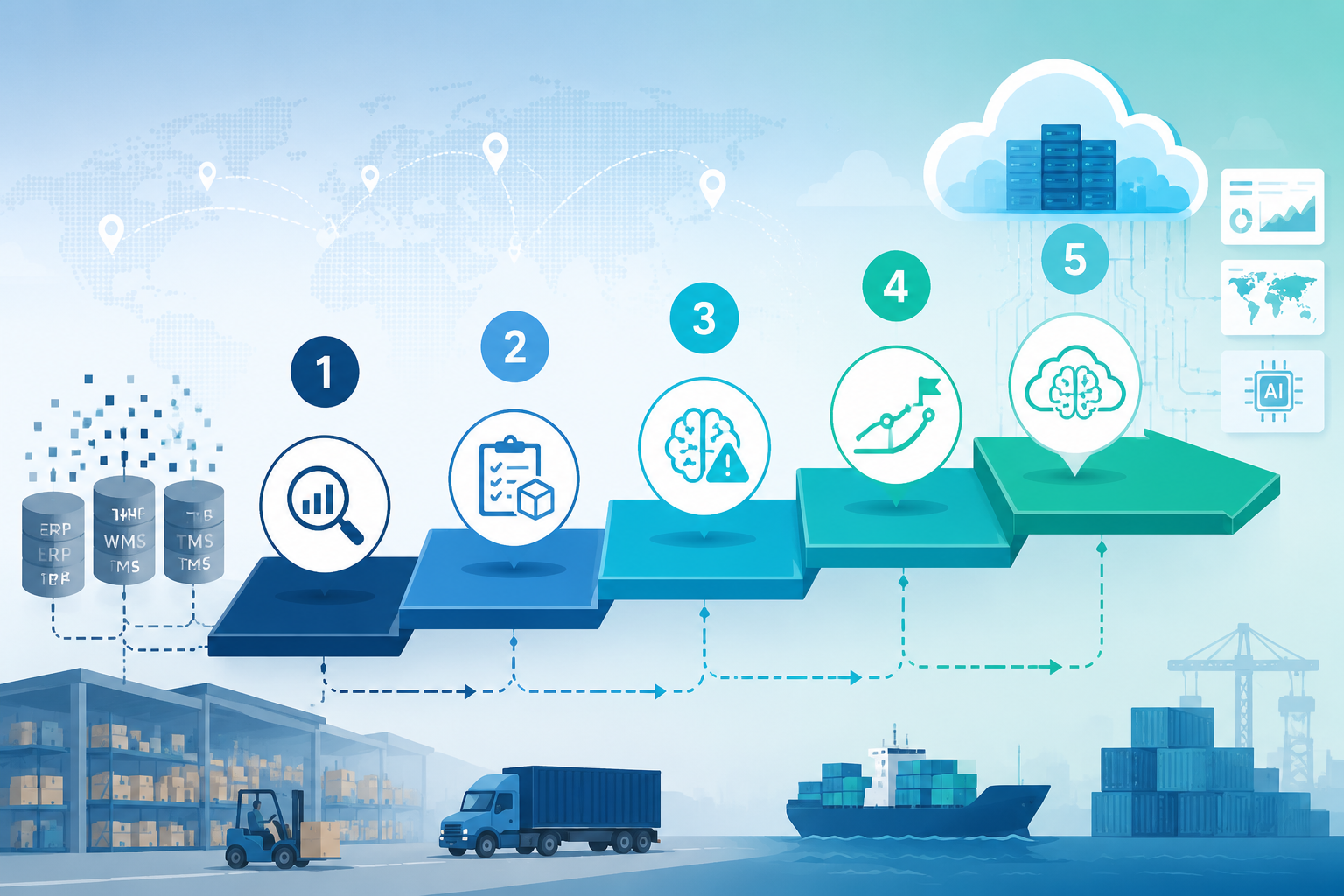
The Five Phases, Before the Detail
The phases are sequential, but they do not deserve equal calendar time. The first two carry the most weight because they reduce ambiguity before spend becomes hard to unwind.
| Phase | Decision the phase must settle | Supply chain AI consequence |
|---|---|---|
| 1. Discovery and data-quality assessment | Which data, systems, owners, definitions, and exceptions are actually in scope? | Determines whether AI models can learn from reconciled signals rather than inherited noise. |
| 2. Workload classification with the 7 R's | Which workloads should be rehosted, replatformed, refactored, retired, retained, rebuilt, or replaced? | Prevents lift-and-shift from becoming the default for pipelines that need AI-ready architecture. |
| 3. Predictive risk modeling | Which migration choices carry the highest operational, integration, security, cost, and downtime exposure? | Makes sequencing a risk decision, not a preference debate. |
| 4. Phased execution | Which cutovers can move safely, and where must rollback capacity exist? | Protects planning, inventory, logistics, and procurement workflows from avoidable disruption. |
| 5. Post-migration optimization | Which AI workloads need tuning, monitoring, cost control, and ROI measurement after go-live? | Turns cloud migration into operating improvement rather than a one-time platform event. |
Phase 1: Discovery Starts With Data Quality, Not Application Names
A supply chain AI migration inventory should not stop at application names, database sizes, or server dependencies. Those are useful, but they miss the failure mode that matters most: a model trained on unreconciled operational data, then deployed into workflows where planners are expected to trust it.
Discovery should map the actual decision chain. For demand planning, that may mean forecast history, promotions, substitutions, allocation rules, inventory positions, customer orders, and planner overrides. For logistics risk sensing, it may mean shipment milestones, carrier events, port congestion signals, supplier commitments, and late manual corrections. For procurement, it may mean supplier master data, purchase orders, lead-time history, contract terms, and quality events. The migration team needs to know not only where this data sits, but which field is authoritative when systems disagree.
The assessment should expose at least five conditions before any AI-enabling workload is classified:
- Master-data alignment: item, customer, supplier, carrier, facility, and lane definitions must be compared across ERP, WMS, TMS, planning, procurement, and finance systems.
- Event freshness: the team must distinguish real-time, near-real-time, batch, manual, and delayed data feeds because AI exceptioning depends on timing.
- Lineage and ownership: each critical field needs an owner, a source, a transformation path, and a known reconciliation rule.
- Historical usability: model training data must be checked for stockouts, one-time disruptions, planning overrides, missing transactions, and business-rule changes that distort history.
- Workflow dependency: the team must know which reports, alerts, planning runs, procurement approvals, and warehouse or transportation handoffs depend on each feed.
This is where supply chain leaders should use a data readiness checklist, not a generic application questionnaire. A checklist such as The CSCO's Data Readiness Checklist for Supply Chain AI Implementation belongs before workload migration decisions because it forces ownership, quality, and lineage questions into the plan while changes are still cheap.
AI-assisted migration tooling can help with discovery, dependency mapping, code conversion, anomaly detection, and automation. AWS cites McKinsey research indicating that AI-driven migration tools can reduce migration timelines by 30% to 40%.[2] That saving is meaningful, but it should not be misread as permission to skip data-quality work. Automation can accelerate a clean decision path; it cannot make a mismatched item master analytically trustworthy by moving it faster.
What the Assessment Should Produce
The output of phase one should be a migration evidence pack, not a slide that says the estate has been assessed. It should include a system inventory, data-domain map, integration catalogue, data-quality profile, AI-use-case dependency map, latency classification, security and compliance constraints, and a list of workflows that cannot tolerate unplanned interruption.
A useful discovery phase also names the places where the business is currently compensating for weak systems. If planners export data every morning to rebuild a shipment-risk view in spreadsheets, that is not a side process. It is evidence that the future AI workload may need an event pipeline, a governed feature store, or a redesigned exception workflow rather than a rehosted report.
Phase 2: Use the 7 R's as a Supply Chain AI Decision Mechanism
The 7 R's are often presented as a cloud migration taxonomy: rehost, replatform, refactor, retire, retain, rebuild, and replace. The framework is useful precisely because it gives leaders more choices than lift-and-shift.[3] For supply chain AI, those choices only work if each one is tested against AI-readiness criteria.
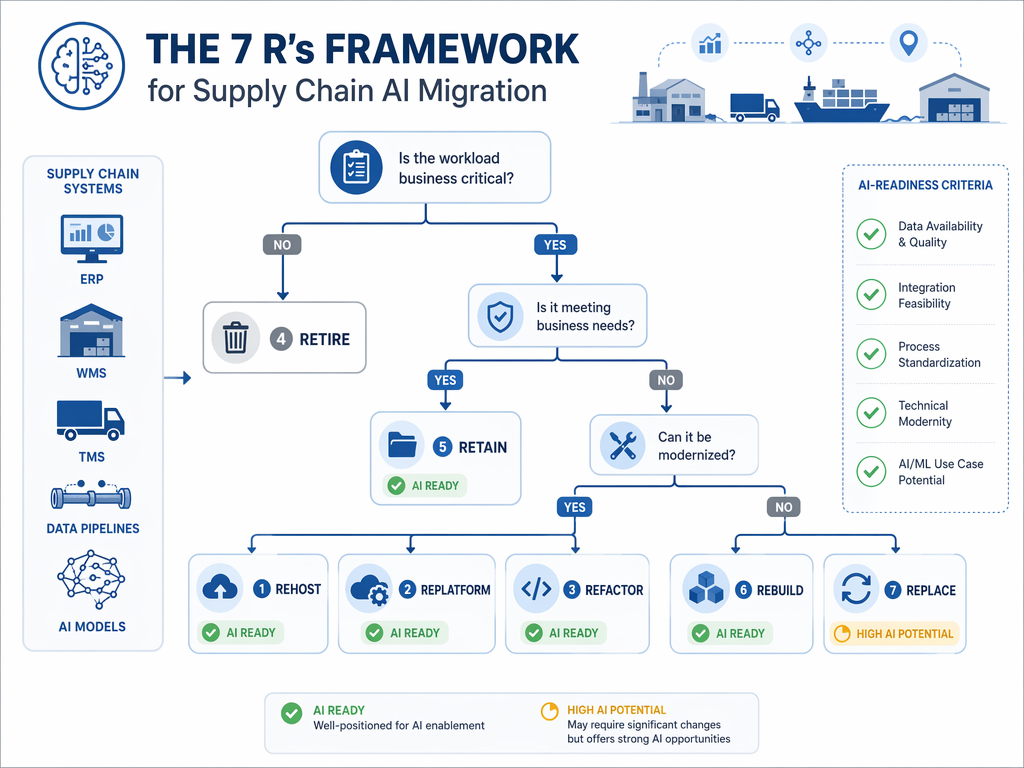
| Migration option | When it can fit | Supply chain AI caution |
|---|---|---|
| Rehost | Stable workload, low AI dependency, limited integration change, acceptable latency. | Risky for pipelines feeding prediction, optimization, or real-time exceptioning because architecture and data contracts remain largely unchanged. |
| Replatform | Application can move with limited platform changes while improving scalability, monitoring, or managed services. | Useful when the workload is not the AI core but needs better resilience or easier integration. |
| Refactor | Data flow, integration model, or application structure must change to support AI training, inference, or event-driven decisions. | Often necessary for ERP/WMS/TMS pipelines that currently rely on brittle batch exports. |
| Retire | Duplicate, obsolete, or unused functionality can be removed. | Important when old reports and shadow tools create conflicting operational truths. |
| Retain | System is too risky, regulated, customized, or low-value to move in the current wave. | Acceptable only if retained systems have clear data contracts and do not block AI-critical signals. |
| Rebuild | Existing capability cannot support target workflows or AI requirements. | Appropriate when the operating model has changed enough that preserving the old logic preserves the wrong process. |
| Replace | A SaaS or packaged capability is better than migrating custom legacy functionality. | Requires careful data ownership and integration design; replacement alone does not guarantee AI-ready data. |
The mistake is to treat these as infrastructure choices. In supply chain AI, a workload's migration path depends on what decision it supports, how fresh the data must be, how many systems it touches, and whether the model will train, score, or trigger workflow from that data.
The AI-Readiness Questions That Change the R
A transportation dashboard may look like a candidate for rehosting until the business wants predictive delay alerts that update as carrier events arrive. A warehouse labor report may look safe to replatform until the future model needs near-real-time task completion, congestion, and inventory movement signals. A supplier-risk spreadsheet may look like a retirement candidate until it turns out to contain the only reconciled view of supplier commitments and late expedite notes.
Before assigning an R, classify each workload against these supply-chain-specific criteria:
- Latency requirement: Does the workload support monthly planning, daily replanning, same-day allocation, real-time warehouse execution, or in-transit exceptioning?
- Integration surface area: How many ERP, WMS, TMS, planning, procurement, supplier, carrier, finance, and external data sources does it touch?
- Data transformation burden: Are there heavy joins, manual corrections, local mappings, unit conversions, or hierarchy reconciliations?
- AI role: Will the workload feed model training, support inference, generate features, monitor drift, or trigger operational actions?
- Business continuity tolerance: Can the process pause during cutover, or does it control replenishment, shipping, inventory promise, production release, or procurement approval?
- Audit and explainability need: Will planners, finance, compliance, or customers need to trace why a recommendation changed?
This is the practical answer to the lift-and-shift temptation. Rehosting may be a perfectly reasonable choice for a low-change archival workload or a stable internal application. It is a poor default for the pipelines that must make ERP, WMS, and TMS signals usable for AI.
A Refactor Example: Macy's Data Pipeline Work
Striim describes Macy's cloud migration work as a move toward real-time data integration for supply chain and inventory use cases, with streaming pipelines used to make operational data available in the cloud.[4] The important point is not the brand name. It is the architectural choice: when AI readiness depends on timely operational signals, refactoring the data movement layer can matter more than moving the existing application footprint unchanged.
That logic applies broadly. If a WMS export lands once overnight and is manually corrected before planners see it, rehosting the downstream report leaves the real constraint intact. If a TMS milestone feed arrives in inconsistent formats by carrier, replatforming the analytics layer may improve performance while leaving the exception model underfed. Refactor is not automatically the sophisticated choice; it is the necessary choice when the existing architecture cannot deliver the signal the AI use case requires.
This is also the point in the roadmap where leaders should revisit why many supply chain AI programs stall. The issue is often less about model ambition than data readiness, as discussed in Why 70% of Supply Chain AI Projects Fail — and How Data-First Implementation Fixes It. Treat that failure statistic as directional rather than courtroom-grade evidence; the operational warning remains useful.
Phase 3: Model Migration Risk Before Sequencing the Waves
Once workloads have candidate R's, the program needs a risk model. Avahi's cloud migration risk matrix compares migration strategies across dimensions such as complexity, downtime, data loss risk, security exposure, cost overrun, performance degradation, and operational disruption.[5] For supply chain AI, that matrix should be extended with workflow criticality and signal-dependency risk.
| Risk dimension | Supply chain AI version of the question |
|---|---|
| Downtime | Would an outage interrupt replenishment, warehouse release, shipment execution, inventory availability, production scheduling, or procurement approval? |
| Data loss or corruption | Would missing events, duplicate transactions, or broken lineage distort model training or exception alerts? |
| Latency degradation | Would slower ingestion or inference cause planners to receive alerts after the operating window has closed? |
| Integration failure | Would an ERP, WMS, TMS, carrier, supplier, or planning-system interface fail silently or produce partial records? |
| Cost overrun | Would high-volume event ingestion, model training, storage, or duplicated environments create cloud spend that the business case did not include? |
| Security and access | Would supplier, customer, contract, shipment, or production data move into a new access model without adequate controls? |
| Adoption risk | Would planners lose confidence because recommendations cannot be traced to recognizable operational facts? |
The value of this exercise is not the score itself. It is the argument it forces. A workload with moderate technical complexity may deserve a later wave if it controls inventory promise during peak season. A refactored data pipeline may deserve earlier investment if several AI use cases depend on it. A retained legacy application may be acceptable if its outbound data contract is stable and monitored; it is not acceptable if it hides the only version of supplier lead-time truth behind manual extracts.
Risk modeling should also expose correlated cutover risk. Moving the planning data store, the inventory availability feed, and the transportation exception engine in the same window may look efficient on a project chart. Operationally, it concentrates too many failure modes around the same planners, customer-service teams, and logistics coordinators.
Phase 4: Execute in Waves With Rollback Capacity Where Operations Cannot Wait
A phased execution plan should sequence by dependency and business tolerance, not by which server group is easiest to move. Start with workloads that reduce uncertainty for later waves: shared data services, integration layers, identity and access patterns, observability, non-critical analytics, and controlled pilots around AI-enabling pipelines.
Execution should then separate workloads into cutover patterns. Some can move through parallel run. Some need dual-write or replication windows. Some require read-only transition periods. Some should not be cut over during quarter-end, peak fulfillment, major product launches, annual supplier negotiations, or network changes. These calendar constraints sound mundane until an exception alert fails during the one week the business cannot absorb ambiguity.
- For planning workloads, protect baseline forecast runs, planner overrides, approval history, and scenario outputs before changing the data platform.
- For inventory workloads, validate on-hand, available-to-promise, in-transit, reserved, damaged, and quarantined states across systems.
- For logistics workloads, test carrier milestones, EDI/API behavior, late-arriving events, duplicate events, and exception alert timing.
- For procurement workloads, preserve approval flows, supplier commitments, contract references, lead-time history, and auditability.
- For AI pipelines, run shadow scoring before planners are asked to act on recommendations.
Rollback planning deserves more respect than it often gets. A rollback is not just restoring a database. It means knowing whether downstream systems have consumed new records, whether planners have acted on recommendations, whether inventory positions have changed, and whether finance or customer commitments now reflect the migrated state. If the process touches execution, rollback design has to include operational reconciliation, not only technical recovery.
Teams building warehouse-specific AI or machine-learning roadmaps can borrow the same sequencing discipline from From Intent to Execution: A Phased ML Implementation Roadmap for Warehouse Management. The operating principle is similar: introduce intelligence only after the workflow can absorb, test, and reverse the change safely.
Phase 5: Optimize the AI Workloads After Migration
Go-live is not the finish line for supply chain AI migration. It is the point where the platform starts producing evidence. The post-migration phase should tune model performance, data freshness, feature pipelines, inference latency, exception routing, cloud cost, and user trust. A migrated workload that runs successfully but produces alerts too late for planners is not optimized. A model with acceptable accuracy but no explainability for inventory decisions may still fail adoption.
AltexSoft's cloud migration ROI guidance emphasizes measuring migration costs and benefits across infrastructure, operations, labor, downtime, performance, and ongoing cloud expenses rather than treating ROI as a one-time savings calculation.[6] For supply chain AI, that accounting should include model-related costs: training, inference, storage, streaming ingestion, monitoring, MLOps support, duplicate environments, and the business labor required to validate recommendations.
| Optimization area | What to measure after migration |
|---|---|
| Data quality | Missing records, duplicate events, late arrivals, unmapped fields, hierarchy mismatches, and reconciliation exceptions. |
| AI performance | Forecast error, prediction precision and recall, optimization quality, drift, and recommendation acceptance. |
| Workflow speed | Time from event to alert, alert to decision, decision to execution, and exception closure. |
| Reliability | Pipeline failures, retry rates, interface errors, failed jobs, and incident recovery time. |
| Cost discipline | Compute, storage, streaming, training, inference, observability, and unused capacity. |
| Business value | Transportation cost, service levels, inventory turns, expedite cost, planner productivity, waste, and working capital effects. |
The expectation setting matters. McKinsey has reported that only 10% of cloud transformations achieve full value, a finding AWS references in its enterprise cloud and AI strategy discussion.[2] That is more useful than a promise of instant AI payoff because it fits the operational reality: value usually arrives after data, workflow, governance, and adoption have caught up with the architecture.
ValueAddVC's 2026 case-study roundup reports a Fortune 500 automotive OEM achieving a 22% transportation cost reduction and 250% ROI in two years from AI logistics optimization, and General Mills reporting more than $20 million in cumulative savings since FY2024 from AI-enabled supply chain work.[7] Those are vendor- or partner-published examples, so they should be read as selective evidence that measurable value is possible, not as benchmarks a migration roadmap can guarantee.
Executives should therefore measure cloud migration for supply chain AI on a multi-year operating horizon. The related discussion in The Real Timeline for AI Supply Chain ROI: Two to Four Years is a useful counterweight to business cases that imply savings begin the moment workloads land in the cloud.
The Decision Logic
A workable cloud migration strategy for supply chain AI connects decisions that are often split across different teams. Data-quality assessment tells architects which signals can be trusted. Workload classification tells sponsors where rehost is safe and where refactor, rebuild, replace, retain, retire, or replatform is more honest. Risk modeling tells the program which choices expose planning, inventory, logistics, or procurement to operational damage. Phased execution protects the workflows that cannot wait. Optimization proves whether the migrated platform is improving decisions at an acceptable cost.
Cloud architecture can make supply chain AI more usable outside isolated pilots. It can support multi-tier visibility, risk sensing, and optimization models that legacy estates struggle to carry. But the migration plan has to treat ERP, WMS, TMS, planning, procurement, and finance data as operating material, not background plumbing. The useful question is not how fast the estate can be lifted into the cloud. It is which decisions the business expects AI to improve, and whether the migration sequence gives those decisions clean, timely, governed data to work with.
References
- Modernizing Legacy Supply Chain Systems with Cloud Migration, Spinnaker SCA.
- Leveraging AI and Cloud for Supply Chain Resilience, AWS.
- AI-Powered Cloud Migration Strategy: A Practical Roadmap, ITG Software.
- Migrating to the Cloud: The First Step Towards AI Readiness, Striim.
- 10 Major Cloud Migration Challenges, Avahi.
- How to Plan Cloud Migration Strategy & Calculate Its ROI, AltexSoft.
- ROI of AI in Supply Chain: Real Case Studies and What the Numbers Actually Show in 2026, ValueAddVC.
Comments
Join the discussion with an anonymous comment.