
The case for AI voice cloning for supply chain training usually starts in the wrong place. It starts with a synthetic voice demo: polished, calm, almost too smooth. On the warehouse floor, the more urgent problem is less polished. A safety procedure changes. The English module still describes the old sequence. The Spanish narration is waiting on localization. A supervisor on nights explains the update at the start of the shift, then again to a late arrival, then again to someone who understood the task but missed the exception.
That is the bottleneck worth solving. Supply chain facilities are already under labor pressure: 78% struggle to hire qualified workers, and 61% report extreme shortages, according to ASCM data cited by Supply Chain Management Review.[1] Warehouse turnover averages about 36%, and workforce instability can push operating costs 15–25% above industry averages, according to SPS Commerce.[2] In that environment, training content that takes weeks to update is not a minor inconvenience. It becomes a daily workaround.

AI voice cloning can help, but only if it is treated as a production and governance method, not as a magic voice layer. In practical terms, the technology uses a short, clean voice sample to generate repeatable narration that can be applied to training scripts, revised SOPs, onboarding modules, and localized audio. In 2026, usable voice models can be created from minutes of clean sample audio, according to Vocaliv.[3] That lowers the barrier to production. It does not remove the need to decide what gets narrated, who approves it, which languages matter, and when a module is safe to publish.
Start With The Training Bottleneck, Not The Voice
The first implementation decision is not which cloned voice sounds most natural. It is which training delay is costing the operation the most trust, time, or rework.
For many supply chain teams, that first use case will be safety or procedure updates. These are the modules where stale narration creates the most obvious risk: a revised lockout step, a new traffic-flow rule, a changed picking exception, a seasonal packing process, a battery-charging procedure, or a new scanner workflow. If the written SOP changes quickly but the voiceover and translations lag behind, workers learn from supervisors, peers, signs, and memory. Some of that works. Some of it drifts.
The better pilot is narrow enough to audit. Pick one recurring content problem where the current process is visibly slow: a monthly safety refresh, a frequently revised SOP, or one onboarding module that always requires live explanation. Then measure whether cloned narration improves the update cycle. Did the revised audio go live sooner? Did the translated narration match the approved procedure? Did supervisors spend less time correcting the same misunderstanding?
| Training bottleneck | Why it fits a first pilot | What to measure |
|---|---|---|
| Safety procedure updates | High consequence if narration trails the current SOP | Time from SOP approval to published narration; comprehension checks; supervisor correction notes |
| New-hire onboarding modules | High repetition under turnover pressure | Onboarding time, module completion, questions escalated to trainers |
| Multilingual refresher training | Inconsistent delivery when translation depends on informal interpreters | Language coverage, accuracy review results, worker comprehension by language group |
| Scanner or workflow changes | Small process changes can create daily errors if explained inconsistently | Error patterns before and after module update; time to publish revised audio |
Voice technology already has a foothold in warehouse execution. Voice-enabled workflows have been associated with 14–19% productivity improvements in warehouse operations, according to SupplyChainBrain reporting on Mountain Leverage.[4] EPG reports that AI-driven voice picking can cut training time by 80%.[5] Those figures are useful context, not a guarantee that cloned training narration will produce the same result. Picking systems, voice-directed work, and training-content production are adjacent problems. They all involve voice, but they do not measure the same thing.
What Has To Be Ready Before A Voice Is Cloned
A clean voice model will not rescue a messy training library. Before vendor demos become contracts, the training team needs to know what content exists, which version is authoritative, and who owns the final words that workers hear.
Script Libraries And SOP Version Control
Start with the scripts, not the audio. A cloned narration workflow needs approved text that maps to the current SOP. If the English script is a transcript from an old video, the Spanish version is a PDF maintained by a bilingual lead, and the latest procedure lives in a SharePoint comment thread, voice cloning will only make confusion faster.
At minimum, the pilot module should have one named source of truth. The script should identify the SOP version, approval date, training owner, safety or compliance reviewer, and language versions in scope. If the procedure changes, the team should be able to see which audio files and modules must be regenerated. This is not glamorous work, but it is where training teams avoid publishing a fluent explanation of an obsolete step.
Sample Audio Quality And Voice Consent
Voice cloning depends on source audio. The sample should be clean, consistent, and approved for this specific use. Background warehouse noise, headset compression, overlapping speakers, and improvised recordings can all reduce quality. More important, the organization needs written consent from the person whose voice is being cloned, with clear limits on how that voice may be used.
Consent should not be buried in a general employment form. A practical consent record states whose voice is being used, which training purposes are allowed, whether multilingual synthetic versions are permitted, who can generate new audio, how long the permission lasts, and what happens if the employee changes roles or leaves. If the company uses a professional or vendor-provided synthetic voice instead of cloning an employee, it still needs licensing terms that cover training use, localization, and future edits.
Language Requirements That Match The Actual Workforce
Large language counts look impressive on vendor pages. WellSaid says it supports more than 50 languages, EPG says LYDIA supports more than 40, and Rask AI says it supports 135.[6][5][7] Those numbers matter only after the training team compares them with the languages and dialect needs inside its own facilities.
A warehouse with English, Spanish, Haitian Creole, Vietnamese, and Arabic speakers has a different requirement than a regional distribution center with mostly English and Polish speakers. A vendor that supports a language in general may not support the pronunciation, pacing, terminology, or review workflow needed for a safety module. The test is not whether the platform can produce audio in a language. The test is whether a qualified reviewer can confirm that the translated narration preserves the procedure.
Review Ownership
Every cloned training workflow needs a human sign-off path. For a low-risk orientation message, the L&D owner may be enough. For safety, compliance, equipment, or hazardous-material handling, the reviewer should include the functional owner of the SOP. For translated modules, language review needs to be assigned to someone qualified to judge procedural meaning, not just conversational fluency.
- The training owner approves the learning objective and module placement.
- The SOP owner approves procedural accuracy.
- The safety or compliance owner approves regulated content.
- The language reviewer approves translated meaning and terminology.
- The platform administrator controls who can generate, edit, export, and publish cloned narration.
This sign-off path should exist before the first cloned module goes live. Otherwise, the fastest person in the system becomes the de facto publisher.
How To Evaluate Vendors Without Getting Distracted By The Demo
Voice quality matters. Workers should not have to fight robotic pacing, odd emphasis, or mispronounced product and equipment terms. But a supply chain training team needs to evaluate more than whether the voice sounds pleasant in a sample paragraph.
The vendor shortlist should be built around operational criteria: language coverage, update speed, security posture, integration with existing L&D assets, localization workflow, and the quality of evidence behind ROI claims. WellSaid cites AI voice production reducing corporate training production costs by about 50% in its customer materials.[6] Rask AI and Verbit describe AI dubbing and localization workflows as reducing time-to-market by more than 80% compared with traditional localization.[7] Those are helpful benchmarks, but they are still vendor-side or adjacent evidence unless the same method is tested against the company’s own training cycle.
| Vendor criterion | What to ask | Why it matters in supply chain training |
|---|---|---|
| Language and accent coverage | Which required languages are fully supported for cloning, dubbing, editing, and review? | A large language list is not enough if the facility’s core workforce languages are weakly supported. |
| Terminology control | Can the platform preserve approved pronunciations for equipment, locations, SKUs, and safety terms? | Mispronounced or mistranslated operational terms can change how workers perform a step. |
| Update workflow | How quickly can a revised script become approved audio in all pilot languages? | The business case depends on faster SOP-to-training cycles. |
| Security and access controls | Who can create voices, generate files, export audio, and publish modules? | A cloned voice is a governed asset, not a shared media file. |
| Consent and audit records | Can the system document consent, generation history, edits, approvals, and publication dates? | Training teams need evidence of who approved what workers heard. |
| Integration | Does the output fit the LMS, mobile learning tool, video editor, or frontline training platform already in use? | A good voice file that requires manual rework at every update will not stay fast. |
| Evidence quality | Are ROI claims based on independent studies, customer cases, or unrelated enterprise voice AI use cases? | The stronger the claim, the more specific the proof should be. |
Security deserves more attention than it usually gets in a demo. Vocaliv describes ISO/IEC 27001 certification in its compliance materials, which is relevant because cloned voices, source audio, scripts, and training records may all be sensitive assets.[3] Certification alone does not answer every governance question, but it is a useful starting point for procurement and information security review.
ROI claims also need sorting. Forrester research cited by Ringly.io reports 331–391% ROI over three years for enterprise voice AI.[8] That figure should not be treated as a forecast for warehouse training. Enterprise voice AI includes broader use cases such as customer service and call-center automation. For a training pilot, the more defensible ROI measures are closer to the work: production cost per module, time from SOP change to published narration, trainer hours spent repeating updates, localization cost, and comprehension results.
Build The First Rollout Around One Auditable Module
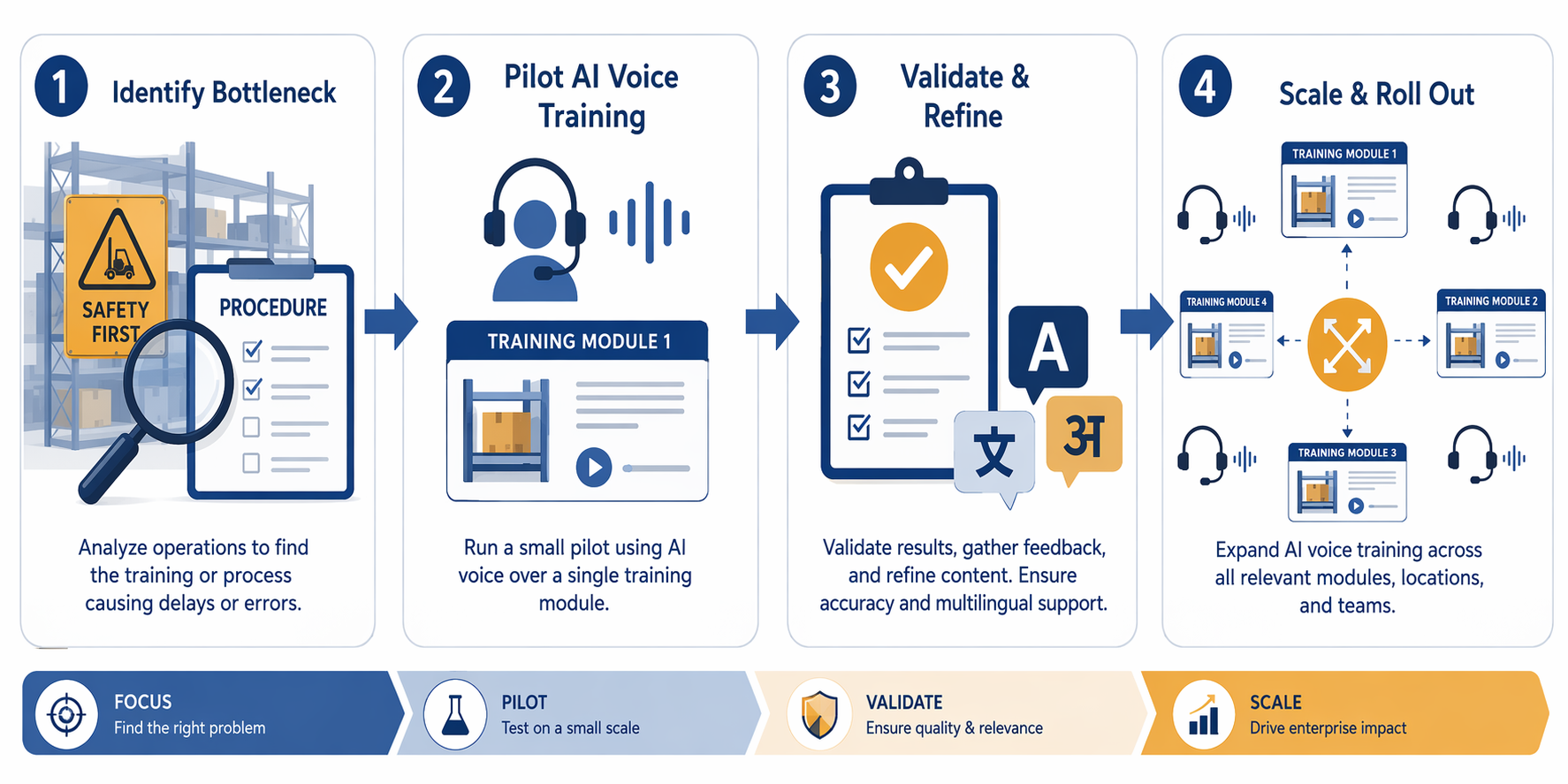
A staged rollout keeps the organization from confusing production speed with training effectiveness. The first cloned narration module should be small enough to inspect closely and important enough that improvement matters.
- Choose one costly bottleneck, such as a safety update or procedure-change module.
- Prepare the approved script, SOP version record, language list, consent record, and reviewer assignments.
- Generate cloned narration for the initial language set.
- Review audio for procedural accuracy, pronunciation, pacing, and language fidelity.
- Publish to the existing training channel and measure update speed, comprehension, and supervisor feedback.
- Expand only after the review workflow holds up under a real SOP change.
The pilot should include a real update event if possible. A static module proves that the voice can be generated. A revised module proves whether the workflow is actually faster than the old way. If the SOP owner changes two sentences and the training team can regenerate, review, localize, and publish the audio without losing control, the organization has learned something useful.
Comprehension should be checked in the same practical style. A short quiz may be enough for some modules. For safety or equipment procedures, observation may be more useful: did workers perform the changed step correctly, and did supervisors still need to restate the instruction? DupDub cites research that multimodal learning combining audio and visuals can improve comprehension by 32%.[9] That supports the case for pairing narration with clear visuals, but the local test is still whether workers understand this procedure in this facility.
Where Cloned Narration Fits In The Training Stack
AI voice cloning is not a replacement for the LMS, the SOP system, the frontline trainer, or the supervisor’s judgment. It is a production layer that can make approved instruction easier to update and deliver consistently. The strongest fit is usually content that is repeated often, changes often, or must be delivered in more than one language.
That includes onboarding explainers, safety refreshers, pre-shift microlearning, scanner-process changes, role-specific task modules, and multilingual versions of existing videos. It may be less useful for coaching conversations, performance feedback, conflict resolution, or training that depends on live judgment in unpredictable conditions.
The larger warehouse voice market shows why operations leaders are paying attention to voice interfaces. The warehouse voice-picking market has been projected to grow from $1.4 billion in 2020 to $4.8 billion in 2031, according to Persistence Market Research figures cited by Picovoice.[10] That market growth does not prove a cloned narration pilot will succeed. It does suggest that voice has become a familiar operational interface, not a novelty. Training teams can use that familiarity, provided they do not skip the controls.
The Metrics That Decide Whether To Expand
The expansion decision should be based on whether the pilot changed the training operation, not whether the audio impressed a steering committee. A cloned voice can sound excellent and still fail if the review queue is slow, translations are unreliable, or supervisors do not trust the published module.
| Metric | What it measures | What a good result looks like |
|---|---|---|
| SOP-to-audio cycle time | How long it takes to turn an approved procedure change into published narration | The revised module reaches workers faster than the previous voiceover or localization process. |
| Production cost per module | Internal labor, vendor costs, recording, editing, and localization effort | Costs fall without shifting hidden work to supervisors or bilingual leads. |
| Language review pass rate | How often translated narration passes procedural review on the first or second review | Errors are caught before publication, and repeated terminology problems decline. |
| Worker comprehension | Whether workers understand the revised instruction | Quiz, observation, or supervisor feedback shows fewer misunderstandings. |
| Supervisor correction load | How often supervisors must restate the same training point after publication | Supervisors spend less time patching gaps in official content. |
| Governance compliance | Whether consent, approvals, generation history, and publication records are complete | The team can audit who approved each voice asset and language version. |
If those measures improve, expansion can move to adjacent modules: more safety topics, broader onboarding, additional languages, or recurring refresher training. If they do not improve, the answer is not always to abandon the tool. The failure may be upstream. The script library may be unreliable. Review ownership may be unclear. The vendor may not handle the required languages well. The pilot should make those weaknesses visible before the organization scales them.
A Practical Threshold For Piloting
AI voice cloning is worth piloting when a supply chain organization can name the training bottleneck, prepare an approved script and SOP record, secure voice consent or licensing, define language-review ownership, and measure whether updates reach workers faster and more consistently.
That threshold is deliberately bounded. The first goal is not to clone every trainer’s voice or replace every recording process. The first goal is to take one painful update cycle, govern it properly, and see whether workers receive current instruction before the floor has already invented its own version.
References
- ASCM supply chain workforce shortage data, Supply Chain Management Review, 2025
- 2026 supply chain trends article, SPS Commerce, 2026
- Voice cloning and ISO/IEC 27001 compliance materials, Vocaliv, 2026
- Voice-enabled warehouse productivity reporting, SupplyChainBrain / Mountain Leverage, 2025
- LYDIA Voice AI-driven voice picking and language coverage materials, EPG / LYDIA Voice, 2026
- Corporate training and customer case study materials, WellSaid
- AI dubbing, training localization, and language coverage materials, Rask AI
- Forrester enterprise voice AI ROI data cited by Ringly.io, Ringly.io
- Multimodal learning and AI training localization materials, DupDub, 2026
- Warehouse voice-picking market projection citing Persistence Market Research, Picovoice
Comments
Join the discussion with an anonymous comment.