
The Strategy-Execution Gap in Logistics ML
The logistics industry is in the midst of a pronounced disconnect between ambition and action. According to ABI Research's 2025 survey of 490 supply chain professionals, 94% of companies plan to deploy AI or generative AI for decision support within the next two years. Yet Gartner's contemporaneous research found that only 23% of supply chain organizations have a formal AI strategy, and just 29% have built the capabilities needed for future readiness. These figures, drawn from the same period, reveal a structural gap: the vast majority of logistics organizations intend to adopt machine learning, but most lack the strategic foundation to execute.
This gap is not a matter of lagging awareness. Logistics leaders are well past the question of whether ML matters. The challenge is organizational: how to move from isolated pilots and vendor demos to production systems that actually shift cost and service metrics. The data suggests that most organizations are stuck in the space between intent and capability.
For a broader view of how this logistics-specific gap fits into overall supply chain AI strategy, see our companion analysis, The AI Strategy Gap in Supply Chain: Why 77% of Organizations Lack a Formal Plan, which covers the portfolio investment framework. This article focuses specifically on the execution barriers unique to logistics operations.
Why the Gap Matters: The Profitability Penalty
The strategy-execution gap is not an abstract organizational problem. It carries a measurable competitive cost. Accenture's July 2024 analysis found that companies with AI-mature supply chains are 23% more profitable than their peers and six times as likely to use AI or generative AI widely. The gap between the 23% who have a strategy and the 77% who do not is, in effect, a profitability gap.
For logistics operations specifically, the stakes are high. McKinsey's 2024 research indicates that AI-enabled distribution operations can achieve 5–20% logistics cost reduction, 20–30% inventory reduction, and 5–15% procurement spend reduction. These are not marginal improvements. They represent the difference between a logistics function that is a cost center and one that is a competitive advantage.
The risk of inaction compounds over time. Organizations that delay building their ML capabilities not only forgo these operational improvements but also fall behind on the data accumulation curve. Machine learning models improve with more and better data. A two-year delay means a two-year data deficit that late adopters will struggle to close.
Root Cause 1: Data Quality and Fragmentation
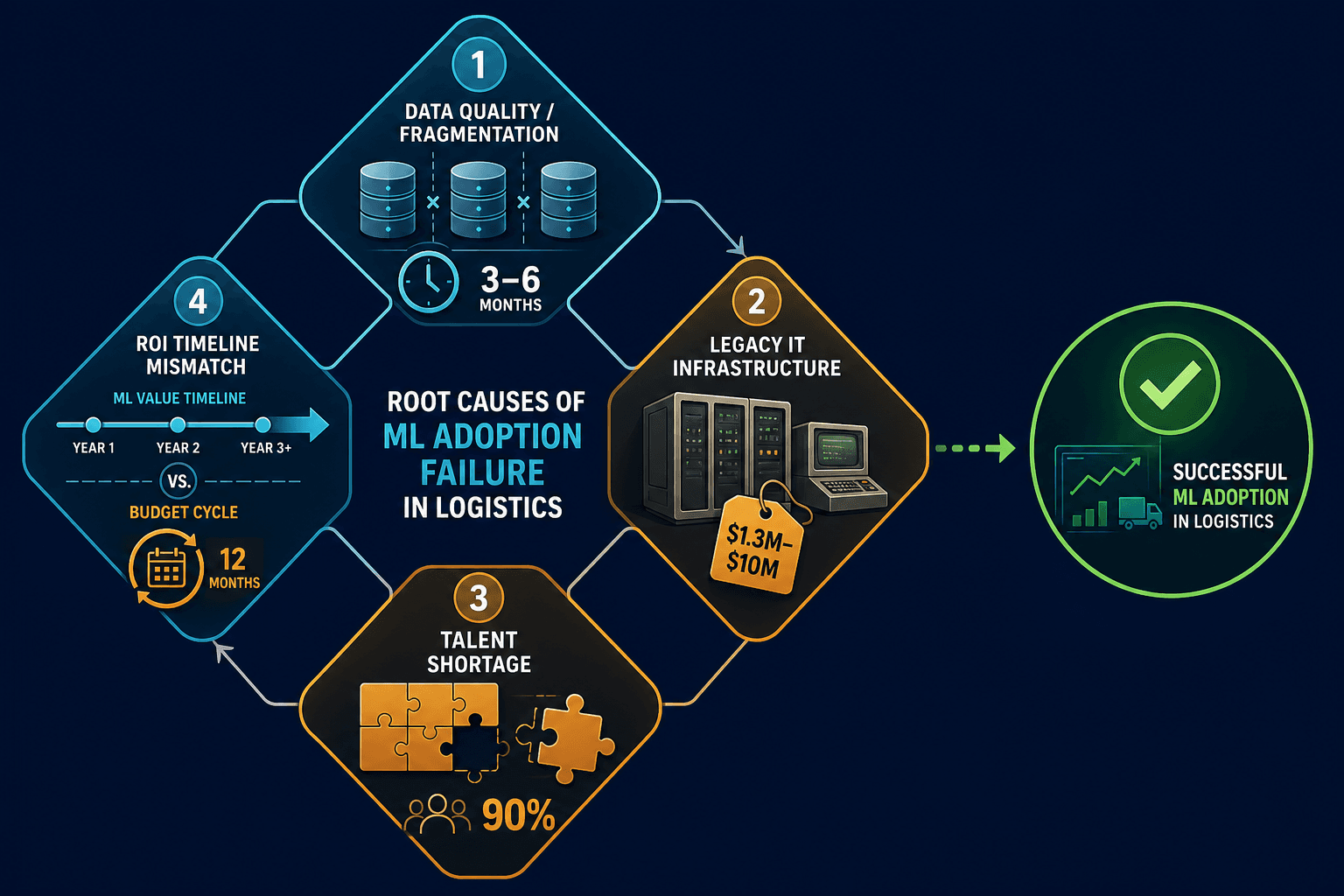
The most frequently cited barrier to ML deployment in logistics is data. Not the absence of data — logistics operations generate enormous volumes of it — but its fragmentation across systems. Data is typically siloed across ERP, warehouse management systems (WMS), transportation management systems (TMS), and a patchwork of spreadsheets and legacy databases. According to GM Insights, this fragmentation creates a data preparation bottleneck of three to six months before any ML model can be trained.
This timeline is a killer for organizational momentum. A six-month data preparation phase means that a logistics team cannot show any model output for half a year. In organizations with annual planning cycles, that delay alone can cause an initiative to lose executive sponsorship before it produces results.
- ERP systems hold order history and financial data but rarely capture granular operational details like dock door utilization or carrier performance.
- WMS data tracks inventory movements within the four walls but does not connect to transportation events.
- TMS data covers shipment-level events but often lacks the product-level detail needed for demand forecasting.
- Customer data, supplier data, and external data (weather, traffic, port schedules) live in entirely separate systems.
The result is that data scientists spend the majority of their time on data engineering rather than model development. This is not a problem that can be solved by hiring more data scientists. It requires an investment in data infrastructure and integration that many logistics organizations have not yet made.
Root Cause 2: Legacy IT Infrastructure
Logistics operations run on systems that were designed in a pre-ML era. Warehouse management systems, transportation management platforms, and enterprise resource planning tools were built for transactional processing, not for feeding machine learning models. The integration cost to connect these legacy systems with modern ML platforms ranges from $1.3 million to $10 million, according to industry data cited by Appinventiv.
This integration tax creates a difficult calculus for logistics leaders. Replacing legacy systems is rarely feasible — the operational risk and capital expenditure are prohibitive for most organizations. But the cost of integration is high enough to delay or kill ML initiatives before they start. The result is that many organizations remain stuck with systems that cannot support the data throughput and real-time processing that ML models require.
| Integration Approach | Typical Cost Range | Timeline | Risk Level |
|---|---|---|---|
| Full legacy system replacement | $10M–$50M+ | 18–36 months | Very high |
| API/microservices wrapper | $500K–$3M | 3–6 months | Moderate |
| Cloud-based ML platform with pre-built connectors | $200K–$1.5M | 4–12 weeks | Low to moderate |
| Custom point-to-point integration | $1.3M–$10M | 6–18 months | High |
The 50% failure rate for ML implementations attributed to data quality and legacy system integration is an industry heuristic rather than a single authoritative study. But the pattern is consistent across multiple sources: GM Insights and Appinventiv both identify legacy integration as a primary failure mode. The implication is clear: organizations that attempt to deploy ML without addressing their integration architecture are taking a significant risk.
Root Cause 3: Talent and Organizational Readiness
The talent shortage in logistics ML is not primarily about finding data scientists. It is about the scarcity of professionals who understand both logistics operations and machine learning. GM Insights reports that more than 90% of organizations lack sufficient digital skills to deploy AI at scale. This is not a hiring problem that can be solved by posting job descriptions. It is a structural constraint that requires organizational development over time.
Compounding the talent shortage is the phenomenon of shadow AI. ActivTrak's 2025 research found that 72% of logistics employees already use AI tools, the highest adoption rate across all industries surveyed. These employees are using AI — often without formal organizational strategy, governance, or oversight. While this grassroots adoption signals that the workforce sees value in AI, it also creates risks: ungoverned tool usage, inconsistent data practices, and models that operate outside of IT and compliance oversight.
The organizational readiness gap extends beyond individual skills. Less than 10% of distributors have crafted an AI roadmap and identified key use cases for deployment, per GM Insights. Without a roadmap, organizations cannot prioritize investments, align teams, or measure progress. The talent shortage and the roadmap gap reinforce each other: without skilled leadership, roadmaps do not get built; without roadmaps, organizations cannot attract and retain the talent that wants to work on strategically important problems.
Root Cause 4: The ROI Timeline Mismatch
Machine learning initiatives in logistics operate on a fundamentally different timeline than the budgeting cycles that fund them. Deloitte's 2025 survey found that while 85% of organizations increased AI investment over the past 12 months, only 6% saw ROI in under a year. Most organizations achieve satisfactory ROI within two to four years. Yet annual budgeting cycles create pressure to demonstrate results within 12 months.
This mismatch is a primary cause of initiative abandonment. A logistics ML project that requires 3–6 months of data preparation, 3–6 months of model development and testing, and another 6–12 months of production rollout and optimization will not show meaningful ROI in the first year. If the organization has not budgeted for this timeline, the initiative faces funding cuts just as it begins to generate value.
- Year 1: Data infrastructure investment, integration costs, pilot deployment — negative ROI expected.
- Year 2: First production models, initial cost savings, process improvements — partial ROI.
- Years 3–4: Scaled deployment, compounding data advantage, full ROI realization.
- Year 5+: Continuous optimization, new use cases enabled by existing data infrastructure.
The disconnect is particularly acute in logistics because the cost savings from ML (reduced transportation spend, lower inventory carrying costs, fewer expedited shipments) are realized incrementally over time. They do not appear as a single line item in a quarterly report. Organizations that evaluate ML investments using the same framework as cost-reduction initiatives — expecting payback within 12–18 months — will systematically underinvest.
Bridging the Gap: A Practical Framework for Logistics Leaders
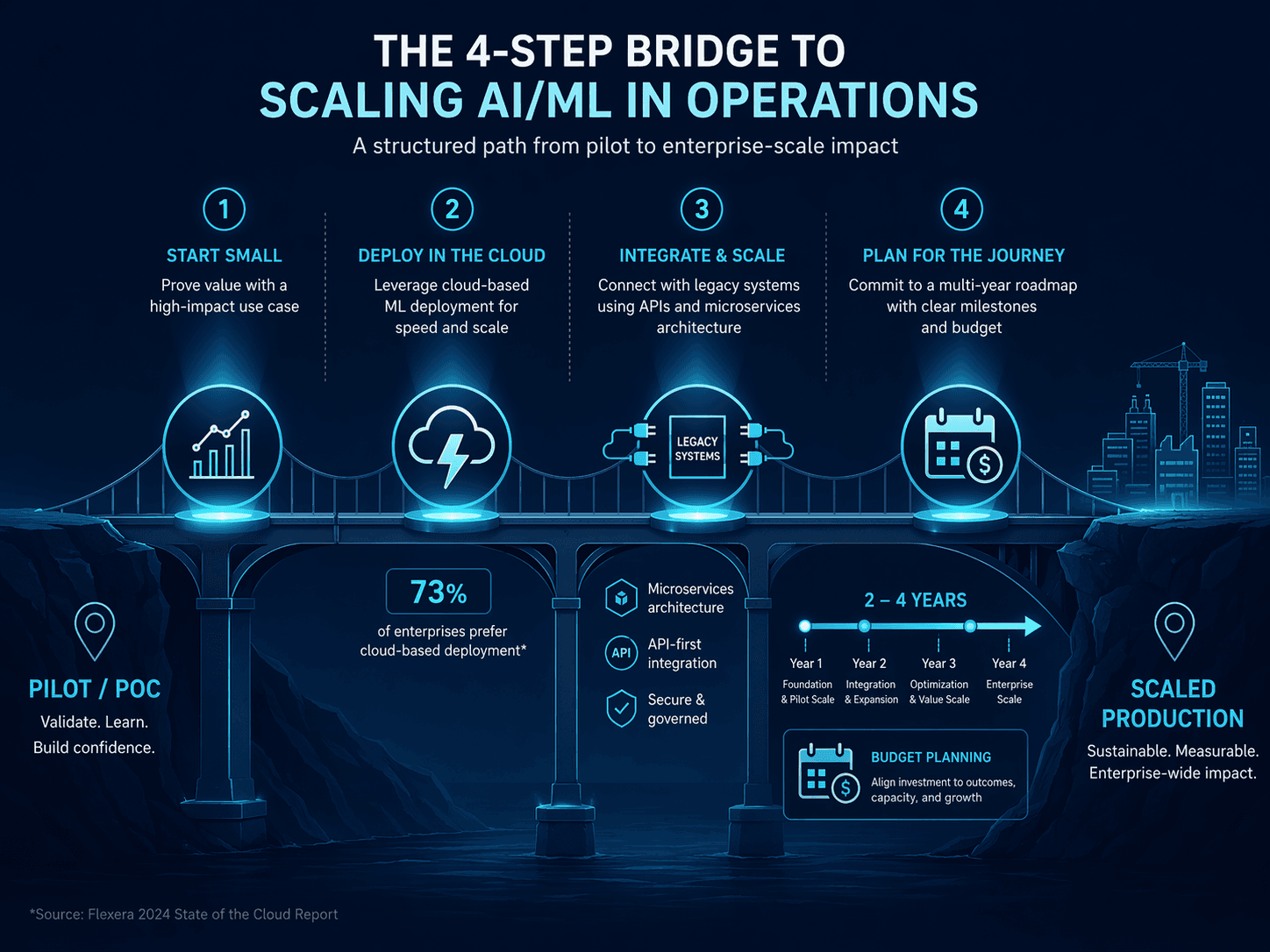
Closing the strategy-execution gap requires a deliberate, sequenced approach. The following framework is designed for logistics leaders who need to move from pilots to production without waiting for perfect conditions.
Step 1: Start with a Single High-Impact Use Case
The most common mistake organizations make is trying to deploy ML across multiple functions simultaneously. This approach multiplies the data integration challenges, the talent requirements, and the timeline risk. Instead, identify a single use case where the data is relatively clean, the business value is clear, and the scope is bounded.
Demand forecasting and route optimization are the two most frequently recommended starting points. Both have well-established ML methodologies, available training data, and clear ROI metrics. Demand forecasting typically requires historical order data and can show improvements in forecast accuracy within months. Route optimization leverages existing transportation data and can reduce mileage and fuel costs directly.
For a deeper understanding of how to assess your organization's readiness for this step, see our AI Maturity Roadmap for Supply Chain Leaders, which provides a staged framework for building AI capabilities over time.
Step 2: Adopt Cloud-Based ML for Faster Rollout
Cloud-based ML deployments now account for 73% of the market, according to GM Insights. The advantage is not just cost — it is speed. Cloud-based ML platforms can be deployed in weeks rather than the six months typically required for on-premise or custom-built solutions. This speed matters because it allows organizations to demonstrate value before the annual budget cycle forces a go/no-go decision.
Cloud deployment also reduces the upfront infrastructure investment. Instead of purchasing and configuring servers, storage, and networking equipment, organizations pay for compute and storage as they use it. This shifts the cost model from capital expenditure to operational expenditure, which aligns better with the multi-year ROI timeline of ML initiatives.
For a technical reference on the different ML architectures and deployment models available, see our AI/ML Technologies in Supply Chain: An Architecture and Capability Reference.
Step 3: Use APIs and Microservices to Wrap Legacy Systems
Replacing legacy WMS, TMS, and ERP systems is rarely the right path. The cost, risk, and operational disruption are disproportionate to the goal of enabling ML. Instead, use APIs and microservices to create a data layer that sits on top of existing systems. This approach extracts the data needed for ML models without modifying the underlying operational systems.
The API/microservices approach has several advantages. It preserves the stability of legacy systems that handle critical daily operations. It allows ML models to be developed and tested independently of the operational environment. And it creates a modular architecture that can be updated as new systems are added or old ones are eventually replaced.
Step 4: Budget for 2–4 Year ROI
The most important organizational change logistics leaders can make is to align their investment timeline with the actual ROI profile of ML initiatives. This means budgeting for negative or neutral returns in year one, partial returns in year two, and full returns in years three and four. It also means educating executive stakeholders about the timeline so that funding is not pulled prematurely.
Organizations that can maintain investment discipline through the first two years will capture a compounding advantage. Each year of production ML generates more data, which improves model accuracy, which drives more cost savings, which funds further investment. The organizations that cut funding at the 12-month mark never reach this virtuous cycle.
The Competitive Window: Why Starting Now Matters
The global machine learning in logistics market was estimated at $4.3 billion in 2025 and is projected to reach $44.5 billion by 2035, growing at a 26.7% compound annual rate, per GM Insights. This growth is not evenly distributed. Organizations that begin their ML journey now will have two to four years of production data and operational experience by the time late adopters begin their first pilots.
This data advantage is self-reinforcing. ML models trained on two years of logistics data will outperform models trained on six months of data. Organizations with mature ML deployments will be able to optimize across more variables, respond faster to disruptions, and identify cost savings that are invisible to organizations still struggling with data preparation.
The window is not closing — it is narrowing. The cost of delay is not that ML will become impossible, but that the gap between early adopters and late adopters will widen. Organizations that start now will have a structural cost and service advantage that their competitors will find difficult to close.
For logistics leaders, the path forward is clear. The strategy-execution gap is real, but it is not inevitable. By understanding the root causes — data fragmentation, legacy IT, talent shortages, and ROI timeline mismatches — and applying a structured bridge framework, organizations can move from the 94% who plan to the 23% who execute. The competitive advantage belongs to those who start now, not those who wait for perfect conditions.