
The Fastest-Adopting AI Technology in Procurement History
Generative AI has entered procurement departments at a pace that has no precedent in the function's history. According to the Wharton/Hackett Group 2025 survey, 94% of procurement executives now use generative AI at least weekly, a staggering 44-percentage-point increase from the prior year. To put that in context: no other AI technology — not robotic process automation, not traditional machine learning for spend classification — has ever crossed the 50% weekly usage threshold among procurement leaders in a single year.
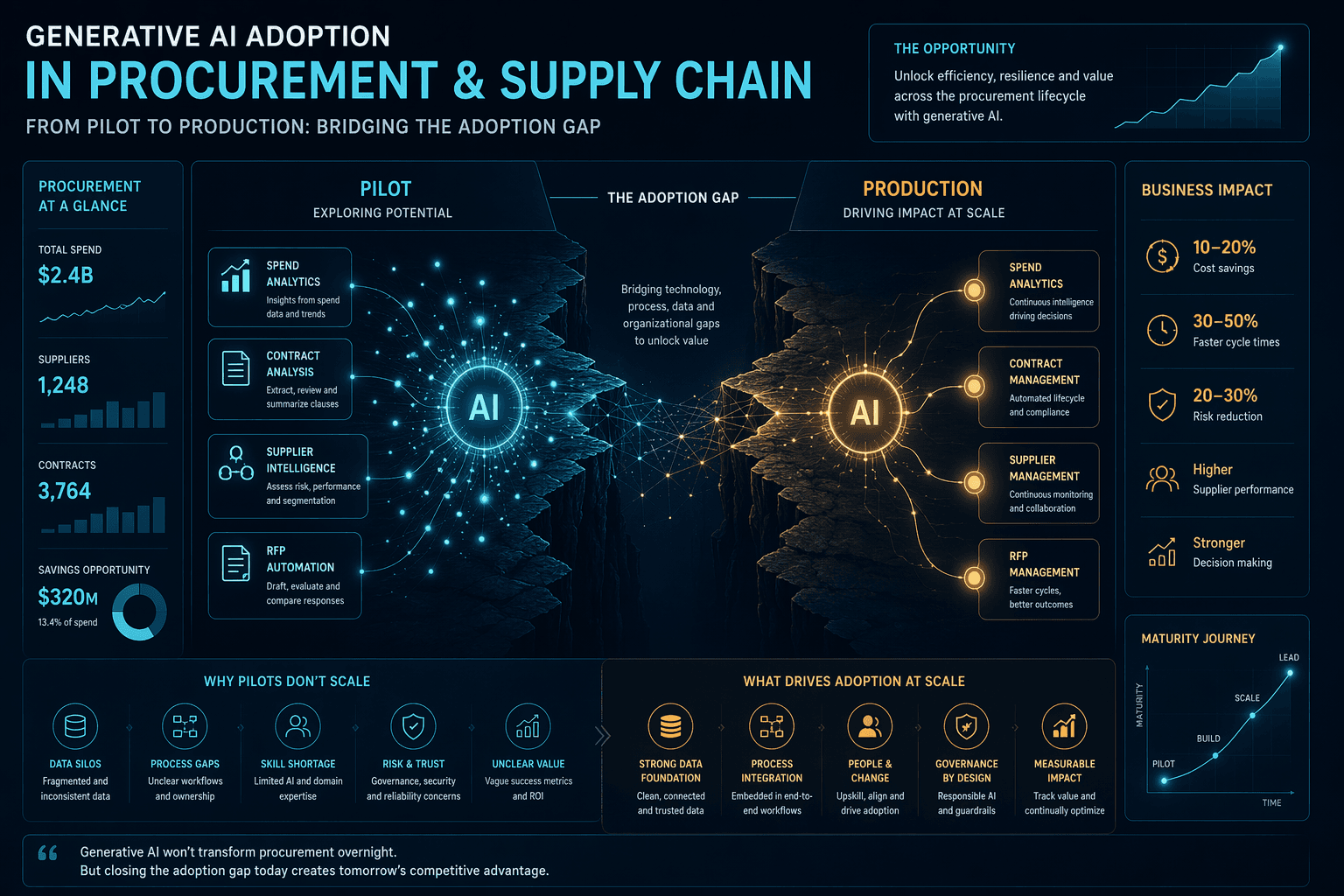
Yet this rapid adoption tells only half the story. The same data reveals a deep chasm between experimentation and production. The Hackett Group's 2025 CPO Agenda report found that 49% of procurement teams piloted generative AI in 2024, but only 4% achieved large-scale deployment. That is a 12-to-1 ratio of pilots to production deployments — a signal that the technology itself is not the bottleneck.
This article unpacks that gap. It defines what generative AI is and is not in the procurement context, presents the five highest-prevalence use cases with concrete adoption data from the Deloitte 2025 Global CPO Survey, analyzes what CPOs actually value about the technology, and examines the structural barriers — data readiness, pilot design, and organizational change — that separate the 4% who succeed from the 45% who pilot without reaching scale.
What Makes Generative AI Different from Traditional ML in Procurement
Procurement teams have used machine learning for years — to classify spend categories, flag anomalous transactions, and score supplier risk. These are analytical tasks: the model ingests structured data (invoice line items, payment terms, delivery dates) and outputs a prediction or classification. Generative AI, by contrast, is a synthetic technology. It produces new content — text, summaries, drafts, even structured data — based on patterns learned from vast training corpora. In procurement, that distinction matters because the highest-value GenAI applications are not about predicting what will happen; they are about generating what should be said or written.
| Dimension | Traditional ML in Procurement | Generative AI in Procurement |
|---|---|---|
| Primary output | Predictions, classifications, scores | Drafted text, summaries, generated documents |
| Data type consumed | Structured (invoice lines, PO history, supplier master) | Unstructured (contracts, RFPs, emails, market reports) |
| Typical task | "Is this supplier high-risk?" | "Draft a supplier negotiation brief based on these three contracts" |
| Human role | Review and act on predictions | Review, edit, and approve generated content |
| Maturity in procurement | Established (10+ years in spend analytics) | Emerging (widespread piloting since 2024) |
This is not to say GenAI replaces traditional ML. The two are complementary. A spend classification model (ML) can identify that 30% of addressable spend sits with unmanaged suppliers; a GenAI tool can then draft a tailored outreach email to each supplier based on their contract history and category profile. The ML layer handles the analytical heavy lifting; the GenAI layer handles the communication and documentation workload that has historically consumed procurement teams' time.
A useful framework comes from Sievo's procurement AI taxonomy, which describes the 80/20 rule: approximately 80% of spend classification can be automated with traditional ML, while about 20% requires human review and exception handling. GenAI shifts the boundary by automating parts of the human-review layer — summarizing why an exception occurred, generating a recommended reclassification, and drafting the justification for audit trails.
The Top 5 Generative AI Use Cases in Procurement (with Data)
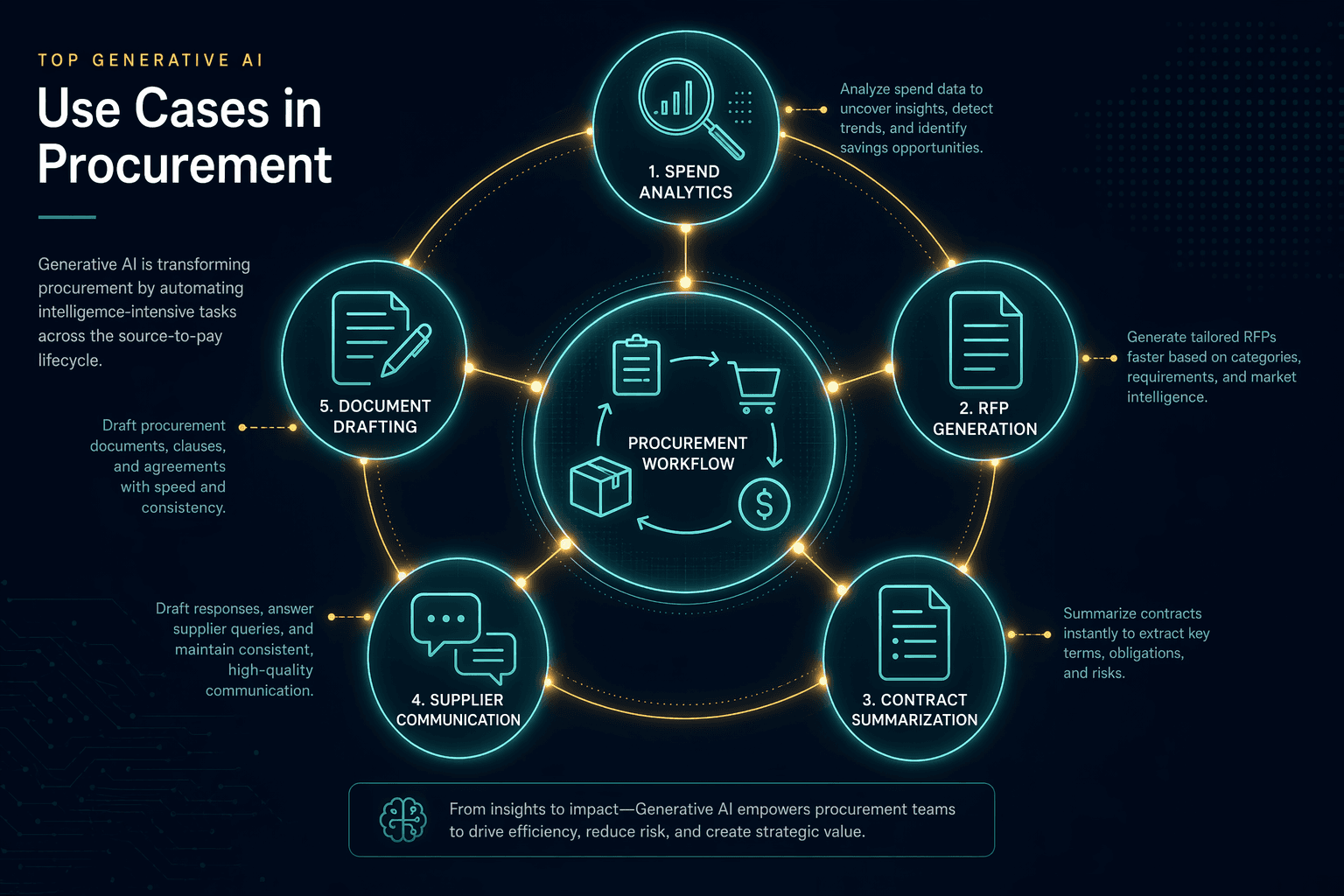
The Deloitte 2025 Global CPO Survey provides the most granular breakdown available of where procurement organizations are actually deploying generative AI. The survey asked CPOs to identify which GenAI applications their teams had adopted. The results reveal a clear pattern: the most adopted use cases are not the most technically ambitious — they are the ones that reduce friction in document-heavy, high-volume workflows.
| Use Case | Adoption Rate (Deloitte 2025 CPO Survey) | What It Does |
|---|---|---|
| Spend analytics and dashboarding | 53.44% | Generates natural-language summaries of spend patterns, flags anomalies, and answers ad-hoc questions about category performance |
| RFP/RFQ generation | 42.33% | Drafts request documents from templates and historical data, reducing creation time from days to hours |
| Contract summarization and key terms extraction | 41.27% | Reads full contract text and produces structured summaries with obligations, termination clauses, and renewal dates |
| Supplier communication automation | Not separately quantified in survey | Generates personalized outreach, negotiation briefs, and performance review drafts based on supplier data |
| Document drafting (SOWs, negotiation memos) | Not separately quantified in survey | Produces first drafts of statements of work, change orders, and internal memos from structured inputs |
Spend analytics leads at 53.44% — more than half of surveyed organizations have deployed GenAI in this area. This makes intuitive sense: spend analytics is already the most data-rich procurement function, with structured transaction data that GenAI can summarize and explain without requiring the model to generate entirely new factual content. The risk of hallucination is lower when the model is summarizing existing data rather than drafting novel clauses.
RFP generation (42.33%) and contract summarization (41.27%) follow closely. Both are document-centric workflows where procurement teams spend disproportionate time on first drafts and manual review. A GenAI tool that cuts RFP creation from three days to three hours does not eliminate the need for subject-matter expert review — but it reallocates the expert's time from typing to evaluating, which is precisely where the value lies.
What CPOs Actually Value: Decision Support Over Cost Cutting
A common assumption about AI in procurement is that its primary value is cost reduction. The Deloitte 2025 CPO Survey data challenges that assumption directly. When CPOs were asked to identify the top value drivers from generative AI, enhanced analytics and decision-making ranked first at 67.68%, followed by productivity gains at 49.43%. Direct cost optimization ranked fourth at 28.90%, behind better management of spend (31.56%).
| Value Driver | Percentage of CPOs Citing as Top Driver (Deloitte 2025 CPO Survey) |
|---|---|
| Enhanced analytics and decision-making | 67.68% |
| Productivity gains | 49.43% |
| Better management of spend | 31.56% |
| Cost optimization | 28.90% |
This finding has direct implications for use-case prioritization and vendor evaluation. A GenAI tool that helps a category manager understand why a spend category is trending up — by synthesizing data from supplier invoices, market indices, and contract terms — delivers more perceived value than a tool that simply flags the trend and suggests a cost-reduction target. The decision-support framing also aligns with the human-in-the-loop governance model that most procurement organizations are adopting: the AI generates insight and draft content; the human makes the final decision.
The emphasis on decision support also explains why spend analytics leads the use-case rankings. Spend data is the foundation of procurement decision-making, and GenAI's ability to turn that data into natural-language narratives — "Your electronics category spend increased 12% this quarter, driven by three suppliers who raised prices in February" — directly serves the top-ranked value driver.
The Adoption Chasm: Why 49% Pilot but Only 4% Deploy
The gap between piloting and production deployment is the single most important dynamic in generative AI for procurement today. The numbers bear repeating: 49% of procurement teams piloted GenAI in 2024; 4% reached large-scale deployment. That is a 92% failure-to-scale rate.
EY's 2025 Global CPO Survey paints a similar picture from a different angle: 80% of CPOs plan to deploy GenAI within three years, but only 36% have meaningful implementations today. The gap between intent and execution is not unique to procurement — it mirrors the broader enterprise AI adoption pattern — but it is particularly acute in procurement because the function's data infrastructure has historically lagged behind sales, finance, and operations.
The Data Readiness Crisis
The most frequently cited barrier to GenAI deployment is data readiness. Gartner's 2025 Leadership Vision for CPOs found that 74% of procurement leaders say their data is not AI-ready. This is not a trivial complaint about data quality — it is a structural issue. GenAI models require clean, well-labeled, and consistently formatted data to produce reliable outputs. Procurement data, by contrast, is often fragmented across ERP modules, supplier portals, email attachments, and scanned PDFs. A GenAI tool asked to summarize a contract cannot do its job if the contract exists only as an unsearchable image in a shared drive.
The data readiness problem compounds the pilot-to-production gap. A team can pilot GenAI on a small, curated dataset — 50 clean contracts, a single category's spend data — and get impressive results. Scaling to 50,000 contracts across 20 categories requires data infrastructure that most procurement organizations do not yet have.
The MIT Finding: 95% of Pilots Deliver No Measurable ROI
MIT's 2025 State of AI in Business study delivered a sobering statistic: 95% of enterprise GenAI pilots deliver no measurable ROI, and only 5% of pilots reach mature production-stage adoption. This finding is consistent across industries and functions, not just procurement. The implication is clear: the pilot itself is not the problem — the problem is that most pilots are designed without a clear path to production.
Common pilot failure patterns in procurement include:
- Piloting on a use case that does not align with a top value driver (e.g., building a custom chatbot when the team's primary pain point is contract data extraction)
- Using a dataset that is too small or too clean to reveal the integration and data-quality challenges that will emerge at scale
- Lacking a formal success metric before the pilot begins — "let's see what it can do" is not a measurement framework
- Underinvesting in change management and assuming the tool will sell itself to end users

Closing the Pilot-to-Production Gap: Practical Best Practices
The organizations that have moved from pilot to production share a set of practices that are less about the technology and more about the surrounding discipline. Based on the patterns that emerge from the adoption data and failure analysis, here are the actions that separate the 4% from the 45%.
- Prioritize data readiness before tool selection. The 74% of leaders who say their data isn't AI-ready are not wrong. Before evaluating GenAI vendors, invest in contract digitization, spend data normalization, and supplier master data cleanup. A GenAI tool is only as good as the data it can access.
- Select use cases that serve decision support, not just automation. The Deloitte data shows that enhanced decision-making (67.68%) is valued more than cost optimization (28.90%). Choose a pilot use case that helps your team make better decisions — spend analytics with natural-language summaries, for example — rather than one that simply automates a task no one enjoys doing.
- Design the pilot with production in mind. Define the success metric before the pilot starts. Include data integration requirements, user adoption targets, and a clear threshold for moving to production. If the pilot cannot meet that threshold, it should stop — not continue indefinitely as a science project.
- Implement human-in-the-loop governance from day one. GenAI outputs in procurement — contract summaries, RFP drafts, spend analyses — must be reviewed by a qualified human before they are used in decisions. Build the review step into the workflow, do not treat it as an afterthought. This is both a risk-management necessity and a way to build trust with end users.
- Build a formal AI strategy. Gartner found that only 23% of supply chain organizations have a formal AI strategy. Without one, GenAI initiatives tend to be reactive, underfunded, and disconnected from broader procurement transformation goals. A strategy does not need to be a 50-page document — it needs to define which use cases are in scope, what data infrastructure is required, and how success will be measured.
For a deeper treatment of the pilot trap and how to structure a disciplined adoption sequence, see our companion article: The Business Case for AI in Procurement: ROI Data, the Pilot Trap, and a Disciplined Adoption Sequence. For additional context on why most organizations lack a formal AI strategy and what to do about it, see The AI Strategy Gap in Supply Chain: Why 77% of Organizations Lack a Formal Plan.
The Road Ahead: From Generative to Agentic AI in Procurement
Generative AI is not the final destination. The next frontier is agentic AI — AI systems that can not only generate content but also take action within defined guardrails. In procurement, agentic AI could autonomously execute routine sourcing events, renegotiate low-risk contracts within pre-approved parameters, and adjust order quantities based on real-time demand signals. McKinsey estimates that agentic AI in procurement could unlock 25–40% efficiency improvements in procurement workflows.
But agentic AI is not a replacement for the foundational work described in this article. The same data readiness challenges, use-case selection discipline, and governance requirements apply — and they are harder, because the stakes are higher when the AI is not just drafting a document but executing a transaction. Organizations that have not yet closed the pilot-to-production gap on generative AI are not ready for agentic AI.
For a concrete example of how agentic AI is being deployed in supply chain, see our profile of Blue Yonder's Agentic AI Transformation: From Planning to Autonomous Execution. The lessons from that deployment — particularly around governance, human oversight, and phased rollout — are directly applicable to procurement.
For now, the priority for procurement leaders is clear: close the pilot-to-production gap on generative AI by investing in data readiness, selecting use cases that serve decision support, and building the governance and strategy frameworks that turn experiments into production systems. The technology is ready. The question is whether the organizations deploying it are.