
The useful version of AI infrastructure stock analysis is not asking whether Nvidia picked good stocks. It is asking what Nvidia is trying not to wait for. By mid-2026, the more revealing pattern is not a single headline stake but a cluster of capital placed near the parts of the AI supply chain where delays become contagious: cloud GPU infrastructure, photonics, EDA, networking, advanced packaging-adjacent capacity, memory, and server systems.
Asia Times described Nvidia’s disclosed equity holdings as growing from a much smaller base of about $230 million to more than $13 billion by the end of 2025, with a further reported $8 billion to $10 billion added in Q1 2026.[1] Those figures should not be treated as a live July 2026 portfolio value; 13-F disclosures lag, market values move, and source-reported estimates need to be checked against the latest filings. But as a supply chain signal, the direction is hard to ignore.
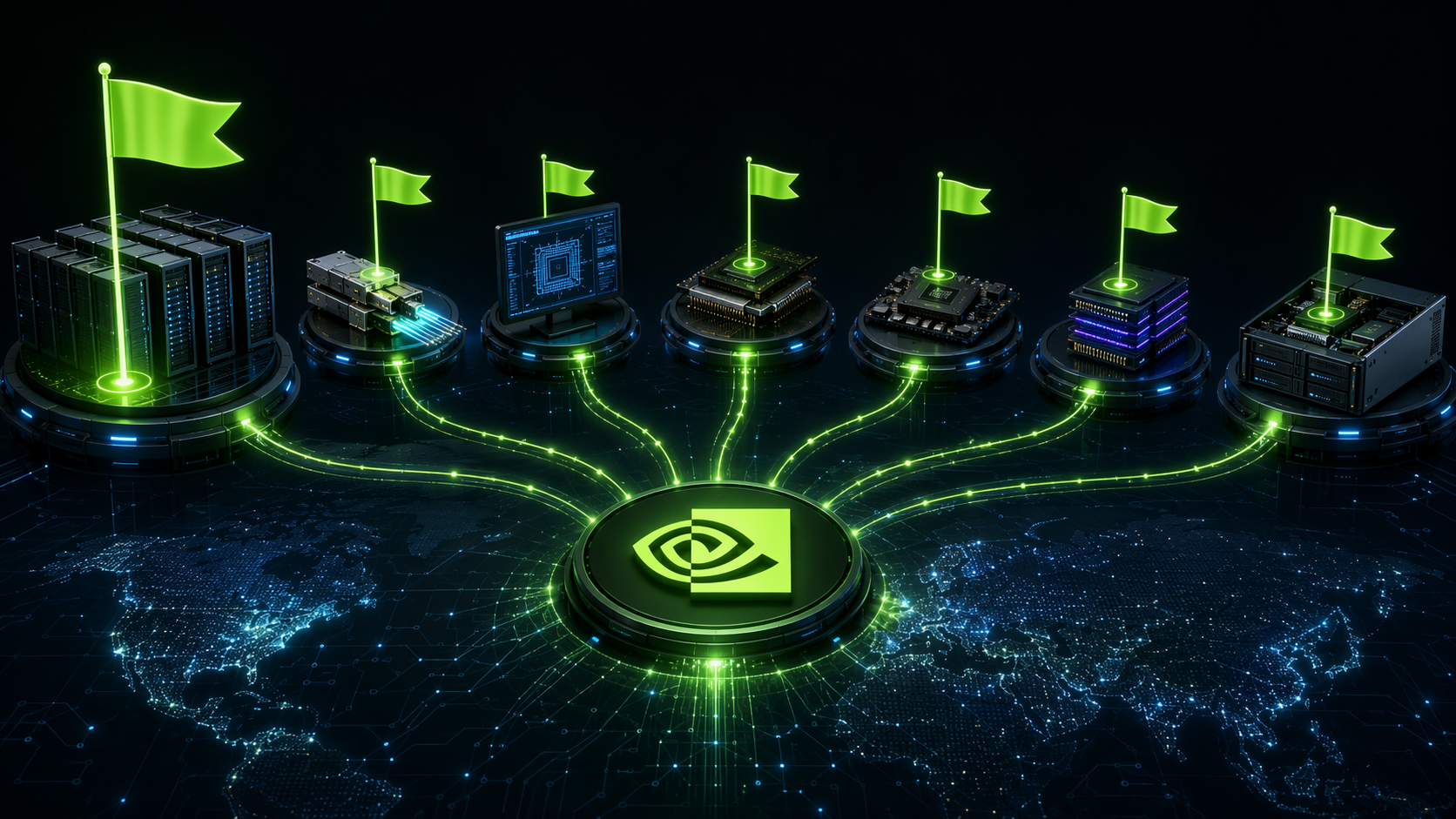
The largest warning light is cloud GPU infrastructure. Asia Times reported that CoreWeave represented 91% of disclosed portfolio value in the relevant snapshot, about $4.3 billion, and Yahoo Finance separately covered Nvidia adding to its CoreWeave position.[1][2] However the current market value has changed since those reports, the procurement implication is clearer than the stock-market theater around it: Nvidia is putting exceptional weight behind the layer that converts chips into available training and inference capacity.
The Portfolio Reads Like a Capacity Map
A GPU does not become useful merely because it leaves a fab. It needs substrate and packaging capacity, high-bandwidth memory, optical links, networking silicon, server integration, data center power, cooling, land, and a cloud or enterprise operator willing to place it somewhere. A delay at any one of those layers can turn a signed AI plan into a waiting-room exercise.
That is why Nvidia’s stakes matter more as a map than as a portfolio. A stake in CoreWeave is not the same kind of signal as a stake in Synopsys. CoreWeave points to the shortage of ready-to-use cloud GPU clusters. Synopsys points to design-tool dependency. Lumentum and Coherent point toward photonics and optical interconnect pressure. Marvell points toward networking. Nebius keeps the cloud infrastructure theme alive beyond one provider.[1][2]
This does not prove that every investment was made to secure preferential access. The filings do not disclose every operational term, and not every strategic stake carries the same commercial rights. The safer reading is narrower: Nvidia is repeatedly placing capital near categories where its own throughput depends on third-party capacity, and those categories deserve earlier attention from anyone planning AI infrastructure procurement.
| Stake Signal | Supply Chain Node | Procurement Question It Raises |
|---|---|---|
| CoreWeave | Cloud GPU infrastructure | Who gets access to deployed GPU clusters when cloud queues tighten? |
| Lumentum and Coherent | Photonics and optical components | Can optical supply keep pace with scale-out networking demand? |
| Synopsys | EDA and IP tools | Are chip design and verification tools becoming a leverage point? |
| Marvell | Networking silicon | Will switching, interconnect, and custom silicon capacity pressure deployment schedules? |
| Nebius | Cloud infrastructure | Is alternative GPU cloud capacity being pulled closer to Nvidia’s orbit? |
CoreWeave Is the Queue Signal, Not Just the Biggest Holding
If one position overwhelms the disclosed portfolio, it deserves to be read first. CoreWeave is not a component vendor in the usual sense. It is closer to a conversion layer: GPUs, networking, data center contracts, power, cooling, and operating know-how turned into rentable capacity. When that layer is scarce, enterprise buyers may technically have access to AI services while still waiting for the configuration, region, price, or performance tier they actually need.
That is the queue-stratification mechanism. Nvidia ships the essential chips, but the market also needs operators capable of absorbing them quickly. A close capital relationship with a GPU cloud provider can help align demand forecasts, deployment timing, and commercial priorities. The filings do not let outsiders measure queue priority directly, so this remains an interpretation, not a disclosed contract term. Still, it is exactly the kind of relationship procurement teams should watch before a delay shows up as a sales excuse.
For enterprise AI buyers, this changes the question to ask cloud vendors. “Can we get GPUs?” is too vague. The better question is which cluster class, in which region, with which networking fabric, under which reservation terms, and with what escalation rights if higher-priority workloads arrive. A portfolio signal cannot answer those questions, but it tells planners where to push for written commitments instead of roadmap language.
Photonics, EDA, and Networking Point to Different Kinds of Scarcity
Photonics scarcity behaves differently from cloud capacity scarcity. If optical components tighten, the effect appears in lead times, qualified supplier lists, transceiver availability, and the ability to build dense AI clusters without compromising performance. Stakes around Lumentum and Coherent therefore matter because optical interconnect is not a cosmetic upgrade; at AI scale, moving data between accelerators is part of the compute system itself.[1]
EDA is quieter but no less strategic. A Synopsys signal is not about today’s GPU delivery slot. It is about the tools used to design, verify, and improve the next generation of chips. Procurement leaders may not buy EDA software directly unless they run silicon programs, but they still inherit the timing consequences when chip vendors, ASIC partners, or advanced packaging roadmaps depend on constrained engineering workflows.
Networking sits between those two. It can be a bill-of-materials issue, a system architecture issue, and a data center operations issue at the same time. Marvell’s relevance is not simply that networking is “hot.” It is that AI infrastructure demand increases the penalty for weak interconnect planning. The buyer who treats networking as an accessory to GPU procurement is usually the buyer who discovers too late that accelerators are idle because the cluster cannot move data efficiently.
The Eight-Segment View Separates Capacity from Hype
Investing.com’s eight-segment AI supply chain framework is useful here because it does not stop at naming bottlenecks. Using Finbox data from August 2025, it compared EDA/IP, semiconductor equipment, foundry, memory, packaging and testing, server systems, data center infrastructure, and networking across financial metrics.[3] For procurement readers, the point is not to turn those categories into stock picks. It is to ask which parts of the chain have both hard capacity constraints and durable supplier economics.
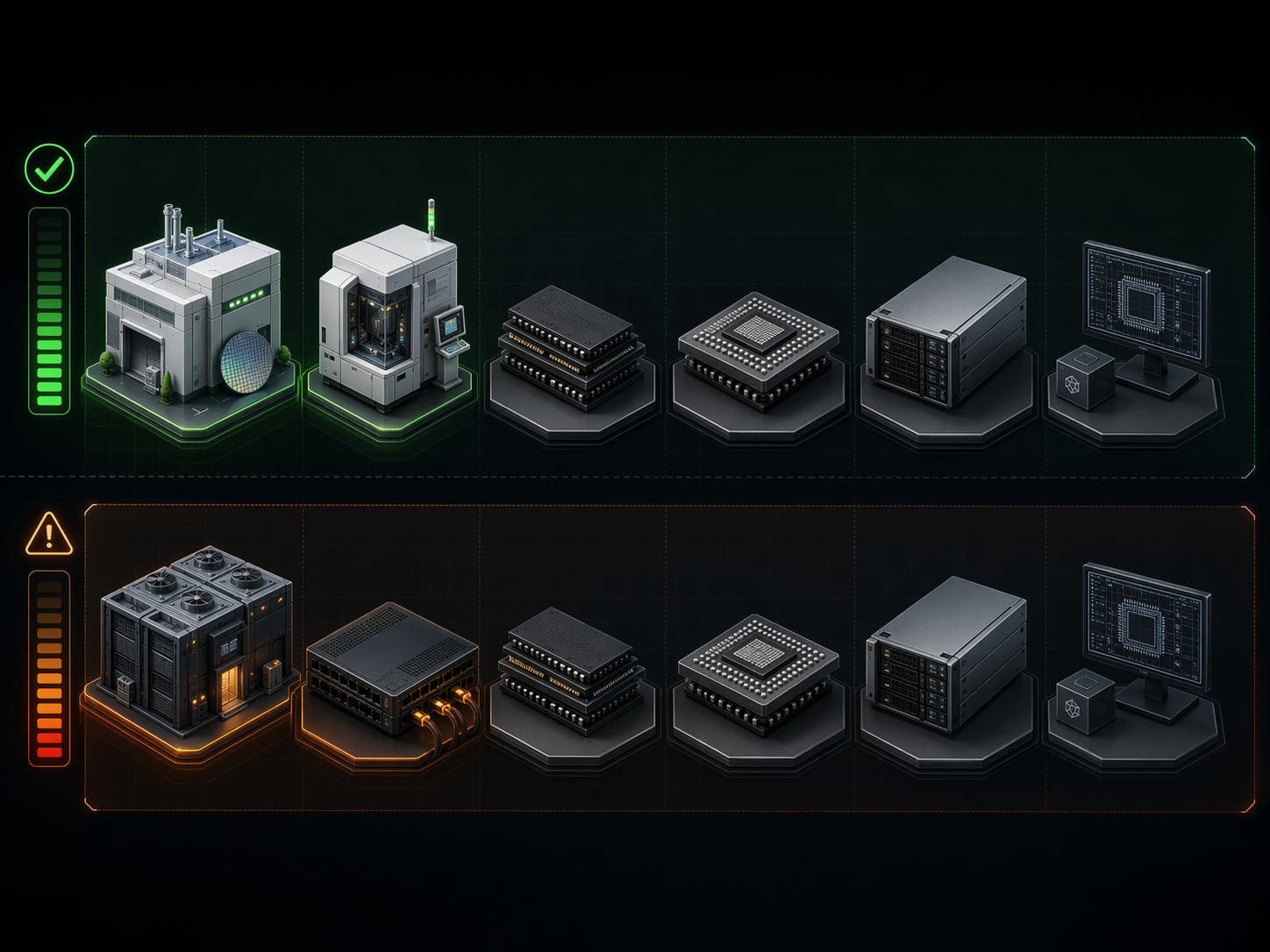
Foundry stands out in that framework. The analysis cited TSMC with a 67% EBITDA margin and a 20.2 P/E, placing it in the category of capacity with unusually strong economics but not the same kind of stretched valuation profile as some infrastructure-adjacent names.[3] That matches what supply chain teams already see in practice: advanced foundry capacity is difficult to substitute, qualification cycles are long, and the buyer cannot fix a bottleneck by adding a second-source line item at the last minute.
Semiconductor equipment falls into a similar planning bucket. It is upstream of upstream: when tool availability, installation windows, or process capability lag, capacity additions elsewhere become promises waiting for machinery. The procurement consequence is indirect but severe. A cloud buyer may never negotiate with ASML or Applied Materials, but the buyer still feels the effect when wafer starts, advanced process ramps, or packaging expansions arrive later than the AI rollout calendar assumes.
Data center infrastructure and networking deserve a different treatment. Investing.com’s framework put Vertiv at a 19% EBITDA margin and a 61 P/E in the August 2025 data set, a contrast that marked data center infrastructure as a higher-pressure area: large demand, premium expectations, and less room for procurement comfort if execution slips.[3] Networking carries a related risk. Buyers are not only competing for hardware; they are competing for designs, validated configurations, deployment teams, and service capacity.
That distinction matters. Foundry and semiconductor equipment may be hard-capacity “sweet spots” in the sense that economics and scarcity reinforce each other. Data center infrastructure and networking look more like danger zones for planners because commercial demand is racing ahead while execution depends on physical sites, power, cooling, interconnect design, and installation labor. ChainSignal’s earlier coverage of TSMC’s AI chip bottlenecks and AI data center constraints tracks the same split from the operating side.
What Procurement Teams Should Monitor Over the Next 6 to 12 Months
Nvidia’s holdings are not a perfect live map. They are a lagged, partial, externally visible version of capital allocation. But lagged capital still matters when supplier reports arrive even later or when account teams soften shortages into phrases like “strong demand environment.” For procurement leaders, the discipline is to convert each stake signal into a watchpoint that can be checked against vendor behavior.
- Cloud GPU infrastructure: Track reservation terms, regional availability, minimum commitments, price escalators, and whether preferred workloads receive faster provisioning.
- Photonics and optical components: Watch lead times, approved vendor lists, transceiver substitutions, and whether cluster designs are being adjusted around optical availability.
- Networking: Ask vendors to specify fabric design, switch availability, deployment labor, and performance guarantees rather than only quoting accelerator counts.
- EDA and chip design dependencies: For custom silicon or ASIC programs, pressure-test design-tool access, verification timelines, and dependency on a small set of software suppliers.
- Foundry, packaging, and memory: Separate booked capacity from qualified capacity, and require suppliers to explain which upstream step can still move the delivery date.
- Data center infrastructure: Monitor power interconnection, cooling equipment, permitting, land constraints, and installation schedules as closely as GPU allocation.
The practical test is whether a vendor can name the constrained step. If the answer stays at the level of “GPU demand is high,” the buyer has learned very little. If the vendor can identify an optical component, a networking fabric, a packaging slot, a power interconnect, or a specific cloud cluster queue, the buyer can start making tradeoffs: reserve earlier, redesign workloads, accept a different region, split providers, or delay a lower-value use case.
This is where Nvidia’s capital placement becomes useful even without proving intent. A new or enlarged stake does not guarantee a shortage, and the absence of a stake does not prove comfort. But when a stake lands in a category already showing long lead times, premium pricing, or tighter vendor terms, it should move that category higher on the procurement risk register.
Vendor Dependency Becomes the Hidden Cost
The uncomfortable consequence for enterprise buyers is dependency stacking. An AI program may appear diversified because it has a cloud provider, a systems integrator, and several software vendors. Under the surface, the same upstream constraints can run through all of them: Nvidia GPUs, the same foundry ecosystem, overlapping optical suppliers, similar networking architectures, and the same power-constrained data center markets.
That makes ordinary supplier diversification less reassuring. Adding a second cloud provider helps only if it changes queue exposure, geographic capacity, network design, or contractual priority. Adding a second server vendor helps only if it changes component allocation or integration capacity. The procurement task is not to collect logos; it is to identify which bottleneck each logo actually bypasses.
Organizations building AI infrastructure capability internally should also treat capital-allocation signals as planning inputs, not gossip. ChainSignal’s look at AI-first supply chain planning is relevant for this reason: the companies that move fastest tend to connect technical architecture, sourcing, and infrastructure constraints before procurement receives an emergency escalation.
Use the Holdings as a Bottleneck Dashboard, with Guardrails
The guardrails matter. Disclosed holdings are delayed. Reported portfolio values can move sharply with market prices. A stake does not disclose the side agreements, supply commitments, technical collaborations, or absence of them. Nvidia may invest for several reasons at once: ecosystem development, customer financing, strategic alignment, financial return, or capacity assurance. Outsiders should not pretend the filings reveal a full operating plan.
Even with those limits, the pattern is more behaviorally revealing than many traditional supplier-intelligence inputs. Supplier presentations tend to describe what capacity will exist after the investment case has already been approved. Nvidia’s equity moves show where a powerful buyer and platform owner is willing to place capital before the rest of the market has a clean capacity report.
For supply chain leaders, the habit is straightforward: when Nvidia’s disclosed capital clusters around a node, check whether your AI roadmap depends on that same node. If it does, ask for allocation evidence, not enthusiasm. Ask for dates, queue position, substitution paths, and the operational step most likely to slip.
References
- Nvidia’s $2 billion sprinkler remaking the AI supply chain, Asia Times, April 2026.
- Nvidia Quietly Buys More Stock, Yahoo Finance.
- Nvidia’s AI Reign Extends Across a Hidden Supply Chain of Investment Gems, Investing.com.
Comments
Join the discussion with an anonymous comment.