
The first AI feature worth noticing in Hint is not the Martha Stewart association, the waitlist, or the seed round. It is the address field. In Fortune’s May 2026 coverage, Hint’s setup is described in unusually plain terms: “the first thing you do is give us your address. That’s it.” From that one input, the app is supposed to begin constructing a working profile of a home before the owner has assembled a folder of manuals, warranties, photos, or service records.[1]
That small moment is why the Martha Stewart Hint app’s AI features are more useful to supply chain leaders than they first appear. They turn the abstraction of agentic AI into a sequence that operations people can actually point to: start with a minimal trigger, enrich it with outside data and owned documents, monitor conditions, warn the user, recommend a response, and, where permission exists, take action.
There is an important boundary around that claim. Hint is not a supply chain product. It was announced in May 2026 and, as of July 2026, remains a pre-launch or waitlist-stage consumer app. Its claims come from company announcements and press interviews, not from public post-launch performance audits. Treating it as validated evidence for enterprise automation would be a category error. Treating it as a visible architecture pattern is more productive.

From One Address to an Operating Loop
Hint’s proposed workflow begins with public information about a property. The company has described the app as pulling data such as weather patterns, soil type, and architectural styles, then combining that with documents the homeowner uploads, including warranties, manuals, and service records.[2] In homeownership language, that sounds like convenience. In enterprise language, it is a data-ingestion and enrichment model.
The distinction matters because many failed automation programs start by asking the user to do too much work before the system returns value. A buyer is asked to clean supplier records. A planner is asked to classify exceptions. A maintenance manager is asked to upload equipment history into yet another tool. Hint’s design claim runs in the other direction: use one low-friction input to infer what can be inferred, then ask the user for higher-value documents only where those documents improve the profile.
For a supply chain agent, the equivalent is rarely an address. It may be a supplier ID, a lane, a part number, an asset tag, a purchase order, or a facility. The pattern is the same. A procurement agent starts from a supplier and pulls internal contracts, open purchase orders, delivery history, quality records, and third-party risk signals. A logistics agent starts from a lane and pulls carrier performance, port conditions, weather exposure, dwell history, and customer-service commitments. A maintenance agent starts from an asset and pulls work orders, manuals, sensor readings, spare-parts availability, and technician notes.
None of that is autonomous yet. It is the necessary first step: the agent must know what object it is watching and which evidence it is allowed to use.
The Pattern: Monitor, Anticipate, Alert, Recommend, Act
Hint has been described as an “always-on, AI-native” home-management platform.[3] That phrase is easy to overuse, but the operating implication is specific: the system is not waiting for a homeowner to ask a chatbot what to do next. It is supposed to keep watching the home profile, compare changing conditions against that profile, and surface work before the owner experiences failure.
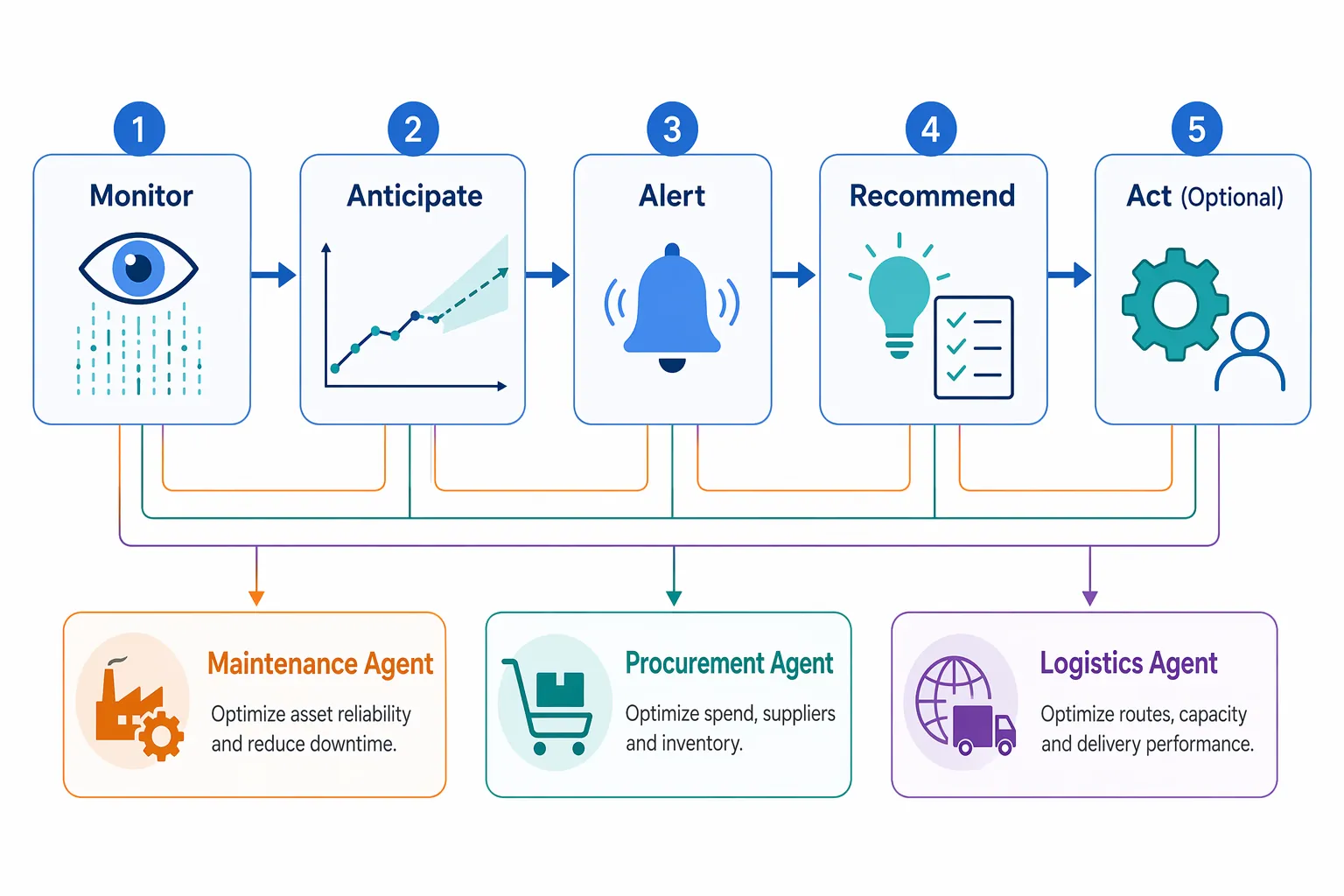
That is the agentic loop in its most usable form:
- Monitor: keep observing the relevant object, condition, supplier, lane, or asset.
- Anticipate: compare the current state with expected risk, timing, cost, or service patterns.
- Alert: notify the right person before the issue becomes an operational failure.
- Recommend: propose a specific response, with enough context to evaluate it.
- Act, where permitted: execute the approved action or a bounded class of low-risk actions.
This is more demanding than a dashboard and more constrained than the usual autonomous-enterprise pitch. A dashboard displays. A chatbot answers. An agent watches, decides when something matters, and moves a work process forward. The hard part is not the vocabulary. The hard part is deciding where the agent’s judgment stops and where human authority begins.
Hint co-founder Yih-Han Ma has described the mission as moving homeowners from reactive to proactive homeownership.[2] The supply chain version is familiar: move from expediting after a missed shipment, repairing after a breakdown, or renegotiating after a supplier shock toward earlier intervention. The useful lesson is not that homes and supply chains are similar. It is that both domains contain assets with histories, documents, conditions, thresholds, and consequences.
What Supply Chain Teams Can Borrow
The cleanest enterprise translation is maintenance. An asset-management agent should not begin by asking a reliability engineer to describe every failure mode from memory. It should start with an asset record, pull the manual, service history, warranty terms, parts list, sensor patterns, and work-order notes, then watch for conditions that change the recommended maintenance window. If it detects a risk, the first action may simply be to alert the maintenance planner. A later action, under tighter rules, may be to create a work order, reserve parts, or suggest a technician skill set.
Procurement agents need the same architecture, but their trust problem is sharper. A procurement agent that monitors suppliers should combine internal spend, contract obligations, open orders, quality records, and external risk signals. Its recommendation might be to split a buy, accelerate a purchase order, hold a supplier review, or seek an alternate source. But the agent’s recommendation cannot be treated as neutral merely because it is generated by software. If a marketplace, procurement platform, or systems integrator has commercial relationships with certain vendors, the organization needs to know whether those relationships influence the recommendation.
Logistics agents sit somewhere between urgency and repeatability. A lane-monitoring agent may observe port congestion, carrier reliability, weather exposure, appointment availability, and order priority. It may alert a transportation manager that a shipment is likely to miss a delivery window. It may recommend rerouting, mode conversion, carrier substitution, or customer notification. In high-value or regulated shipments, that recommendation may require human approval. In routine, low-risk moves, the organization may eventually allow bounded action without manual review.
| Hint Pattern | Supply Chain Translation | Governance Question |
|---|---|---|
| Address-first setup | Start from supplier, lane, asset, facility, part, or order | What object is the agent authorized to profile? |
| Public data pull | Use external risk, weather, market, logistics, or supplier signals | Which outside sources are trusted and refreshed? |
| Uploaded homeowner documents | Use contracts, manuals, POs, warranties, service records, and SOPs | Which internal documents can the agent read? |
| Continuous monitoring | Watch for supplier, asset, shipment, demand, or compliance changes | What threshold turns a signal into an exception? |
| Recommendation | Suggest expedite, reroute, reschedule, rebuy, repair, or review | How is the recommendation explained and audited? |
| Optional action | Create work orders, reserve inventory, notify stakeholders, or execute approved changes | Who permits action, and what actions remain off limits? |
The table looks tidy because the architecture is tidy. Implementation will not be. Enterprise data is fragmented across ERP, TMS, WMS, EAM, procurement suites, spreadsheets, supplier portals, and email. Documents may be outdated or contradictory. Master data may identify the same supplier, site, or asset in several ways. An agent that cannot reconcile those differences will produce polished recommendations on top of weak evidence.
The Economic Signal Is About Scaling Judgment
Hint’s funding story is secondary, but it does say something about how investors are reading the model. Fortune reported that Hint raised $10 million in seed funding from Slow Ventures in May 2026. The same coverage contrasted that with human-concierge home models such as Honey Homes, reported at $9.25 million raised, and Birdwatch, reported at $3.2 million raised.[1]
The useful point is not that one funding amount proves one operating model will win. It does not. The useful point is the scaling thesis behind the investment. Slow Ventures’ Kevin Colleran described the logic this way: “The more Hint learns about your home, the more the system can do without human intervention.”[1]
That sentence could be lifted into almost any supply chain agent proposal. The more the system learns about a supplier, asset, lane, contract, or customer promise, the more exceptions it should handle without escalating every decision to a planner or manager. The cost curve is supposed to change because the agent reuses what it learns. Human-heavy operating models can deliver excellent service, but their capacity usually expands by adding people. AI-native models promise a different shape: more monitored objects per human reviewer, more early warnings per analyst, and more routine actions executed inside preset boundaries.
Supply chain leaders should be careful with the word “promise.” The public material on Hint supports an autonomy-scaling argument. It does not prove realized savings, reduced failures, or better service outcomes at scale. The same standard should apply to enterprise vendors. A demo that shows an agent recommending a shipment reroute is not evidence that the agent improves service levels across thousands of lanes. A pilot that automates purchase-order follow-up is not evidence that strategic sourcing can be delegated.
Executive Expectations Are Moving Faster Than Proof
The pressure is real. IBM Institute for Business Value reported that, by 2026, 57% of executives expect agentic AI to make proactive supply chain recommendations, and 62% expect AI agents to make autonomous supply chain decisions.[4] Those figures are useful as a temperature reading. They show where executive expectations are heading. They do not show that those capabilities have been deployed safely, widely, or effectively.
This gap between expectation and proof is exactly where many supply chain technology decisions go wrong. Leaders approve “agents” because the language sounds directional and modern. Operators inherit a workflow that may still depend on unclear data rights, brittle integrations, manual exception triage, or recommendations no one trusts enough to execute.
A practical internal conversation should avoid debating whether agentic AI is real in the abstract. It should ask what the agent is allowed to observe, how often it observes, what it compares conditions against, which exceptions it escalates, what evidence appears with a recommendation, and what class of actions it can take without a person clicking approve.
Recommendation Independence Is Not a Detail
One of the most important claims in the Hint coverage is also one of the easiest to overlook. Colleran said Hint’s recommendations are “blind to commercial deals.”[1] For a home app, that means the system is not supposed to recommend a contractor, product, or service because of a hidden business arrangement. For supply chain, the same principle becomes a governance requirement.
A procurement agent that recommends Supplier B over Supplier A must be able to show why. Was the recommendation based on lead time, quality performance, contract price, tariff exposure, capacity risk, ESG documentation, service history, or inventory position? Was any supplier promoted because the software provider has a marketplace relationship, reseller incentive, implementation partnership, or preferred network arrangement? If the organization cannot answer that, the agent may be useful for discovery but unsafe for autonomous award decisions.
The same issue appears in logistics. If an agent recommends a carrier substitution, the transportation team needs to know whether the recommendation reflects actual performance and constraint data or a commercial relationship embedded in the platform. In maintenance, if an agent recommends a part, contractor, or service interval, the plant team needs to know whether the recommendation is driven by asset condition or by a monetized channel.
Independence does not mean the agent never uses preferred suppliers or approved carrier lists. Most enterprises want agents to operate inside commercial policy. Independence means the agent’s reasoning is visible enough to distinguish policy-compliant optimization from undisclosed steering.
Data Provenance Comes Before Autonomy
Hint’s model depends on combining public data with user-supplied documents.[2] That mix is also where enterprise AI agents become powerful and risky. Public and third-party data can expand visibility beyond the four walls of the company. Internal documents can make the recommendation specific to the company’s obligations. Together, they can create a useful operational memory. But the agent needs to preserve provenance: where each fact came from, when it was refreshed, and whether it is authoritative.
A supplier-risk agent, for example, may combine a contract clause, an open purchase order, a news signal, delivery performance, and inventory coverage. If it recommends accelerating supply, the buyer should not receive a vague confidence score. The buyer should see the contract exposure, the affected materials, the open orders, the inventory buffer, and the external signal that triggered concern. Without that trail, the recommendation becomes another black-box exception to investigate.
Document access also needs limits. An agent may need to read warranties, contracts, certificates, routing guides, maintenance manuals, and service records. It does not automatically need access to every email thread, commercial negotiation, personnel file, or legal dispute. Enterprise architecture teams should define document scopes by use case rather than giving a general-purpose agent broad access and hoping audit controls catch misuse later.
Where Alerting Ends and Acting Begins
The most useful agentic systems will not make every action autonomous. They will separate alerting, recommendation, assisted execution, and autonomous execution by risk. That sounds obvious until a vendor demo collapses all four into one smooth workflow.
In procurement, a low-risk action might be drafting a supplier email, preparing an RFQ package, or flagging a contract clause for review. A higher-risk action might be changing an award decision, committing spend, or substituting a supplier for a regulated component. In logistics, an agent might autonomously notify a customer-service team of a likely delay, but require human approval before paying for an expedited mode change. In maintenance, an agent might create a work-order draft automatically, while a maintenance planner approves downtime.
This is where the Hint analogy is useful precisely because it is ordinary. A homeowner may accept an alert about servicing equipment. They may appreciate a recommendation. They may not want the app to book a contractor, authorize payment, or change a system setting without permission. Enterprises have the same instinct, with larger consequences. The permission boundary should be designed before autonomy is celebrated.
What Not to Overclaim From Hint
There are tempting claims around home-management AI that should remain outside the evidence line for now. Specific energy-savings or equipment-life figures attributed to company interviews have not been independently verified through public post-launch audits. They may become testable later. As of July 2026, they should not be treated as performance benchmarks for either homes or enterprise operations.
The better comparison is architectural, not statistical. Hint shows how an agent can start with a simple object, enrich its understanding, monitor continuously, recommend next actions, and scale toward more autonomy as the profile improves. That is enough to make it a useful teaching model. It is not enough to make it a proof point for ROI, resilience, energy savings, equipment longevity, or supply chain productivity.
The Internal Questions Supply Chain Leaders Should Ask
If Hint helps with anything, it helps strip agentic AI down to architecture decisions. Before approving a procurement, maintenance, planning, or logistics agent, leaders should pressure-test the system in operational terms:
- What is the agent’s starting object: supplier, asset, lane, facility, part, order, or customer commitment?
- Which public, third-party, and internal data sources can it use, and which source is authoritative when records conflict?
- Which documents can it read, and how are permissions, retention, and sensitive information handled?
- What does the agent infer from the data, and how does it show the evidence behind that inference?
- When does the agent merely alert, when does it recommend, and when can it execute?
- Who approves higher-risk actions, and how is approval captured for audit?
- How does the organization prove recommendations are not distorted by hidden vendor incentives?
Those questions are less glamorous than the phrase “autonomous supply chain,” but they are where the work sits. Hint gives supply chain leaders a memorable blueprint for the agentic AI loop: monitor, anticipate, alert, recommend, and optionally act. It does not give them a validated enterprise case study. The value is in using the blueprint without importing the hype.
References
- Exclusive: Martha Stewart AI startup Hint seed funding Slow Ventures, Fortune, May 13, 2026.
- Martha Stewart Hint app Yih-Han Ma interview, Realtor.com.
- Martha Stewart's Hint AI home management startup, Moneywise, 2026.
- Supply chain AI: automation or oracle?, IBM Institute for Business Value.
Comments
Join the discussion with an anonymous comment.