
The uncomfortable fact in AI supply chain disaster preparedness is not that companies have failed to notice AI. They have noticed it loudly. The problem is that intent is racing far ahead of operating design: 94% of supply chain organizations plan to adopt AI, while only 23% have a formal AI strategy in place, according to Gartner and ABI figures summarized for 2026 supply chain AI adoption.[1]
That gap matters because disasters do not wait for a pilot to become a program. Marsh estimates global supply chain disruptions cost $184 billion annually, and 65% of companies face at least one bottleneck.[2] Weather, supplier distress, labor disruption, port congestion, regulatory shifts, and demand shocks rarely arrive in tidy sequence. They overlap. When they do, the difference between a useful AI capability and a resilience theater piece is whether someone has already decided which signal triggers which action.

The technology side is not trivial, but it is no longer the most interesting bottleneck. AI can detect weather exposure earlier, surface hidden supplier dependencies, sense demand changes, reroute freight, and coordinate recovery through control towers. RAND describes AI as shifting disaster management from reactive response toward predictive warning, damage assessment, and logistics coordination.[3] That is a meaningful shift. It still does not answer the harder operating question: who is allowed to act on the warning before the port closes, the supplier misses a shipment, or the customer allocation decision becomes political?
Preparedness Starts Before the Alert Looks Certain
Early detection is the part of AI supply chain disaster preparedness that has moved furthest beyond speculation. Models trained on weather feeds, supplier locations, lane history, inventory positions, and external risk signals can identify exposure before a disruption becomes visible in the usual operational reports. Existing ChainSignal analysis of AI severe weather prediction for supply chain resilience describes how severe-weather impact prediction can give teams up to seven days of lead time and reduce forecasting errors by 20% to 50% when the right meteorological and supplier data are connected.
A seven-day signal does not automatically make the supply chain resilient. It changes the decision window. Procurement can ask whether an alternate supplier has qualified capacity. Transportation can decide whether to pull freight forward or shift modes. Inventory planners can choose where to protect stock and where to accept service risk. Customer teams can prepare allocation rules before the loudest account gets the first exception.
Everstream reports that AI can enable 50% to 70% faster disruption assessment and a 30% reduction in revenue losses from supply disruptions.[4] Those are operationally useful claims, especially because speed of assessment is often the first failure in a crisis. But they should be read as bounded evidence of what integrated risk analytics can help achieve, not as a guarantee that any AI dashboard will cut losses by a third.
The practical test is whether the alert contains enough context to make a decision. A storm cone over a port is information. A storm cone tied to purchase orders, supplier shipment status, available inventory, carrier commitments, customer priority, and contractual penalties is preparedness. The first can be watched. The second can be acted on.
Supplier Risk Mapping Turns Warnings into Exposure
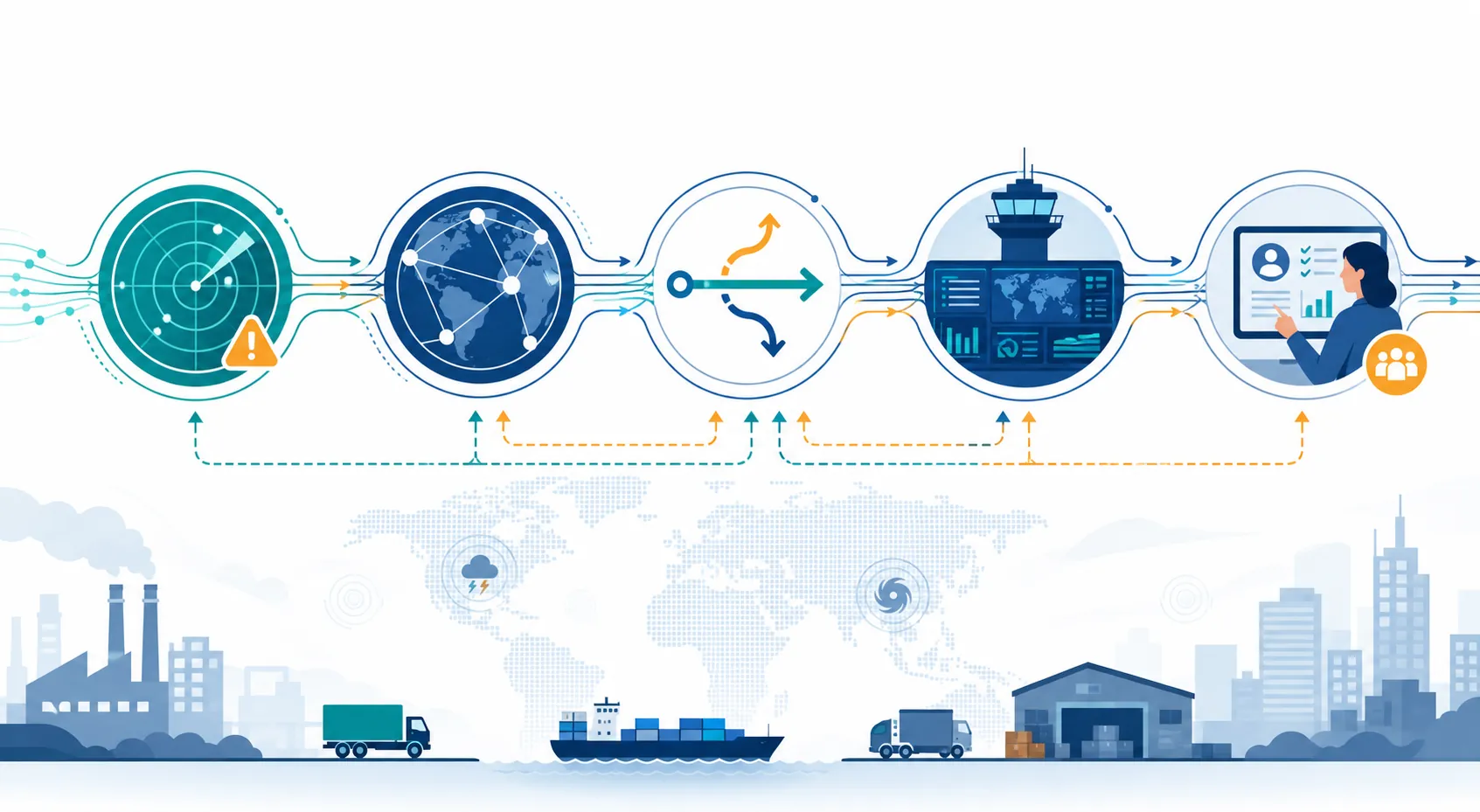
Most companies cannot respond well to a disruption they cannot locate. That is why supplier network mapping sits directly after early detection in the preparedness timeline. A forecasted flood, power outage, cyberattack, or border closure only becomes operationally useful when the company knows which suppliers, sub-tier suppliers, materials, plants, lanes, and customer orders are exposed.
The visibility gap is severe. A GEODIS survey figure summarized in supply chain AI statistics found that only 6% of businesses had achieved full end-to-end supply chain visibility.[1] That number explains why so many crisis calls begin with basic discovery: which components come from the affected region, who owns the supplier relationship, whether an alternate has been qualified, and whether the inventory record is current enough to trust.
AI-powered network mapping tools are useful because they can connect internal supplier master data with shipment records, public risk information, corporate ownership links, facility locations, and external event feeds. The result is not perfect transparency. It is a better map of where the unknowns are concentrated. In a disruption, that can be enough to prioritize the first twenty calls instead of spending the first day building a spreadsheet from memory.
This is also where risk scoring earns its keep, provided it is not treated as a decorative heat map. A useful score separates different types of exposure: single-source dependency, regional concentration, financial distress, climate hazard, logistics fragility, quality history, and substitution difficulty. Those dimensions do not all imply the same response. A financially weak supplier may need commercial intervention. A flood-exposed supplier may need inventory pre-positioning. A sole-source component may need executive approval for redesign or qualification spending long before any specific disaster arrives.
Demand Sensing and Rerouting Decide Whether the Warning Pays Off
Once exposure is known, the next question is movement. Can the company change the plan quickly enough to protect service, margin, or recovery time? This is where real-time demand sensing and logistics rerouting become part of disaster preparedness rather than ordinary planning optimization.
Demand sensing matters because disasters distort both supply and demand. A storm can reduce regional demand for some products while increasing demand for repair parts, medical supplies, emergency goods, or replacement inventory. A geopolitical event can trigger customer over-ordering. A supplier outage can create artificial scarcity that makes the historical forecast misleading. AI models that ingest orders, point-of-sale signals, inventory movements, external events, and customer behavior can help planners distinguish a durable demand shift from panic noise.
Rerouting is where the operational pressure becomes visible. A traditional response may wait for a delayed shipment notice, then escalate through transportation, procurement, customer service, and finance. AI-integrated supply chains have been reported to respond 30% to 40% faster to disruptions than traditional models, according to analysis cited in the Georgetown Journal of International Affairs.[5] The value is not that the model is clever in isolation. The value is that route options, cost trade-offs, service commitments, and constraints can be evaluated while action is still possible.
The decision still has to be owned. If an AI system recommends shifting freight from ocean to air, someone must know the margin threshold, customer priority rule, carbon or compliance constraint, and approval path. If it recommends using a backup carrier, transportation needs to know whether rates, insurance, and capacity are already contracted. If it recommends allocating scarce supply, sales and operations need a rule stronger than whoever escalates first.
SAP has reported that AI agents can cut supplier onboarding time by up to 50%, reduce unplanned outages by 30%, and reduce lead times by 25%.[6] Those figures point to the benefit of embedding AI into workflow rather than leaving it as analysis outside the system of record. Faster onboarding only protects resilience if compliance, quality, finance, and master data steps are actually connected. Shorter lead times only matter in a disaster if planners trust the promise dates enough to change customer commitments.
Control Towers Are Useful When They Control Something
The phrase “control tower” has been stretched by software marketing, but the underlying need is real. During a disruption, planning teams need a shared operating picture that joins ERP, transportation management, warehouse management, supplier data, order commitments, inventory, and external risk feeds. Without that integration, each function optimizes its own fragment while the overall response drifts.
A cognitive control tower improves preparedness when it does three things at once: detects a material change, translates that change into business impact, and pushes a recommended action into a workflow where the right person can approve, reject, or modify it. The control tower should not merely show that a lane is at risk. It should show which orders are affected, which inventory can be redeployed, which carrier alternatives are available, what service promises are endangered, and who has decision rights.
Agentic AI adds another layer. Instead of waiting for a planner to query a dashboard, an agent can monitor exceptions, assemble options, trigger supplier outreach, reserve capacity within approved limits, or draft escalation messages. Gartner has projected that 15% of daily logistics decisions will be made autonomously by AI agents by 2028, a forecast cited in supply chain AI research summaries.[1] That is plausible enough to plan for and risky enough to govern carefully.
Autonomy should be narrow before it is broad. A freight agent might be allowed to rebook within a preapproved cost band when service risk exceeds a threshold. A supplier agent might request updated capacity confirmations from alternate suppliers but require human approval before issuing purchase orders. A customer allocation agent might generate options but leave final prioritization to an executive S&OP or crisis team. These boundaries are not bureaucracy. They are how a company prevents a fast system from making a bad decision faster.
| Disaster timeline moment | AI capability | Decision it improves | Condition required |
|---|---|---|---|
| Before impact | Predictive analytics | Pull forward, pre-position, qualify alternatives | Reliable external feeds connected to internal orders and assets |
| Exposure assessment | Supplier network mapping | Prioritize suppliers, materials, and customer commitments | Multi-tier visibility and current supplier master data |
| Active disruption | Demand sensing and rerouting | Allocate inventory, shift modes, change routes | Predefined cost, service, and approval rules |
| Coordinated response | Cognitive control tower and agents | Trigger workflows and synchronize functions | ERP, TMS, WMS, supplier, and risk data integration |
| Recovery and learning | Human-in-the-loop governance | Adjust playbooks, thresholds, and model permissions | Clear ownership and post-event review discipline |
The Strategy Gap Is an Operating Risk
The strongest case for AI in supply chain resilience is also the best argument against casual adoption. The tools can now influence real decisions across the disaster timeline. That makes weak governance more dangerous, not less.
A formal AI strategy is not a slide that says the company will use predictive analytics. It defines which disruption decisions AI may support, which systems must be integrated, which data owners are accountable, which thresholds trigger escalation, which decisions can be automated, which require approval, and how model performance is reviewed after an event. Without those rules, AI becomes another source of alerts in an already noisy room.
The readiness problems are not abstract. Gartner-related 2025 figures summarized in supply chain AI adoption research indicate that 90% of supply chain leaders say their companies lack the talent and skills needed to achieve digitization goals.[1] Separately, 57% of manufacturing leaders identify data quality as their top barrier to AI adoption.[1] These are not side issues. Talent and data quality determine whether an early warning becomes a planned intervention or a disputed chart.
The purchasing signal is also noisy. ABI Research found that 65% of supply chain professionals consider AI or generative AI capabilities important or very important in technology purchase decisions, based on a 2025 survey of 490 professionals.[7] That shows AI is influencing buying criteria. It does not prove that buyers have the data architecture, operating model, or escalation discipline to use those capabilities in a crisis.
This is the recurring failure mode: adoption is treated as preparedness. A company buys a risk platform, connects a portion of its supplier base, pilots a forecasting model, and announces an AI-enabled resilience program. Then the next disruption hits, and the response still depends on manual extracts, regional knowledge, email chains, and conference calls because no one resolved who had authority to override the plan.
What a Deployable AI Preparedness System Looks Like
The deployable version is less glamorous than the demo. It starts with a short list of disruption decisions the company actually needs to improve: reroute freight, approve premium transportation, qualify alternate suppliers, allocate constrained inventory, move safety stock, change production sequence, or notify customers. AI capabilities should be mapped to those decisions, not collected as features.
- Define the decision window: whether the model must give days, hours, or minutes of usable lead time.
- Name the decision owner: the planner, transportation manager, procurement lead, risk officer, or executive team that can act.
- Connect the required systems: ERP, TMS, WMS, supplier data, inventory, customer commitments, and external risk feeds.
- Set escalation thresholds: cost bands, service-risk levels, geographic exposure, revenue impact, and customer priority rules.
- Review outcomes after the event: which alerts arrived early, which were ignored, which actions worked, and which permissions were too narrow or too loose.
This is also where digital twins and scenario planning can be useful, especially for companies facing climate, geopolitical, or route concentration risk. A scenario model can test what happens if a port closes, a supplier region floods, a commodity route is interrupted, or demand shifts abruptly. But the model is only as useful as the response options it can test. For scenario planning around route and commodity shocks, the practical issue is not whether AI can generate scenarios; it is whether the organization has credible alternatives to compare.
The World Economic Forum has argued that AI can help protect global supply chains from the next major shock, particularly by improving visibility, prediction, and coordination.[8] That is a reasonable direction of travel. It should not be read as a promise that AI insulates a company from disruption. The better claim is narrower and more useful: AI can improve the timing and quality of preparedness decisions when the surrounding operating system is ready for it.
The 2026 Test
There are credible performance signals. McKinsey figures cited in supply chain AI analysis report that AI-enabled supply chains can reduce logistics costs by 15%, improve inventory levels by 35%, and enhance service levels by 65%.[5] Those outcomes explain why boards and operating teams are paying attention. They also raise the standard for implementation. If the organization wants resilience results, it has to manage AI as a decision system, not a procurement category.
For 2026, the real bottleneck in AI supply chain disaster preparedness is no longer mainly whether models can see useful patterns. In many domains, they can. The bottleneck is whether companies can formalize strategy, integrate the data, assign decision rights, govern automation, and rehearse human-machine response before the next disruption arrives. The next crisis will not care that 94% planned to adopt AI. It will expose the 23% question: whether there was a working strategy when the alert came in.
References
- Supply Chain AI Statistics: 18+ Statistics You Should Know for 2026 — Open Sky Group
- Supply chain trends in 2026: A continuation of complexity and risk — Marsh
- How AI Is Changing Our Approach to Disasters — RAND, August 2025
- Artificial Intelligence's Role in Supply Chain Risk Management — Everstream Analytics
- The Role of AI in Developing Resilient Supply Chains — Georgetown Journal of International Affairs
- Blueprint for Supply Chain Resilience in 2026 — SAP News, February 2026
- Supply Chain Disruptions 2026: How to Build Resilience with AI and Automation — ABI Research
- AI will protect global supply chains from the next major shock — World Economic Forum, January 2025
Comments
Join the discussion with an anonymous comment.