
Sundar Pichai's most important AI comment this year was not that Alphabet plans to spend somewhere around $180 billion to $190 billion on capital expenditures in 2026. It was the operational admission attached to it: Google Cloud revenue "would have been higher" if the company had more compute capacity, and the limits he named were "power, land, supply chain constraints."[1][2]
That is a different kind of AI story. Demand is not the immediate problem. Capital access is not the immediate problem. The bottleneck has moved into the parts of the system that large industrial programs always have to confront: substations, long-term power contracts, construction calendars, equipment queues, chip commitments, utility interconnections, and permitting sequences.
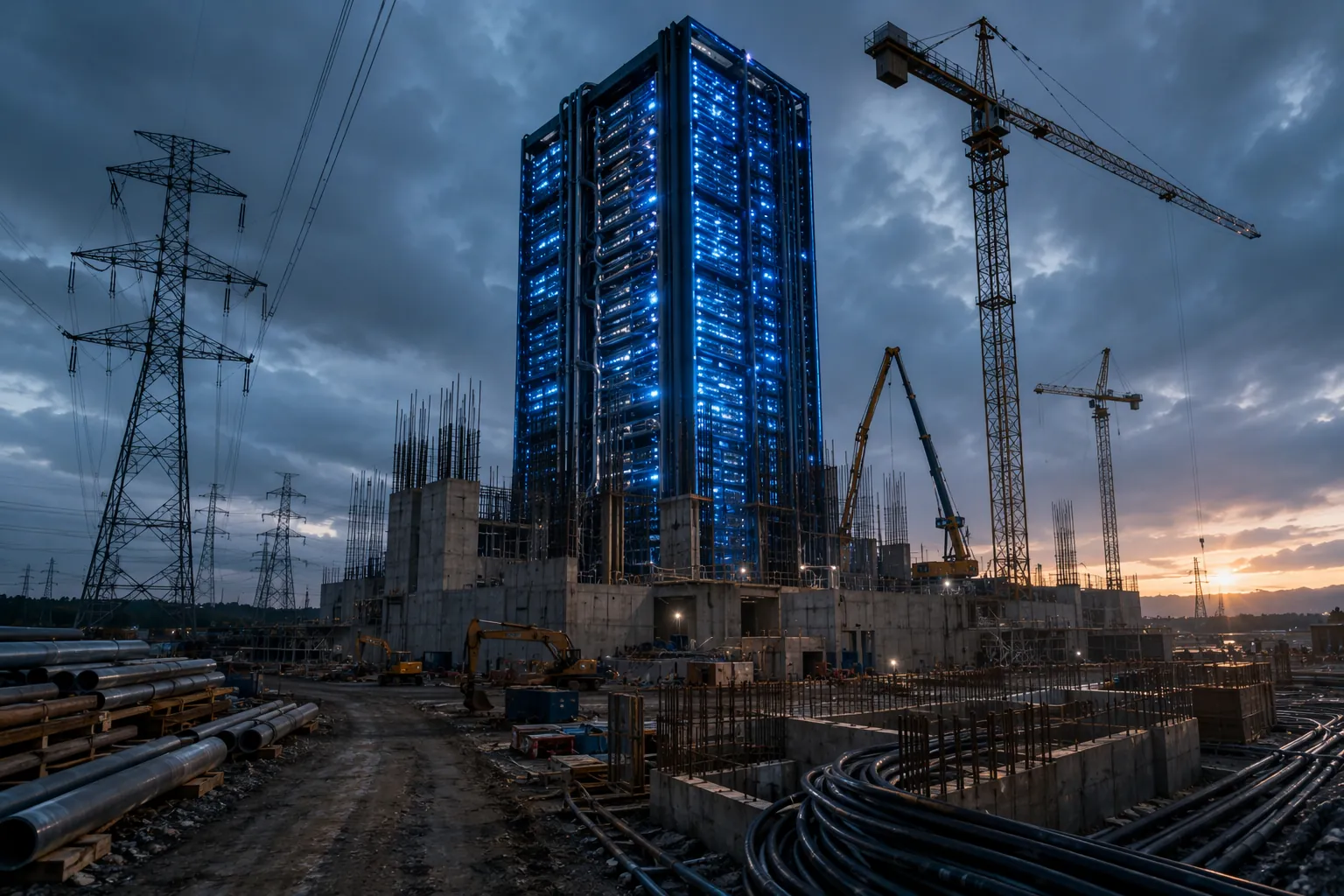
The spending number still matters because of its scale. Alphabet's 2026 capital expenditure guidance of $180 billion to $190 billion is nearly double the company's 2025 capex of $91.4 billion, while Google Cloud backlog has been reported at $460 billion.[1][2] If the midpoint lands, the program sits in the range of what reporting has described as the largest corporate capital program in history.[1][2]
But treating that figure as if it automatically becomes usable AI capacity is the mistake. A corporate budget can authorize demand on the supply base. It cannot make grid transmission appear on a software release cycle, cannot pour cured concrete before a site is ready, and cannot conjure advanced chips outside the cadence of wafer starts, packaging capacity, and committed supply.
For readers who want the capital-allocation version of the Alphabet thesis, ChainSignal has covered that adjacent angle in What Berkshire's $30B Alphabet Bet Means for AI Supply Chain Stocks. The more useful question here is what has to physically happen before Google's AI spending becomes capacity customers can actually use.
The bottleneck stack underneath Google's AI spending
Google's AI buildout is often described as infrastructure spending, but that phrase is too smooth. The work is a stacked supply chain. Each layer has its own lead times, constraints, and failure modes.
| Layer | What Google needs | Why it can bind capacity |
|---|---|---|
| Power | Long-term energy procurement, grid access, substations, transmission availability | Electricity supply and interconnection timing can limit whether a completed facility can operate at planned load |
| Land and construction | Sites, permits, concrete, steel, electrical systems, cooling, crews | Data centers can take 18 to 24 months to build, before accounting for wider grid timelines |
| Chips and hardware | TPUs, GPUs, networking gear, memory, servers, racks, thermal systems | Compute capacity depends on upstream semiconductor and equipment commitments, not just purchase intent |
| Operations | Commissioning, reliability engineering, staffing, customer allocation | Revenue arrives only when capacity is installed, powered, tested, and made available |
That stack explains why Pichai's comment lands less like an earnings footnote than an operations confession. A sales organization can book cloud demand faster than a utility can energize new load. A model team can create demand for inference capacity faster than a construction manager can deliver a campus. A procurement team can sign commitments before the physical system can absorb them.
The demand curve is running faster than the build curve
The sharpest mismatch is timing. Data center construction is described in the research record for this buildout as an 18- to 24-month process, while grid transmission timelines can run 5 to 10 years.[1][2] That gap is not a rounding error. It is the difference between a company expanding capacity on a technology product cycle and the electrical system expanding on an infrastructure cycle.
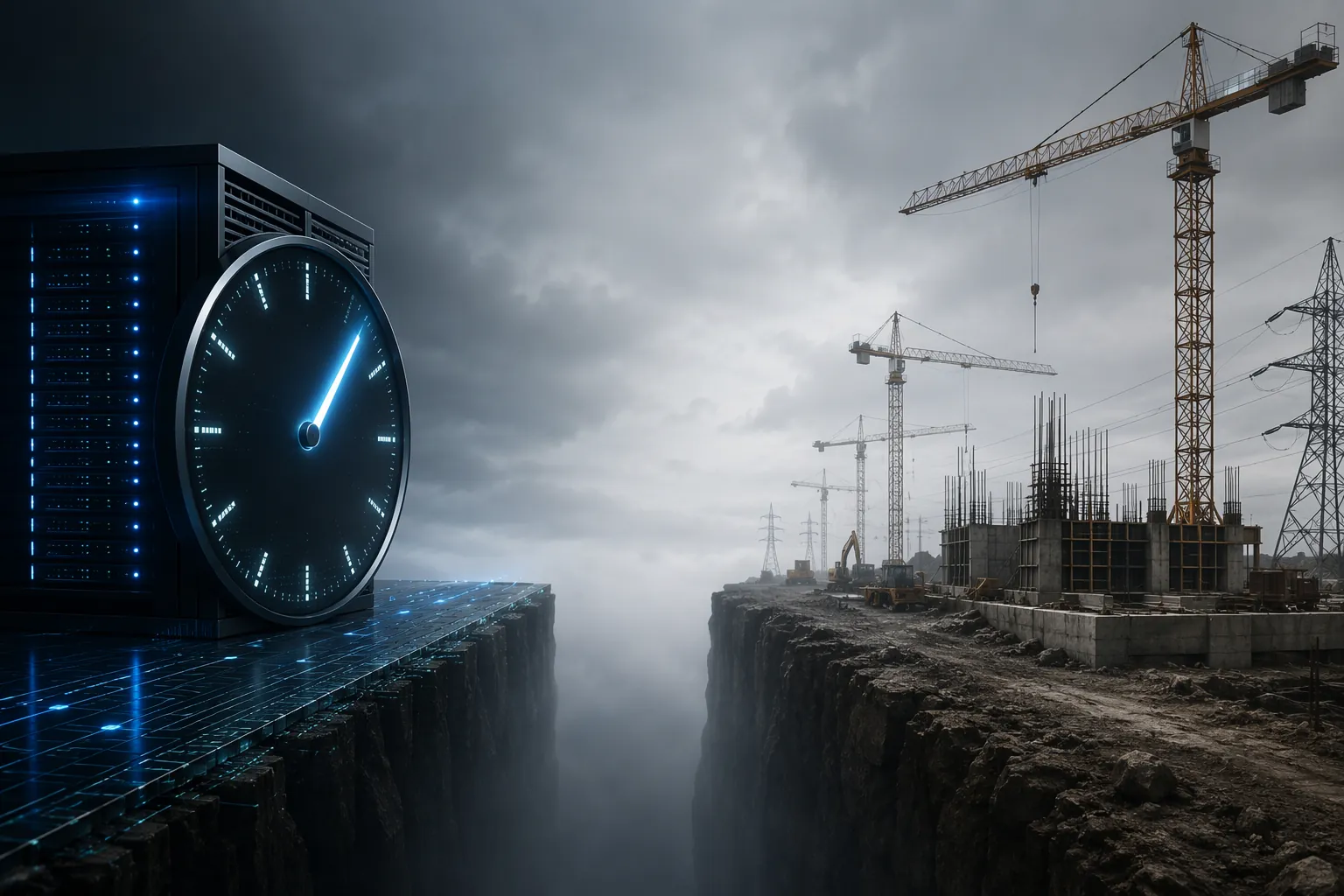
The pressure on that system is visible in the reported internal target attributed to Google Cloud infrastructure chief Amin Vahdat: Google needed to "double capacity every 6 months." CNBC referenced the memo in February 2026 reporting, after originally reporting it in November 2025.[1] The original memo sourcing deserves verification, but the operating implication is clear enough: the demand signal being sent to infrastructure teams is not incremental.
A six-month doubling cadence is brutal when the dependent assets are measured in years. Even if a data center building can be delivered in the 18- to 24-month window, the site still has to line up power, cooling, switchgear, transformers, networking, chips, and commissioning. The longest item in the chain governs throughput. If the grid connection or transmission upgrade is late, a building shell does not solve the revenue problem.
This is why AI infrastructure is becoming familiar terrain for supply chain leaders. The constraint is not a single supplier shortage in the usual sense. It is a sequencing problem across assets that mature at different speeds. Software demand arrives continuously. Capital can be approved quarterly. Construction might be planned over multiple years. Transmission can require a decade-scale horizon. The system does not move at the speed of its fastest component.
Why more money helps, but does not erase the calendar
Money can secure options earlier. It can reserve supplier capacity, support parallel site development, pre-buy equipment, and make a customer more attractive to utilities and developers. It can also create strain. When a hyperscaler tries to buy power, chips, land, construction labor, and electrical equipment at once, the program becomes exposed to the same upstream queues that affect factories, warehouses, ports, and industrial plants.
That is the part hidden by the phrase "AI investment." The investment is not a monolithic act. It is a set of purchase orders, power agreements, site decisions, engineering reviews, chip allocations, and interconnection processes. Every one of those has an owner waiting on someone else.
Power is no longer a back-office procurement category
Google's power procurement makes the constraint visible. In Malaysia, Google and TotalEnergies signed a 21-year power purchase agreement tied to 1 TWh of renewable electricity from TotalEnergies' Corporate Green Power Programme solar plant.[3] The details matter because they show the kind of input Google is trying to lock up before it is needed: long-duration energy supply connected to a specific regional growth plan.
The same logic sits behind nuclear arrangements involving Kairos Power and the Tennessee Valley Authority, which have been reported as part of Google's effort to secure firm, low-carbon power for data center load.[3] These are not public-relations side quests. They are procurement moves for a world in which electricity availability can determine whether expensive compute assets can be monetized.
For a conventional enterprise buyer, energy may sit several layers away from the software budget. In Google's AI buildout, it moves into the critical path. A cloud customer does not care whether the limiting factor is an unbuilt transmission line, a delayed substation, or a power contract that has not yet begun delivery. The commercial effect is the same: demand exists, but capacity cannot be served.
Chips are a capacity plan, not just a component order
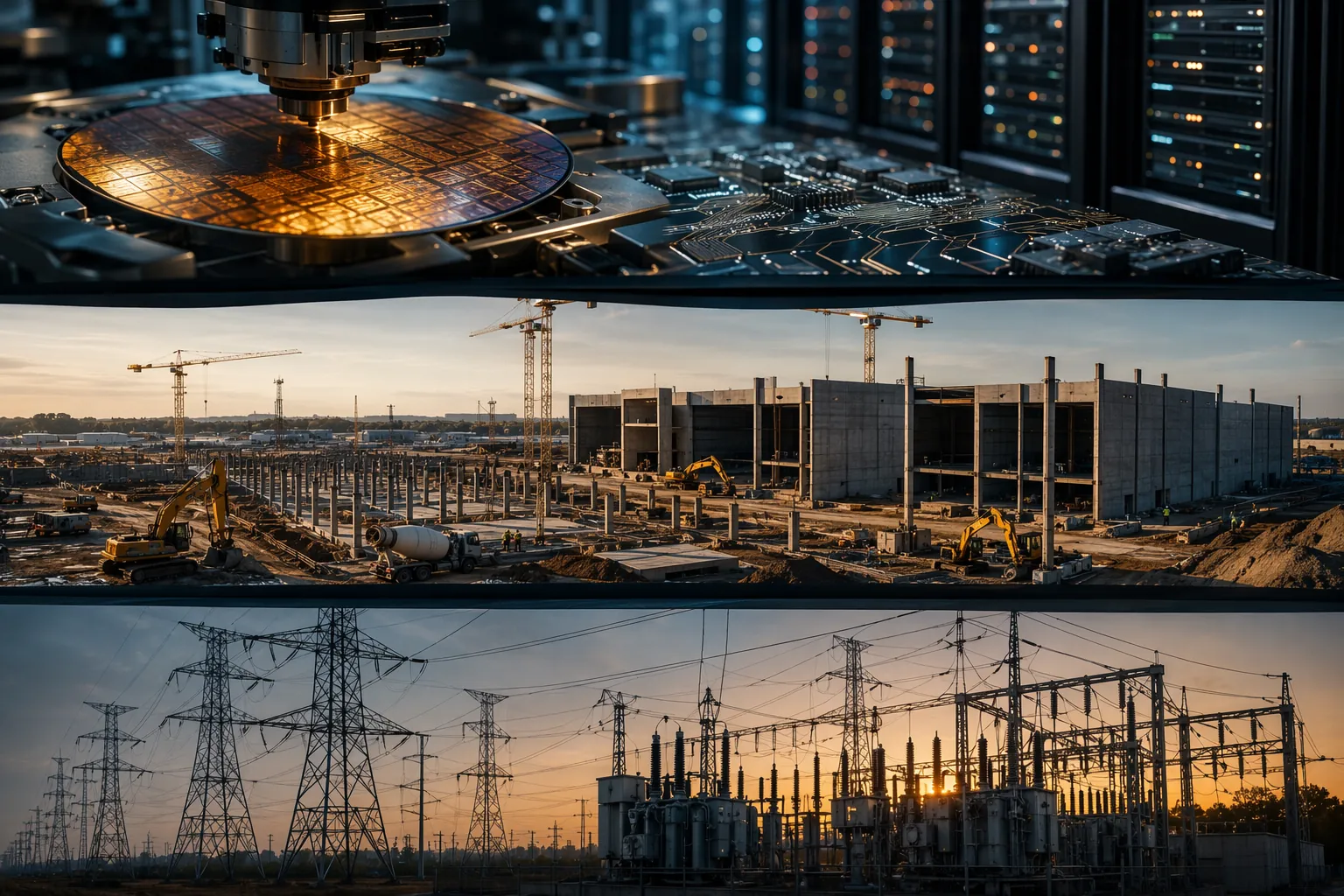
The chip layer has the same character. Google's TPU v7 Ironwood supply plan reportedly includes commitments of about 1 million chips for 2026.[1][2] That number should not be read only as a technology milestone. It is a supply chain commitment against future cloud capacity, with dependencies upstream in fabrication, packaging, testing, server integration, networking, and deployment.
Owning a custom accelerator strategy gives Google more control than a buyer relying entirely on merchant GPUs. It does not remove the industrial base underneath the chip. Wafer capacity, advanced packaging, memory supply, substrates, test equipment, and assembly flows still determine how quickly silicon becomes installed compute. A committed chip volume is a prerequisite for capacity, not capacity itself.
That distinction matters for supply chain executives watching AI adoption inside their own companies. Procurement of AI tools is often discussed as if software subscriptions are the scarce item. At hyperscaler scale, the scarce item is frequently the physical ability to host the workload. The software contract is downstream of a long queue of industrial inputs.
The backlog shows demand pressing against the constraint
The reported $460 billion Google Cloud backlog gives the constraint context.[1][2] Backlog is not the same thing as recognized revenue, and it should not be treated as a clean measure of unmet AI demand alone. It does, however, indicate that customer commitments are large enough for capacity availability to become a front-line commercial issue.
That is why Pichai's "would have been higher" comment matters. It narrows the problem. Google is not saying merely that AI demand might someday justify more infrastructure. It is saying current cloud growth has already been held below what demand could support because the required compute capacity was not available.[1][2]
There is a useful discipline in keeping that conclusion narrow. The evidence does not prove every AI workload is profitable, every customer commitment will convert as expected, or every dollar of capex will earn an adequate return. It does show that, at Google's scale, the limiting variable has shifted into capacity execution.
Why supply chain leaders should care
The immediate lesson is not that every company should copy Google's AI spending. Almost no one can. The lesson is that AI programs, once they become operationally serious, stop being abstract technology bets and start behaving like capacity programs.
That matters for companies adopting AI inside supply chain planning, procurement, logistics, manufacturing, and customer operations. Market-sizing estimates for AI in supply chain vary by definition, but one cited Precedence Research scope places the market at about $9.94 billion in 2025 and projects it to reach $236 billion by 2035, a 37.3% CAGR.[4] Those numbers describe adoption opportunity, not guaranteed effectiveness. The operational question is still whether the compute, data, integration capacity, governance, and process ownership exist to turn adoption into usable throughput.
Google's buildout is simply the extreme version of a pattern many operators already recognize. The executive decision is fast. The physical system is slower. The supplier base has its own constraints. The site team has its own calendar. The utility has its own queue. The revenue plan assumes all of them converge.
- If power is the constraint, the capacity plan needs energy sourcing and interconnection work early, not after the technical architecture is chosen.
- If construction is the constraint, capital approval is only the start of the schedule, not the schedule itself.
- If chips are the constraint, supplier commitments have to be read alongside fabrication, packaging, and integration lead times.
- If demand is growing faster than infrastructure, allocation decisions become commercial decisions, not just engineering decisions.
The number may move; the constraint does not disappear
Some figures around Google's 2026 program should be handled carefully. The $180 billion to $190 billion capex range is guidance, not a final reported 2026 result.[1][2] The reported $80 billion in equity raises comes from secondary analysis rather than a primary filing reviewed here.[5] The "double capacity every 6 months" memo was referenced by CNBC in February 2026 after earlier reporting, and the original memo should be verified before being treated as a primary document.[1] Market-sizing estimates for AI in supply chain also vary depending on scope definitions.[4]
Those uncertainties do not weaken the central operational point. Google's AI spending is being governed by the same forces that govern other large capacity programs: supplier lead times, utility infrastructure, permitting, land, construction sequencing, power procurement, and hardware availability. The remarkable part is not that an advanced AI company has escaped those constraints. It is that the company with extraordinary demand, capital access, and technical ambition is still bound by them.
References
- Alphabet resets the bar for AI infrastructure spending, CNBC, https://www.cnbc.com/2026/02/04/alphabet-resets-the-bar-for-ai-infrastructure-spending.html
- Alphabet plans record $185 billion AI spending—but CEO says it still won't be enough, Fortune, https://fortune.com/2026/02/04/alphabet-google-ai-spending-supply-constraints/
- How Google and TotalEnergies Power the AI Supply Chain, SupplyChainDigital, https://supplychaindigital.com/news/google-totalenergies-power-ai-supply-chain
- Supply Chain AI Statistics: 18+ Statistics You Should Know for 2026, OpenSky Group, https://openskygroup.com/supply-chain-ai-statistics/
- Google AI Infrastructure Spend 2026: $185B Capex, TPU v7, and the Gemini Cloud Bet, ValueAddVC, https://valueaddvc.com/blog/google-ai-infrastructure-spend-2026-185b-capex-tpu-v7-and-the-gemini-cloud-bet
Comments
Join the discussion with an anonymous comment.