
Alphabet’s 2026 capital spending guidance landed less like a budget update than a purchasing signal to every supplier sitting upstream of AI infrastructure. On its Feb. 4, 2026 earnings call, the company guided for $175 billion to $185 billion in capex for 2026, roughly twice its $91.4 billion in 2025 spending and more than three times its $52.5 billion in 2024 spending. About 60% is expected to go to servers, with the remaining 40% directed to data centers and networking, and CEO Sundar Pichai said Google expects to be “supply constrained” through all of 2026.[1][2]
That last phrase matters more than the headline number. A buyer of Google’s size can prepay, reserve, dual-source, redesign, and still not turn dollars into capacity at will. The practical question is therefore not whether Google can afford the buildout. It is which physical queues get longer when one hyperscaler doubles infrastructure spending and still cannot get everything it wants.

The squeeze does not stop at AI accelerators. It moves outward from advanced packaging to high-bandwidth memory, then into substations, transformers, utility interconnects, and the ordinary component markets used by hardware companies that never planned to compete with hyperscalers. Capacity, in this market, is not a single noun. It is a stack of reservations.
Server Dollars First Hit the Packaging Queue
The first hard chokepoint is not the data center shell or the finished server rack. It is advanced semiconductor packaging, especially TSMC’s CoWoS process, which is used to integrate accelerators with high-bandwidth memory close enough to feed AI workloads. CoWoS capacity has become one of the most contested manufacturing slots in the AI supply chain because the package is where compute silicon and memory bandwidth become a usable accelerator.
Reportedly, Google cut its 2026 TPU production target from 4 million units to 3 million units because of CoWoS limits, and it has explored Intel’s EMIB-T packaging for ninth-generation TPUs as a possible dual-source hedge.[3][4] The reporting on that cut depends on unnamed sourcing, and some related CoWoS coverage is not fully visible without a paywall, so it should be treated as a constraint signal rather than a settled production ledger. Still, the direction is consistent with the larger procurement reality: even internal silicon programs remain exposed to outsourced packaging capacity.

This is where the phrase “AI capex” starts to obscure more than it explains. A server allocation is not secured when the budget is approved. The buyer needs wafers, substrates, interposers, HBM stacks, test capacity, board capacity, integration slots, racks, and power. CoWoS is painful because it sits early enough in the chain to delay everything after it, but specialized enough that normal server supply cannot simply absorb the demand.
For non-Google buyers, the effect is not necessarily that they lose the exact same TPU package slot. Many will never buy TPUs. The effect is that the same advanced packaging ecosystem is being scheduled around hyperscaler demand and top-tier accelerator road maps. AI chip vendors, cloud platforms, and large customers negotiate around limited output first. Smaller programs then face narrower windows, less flexibility, and fewer credible promises from suppliers.
HBM Turns Compute Demand Into a Memory Allocation Problem
Once packaging capacity is reserved, the next constraint is memory. AI accelerators need high-bandwidth memory because model training and inference are often limited not only by the number of operations a chip can perform, but by how fast data can be moved into and out of the compute units. That makes HBM less like an optional premium component and more like a gatekeeper for useful AI server capacity.
Mission Cloud reports that AI data centers are consuming about 70% of global memory output, and that HBM capacity is sold out through at least the end of 2026.[5] Bank of America estimates cited by Quasa project the HBM market at $54.6 billion in 2026, up 58% year over year, with SK Hynix holding roughly 50% to 62% market share.[6] Those figures describe adoption and allocation pressure, not guaranteed application performance. The important procurement point is simpler: the highest-value AI buyers are pulling memory manufacturing decisions toward HBM.
That shift has a displacement effect. Manufacturing one bit of HBM can displace multiple bits of conventional DRAM, according to Mission Cloud’s summary of the supply dynamic.[5] A memory maker that expands HBM exposure is not just adding a product line; it is changing the opportunity cost of capacity that might otherwise support PCs, phones, embedded systems, networking equipment, or industrial hardware.
The consequences show up in uncomfortable places. A procurement director buying industrial controllers may not have an HBM line item, but the supplier base behind that controller is still watching DRAM, NAND, substrates, and related component pricing. When hyperscalers reserve advanced memory output far ahead of shipment, smaller buyers are left negotiating over what is still available, at what premium, and with what lead-time caveats.
| Layer | What Is Constrained | Who Feels It Outside Google |
|---|---|---|
| Advanced packaging | CoWoS and comparable high-end integration capacity | AI chip vendors, cloud competitors, accelerator startups, server integrators |
| Memory | HBM output and the manufacturing capacity it pulls away from conventional DRAM | PC, device, embedded, networking, and industrial hardware buyers |
| Electrical infrastructure | Transformers, substations, interconnects, and related grid equipment | Utilities, campuses, factories, logistics parks, manufacturers, and municipalities |
| General components | Parts exposed to AI-driven allocation and pricing pressure | Small hardware makers and consumer electronics manufacturers |
The Bottleneck Leaves the Server Room at the Substation
Packaging and HBM explain why server dollars do not instantly become server capacity. Power equipment explains why the buildout becomes a multi-year local infrastructure problem. Data centers need enormous electrical service, and that demand lands on a grid supply chain that was already dealing with aging infrastructure, electrification, renewable interconnection, and manufacturing capacity limits.
By the first quarter of 2026, transformer lead times had exceeded 160 weeks, up from about 52 weeks in 2020–21, according to Reuters reporting that cites Wood Mackenzie. Utilities are now ordering some equipment five years ahead, and transformer costs are rising 4% to 10% annually.[7] These are not software-cycle lead times. They are capital equipment lead times, and they force every serious power user to make decisions years before the load arrives.
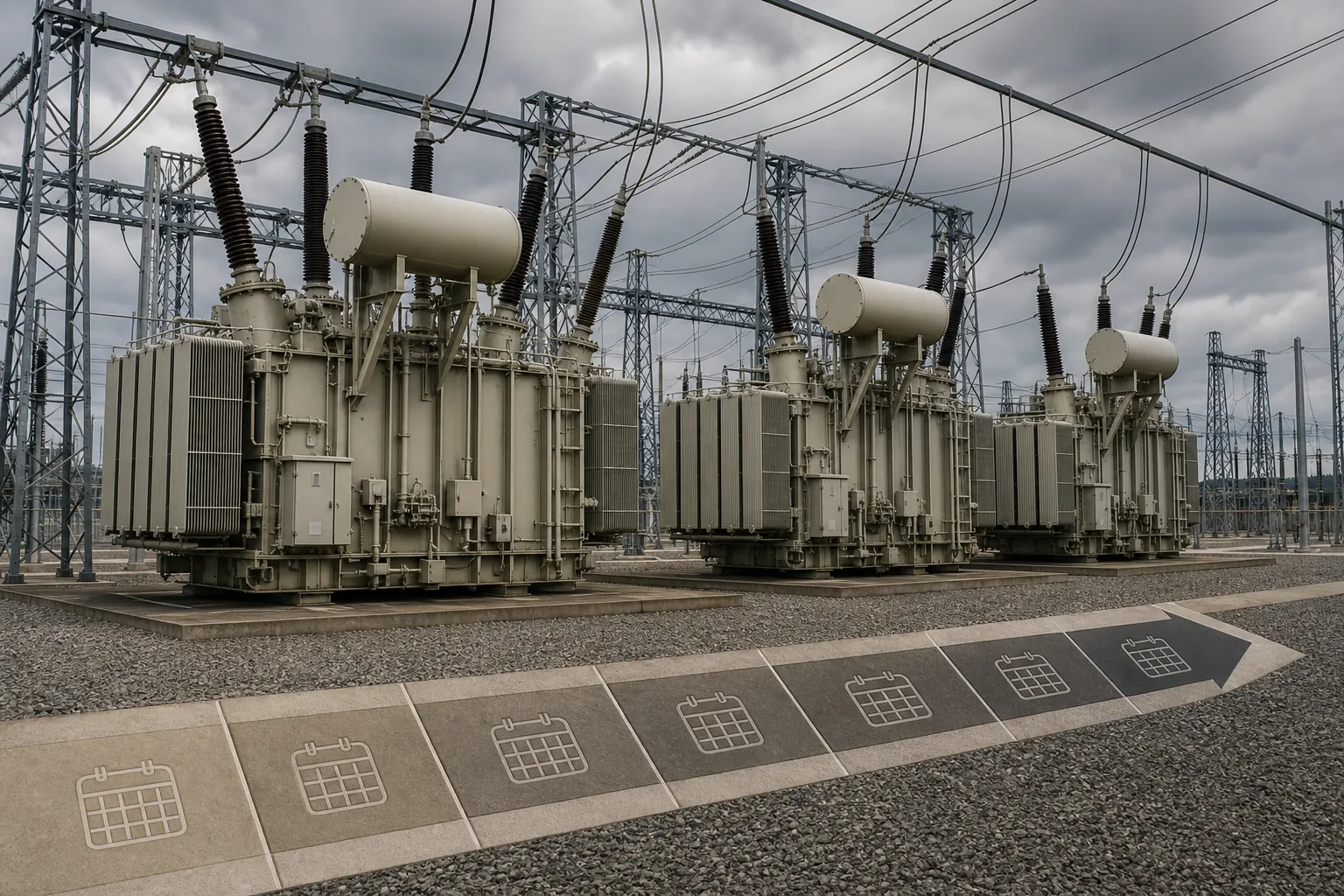
Wood Mackenzie’s scenario work, as reported by Reuters, suggests data centers’ share of the U.S. electrical equipment market could rise from less than 2% in 2020 to 40% under accelerated scenarios.[7] That is a scenario, not a settled outcome. But even as a scenario, it is useful because it tells procurement teams what kind of buyer they may be standing next to in the allocation queue: not another plant expansion of similar scale, but a sector willing to reserve power infrastructure as a strategic input to compute growth.
The transformer problem is where the AI buildout stops being a semiconductor story. A factory waiting on a substation upgrade, a logistics park seeking new service, a hospital campus planning backup capacity, or a utility trying to harden its distribution network can all be affected by the same equipment market. They are not competing with Google for TPUs. They may be competing with Google, Microsoft, Amazon, Meta, AI labs, and colocation developers for transformers, switchgear, breakers, engineering attention, and interconnection priority.
This is also the layer where substitution becomes hardest. A buyer can sometimes redesign a board around a different component. A cloud platform can explore an alternate packaging technology. A memory supplier can shift investment toward HBM, though not instantly. But high-voltage electrical equipment has qualification, safety, permitting, transportation, and utility-approval constraints. If the transformer slot is missed, the remedy is rarely a quick spot buy.
Spillover Is Already Showing Up in Smaller Hardware Markets
The clearest supply-chain signals usually appear first in specialized markets, but the pain does not stay there. Mission Cloud reported that Raspberry Pi’s CEO said some component costs had “more than doubled over the last quarter,” contributing to price increases of $30 to $60 per unit, and attributed the pressure to hyperscaler AI demand.[5] The same source also points to margin pressure at Apple from AI-driven memory costs.[5]
Those examples should not be overread. The Raspberry Pi and Apple links to AI demand are not proven in the same way as a company’s own capex guidance or a reported transformer lead-time dataset. They are still useful because they show how the economics can migrate. A hyperscaler does not need to buy the exact component used in a small board computer to change the pricing environment around wafers, memory, substrates, and supplier priorities.
For smaller hardware makers, the operational problem is not only price. It is the collapse of slack. A part that used to be available with manageable lead time becomes quote-dependent. A supplier that used to hold inventory asks for longer commitments. A redesign that once saved cost becomes a way to escape an allocation bottleneck. None of this requires every component shortage to be caused by AI. It only requires enough high-margin AI demand to change how suppliers ration capacity.
Guidance Is Not Actual Spending, but the Constraint Signal Is Hard to Ignore
Alphabet’s $175 billion to $185 billion figure is guidance, not audited 2026 spending. It can be revised. Projects can shift. Vendor deliveries can slip. Capital expenditures can be recognized on a different cadence than procurement commitments. That matters for anyone trying to model quarterly supplier revenue or hyperscaler free cash flow.
For supply chain planning, though, the more important fact is that Google is signaling demand into constrained systems while also acknowledging that it expects to remain supply constrained through the year.[1][2] A rich buyer saying it cannot buy its way out of the queue is not just describing its own execution risk. It is confirming that the queue exists.
That distinction keeps the analysis grounded. The reported TPU cut is a plausible signal, not courtroom-grade proof. HBM market forecasts are estimates, not physical shipment guarantees. Wood Mackenzie’s electrical equipment share is scenario work, not destiny. But the layers point in the same direction: compute demand is outrunning several kinds of capacity at once, and those capacities cannot all be expanded on the same schedule.
Why 2028 Is a Planning Boundary, Not a Magic Relief Date
The duration question is where the temptation to overstate is strongest. Not every shortage will last the same length of time. CoWoS capacity can expand on one schedule, HBM capacity on another, and transformer production on a third. Demand can also change. A model architecture shift, a slowdown in cloud commitments, financing stress, or a utilization surprise could alter the slope of orders.
Still, the available forecasts do not support treating this as a short procurement disturbance. Goldman Sachs’ baseline model projects $7.6 trillion in cumulative AI infrastructure capex between 2026 and 2031, including $765 billion annually in 2026.[8] McKinsey estimates $5.2 trillion in AI data center capex will be needed by 2030.[9] Those are scenario-based forecasts, not purchase orders. Their usefulness is in the duration signal: large buyers are planning infrastructure programs over years, not quarters.
Mission Cloud’s CTO describes “years of this dynamic before supply catches up to demand.”[5] That judgment fits the physical stack better than a clean shortage-ending date. Packaging tools, memory fabs, transformer plants, substations, and utility interconnects do not all come online together. Even when one layer eases, another can keep the final project constrained.
For non-AI industries, the planning implication is uncomfortable but clear. Transformer lead times, memory allocation, packaging bottlenecks, and supplier prioritization should be treated as structural variables through 2028 and beyond, not as temporary noise from a single capex cycle. A procurement plan that assumes normal spot availability may be betting against hyperscaler reservation behavior, utility equipment backlogs, and a multi-year race to convert electricity into compute.
References
- CNBC coverage of Alphabet Q4 2025 earnings, CNBC, Feb. 4, 2026.
- Fortune coverage of Alphabet 2026 capex guidance, Fortune, Feb. 2026.
- Tom’s Hardware report on Google TPU production targets, Tom’s Hardware.
- DigiTimes report on CoWoS constraints and Intel EMIB-T packaging, DigiTimes.
- Mission Cloud analysis of AI infrastructure supply chain constraints, Mission Cloud.
- Quasa summary of Bank of America HBM market estimates, Quasa.
- Reuters report citing Wood Mackenzie on transformer lead times and data center electrical equipment demand, Reuters.
- Goldman Sachs baseline model for cumulative AI infrastructure CapEx, Goldman Sachs.
- McKinsey estimate of AI data center CapEx needs by 2030, McKinsey.
Comments
Join the discussion with an anonymous comment.