
The question behind Alphabet’s AI spending and stock impact is not whether a portfolio manager should buy the dip. For a supply chain technology leader, the harder question is whether Google Cloud has become a safer foundation for AI workloads because Alphabet is spending aggressively, or a riskier one because the spending now carries visible financing strain.
In 2026, both readings are defensible. Alphabet is committing roughly $180 billion to $190 billion to AI infrastructure, about double the $91.4 billion it spent in 2025, with about 60% directed to servers and about 40% to data centers and networking equipment.[1][2] The stock sold off when investors first saw the scale of that plan, rallied when Google Cloud showed unusually strong growth, fell again on dilution concerns, and dropped after a reported Gemini 3.5 Pro delay. At the same time, Google Cloud reported $20 billion in Q1 2026 revenue, up 63% year over year, and a backlog that reached $462 billion.[3][4]

The Stock Is Reacting to Four Different Signals
The market reaction matters because it separates one vague concern — “AI spending is high” — into several different risks. Those risks do not all matter equally to an enterprise buyer.
| 2026 event | Reported stock reaction | What investors saw | What enterprise buyers should test |
|---|---|---|---|
| February capex plan | About -5% | Alphabet reset expectations around AI infrastructure spending | Whether capacity will arrive in time for production AI demand |
| April Q1 earnings | About +7% | Google Cloud growth suggested monetization, not just construction | Whether cloud commitments translate into usable AI services and support |
| June equity raise | About -3.86% | Dilution became part of the AI funding story | Whether supplier financing pressure could affect pricing, terms, or roadmap discipline |
| July Gemini delay report | About -9% | Product timing concerns returned | Whether infrastructure strength is being matched by dependable AI product execution |
The February decline followed Alphabet’s announcement of the $180 billion spending plan.[1] The April rally came after Q1 results showed Google Cloud revenue growth of 63% and a sharply larger backlog.[3][4] The June decline followed reports of an $80 billion equity raise, described as Alphabet’s first major stock sale in roughly two decades.[5][6] The July drop followed Reuters reporting that a Gemini 3.5 Pro delay and spending concerns were weighing on the stock around earnings.[7]
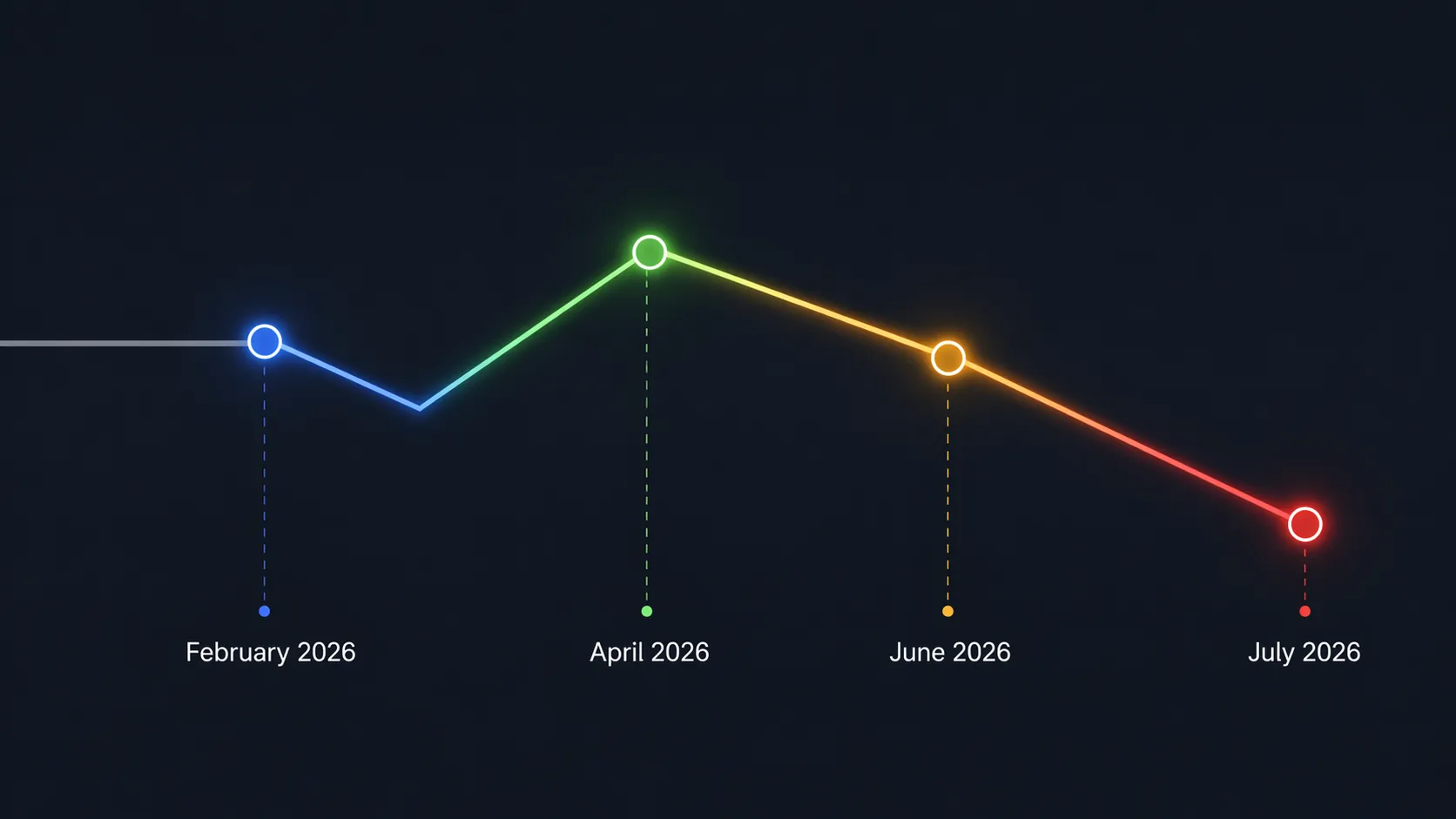
That sequence is why a clean answer is not available yet. The same company is showing real enterprise demand, real technical ambition, real funding pressure, and real product-timing volatility. Treating the stock reaction as simple panic misses the point. Treating it as irrelevant Wall Street noise misses another one.
The Cloud Numbers Are the Strongest Part of the Case
For enterprise platform decisions, Google Cloud’s Q1 performance is the fact that deserves the most weight. A $20 billion quarter with 63% year-over-year growth is not a model demo, a conference keynote, or a promise that capacity will eventually be monetized. It is revenue already showing up in the cloud business.[3][4]
The backlog matters even more for a supply chain reader. A $462 billion backlog, described as nearly doubling quarter over quarter, indicates that customers are committing future spend at a scale that helps explain why Alphabet is not behaving like a company merely chasing an AI narrative.[3][4] Backlog is not the same thing as realized revenue, and it does not prove that every AI workload will be profitable. But it does show that demand is not purely speculative.
That distinction is practical. A retailer building demand sensing on top of cloud data pipelines, a manufacturer testing inventory optimization across plants, or a logistics provider running route-planning experiments does not only need access to a foundation model. These teams need dependable compute, predictable service levels, integration with existing data estates, and a vendor that can keep investing through the long middle period between pilot success and operational dependence.
Alphabet’s spending looks more credible when seen against those commitments. If AI demand keeps moving from experimentation into high-volume inference, capacity is not a cosmetic advantage. It becomes the difference between a platform that can absorb production load and one that rations access, pushes customers into awkward queues, or makes pricing hard to forecast.
Capacity Constraints Are Not Abstract for Supply Chain AI
Alphabet’s own executives have framed the issue in capacity terms. Sundar Pichai cited compute capacity as the company’s biggest concern, AI infrastructure chief Amin Vahdat said Google must double serving capacity every six months, and CFO commentary has described the company as supply-constrained even while ramping.[2][3]
For supply chain AI, that matters because many of the highest-value use cases are not one-off prompts. Demand forecasting and demand sensing may run across many product-location combinations. Inventory optimization can require repeated scenario runs when planners test service levels, lead-time assumptions, or substitution rules. Logistics routing can become inference-heavy when models are used repeatedly against changing constraints rather than occasionally for analysis.
The link between Alphabet’s capex and those supply chain workloads is an analytical interpretation, not a specific Alphabet promise. Still, the direction is hard to ignore: if a cloud provider can bring more AI serving capacity online and lower the unit cost of inference, it improves the odds that supply chain AI can move beyond demonstration environments into recurring operational workflows.
TPUs Make the Bet More Than a Spending Contest
The better version of Alphabet’s AI spending case is not “bigger is better.” It is that Google is spending into a differentiated infrastructure stack, especially custom TPUs. Research cited in the brief indicates that Google’s TPUs can make some AI workloads about 30% cheaper and up to 4x faster than Nvidia equivalents.[8]
That kind of advantage is not equally important for every buyer. It matters most where inference volume is high enough that small unit-cost differences compound, and where latency or throughput affects whether planners actually use the system. A supply chain team running occasional strategic simulations may care more about integration and model governance. A team embedding AI into daily replenishment, allocation, or routing decisions will care much more about recurring inference economics.
This is where Google Cloud’s case can be stronger than a generic cloud-growth story. If TPU economics hold for the relevant workloads, the advantage is not only technical; it changes the operating cost profile of AI systems that must run continuously. That is the line between an impressive pilot and a system that finance, operations, and IT can afford to keep in production.
The Financing Risk Cannot Be Dismissed
The bear case is not just impatience. Reports of an $80 billion equity raise, including a $10 billion private placement from Berkshire Hathaway, changed the debate from operating ambition to funding structure.[5][6] Berkshire’s participation is a meaningful confidence signal, especially because it suggests patient capital is willing to underwrite part of the buildout. It is not the same as proof that the capex cycle will convert into profitable cloud revenue on the timetable enterprise buyers would prefer.
There is also a source-quality caveat. The equity raise and Berkshire placement are reported through financial commentary sources referenced in the brief, not through SEC filings in the provided materials. That does not make the reports unusable, but it does mean they should be treated as reported market information rather than final primary-document evidence.
The cash-flow pressure is more broadly documented. Reuters reported on July 22, 2026, that the AI investment boom is putting Big Tech’s free cash flow under pressure, and that the five hyperscalers could outspend operating cash flow by 2027.[9] In Alphabet’s case, Q1 2026 free cash flow roughly halved while capex more than doubled, according to the research brief’s Reuters-based synthesis.[9]
A supply chain executive cannot wave that away. A cloud provider under sustained cash-flow pressure may still be a superb technical partner, but buyers should assume that pricing discipline, reserved-capacity terms, product prioritization, and regional rollout choices could become more consequential. The risk is not that Google Cloud disappears. The risk is that customers build around a cost and capacity curve that later tightens.
Valuation Gives Some Buffer, Not a Platform Guarantee
Alphabet’s valuation context also keeps the story from becoming a simple AI bubble warning. The research brief cites a P/E of about 28.7 for Alphabet, far below AI software peers such as Palantir at 181x, along with consensus analyst price targets of $413 to $438 versus a current price around $364.[9] That gives Alphabet more valuation buffer than companies priced almost entirely on future AI expansion.
For platform buyers, though, valuation buffer is a secondary comfort. It may reduce the likelihood that the company is being valued on fantasy alone. It does not answer whether a specific supply chain architecture should become deeply dependent on Google-only services, TPU-specific optimizations, or tightly coupled AI tooling that would be expensive to rebalance later.
How to Read the Gemini Delay
The reported Gemini 3.5 Pro delay belongs in the trust equation, but it should not dominate it. Reuters reported on July 21, 2026, that Gemini delay and spending worries were looming over Alphabet’s earnings, and the research brief records a July stock decline of about 9% tied to that concern.[7]
A model delay can matter if a buyer is committing to a roadmap that depends on specific model capabilities arriving on schedule. It matters less if the buyer’s immediate plan is centered on cloud data foundations, model operations, inference cost, and the ability to run a portfolio of models. The useful lesson is not that one product delay invalidates the infrastructure thesis. It is that technical infrastructure confidence should not be allowed to become roadmap certainty.
What This Means for a Google Cloud AI Roadmap
A supply chain AI roadmap should treat Google Cloud as increasingly credible where AI infrastructure economics matter. The evidence is strongest for capacity, enterprise demand, and potential TPU price-performance advantages. It is weaker for assuming that every part of Alphabet’s AI spending will convert smoothly into free cash flow, predictable product timing, or buyer-friendly commercial terms.
That leads to a practical architecture stance rather than a stock verdict:
- Use Google Cloud aggressively for workloads where TPU economics, capacity access, and cloud-native AI tooling create a measurable advantage.
- Avoid making the first production design dependent on a single proprietary path unless the cost savings clearly outweigh future switching and rebalancing costs.
- Negotiate capacity, pricing, and exit flexibility while Alphabet is still converting infrastructure spending into long-term cloud commitments.
- Separate model roadmap bets from infrastructure bets; a delay in one product line should not automatically derail a broader cloud strategy, but it should affect dependency planning.
- Keep multi-cloud patterns viable for data movement, orchestration, and model serving until several more quarters show sustained capex-to-revenue conversion and healthier free cash flow.
The important procurement question is not whether Alphabet’s AI spending is “good” or “bad.” It is who carries the risk if the return curve takes longer than expected. Alphabet can absorb more uncertainty than most vendors, and Google Cloud’s growth suggests the spending is already attached to real demand. A supply chain organization still has to live with the architecture it signs.
Google Cloud now looks more compelling for inference-heavy supply chain AI than it did before this capex cycle became visible. It also deserves more careful contract and architecture design for the same reason. Use the advantages. Do not convert Alphabet’s conviction into single-cloud dependency until the spending shows sustained revenue conversion, cash-flow resilience, and product execution over more than one volatile quarter.
References
- Alphabet stock sinks after Google parent announces $180 billion spending plan for 2026 in massive AI bet — Yahoo Finance, Feb 2026
- Alphabet says capital spending in 2026 could double, cloud business booms — Reuters, Feb 4 2026
- Investors trust Google more than Meta when it comes to spending on AI — CNBC, Apr 29 2026
- Microsoft, Meta, and Google just announced billions more in AI spending—and only Google convinced investors it's paying off — Fortune, Apr 29 2026
- Alphabet's AI Spending Plan Turns Dilution Into the Key Debate — Investing.com, Jun 2026
- Google Broke a 20-Year Funding Habit. How Will Its Stock React? — Yahoo Finance, Jun 2026
- Alphabet's Gemini delay, spending worries loom over earnings — Reuters, Jul 21 2026
- AI Capex 2026: The $690B Infrastructure Sprint — Futurum Group, Feb 2026
- AI investment boom puts Big Tech's free cash flow under pressure — Reuters, Jul 22 2026
Comments
Join the discussion with an anonymous comment.