
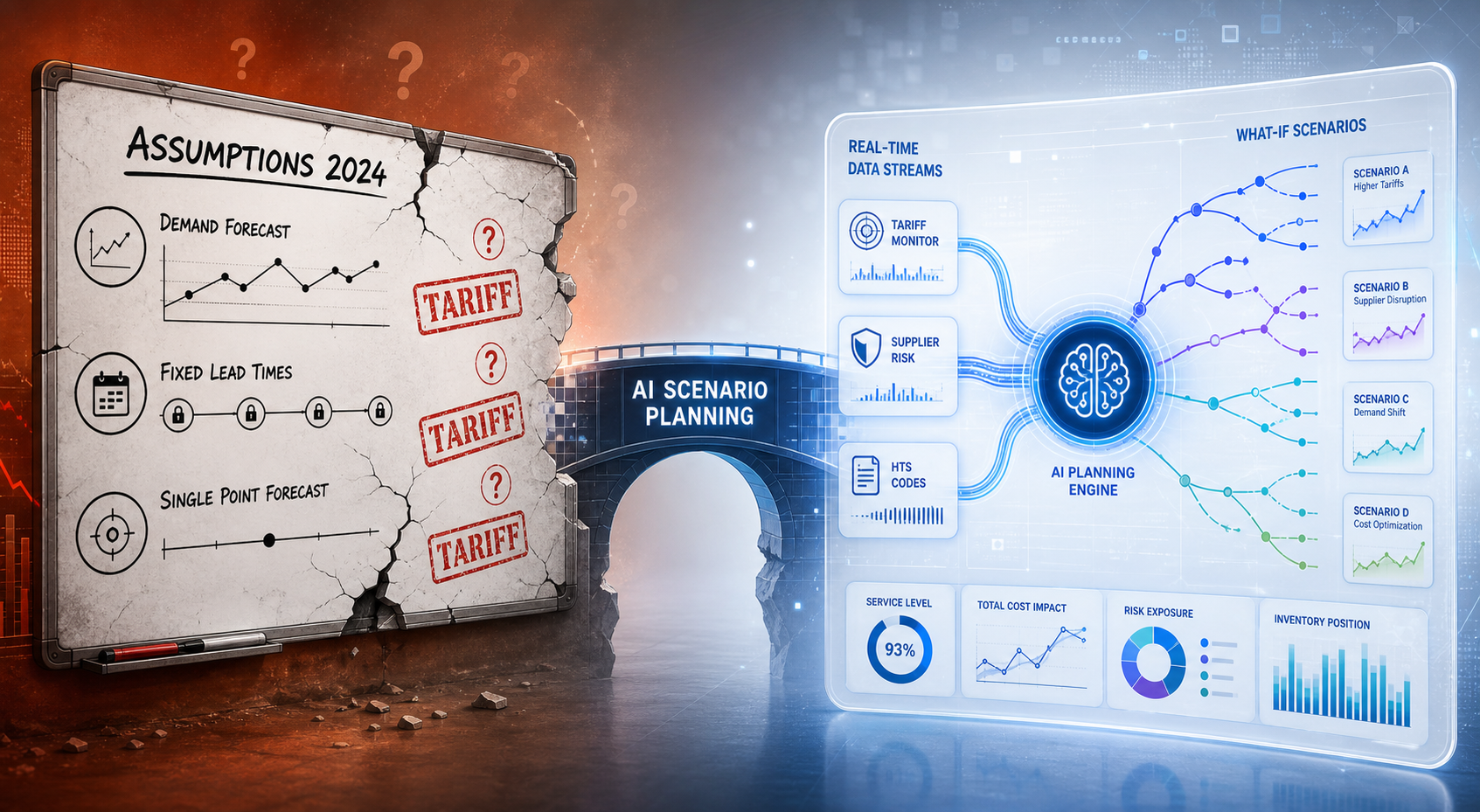
The Planning Paradox: Why Investment Stalled While Tariffs Surged
In early 2026, a contradictory picture defines supply chain planning. On one side, the 2025 tariff regime has touched nearly every network: 82% of surveyed companies reported tariff-affected supply chains according to McKinsey’s 2025 Supply Chain Risk Pulse survey. On the other side, investment in advanced planning systems dropped from 47% to 25% year over year. Faced with rising uncertainty, organizations reached for tactical buffers — stockpiling inventory, dual-sourcing, and nearshoring — rather than investing in the digital planning infrastructure needed to model that uncertainty structurally.
The logic seems defensible: when you cannot predict what tariffs will look like next quarter, why spend millions on planning software that relies on stable inputs? But that logic rests on a misunderstanding of what the new planning tools actually do. The older generation of advanced planning systems (APS) — deterministic, single-forecast, static-input engines — is indeed ill-suited to tariff volatility. The newer generation, built on AI-driven scenario modeling, is designed precisely for this environment. The investment retreat suggests that many planning leaders are conflating the old APS paradigm with what AI planning now delivers. This article is our attempt to draw that distinction clearly, building on an earlier piece about recalibrating post-deal model parameters but moving from narrow recalibration to the broader paradigm crisis.
Broken Assumption #1: Historical Demand Patterns No Longer Predict the Future
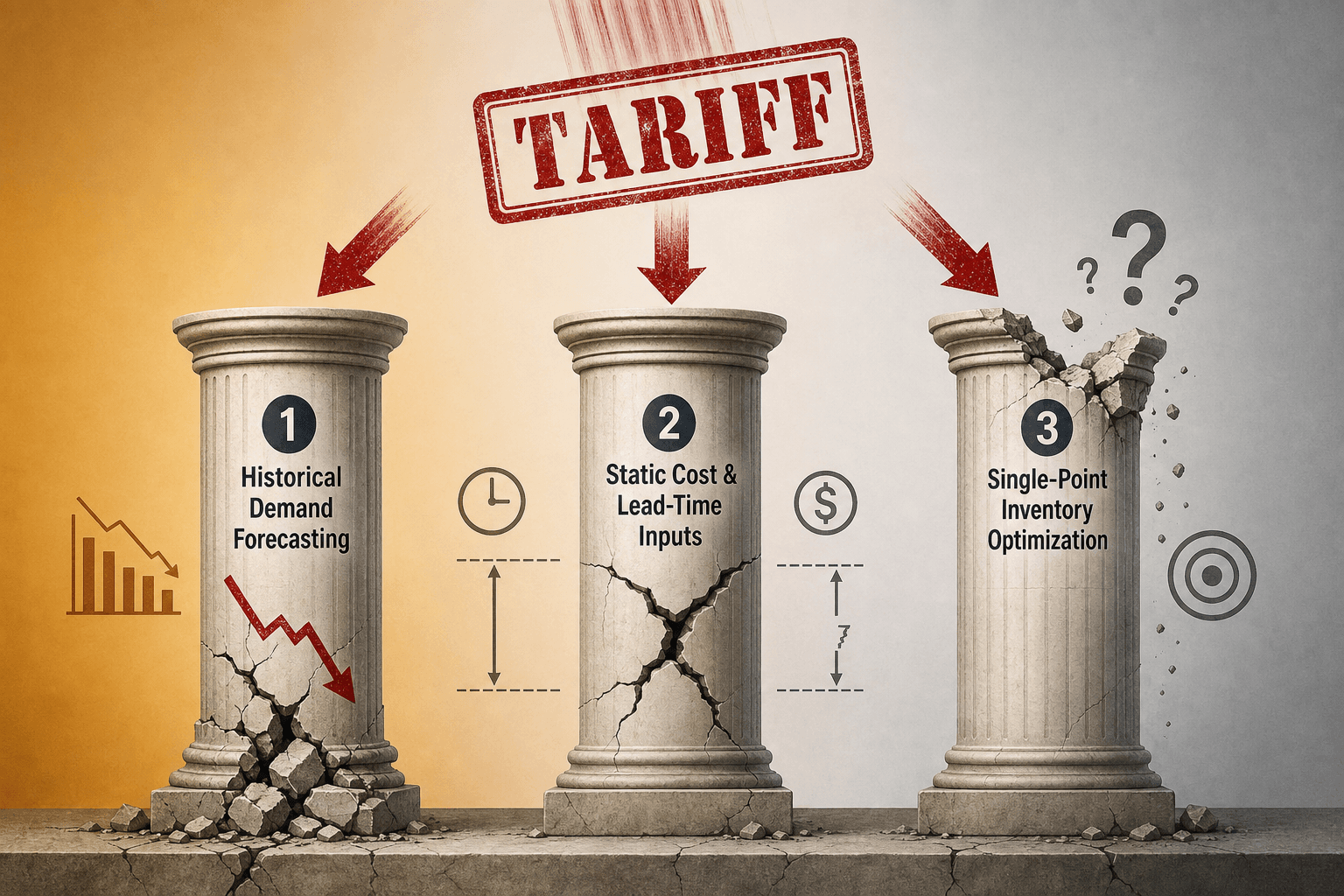
Demand forecasting built on historical patterns assumes that the past is a reliable guide to the future. The 2025 tariff regime violated that assumption at scale. Netstock’s 2025 Benchmark Report found that 63% of SMBs experienced direct operational impacts from tariff changes, and 68% identified lead-time variability as their top supplier challenge. When lead times fluctuate by weeks, historical weekly or monthly demand patterns lose their predictive power. A five-year average seasonal forecast means nothing if the sourcing geography shifted in Q1.
AI adoption in forecasting has risen — from 52% of companies in 2024 to 63% in 2025, per the same Netstock data — but adoption alone does not solve the problem if the AI is simply fitting curves to broken historical data. Traditional machine learning forecasting models, even sophisticated ones, extrapolate from past patterns. When tariffs cause step changes in demand — a 17% drop in US imports from China in H1 2025, a 14% rise from the EU, according to Z2Data — extrapolation produces confident but wrong predictions. This is the critical distinction: AI forecasting applied as a better curve-fitter is still reactive. The structural shift needed is toward models that treat tariff scenarios as explicit input variables, not as noise to be averaged out. For a detailed reference on how AI forecasting is currently deployed in practice, see our structured use case entry on AI demand forecasting in CPG and retail.
- Traditional forecasting assumes demand is stationary enough to extrapolate. Tariffs create non-stationary demand shifts that violate this assumption.
- Lead-time variability (cited by 68% of firms as their top challenge) breaks the temporal alignment between historical demand and current supply availability.
- AI forecasting without scenario inputs improves fit on historical data but cannot anticipate tariff-driven regime changes.
Broken Assumption #2: Static Lead-Time and Cost Inputs Are a Liability
Most integrated business planning (IBP) and S&OP processes operate on landed-cost and lead-time tables that are updated quarterly — or annually. Those tables assume that the cost to source a unit from a given supplier and the time to receive it remain stable between updates. The 2025 tariff regime made that assumption dangerous.
Thomson Reuters documented a direct consequence: tariff-driven forecast accuracy degradation caused companies to pause or cancel orders and renegotiate vendor terms. When planners cannot trust the cost and lead-time numbers feeding their planning engines, every output — from procurement schedules to inventory targets — becomes suspect. Companies began routing shipments through Canada to avoid double tariffs and reorganizing supply chains on the fly. That is not planning; it is firefighting.
The scale of the input disruption is captured by the effective tariff rate. According to the Yale Budget Lab, the average effective US tariff rate reached 16.8% as of November 2025 — the highest since the Smoot-Hawley era of 1935. That rate fluctuated throughout the year, climbing as high as 22.5% in April before settling back. When the fundamental cost of importing changes by double-digit percentages within months, a static landed-cost table updated every quarter is not just inaccurate; it is actively misleading. Traditional APS platforms, which bake these assumptions into deterministic optimization models, cannot adapt because they lack the architecture to treat costs and lead times as stochastic, event-driven variables.
Broken Assumption #3: Single-Point Inventory Optimization Cannot Keep Up
Single-point inventory optimization — the practice of calculating one optimal safety stock level per SKU per location based on historical demand and lead-time distributions — assumes that the underlying demand and supply parameters are stable enough that a single number has decision value. Under tariff volatility, that assumption creates dangerous oscillation.
McKinsey found that 45% of companies increased inventories as a tariff mitigation strategy. This is rational for each firm individually but collectively creates the bullwhip effect on a macro scale: everyone stockpiles, warehouse congestion spikes, lead times extend further, safety stock calculations ratchet up, and the cycle reinforces itself. Then, when a tariff deadline shifts or an exemption is granted, the same firms are left holding excess inventory that ties up working capital. The Flexport analysis of 2025 import patterns confirms front-loading behavior, with warehouse congestion following close behind.
The problem is not that inventory optimization is wrong in principle; it is that single-point optimization — whether computed in Excel, an ERP module, or a traditional APS — cannot model the branching outcomes that tariff uncertainty creates. What is needed is multi-echelon inventory optimization (MEIO) that evaluates ranges of safety stock across different tariff scenarios. For a detailed treatment of how AI-driven MEIO works in practice, see our deployment evidence and risk assessment for AI safety stock optimization.
| Dimension | Traditional Single-Point Optimization | Multi-Echelon Scenario-Driven MEIO |
|---|---|---|
| Data inputs | Historical demand, fixed lead times, static costs | Real-time demand signals, tariff scenario layers, supplier risk feeds, HTS-code-level cost projections |
| Output format | One safety stock number per SKU per location | Range of optimal inventory positions per scenario, with probability weighting |
| Response to disruption | Recompute after disruption occurs (reactive) | Pre-compute contingency inventory plans for each scenario (proactive) |
| Update frequency | Monthly or quarterly batch cycle | Continuous with event-triggered scenario rebalancing |
| Risk visibility | None until KPIs signal a stockout or excess | Probabilistic service-level and working-capital trade-offs visible for each scenario |
The New Paradigm: AI Scenario Planning with Dynamic Assumption Updating
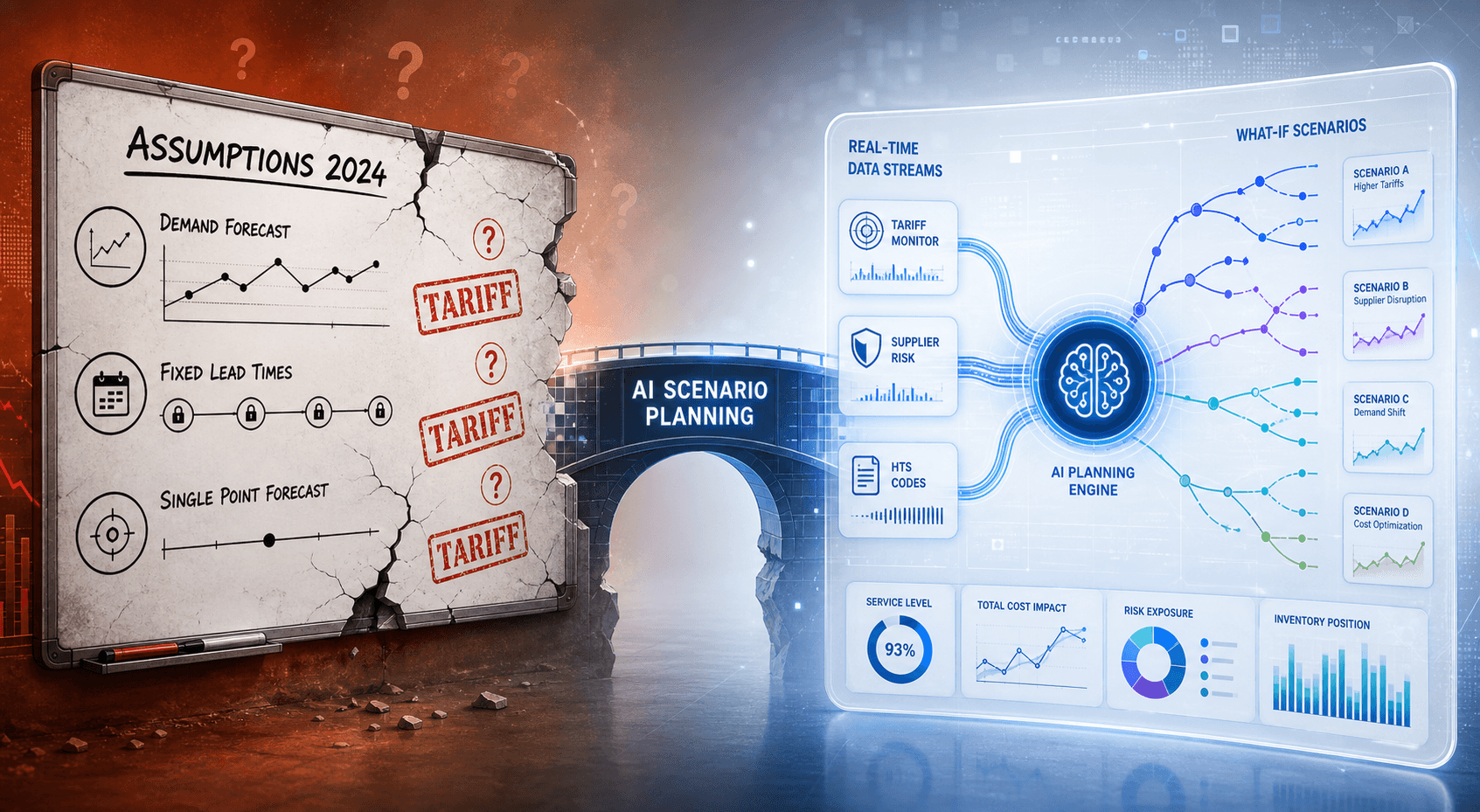
If the three broken assumptions share a common flaw, it is this: traditional planning frameworks treat assumptions as inputs that, once set, remain valid until the next planning cycle. The tariff regime of 2025 demonstrated that assumptions — about demand patterns, landed costs, lead times, and inventory targets — can shift meaningfully within weeks. The appropriate response is not to build better point forecasts but to replace the single-forecast paradigm with scenario-based modeling.
Anaplan’s analysis of tariff disruption frames this clearly through a cascade of effects: first-order effects (higher landed costs, pricing pressure), second-order effects (inflation, demand shifts, port delays), and third-order effects (CapEx decisions, supplier diversification, network footprint changes). Each order operates on a different time horizon, and each feeds back into the planning assumptions of the others. A conventional monthly S&OP process cannot keep up because it treats the second and third orders as external context rather than as variables that should reshape the plan itself.
AI-driven scenario planning addresses this by replacing the single demand forecast with a branching tree of possible outcomes, each weighted by probability and updated as new tariff signals arrive. Netstock’s approach, for example, allows planners to test multiple futures with quantified trade-offs across service levels, working capital, and margins. The key architectural difference is that the planning engine treats assumptions — not just demand data — as dynamic, updatable variables. When a new tariff rate is announced, the scenario weights rebalance automatically, and the planner sees which inventory, sourcing, and production decisions are robust across the scenario range, not just optimal under a single guess.
| Dimension | Old Paradigm (Static Assumptions) | New Paradigm (Dynamic Scenario Modeling) |
|---|---|---|
| Core input | Historical demand data, fixed cost tables, static lead times | Multi-scenario assumptions updated by real-time tariff intelligence, supplier signals, and HTS-code data |
| Planning frequency | Monthly or quarterly S&OP cycle | Continuous with event-triggered scenario rebalancing |
| Forecast output | Single point forecast with error margin | Range of probabilistic outcomes across tariff scenarios |
| Risk handling | Safety stock buffer (reactive, cost-heavy) | Scenario-specific contingency plans with pre-computed responses |
| Technology foundation | Deterministic APS, spreadsheet models, ERP planning modules | AI scenario engine with explainable outputs, dynamic assumption layers, and human-in-the-loop governance |
A critical enabler of this paradigm is the ability to detect when planning assumptions have drifted outside their valid range. Without automated drift detection, even a well-designed scenario engine will produce outputs based on stale inputs. Our implementation guide on AI model drift detection for demand planning provides a practical framework for monitoring forecast accuracy degradation, lead-time shifts, and cost-structure changes — the very variables that tariff volatility destabilizes.
Early Evidence: Automotive AI Scenario Planning Cuts Disruption Delays by 25%
The strongest early evidence for the new paradigm comes from the automotive sector, which faced compounded tariff pressure on steel, aluminum, electronics, and finished vehicles. According to the Center for Supply Chain and Procurement (CPSCP), US automotive manufacturers using AI-driven predictive scenario planning experienced a 25% reduction in disruption-related delays in early 2025 compared to the same period in 2023. The AI models simultaneously simulated supplier failures and tariff adjustments, enabling planners to identify alternate sourcing strategies before disruptions materialized rather than scrambling after the fact.
This aligns with the broader capability that SCMR’s interviewed planning expert described: “AI reduces decision latency, enabling faster reactions to disruptions.” In practice, reducing decision latency means the time between a tariff announcement and an updated sourcing or inventory decision shrinks from weeks to days or hours. The automotive case suggests that the 25% delay reduction came not from forecasting disruptions better but from having pre-computed response options ready to execute.
Rebuilding Your Planning Assumptions: An Implementation Roadmap
For planning leaders who recognize that their current assumptions are no longer valid, the path forward requires structural changes, not incremental adjustments. The following five-step roadmap is designed for VP/Director of Planning and S&OP leaders at mid-to-large enterprises who need to move from awareness to action.
- Audit your current planning assumptions for tariff sensitivity. Review every landed-cost table, lead-time distribution, and demand forecast model for tariff-exposed SKUs. Identify which assumptions are hard-coded in your APS or ERP and which are updated dynamically. Most teams discover that 60–80% of their assumptions are static and were last updated before the 2025 tariff regime took effect. Without this audit, you cannot know where the risks are concentrated.
- Adopt scenario planning tools that treat assumptions as variables. Replace deterministic planning engines or spreadsheet-based S&OP with platforms that support branching scenario trees, probabilistic weighting, and event-triggered rebalancing. The evaluation criteria should focus on how the platform handles assumptions as updatable parameters, not on forecast accuracy alone. For a side-by-side comparison of major AI planning platforms, see our Q2 2026 architecture comparison of Blue Yonder, Kinaxis, and o9 Solutions.
- Implement automated model drift detection. Without drift monitoring, even a well-designed scenario engine will degrade silently as assumptions go stale. Deploy monitoring that tracks forecast error distribution shifts, lead-time distribution changes, and cost-structure deviations. Alerts should trigger a scenario rebalance, not just a manual review. Our implementation guide on drift detection and response offers a structured framework for this step.
- Build collaborative S&OP with explainable AI outputs. The planning function currently spends roughly 90% of its time assembling and validating information, according to the SCMR expert interview. AI that provides explainable, natural-language scenario summaries can redirect that time to strategy and decision-making. The key is explainability: stakeholders across commercial, finance, and operations need to understand why a scenario recommends a specific inventory or sourcing action, not just what the recommendation is.
- Evaluate vendors against scenario-planning capability, not forecast accuracy. Traditional vendor selection processes emphasize MAPE (mean absolute percentage error) and other point-forecast metrics. Under tariff volatility, the more important capability is how the platform handles assumption uncertainty: how many scenarios can it model simultaneously? Can it ingest real-time tariff data feeds? Does it support probabilistic vs. deterministic outputs? Our vendor comparison page provides structured evaluation dimensions for this step.
Comments
Join the discussion with an anonymous comment.