
The latest Red Sea shock entered freight budgets through an oil screen first. On July 23, 2026, Houthi attacks on the Saudi tankers Encelia and Layla helped push Brent crude to $101.10, its first move above $100 since May and part of a July surge of more than 30%.[1] For supply chain teams, the important part is not the round number. It is that the same event tightened physical shipping routes and reset the fuel-cost assumptions sitting inside freight contracts, bunker adjustment factors, procurement forecasts, and supplier price talks.
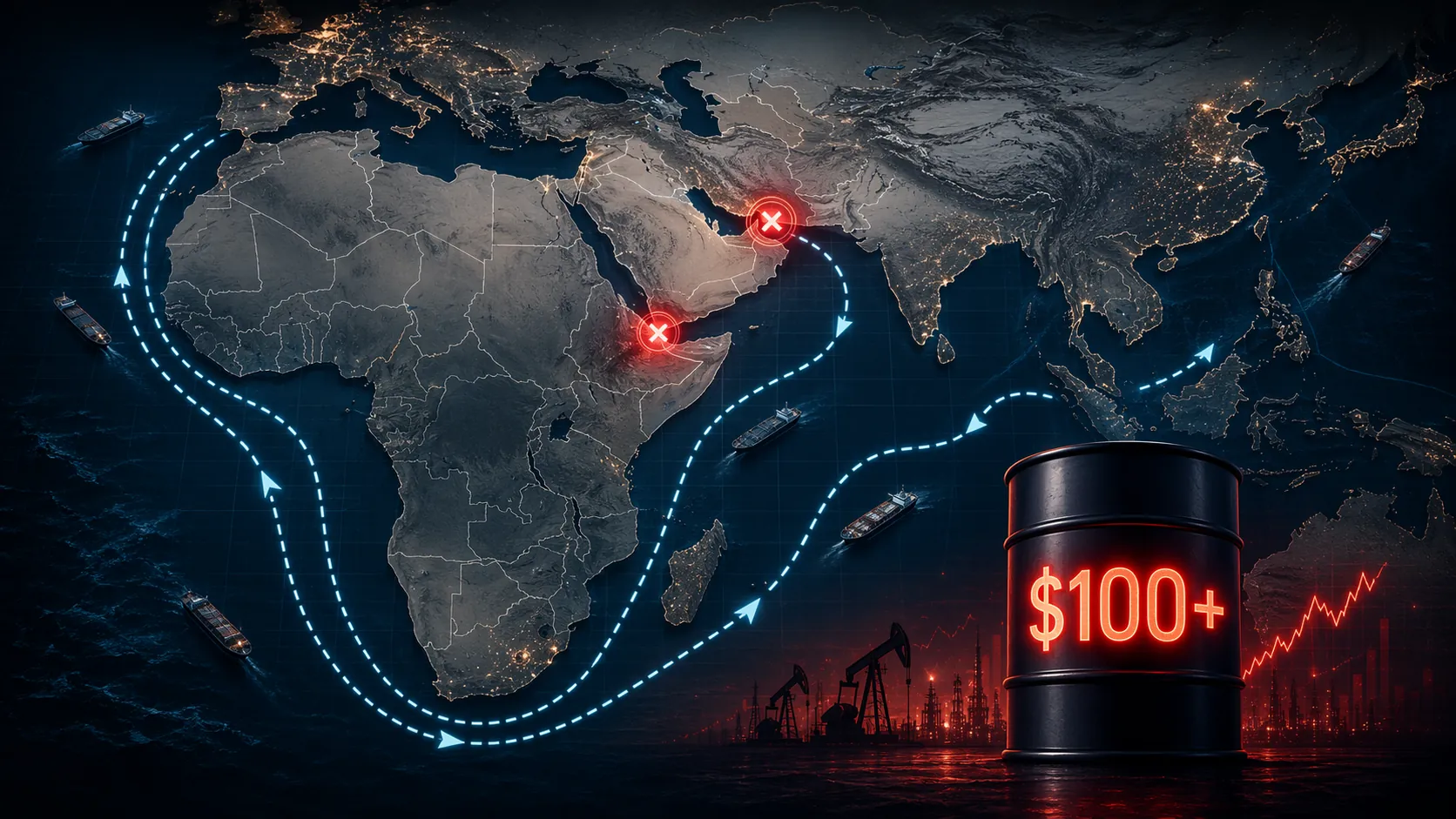
That is why the usual shorthand — Red Sea attacks raise shipping costs — is too small for Q3 2026. The Bab el-Mandeb route into the Red Sea is under renewed Houthi blockade as of July 20, while the Strait of Hormuz has been described as effectively closed since March 2, blocking a route associated with about 20% of global oil and LNG flows.[2] These two chokepoints do not hit the same cost ledger in the same way. Bab el-Mandeb changes the path, duration, and risk premium of many container and tanker voyages. Hormuz changes the availability and price of energy inputs that spread into lanes nowhere near the Red Sea.
The Dual-Chokepoint Problem
A single chokepoint closure can often be managed as a routing problem, even if the solution is expensive. A dual closure forces two different systems to fail into each other: physical vessel circulation and energy-price transmission. The Red Sea side adds miles, days, and insurance. The Hormuz side tightens oil and LNG supply, lifting bunker and fuel-linked logistics costs across the network.
The distinction matters because the first bill does not arrive everywhere. An Asia-Europe container move that avoids the Red Sea and sails around the Cape of Good Hope faces a direct transit-extension problem. A transpacific move that never approaches Bab el-Mandeb may still see bunker adjustment factors rise if global fuel prices move with Hormuz risk. Treating both as one “crisis surcharge” makes it harder to challenge invoices, reprice contracts, or decide where inventory buffers actually belong.
Oil-market forecasts should stay in their lane. Financial Post reported Brent nearing $100 as Houthi attacks amplified supply risks, while Saudi officials cited in logistics coverage warned that oil could reach $180 if the Hormuz closure persisted.[3][2] Goldman Sachs’ March scenario work said oil could breach $100 within days of a major supply disruption, and its later $120-plus Q4 scenario should be read the same way; RBC’s $128–$146 range is tied to a full regional-war scenario.[4][3] Those are scenario markers, not procurement facts until they appear in actual fuel tables, carrier tariffs, and supplier quotes.
Cost Channel One: Transit Extension
The visible shipping disruption is still severe. Cape of Good Hope rerouting can add 10 to 20 days to affected voyages, turning a routing workaround into a working-capital, inventory, and service-level problem.[2] Longer voyages absorb vessel capacity before any new demand appears. J.P. Morgan’s 2024 Red Sea analysis estimated that Cape rerouting reduced effective global container capacity by about 9%, a useful benchmark for the mechanics of capacity absorption even though that work did not model the 2026 Hormuz closure.[5]
The costs then stack. Emergency conflict surcharges have been reported at $500 to more than $2,000 per TEU, equipment imbalance surcharges at $150 to $600 per TEU, and war risk insurance rising from 0.6% to more than 2% of cargo value.[2][6] Protection and indemnity coverage for Gulf transits was also reported as cancelled from March 5, changing some shipments from expensive to contractually difficult.[2] These figures are not timeless benchmarks; they are near-real-time crisis inputs. A procurement team using last week’s surcharge file may already be negotiating from stale data.
Carrier actions turn that cost stack into execution risk. Maersk, MSC, CMA CGM, and Hapag-Lloyd have been reported as suspending Middle Eastern transits and issuing force majeure declarations.[2] Once force majeure enters the file, the dispute moves beyond rate reasonableness. Shippers have to identify which purchase orders are stranded, which customer commitments depend on those sailings, which suppliers can move through alternate gateways, and which contracts allow recovery of extraordinary charges.
There is also the human backlog behind the vessel count. Carra Globe, citing a U.S. military official, reported more than 1,550 vessels and 22,500 mariners stranded near the Strait of Hormuz as of May 2026.[7] The sourcing caveat matters, but the operational implication is plain enough: ships and crews held in place are not just delayed cargo. They are missing capacity, interrupted rotations, uncertain relief schedules, and a source of knock-on unreliability for voyages that were never supposed to touch the crisis zone.
| Transit-extension variable | Operational consequence |
|---|---|
| 10-20 additional days on Cape routings | More inventory in motion, later receipts, higher buffer requirements |
| Roughly 9% effective container-capacity reduction in 2024 Red Sea rerouting analysis | Less available vessel capacity even before demand changes |
| $500-$2,000+ per TEU emergency conflict surcharges | Lane-specific freight overruns and customer margin pressure |
| War risk insurance rising from 0.6% to more than 2% of cargo value | Higher landed cost and possible cargo-by-cargo approval |
| Force majeure and suspended Middle Eastern transits | Contract review, alternative gateways, and exception management |
The 2024 Red Sea-only studies remain useful because they explain why a longer voyage removes capacity from the system. They are less useful if applied as a ceiling for 2026. This crisis includes a second chokepoint tied directly to energy flows, so the Cape-route calculation is only one half of the budget exposure.
Cost Channel Two: Oil-Price Transmission
Oil above $100 is evidence that the crisis is serious, but it is also a separate cost engine. The Hormuz closure affects a route associated with one-fifth of global oil and LNG flows, so the price effect is not limited to tankers trying to pass through the Gulf.[2] When bunker fuel costs rise, carriers can pass them through bunker adjustment factors, emergency fuel mechanisms, or broader rate resets. The invoice may arrive on a lane that has no geographic connection to Bab el-Mandeb.
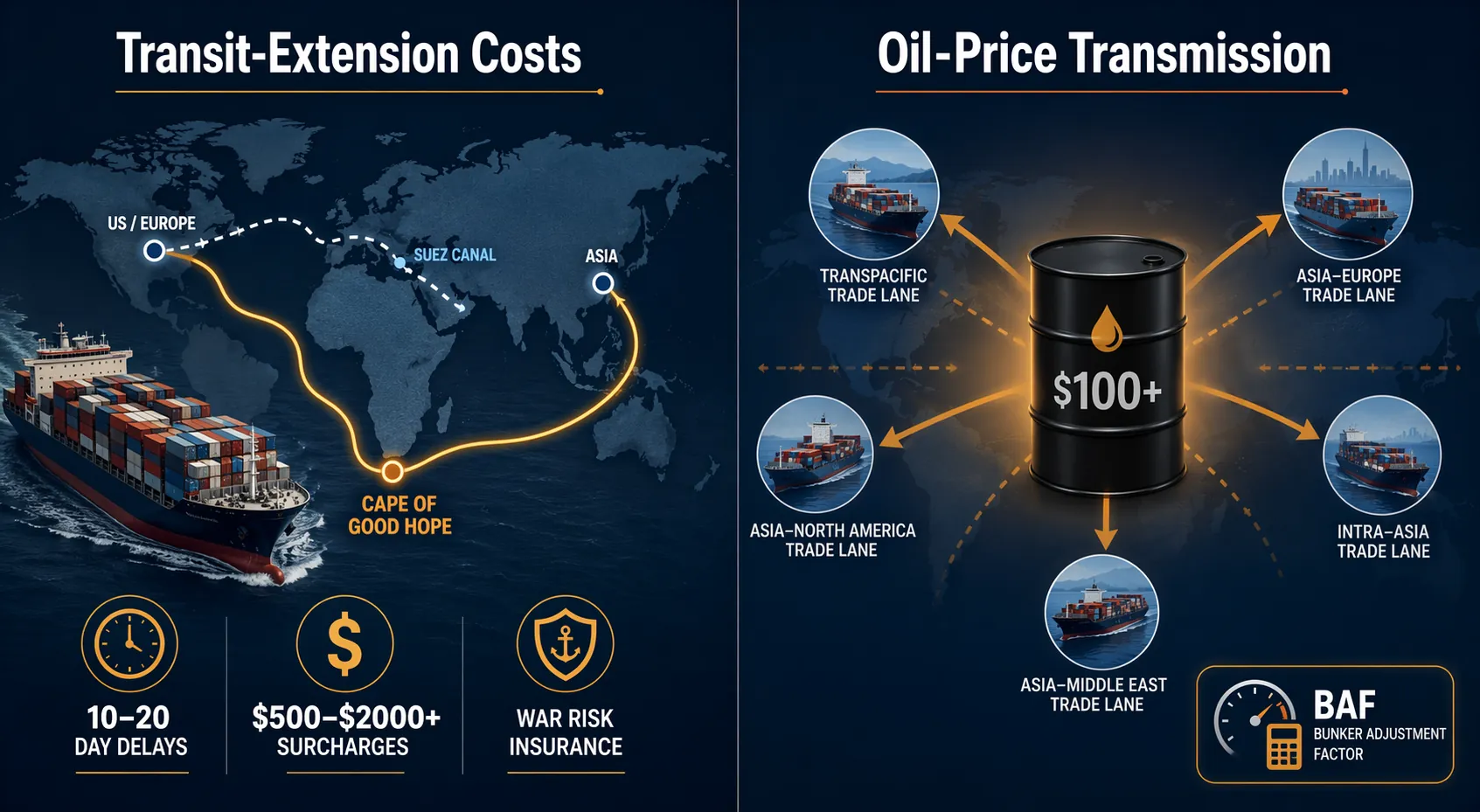
That is the budget trap. A shipper can reroute Asia-Europe cargo around the Cape and calculate the extra days, added inventory, and emergency charges. It cannot isolate fuel pass-through as neatly. Fuel-linked cost changes can show up in ocean freight, trucking, air freight alternatives, supplier energy surcharges, packaging inputs, and commodity-linked purchase categories. The Red Sea lane manager may be handling a routing exception while the enterprise procurement team is already absorbing a fuel-price assumption change across many categories.
The LNG side widens the effect into industrial inputs. Al Jazeera reported that fertilizer prices had risen 100% to 150% in parts of Asia because of disrupted Qatar and Gulf natural gas supply.[8] That does not mean every food or agricultural input will move by the same amount. It does mean that a shipping disruption framed only as container delay can miss upstream price pressure in energy-intensive supply chains.
Trade-growth warnings point in the same direction. Bramwith Consulting cited a WTO warning that global trade growth could slow from 4.6% in 2025 to 1.9% in 2026.[6] That figure should not be read as proof that any one contract will fail or any one lane will become uneconomic. It is a signal that the disruption is large enough to affect demand planning, supplier solvency checks, and freight-capacity assumptions at the same time.
Why One Surcharge File Will Not Be Enough
The two cost channels need different owners and different questions. Transit-extension exposure belongs first to lane management: which shipments are on affected strings, which SKUs can tolerate another two or three weeks in transit, which ports can receive diverted cargo, and which customers must be told before the next allocation cycle. Oil-price transmission belongs to enterprise cost planning: which contracts have fuel escalators, which suppliers can reopen pricing, which budgets assume sub-$100 oil, and which commercial teams need revised margin floors.
| Question | If the issue is transit extension | If the issue is oil-price transmission |
|---|---|---|
| Where does it hit first? | Asia-Europe, Middle East, Gulf-linked, and Red Sea-exposed lanes | All lanes and fuel-linked categories, including routes far from the conflict |
| What should be measured? | Added transit days, capacity loss, surcharge exposure, insurance status | BAF changes, fuel escalators, supplier energy clauses, margin sensitivity |
| Who reviews it? | Logistics, trade compliance, inventory planning, customer operations | Procurement, finance, category managers, pricing and commercial teams |
| What decision comes soonest? | Reroute, defer, expedite, split shipment, or change gateway | Reforecast freight budgets, renegotiate pass-throughs, adjust pricing assumptions |
This split also changes how teams should argue with carriers and suppliers. A war-risk premium on a Gulf-linked shipment is a lane-specific charge that can be checked against routing, cargo value, and insurance availability. A bunker adjustment factor applied to a transpacific contract is a fuel-cost mechanism, not proof that the box itself faced Red Sea danger. Both may be valid. They should not be validated with the same evidence.
The contract calendar raises the stakes. If annual or semiannual freight negotiations are approaching, teams need to separate temporary emergency charges from base-rate resets and fuel formulas. If supplier agreements allow energy pass-throughs, category managers need to know whether they are seeing a documented input-cost change or a general attempt to recover crisis margin. The answer will vary by lane, commodity, supplier geography, and contract language.
Mitigation Starts by Separating the Work
For transit-extension risk, the first useful exercise is a lane-and-order exposure map, not a market forecast. List cargo already on the water, cargo booked but not loaded, and cargo still available for sourcing or production changes. Then mark which shipments face Cape routing, suspended service, Gulf insurance complications, or carrier force majeure. That gives logistics teams a defensible basis for deciding where to add inventory, where to split shipments, and where air freight is worth considering despite higher fuel costs.
For oil-price transmission, the work belongs closer to finance and procurement. Pull the freight contracts with BAF clauses, fuel tables, and emergency adjustment language. Identify suppliers with energy-indexed pricing or recent surcharge notices. Recut landed-cost assumptions for SKUs where freight or energy is material to margin. A route map will not answer those questions; a clause and cost-driver review will.
Normalization timing should be used carefully. DHL Global Forwarding was cited as forecasting four to six months to normalization after the Hormuz closure.[7] That may be a reasonable planning window, but it is not a promise that capacity, insurance, fuel, and supplier pricing normalize on the same date. Vessel schedules can recover before contract prices do. Oil prices can fall before suppliers remove energy surcharges. Insurance restrictions can outlast the headline reopening of a route.
Scenario planning tools can help only if they preserve this distinction. ChainSignal’s related work on AI oil disruption detection at the Strait of Hormuz and AI capabilities for disruption planning is most relevant where teams need earlier signals, faster lane triage, and clearer cost-driver separation. The useful output is not a single crisis score. It is a decision queue: which lanes need routing action now, which contracts need fuel review, and which supplier prices need evidence before approval.
The practical fork is now unavoidable. Transit-extension exposure calls for lane-level routing, inventory, carrier, and insurance decisions. Oil-price transmission calls for enterprise-wide freight-cost, procurement, and pricing assumptions. Red Sea attacks may have supplied the July 23 headline, but $100 oil is already moving through the supply chain by a different route.
References
- Oil hits $100 for the first time since May after Houthi attacks on Saudi ships in Red Sea, The National, Jul 23, 2026
- The Double Chokepoint: Navigating the Simultaneous Blockade of the Red Sea and the Strait of Hormuz, Simple Forwarding
- Oil nears US$100 as Houthi attacks in Red Sea amplify supply risks, Financial Post
- Oil prices 'could breach $100 a barrel within days' amid supply disruption from Iran war — Goldman Sachs, The Guardian, Mar 8, 2026
- The Impacts of the Red Sea Shipping Crisis, J.P. Morgan
- Oil Price Surge: What It Means for Supply Chains, Logistics and Procurement in 2026, Bramwith Consulting
- Strait of Hormuz Closure 2026: What It Means for Your Supply Chain and Shipping Routes, Carra Globe
- How will soaring oil prices caused by Iran war impact food costs?, Al Jazeera, Mar 10, 2026
Comments
Join the discussion with an anonymous comment.