
The July 20 Houthi blockade declaration against Saudi Arabia changes the oil and supply chain disruption story in a specific way: it threatens the route that many buyers had already treated as the escape lane after the February 2026 closure of the Strait of Hormuz. This is not simply one more danger zone added to a map. It is the workaround itself being put under pressure.
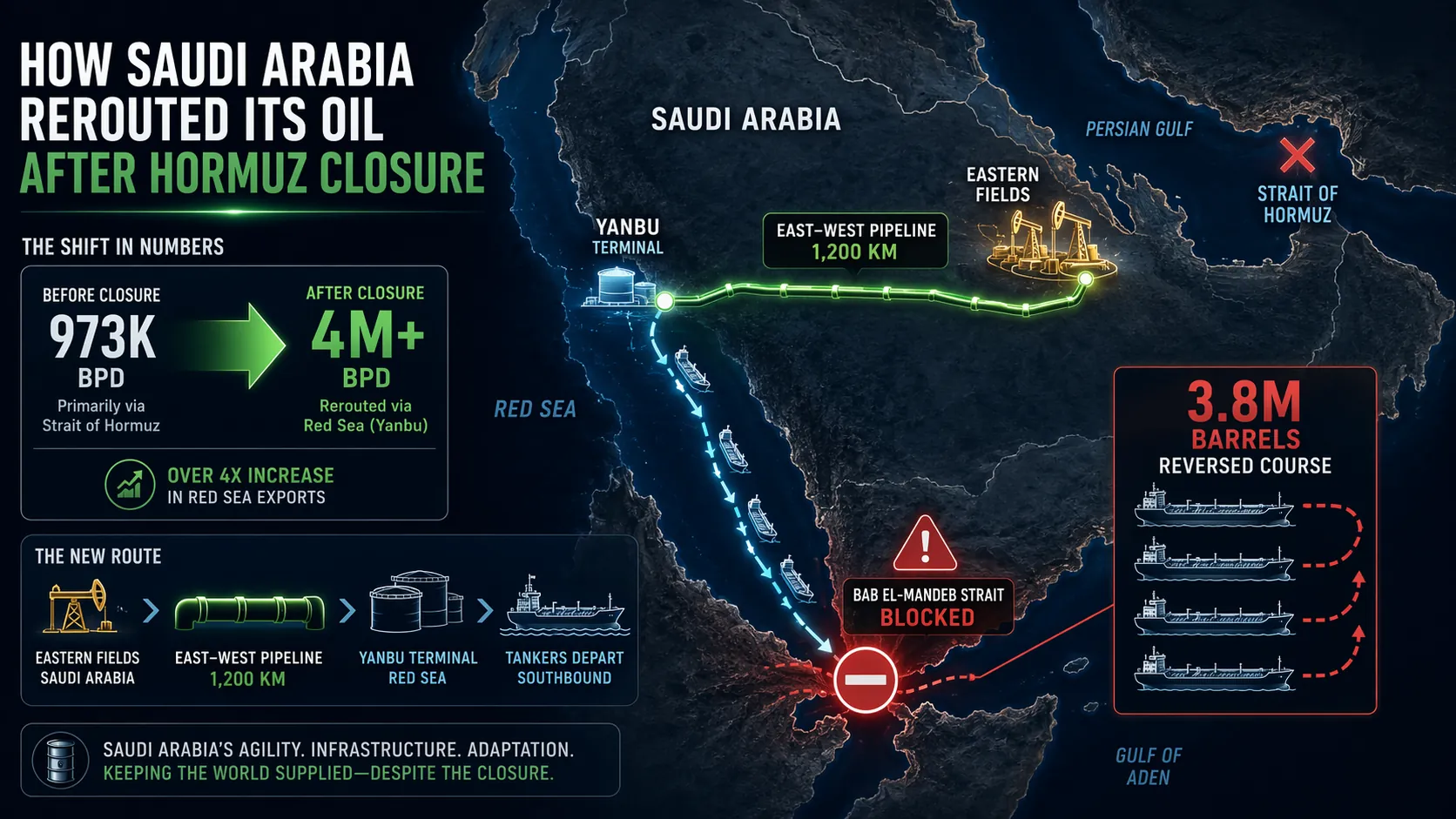
By July 21, the physical market was already behaving as if the risk was operational, not theoretical. Kpler data cited by Reuters showed only three commodity vessels transiting Hormuz that day, with no VLCCs or LNG tankers recorded. Bab el-Mandeb traffic fell 34% in the 24 hours after the Houthi announcement, a one-day move that should not be treated as a steady-state trend, but cannot be ignored by anyone booking cargoes, coverage, or refinery runs for the next few weeks. Four tankers carrying 3.8 million barrels of crude reversed course away from Bab el-Mandeb after the declaration.[1]
Why Yanbu Became the Critical Corridor
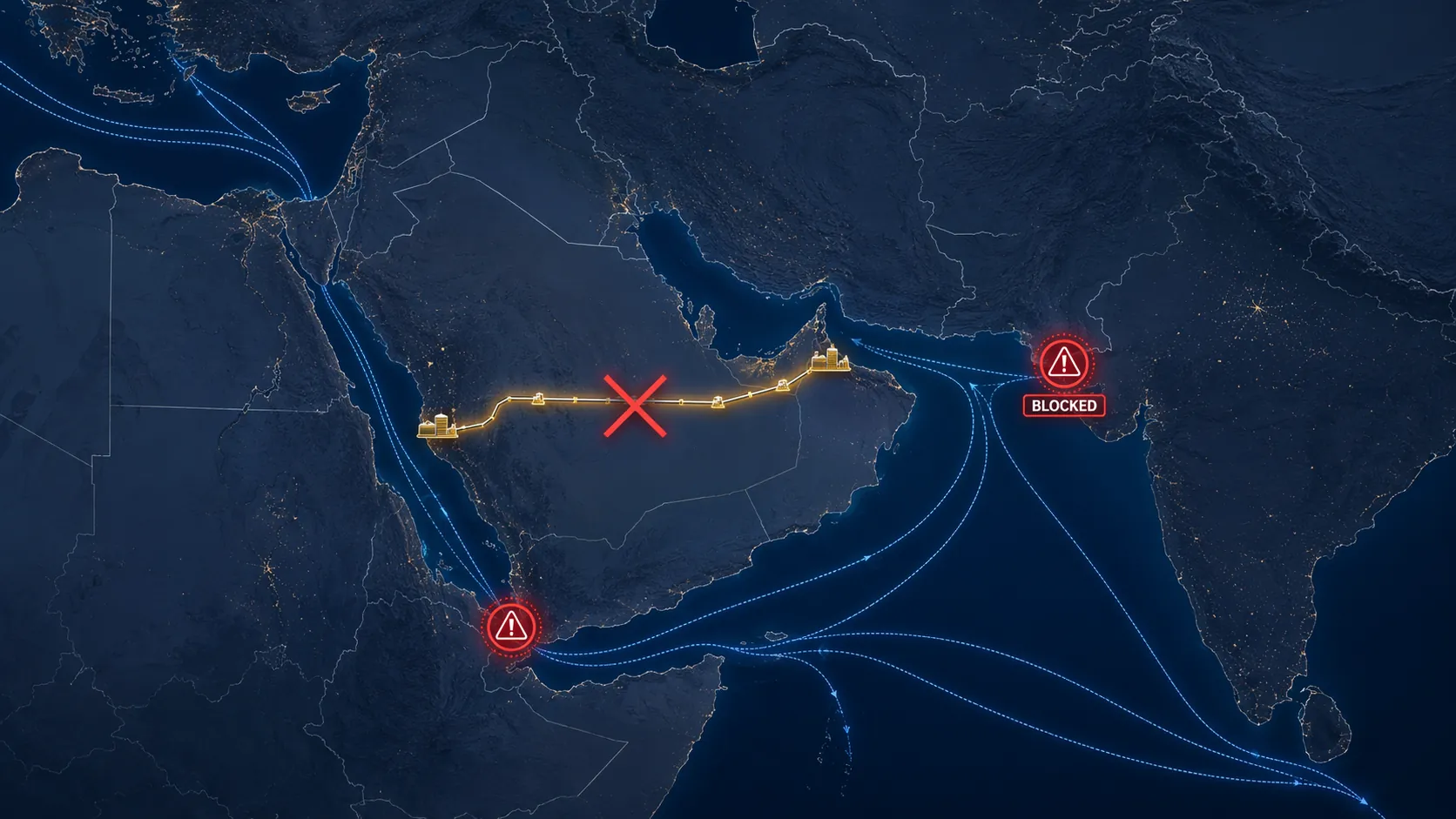
After Hormuz closed in February, Saudi Arabia’s Red Sea export route through Yanbu became the main practical alternative for moving crude out without sending tankers through the Gulf chokepoint. Tanker-tracking data cited by Reuters showed Saudi exports through Yanbu rising from roughly 973,000 barrels per day to more than 4 million barrels per day, a more than fourfold jump that turned a bypass into a core artery.[1]
That matters because the Yanbu route is not independent of the Red Sea. Crude can move west across Saudi Arabia to the port, but once it loads there, many voyages still have to move south through Bab el-Mandeb to reach Asian buyers. The pipe and port solve the Hormuz problem only up to the point where a vessel needs to leave the Red Sea.
The scale of that exposure had already expanded before the blockade declaration. Total petroleum flows through Bab el-Mandeb reached 7.4 million barrels per day in June 2026, equal to roughly 7% of global oil output and up from 4.2 million barrels per day before the war, according to Kpler data cited by Al Jazeera.[2]
For a refinery scheduler, the dangerous part is not only the headline volume. It is the sequencing. A buyer who shifted nominations away from Gulf load ports toward Yanbu after Hormuz now faces a second decision point: wait, reroute, substitute, defer, or pay more for freight and insurance while the vessel, the crude, and the refinery window all drift out of alignment.
The Remaining Routes Are Buffers, Not Replacements
Once Bab el-Mandeb becomes unreliable, the usual route map starts to shrink quickly. The SUMED pipeline across Egypt is real capacity, not a PowerPoint arrow, but it is capped at about 2.5 million barrels per day. That limit matters when the displaced flow is measured in millions of barrels per day and when the Yanbu corridor alone had recently been carrying more than 4 million barrels per day.[1][2]
Suez is also not a clean substitute for every tanker. Fully laden VLCCs cannot transit the canal, which pushes operators toward lightering or different vessel combinations. Those are not just nautical details. Lightering creates extra handling, timing, chartering, inspection, and insurance friction before the crude even reaches the next buyer.[2][4]
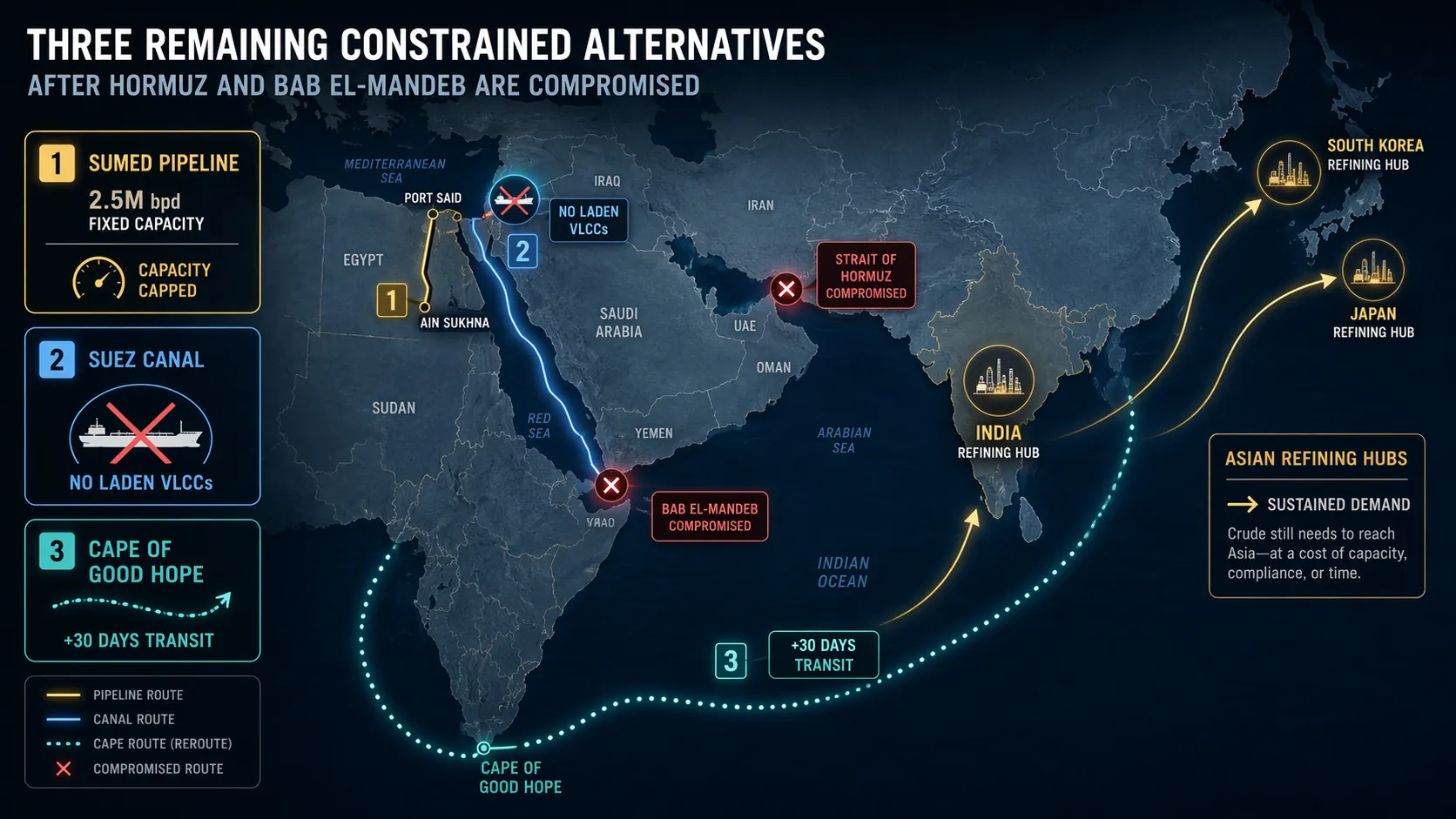
The Cape of Good Hope route is physically available for many voyages, but availability is not the same as equivalence. For Yanbu cargoes bound for South Korea, rerouting via Suez and around the Cape would increase the journey from about 24 days to about 54 days, according to Kpler estimates cited by Al Jazeera.[2] That is a change in working capital, tank inventory, demurrage exposure, blending plans, and refinery crude slate confidence.
| Alternative | Constraint that matters operationally |
|---|---|
| SUMED pipeline | About 2.5M bpd fixed capacity; cannot absorb all displaced Yanbu and Red Sea volumes |
| Suez Canal | Fully laden VLCCs cannot transit; lightering adds time, cost, and coordination risk |
| Cape of Good Hope | Can add roughly a month on some Asia-bound routes, resetting lead-time and inventory assumptions |
| Wait-and-see transit | Depends on enforcement, naval risk, and insurance response that remain fluid as of July 24 |
Asia Carries the Lead-Time Shock
The burden does not fall evenly. Al Jazeera reported that India receives more than 50% of its crude via Bab el-Mandeb, while Pakistan receives 36%, the Philippines 37%, South Korea 31%, and Japan 28%.[2] Those percentages do not mean every barrel disappears if traffic slows; they show where procurement teams have the least room to pretend this is someone else’s routing problem.
A refinery with enough crude in tank can absorb delay differently from one waiting on a specific grade for a specific run. A national buyer with term supply and storage can behave differently from a smaller importer buying spot cargoes in a rising freight market. The common exposure is timing: when the workaround adds weeks, the cost is carried before the invoice fully shows it.
This is why the price discussion needs discipline. Stratas Advisors estimated that a full Bab el-Mandeb closure could push oil above $115 to $120 per barrel, while Brent had already peaked at $126 earlier in 2026 and was trading near $89 per barrel on July 20.[1] Those are three different signals: a scenario estimate, a prior realized spike, and a current market level. Treating them as one straight line is a poor way to run either a hedge book or a supply plan.
Freight Is Where Bottlenecks Show Up First
Oil price forecasts get the attention, but freight often exposes the stress sooner. During the initial Hormuz crisis in March 2026, VLCC rates reached an all-time high of $423,736 per day, according to LSEG data cited by Reuters.[3] That number is not a forecast for the current Red Sea phase. It is a reminder of how quickly vessel scarcity, risk premiums, and route length can turn into cash cost.
A longer route does not merely cost more because it burns more fuel. It keeps the ship out of position for longer. It delays the next loading window. It forces charterers to compete for replacement tonnage. It can move a procurement team from a normal freight negotiation into a continuity decision, where the question is no longer whether the rate is attractive but whether the cargo arrives at all.
Insurance is the unresolved amplifier. As of July 24, 2026, the degree to which insurers will continue to cover Red Sea transits, and at what premium, remains fluid. That uncertainty is already enough to change behavior because carriers, traders, and cargo owners do not need a formal closure notice to pause a voyage when the exposure is unclear.
The Contagion Is Wider Than Saudi Crude
The immediate mechanism is crude, but the same geography carries other flows. Suez Canal traffic was already down 52% versus 2023, and container shipping, grain, and manufactured goods are also exposed to the broader Red Sea disruption.[5] For companies outside energy, the tanker crisis still matters because vessel avoidance, insurance repricing, and port schedule instability do not stay neatly inside one commodity lane.
Nor is the risk limited to Middle East-origin barrels. Reuters reported that 1.9 million barrels per day of Russian crude also transits Bab el-Mandeb to Asia.[6] That complicates substitution math: replacing Saudi or Gulf-linked flows with other barrels does not help much if the alternative supply also depends on the same strait.
The right comparison is therefore not “Hormuz versus the Red Sea.” It is “Hormuz closure plus a threatened Red Sea workaround.” That distinction is what changes the planning file. A company can survive a chokepoint disruption if the bypass has capacity, accepts the needed vessel class, and preserves the delivery window well enough to keep production or refining stable. Here, each remaining option fails at least one of those tests.
What Continuity Teams Should Change Now
The first adjustment is lead time. Any plan still treating Yanbu and Bab el-Mandeb as a reliable bypass for Hormuz is now using an outdated assumption. The second is capacity. SUMED, Suez, and Cape routing should be modeled as partial buffers with physical and commercial constraints, not as substitutes for the lost corridor.
- Recalculate crude, fuel, and freight exposure using constrained routing capacity rather than nominal route availability.
- Separate current Brent levels from closure scenarios and prior spikes when briefing finance or procurement committees.
- Identify cargoes that depend on Bab el-Mandeb even if their origin is not Saudi Arabia or the Persian Gulf.
- Ask carriers and insurers for transit-specific assumptions, not general Red Sea policy language.
- Stress-test refinery and production schedules against a roughly one-month extension on the most exposed routes.
For teams building their monitoring process, AI-driven geopolitical early warning can help flag changes in traffic, attacks, insurance language, and port behavior before they become a missed delivery. If the question is tool selection rather than alert design, the useful test is whether a platform can connect geopolitical signals to routings, suppliers, shipment exposure, and inventory consequences; that is the practical standard for choosing an AI platform for geopolitical supply chain risk.
The recovery work is just as concrete. Supply chain disaster recovery planning should now include route-specific restoration assumptions, not only supplier substitution. And when evaluating AI for logistics risk assessment, the question is not whether a dashboard can display a crisis marker over a strait. It is whether it can show which purchase orders, cargoes, plants, and customers inherit the delay.
As of July 24, 2026, the enforcement of the Houthi blockade and the insurance response are still moving targets. The planning assumption, however, has already changed. Supply chains can no longer treat Yanbu and Bab el-Mandeb as a dependable bypass for Hormuz. The remaining alternatives may reduce the damage, but they do not recreate the corridor that buyers had been relying on.
References
- Houthi Red Sea blockade would lift oil prices, workarounds could limit impact, Reuters, July 20, 2026.
- Can the Suez save Asian oil consumers after Houthis shut Bab al-Mandeb?, Al Jazeera, July 22, 2026.
- Middle East oil shipping costs surge to all-time high as US-Iran conflict intensifies, Reuters, March 2, 2026.
- The Houthis just announced a blockade on Saudi Arabia. What does it mean for the global economy?, Atlantic Council.
- Houthis Red Sea Bab el-Mandeb Saudi oil Iran, CNBC, July 22, 2026.
- Why are Houthis threatening to attack Red Sea shipping and what does it mean for oil?, Reuters, July 15, 2026.
Comments
Join the discussion with an anonymous comment.