
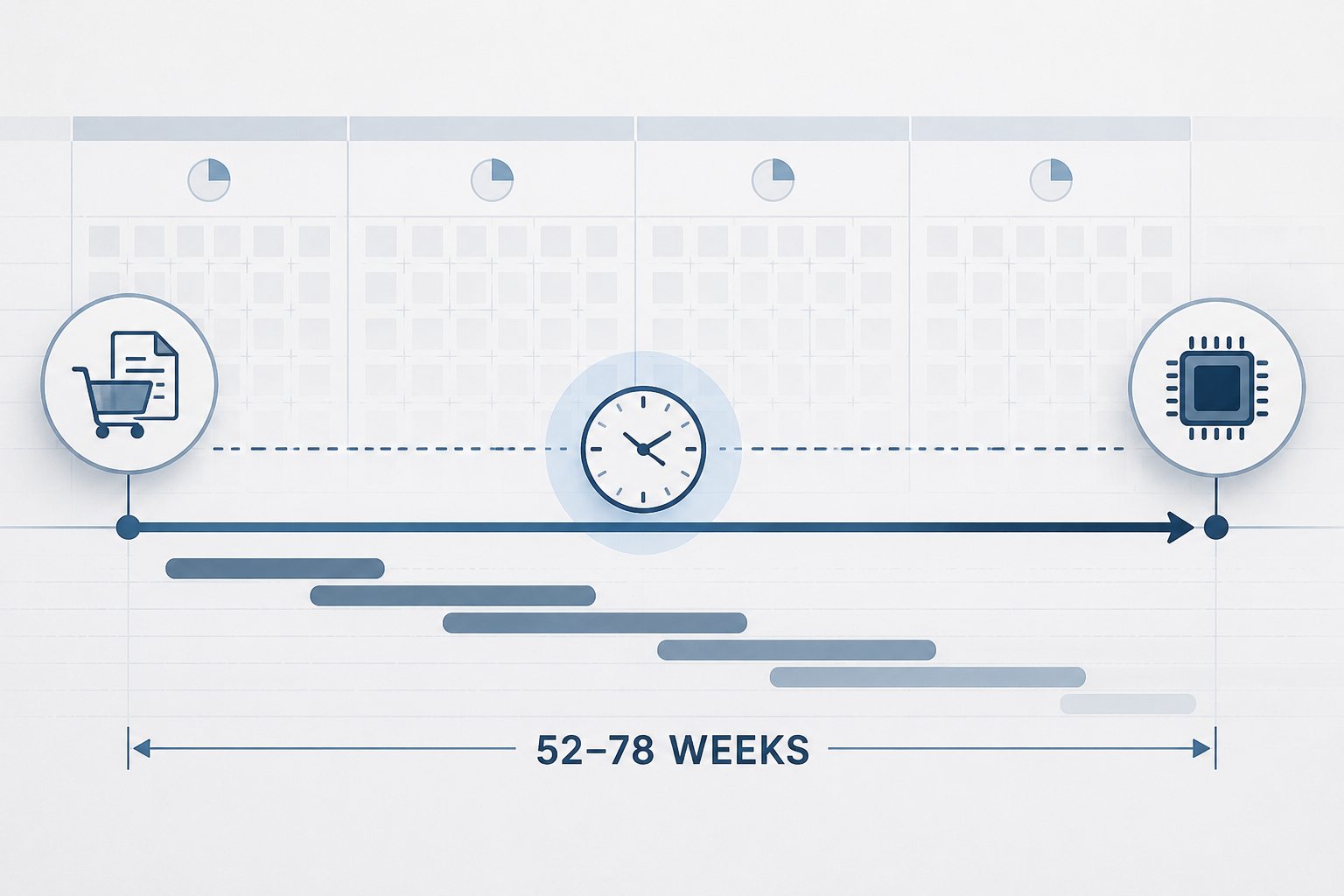
The nvidia vs amd ai chip supply chain forecast in 2026 is less about which GPU looks stronger on paper and more about which vendor already has a confirmed slot in TSMC's advanced-packaging queue. CoWoS capacity is sold out through 2026, and lead times are running 52–78 weeks, so a buyer's real risk is not benchmark disappointment but a delivery date that slips beyond the planning horizon. TSMC is still ramping capacity, from 35K wafers per month in late 2024 toward 130K wafers per month by the end of 2026, but demand still outruns supply. [1]

CoWoS Is the Booking Window
That is why the packaging queue matters more than the chip spec sheet. In an enterprise procurement calendar, the question is not whether a part is technically competitive; it is whether the part can be assembled, packaged, and shipped inside the quarter that finance already budgeted. If the packaging slot is booked 52 to 78 weeks out, then wafer starts are not the binding constraint. CoWoS is. [1]
The Allocation Gap Is the Forecast
The most useful directional estimate is the one Morgan Stanley has circulated through outlets like Astute Group: NVIDIA controls about 60% of TSMC CoWoS capacity, or roughly 595K wafers, while AMD gets about 11%, or roughly 105K wafers. The top three customers - NVIDIA, Broadcom, and AMD - account for more than 85% of total capacity. Those figures are not exact planning inputs, but they are precise enough to show the shape of the market. [2]
That gap is the forecast variable procurement teams should care about. A few percentage points of packaging allocation are not abstract market share trivia; they are delivery slots, escalation paths, and whether a second-source plan is real or just a comfortable sentence in a steering committee deck.
Why NVIDIA Keeps Priority
NVIDIA's advantage is structural because it has been built into the supply chain, not just into product launches. The company says it is making $40B in supply chain investment in 2026, and separate reporting points to a $500B planned U.S. manufacturing commitment over four years. NVIDIA has also reserved long-term HBM4 supply with SK Hynix, which reinforces access to the rest of the AI stack rather than only to the final GPU package. [3][4]
That spending does not mean NVIDIA's CoWoS allocation is infinite, and it should not be read that way. It does mean the company is buying priority across the ecosystem, which is a very different thing from a simple benchmark win. For buyers, that distinction matters because a faster chip that cannot be packaged on time is still a schedule risk.
AMD Has a Path, Not the Ceiling
AMD is not standing still. Its $10B-plus Taiwan ecosystem push signals intent to win more of the supply chain, and MI400 is expected to be first to TSMC's N2 process node. That matters if older nodes stay tight or if performance-per-watt shifts buying behavior. But it does not change the near-term packaging ceiling, because CoWoS allocation is still what decides whether the chip is available inside the current planning window. [5][6][1]
This is where a lot of second-source talk gets sloppy. AMD can improve its position, win design credibility, and close gaps over time. It still has to move through the same packaging bottleneck, and right now that bottleneck is not configured to reward equal access.
What Buyers Can Actually Plan For
For a buyer choosing between NVIDIA-only, AMD-only, or dual-source planning, the operational difference is blunt. NVIDIA-only planning is the safest bet for confirmed packaging access, even if it comes with a premium and a tighter commercial relationship. AMD-only planning carries more schedule uncertainty because its current allocation base is much smaller. Dual-source planning only helps when the packaging slots are actually reserved on both sides; otherwise it is a hedge on paper, not in the booking system. [7]
That is also why early allocation can command a premium. In a scarce-capacity market, price is often just a visible symptom of priority access. The hidden variable is whether procurement can place an order that survives the lead time without being pushed back by a more favored customer.
What Could Change in 2027
The 2027 view is still conditional. TSMC's CoWoS ramp could keep improving supply, HBM4 allocation could tighten or loosen the broader AI stack, and the 2nm transition could shift which platforms get prioritized. AMD may win more packaging allocation if its ecosystem investments translate into real demand and real reservations. But the whole market still depends heavily on Taiwan-centered manufacturing, and U.S. packaging alternatives remain years from full scale. Geopolitics and tariffs are still live variables rather than background noise. [1][8]
So the practical forecast through at least Q3 2026 is not which roadmap looks better. It is which vendor has enough advanced-packaging allocation to ship inside enterprise decision timelines.
References
- TSMC Foundry Allocation 2026 — siliconanalysts.com
- Advanced Packaging Demand Soars: Nvidia Secures 60% of CoWoS Capacity — Astute Group
- Nvidia's $40B Supply Chain Investment — TraxTech
- Nvidia Considers Massive US Supply Chain Expansion — Investopedia
- AMD and Nvidia Taiwan Investment Plans — Astute Group
- AMD MI400 Series: $7.2B AI GPU — Tech-Insider
- NVIDIA Rubin & the 2026 Component Shortage — GlobX
- 3 Biggest Supply Chain Risks in 2026 — Supplyframe
Comments
Join the discussion with an anonymous comment.