
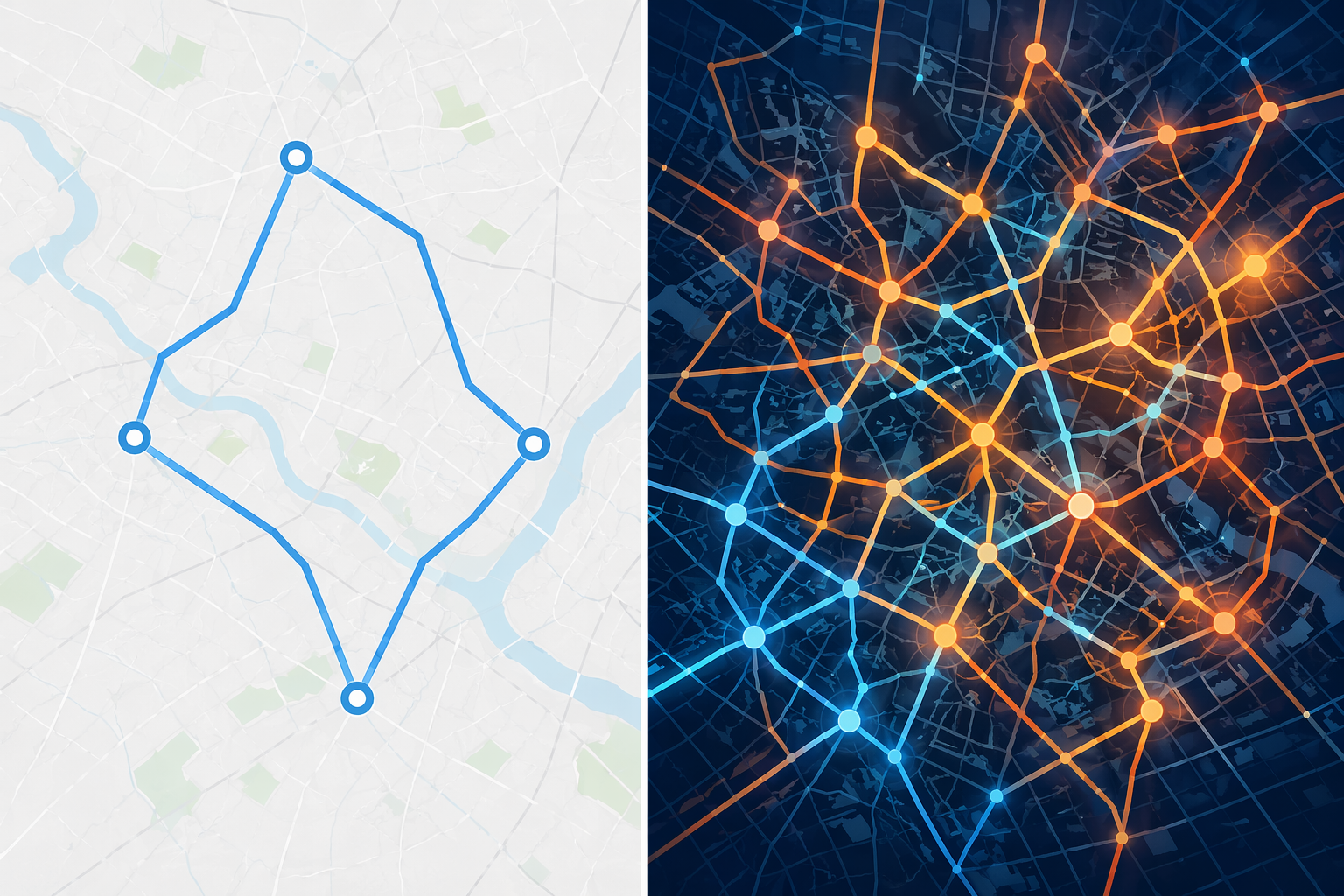
If you searched for AI route optimization free, the plain answer is this: free route optimization tools can be genuinely useful, but most are not AI in the machine-learning sense. They usually take a fixed set of stops, apply a deterministic or heuristic routing method, and return a better sequence than a dispatcher would build by hand. That is still valuable. It is just not the same thing as a system learning from delivery history, driver behavior, service-time patterns, live traffic, capacity constraints, and late-day exceptions.
The practical question is not whether a free planner is “good” or “bad.” A free planner may be exactly right for a contractor with one van, a handful of stops, and no promise more specific than “today.” The trouble starts when a free-tier route sequencer is treated like a full AI dispatch engine. Those two tools sit in different operating worlds.
The free tier usually tells you what the product is built to handle
Stop limits are not just pricing details. They are a useful clue about the workload the vendor expects the free product to carry. As of June 2026, free route-planning limits across commonly mentioned tools cluster around small daily routes, not multi-driver dispatch operations.[1][2][3]
| Tool | Free-tier routing boundary noted in available sources | What that usually means operationally |
|---|---|---|
| Google Maps | 10 stops | Useful for a very small route, manual adjustment still likely |
| Apple Maps | 15 stops | Good for navigation and light sequencing, not fleet optimization |
| MapQuest | 26 stops | Higher stop count, still a consumer/light-business planning pattern |
| RouteXL | 20 stops free; 250 on paid | Clear boundary between small-route planning and heavier optimization |
| NextBillion.ai Free | 10 stops | Developer-friendly entry point, not a full-scale dispatch setup |
| Circuit Route Planner Free | 10 stops | Suitable for testing or very small delivery rounds |
| RoadWarrior Free | 8 stops | A light route planner for limited daily use |
| Routific Free | 100 orders/month | Monthly cap matters more than a single-route cap for recurring delivery work |
A dispatcher can do real work inside those limits. A florist running a few local deliveries, a service technician stacking appointments across one side of town, or a small courier business testing whether route planning beats spreadsheet sorting may get immediate value. Nobody needs enterprise software to sequence eight stops.
But the ceiling arrives quickly. Once the operation has multiple drivers, promised time windows, recurring customers, vehicle capacity limits, pickups mixed with drop-offs, or midday changes, the stop count is no longer the only issue. The tool has to understand constraints, not just draw a shorter line.
Why a better sequence is not automatically AI
Route optimization is often built around the traveling salesman problem: given a set of stops, find an efficient order to visit them. That problem becomes ugly fast. Routific’s explanation of TSP complexity gives the useful example that 25 stops can produce 15.5 septillion possible route combinations.[4] No dispatcher is checking those manually, and no ordinary app is brute-forcing every option in real time.

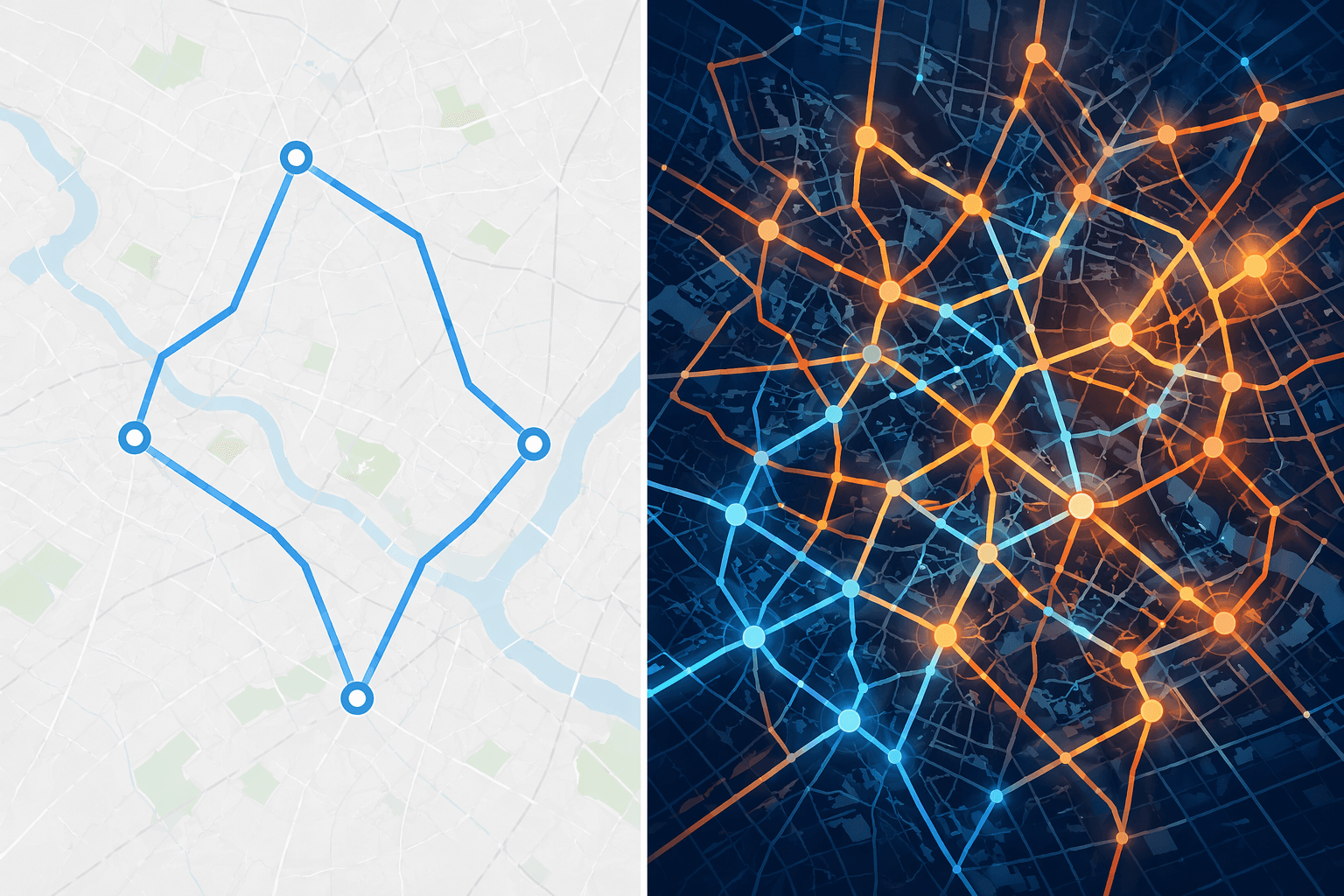
That is why many tools use heuristics: practical methods that search for a good route without exhaustively testing every possible route. A heuristic can be fast, inexpensive to run, and a major improvement over manual sequencing. It may also be entirely deterministic. Give it the same stops and the same settings, and it will produce the same or similar answer because it is solving the current input set, not learning from a body of past deliveries.
Machine-learning-based route optimization is different. In vendor descriptions of paid AI systems, the route engine may be trained on large delivery histories and may process a wider set of variables: traffic patterns, delivery time windows, vehicle capacity, driver skills, customer preferences, and historical delivery durations. Onfleet, for example, describes AI routing models trained on more than 400 million deliveries and contrasts that with simpler optimization approaches using a much smaller set of static variables.[5]
That Onfleet figure should be read as vendor-published evidence, not neutral proof that every paid AI platform will perform the same way. Still, it points to the real distinction. Free tools commonly optimize from the information you type in today. More advanced AI systems try to improve the decision by using what the operation, drivers, customers, and network have already taught the system.
A simple example of the method gap
Imagine two stops that are close together on a map. A basic optimizer may put them back-to-back because the mileage is low. A richer system might separate them because one customer usually takes longer to receive goods, one street becomes difficult after school dismissal, the driver assigned to that zone has a better success rate with a certain customer type, or a delivery window penalty matters more than a few extra minutes of drive time.
That example is hypothetical, but the operating pattern is familiar: the shortest-looking route is not always the route that survives contact with the day. The more constraints you have, the more expensive a “free” route can become after someone has to repair it.
When a free route planner is enough
Free tools are a reasonable fit when the job is small, the route is mostly static, and the cost of a slightly imperfect sequence is low. Geotab’s 2026 route optimization software roundup frames free tools as most suitable for operations under roughly 20 stops, a single driver, and occasional use.[6]
- One driver is covering a small route.
- Stops are not changing constantly after dispatch.
- Delivery windows are loose or informal.
- Vehicle capacity is not a binding constraint.
- The route is planned occasionally, not as a dense daily operation.
- A person can still review and correct the route without delaying the day.
In that setting, Google Maps, Apple Maps, RouteXL, Circuit, or another free planner can be a perfectly practical bridge. The tool may not be “AI,” but it may still remove a lot of low-value planning work. For a business coming from manual address sorting, even a basic optimizer can feel like a step change.
The mistake is expecting that same layer to behave like a dispatch brain. A free planner may choose a decent stop order before the driver leaves. It usually will not keep re-solving the route as drivers fall behind, customers reschedule, service times stretch, or capacity problems appear.
When paying starts to make operational sense
Paid route optimization becomes easier to justify when routing errors begin to create visible operating costs: missed windows, overtime, extra miles, vehicle underuse, failed deliveries, dispatcher rework, or customer-service calls. The trigger is not a magical stop count. It is the point where the route plan has to account for more variables than a lightweight tool can process.
| Operating condition | Free planner likely fit? | Why the paid tier may matter |
|---|---|---|
| One driver, under about 20 stops, loose windows | Often yes | Manual review can catch most issues |
| Multiple drivers sharing the same delivery area | Often no | The system must allocate work, not just sequence one route |
| Tight delivery or service windows | Risky | A short route can still be a late route |
| Capacity, skills, equipment, or vehicle-type constraints | Usually no | The optimizer must know which driver or vehicle can legally or practically serve each stop |
| Recurring delivery density | Depends | Historical service times and customer patterns start to matter |
| Midday order changes or live exception handling | Usually no | Static pre-dispatch routing is not enough |
There is also a personnel cost hidden here. If a coordinator spends the morning cleaning up imported stops, resequencing routes, calling drivers, and explaining late arrivals, the software may be free while the operation is not. That does not mean the business should immediately buy the most advanced AI platform. It means the real comparison is between subscription cost and the cost of workarounds.
For a deeper technical look at what dynamic AI routing does once live constraints enter the picture, see AI-driven dynamic routing optimization for last-mile delivery.
What the big ROI numbers can and cannot tell a small fleet
The strongest route-optimization economics come from large, deeply embedded systems. UPS ORION is the obvious scale marker: FleetRabbit’s 2026 discussion cites a $250 million development cost, $300 million to $400 million in annual savings, and 100 million miles eliminated.[7] Those figures are useful because they show what routing can be worth when the network is huge and the system is built into daily execution.
They are less useful if they are used to imply that a small business buying a SaaS subscription will see UPS-like economics. ORION is not a plug-in free tier. It is an enterprise deployment at enterprise scale, and the cited cost and savings figures trace back to corporate and case-study reporting rather than a universally transferable benchmark.
FleetRabbit also reports industry-average fuel savings of 10% to 20% from AI routing and planning-time reductions of 75% to 85%.[7] Those numbers are directionally plausible for operations with enough routing complexity, but they are vendor-published benchmarks. A small fleet should treat them as a prompt to build its own model: current fuel spend, dispatcher hours, overtime, failed delivery rate, and customer penalties before and after the routing change.
The buying decision is mostly about data depth, not the word “AI”
The route-planning market has made “AI” too elastic. Some vendors use it for any algorithm that improves a route. Others reserve it for machine-learning systems trained on large operational histories. Because there is no single industry-standard definition in everyday marketing, buyers have to ask narrower questions.
- Does the system only optimize from today’s stop list, or does it learn from historical delivery durations and outcomes?
- Can it account for time windows, vehicle capacity, driver skills, service times, customer preferences, and traffic patterns at the same time?
- Does it re-optimize routes during the day when orders, delays, or cancellations appear?
- Can it assign work across multiple drivers or vehicles, or only sequence stops for one route?
- Does the reporting show operational outcomes, or only route distance and estimated drive time?
A free tool that honestly provides basic route sequencing is not a problem. It may be the right answer for another quarter, especially if the alternative is no optimization at all. The problem is buying into the label before checking the operating fit. Free tiers usually deliver useful route planning, not true AI optimization. Paying starts to make sense when the business needs richer data processing, learning from history, and real-time handling of constraints that a capped route planner was never built to carry.
References
- 10 Best Free Route Planners, Routific
- Top 5 Free Route Planner Apps, NextBillion.ai
- Top 5 free route planning apps, Kardinal
- Algorithms for the Travelling Salesman Problem, Routific
- 3 Best AI Route Optimization Software in 2026, Onfleet
- 9 best route optimization software tools for fleets [2026], Geotab
- AI Route Optimization vs Traditional Methods in 2026, FleetRabbit
Comments
Join the discussion with an anonymous comment.