
Why AI Architecture, Not AI Features, Is the 2026 Differentiator
Through 2024 and 2025, the question most supply chain leaders asked during software evaluations was simple: "Does it have AI?" Nearly every vendor answered yes, and the market responded accordingly. The AI in supply chain market reached an estimated $9.94 billion in 2025, with Precedence Research projecting a 37.3% compound annual growth rate to $236 billion by 2035. A separate survey from ABI Research found that 94% of supply chain companies plan to use AI or generative AI for decision support within two years.
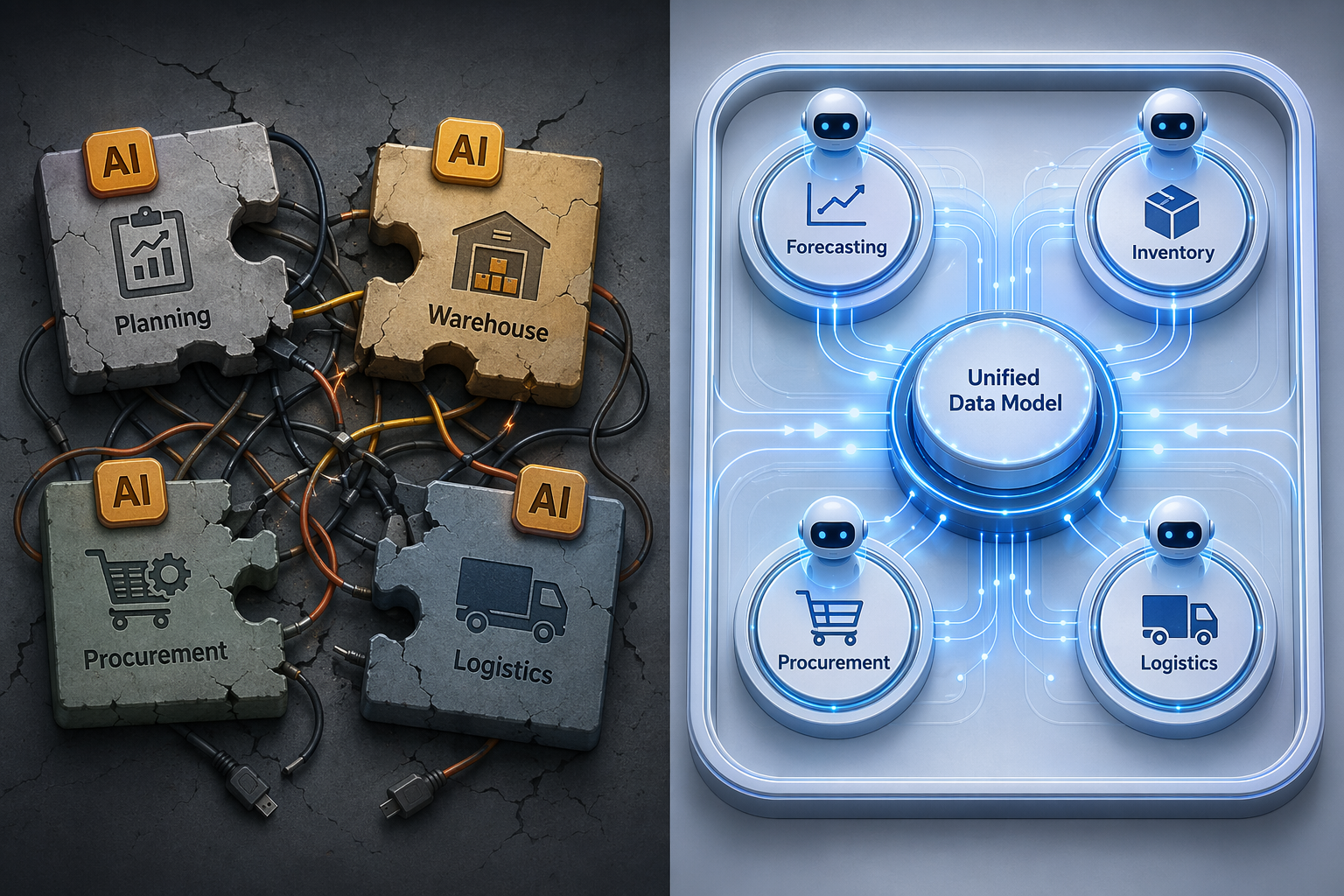
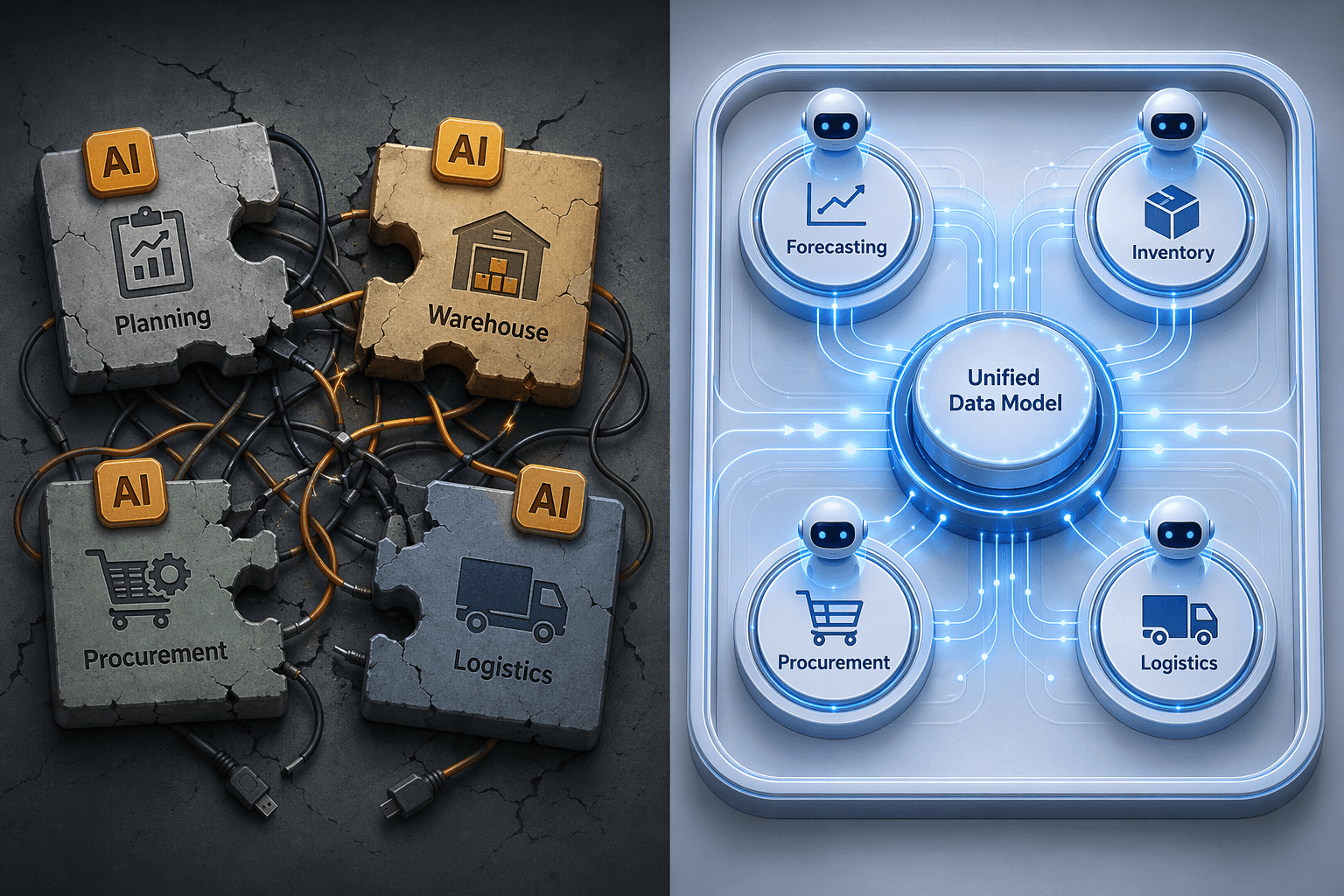
But in 2026, the question has shifted. The market has matured past the binary "AI or not" check. The real differentiator is no longer whether a platform has AI capabilities, but how that AI is architected — and specifically, whether it is bolted onto a legacy planning engine or natively embedded into a unified data model with agentic execution capabilities.
This distinction matters because it directly determines the speed at which a platform can move from signal to action. Gartner forecasts that supply chain management software with agentic AI capabilities will grow from less than $2 billion in 2025 to $53 billion in spend by 2030, and predicts that by 2030, 60% of enterprises using SCM software will have adopted agentic AI features, up from just 5% in 2025. The firms that select platforms built for this trajectory will have a structural advantage over those that lock into bolt-on architectures that cannot close the loop between insight and execution.
Five Evaluation Criteria That Separate Effective Deployments from Underperformers
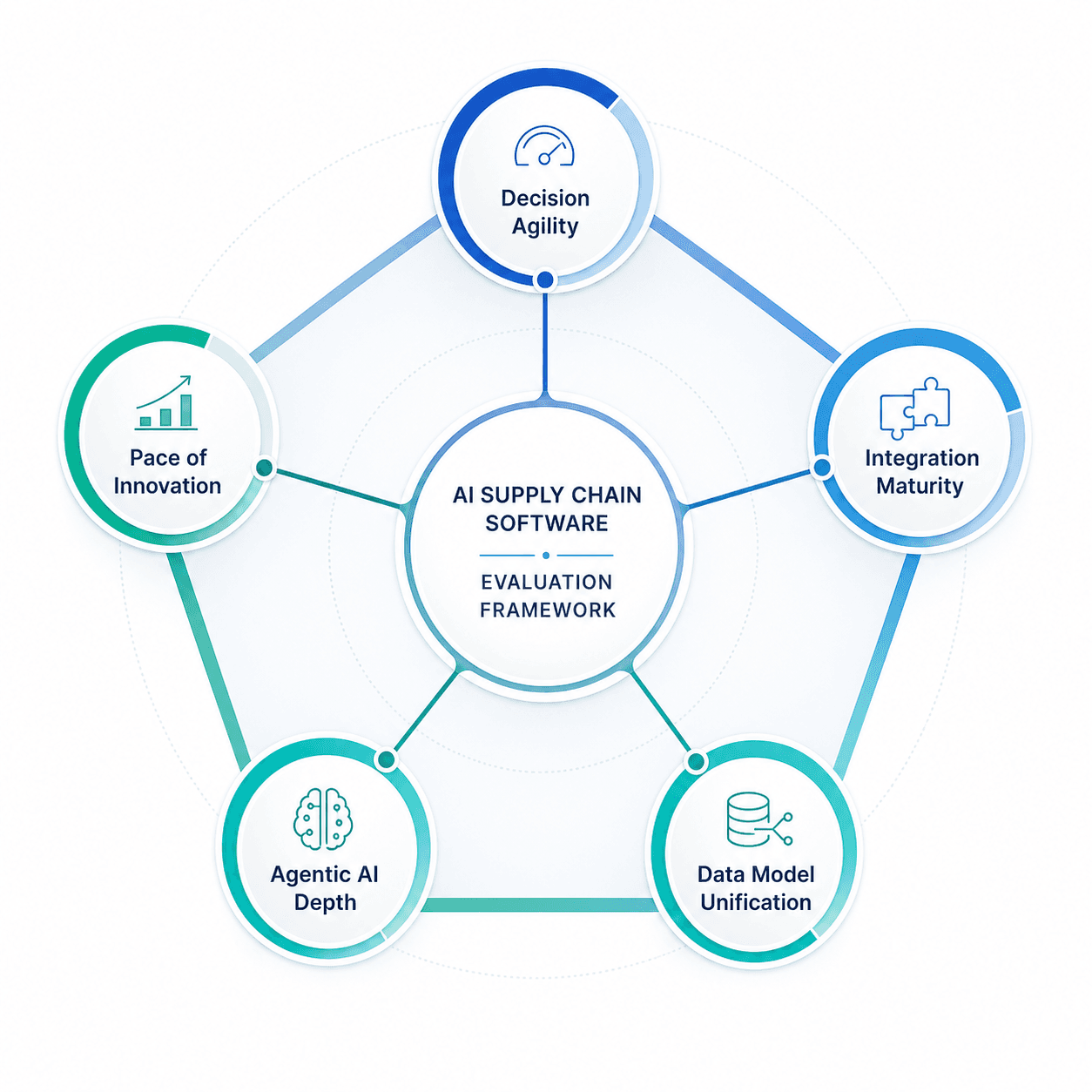
Feature checklists are no longer sufficient for vendor selection. The following five criteria, drawn from independent analyst frameworks and documented deployment outcomes, provide a structured lens for evaluating platforms. Each criterion addresses a specific failure mode observed in underperforming AI supply chain deployments.
1. Decision Agility: Signal-to-Action Speed
Decision agility measures the time between an external signal — a demand shift, a supplier delay, a port closure — and an actionable decision executed in the system. Platforms with natively embedded AI can compress this window from days to minutes. The Deposco buyer's guide notes that organizations running AI effectively across supply chain functions see order fulfillment speeds improve by 40%, inventory accuracy exceed 99%, and labor productivity gains of 30–50%. These outcomes are not achievable when AI recommendations must pass through manual review cycles in disconnected modules.
2. Integration Maturity: Beyond Plug-and-Play Claims
Every vendor claims easy integration with ERP, WMS, and TMS systems. The reality is that integration maturity varies dramatically. Platforms designed with open APIs and pre-built connectors to systems like SAP, Oracle, and Microsoft Dynamics reduce deployment risk. The Panorama Consulting Group assessment identifies integration maturity as one of five key evaluation criteria, emphasizing that plug-and-play integration with existing enterprise systems is a prerequisite for AI to function on current, accurate data.
3. Data Model Unification: Single Source of Truth vs. Silos
Data fragmentation is the single most common cause of AI underperformance in supply chain. The Deposco guide identifies it as one of three structural issues that cause AI systems to fail. Platforms that maintain separate data models for planning, inventory, logistics, and procurement force AI models to reconcile inconsistent definitions of products, locations, and lead times. Platforms with a unified data model — where all functions operate on the same semantic layer — eliminate this reconciliation overhead and produce more reliable predictions.
4. Agentic AI Depth: Decision-Support vs. Closed-Loop Execution
This is the 2026 dividing line. Most platforms today offer decision-support AI: dashboards, alerts, and recommendations that a human planner must review and approve. Agentic AI goes further — it executes discrete tasks within defined parameters. Gartner notes that "simple AI agents are capable of executing discrete supply chain tasks" and that as business value is demonstrated, leaders will start prioritizing investments in "clusters of simple AI agents to enable orchestration of multi-step workflows." The gap between decision-support and closed-loop execution is where most ROI leakage occurs.
5. Pace of Innovation: Release Cadence and Platform Evolution
Supply chain AI is evolving rapidly. Platforms that release quarterly or monthly updates — adding new AI models, data connectors, and agent capabilities — provide a faster path to value than platforms with annual release cycles. The Panorama framework includes pace of innovation as a core criterion, specifically calling out the ability to leverage AI and digital twin capabilities as markers of a platform's forward trajectory.
Tiered Vendor Landscape: Enterprise, Mid-Market AI-Native, and Specialist Platforms
The AI supply chain software market in 2026 is best understood through three tiers, each serving a distinct buyer profile. The Viewpoint Analysis guide and Horizon Solutions market overview both segment the landscape this way, and the distinction maps directly to the five evaluation criteria above.
Enterprise Tier: For $3B+ Operations with Complex Global Networks
Enterprise platforms — Blue Yonder, o9 Solutions, Kinaxis, SAP IBP, and Oracle SCM — are designed for organizations with multi-echelon supply chains, thousands of SKUs, and global sourcing networks. These platforms typically offer the deepest functional coverage but require significant implementation investment.
Blue Yonder's Luminate platform, for instance, has documented outcomes including 7–15% savings for DHL. Kinaxis Maestro delivered a 47% increase in forecast accuracy and a 14% reduction in on-hand inventory for a pharmacy services company. o9 Solutions has helped a capital goods manufacturer increase forecast accuracy, though specific figures were not disclosed in the source material.
The trade-off is deployment complexity. Enterprise platform implementations typically run 6–18 months, and the Deloitte data cited in the Open Sky Group aggregation shows that while 85% of organizations increased AI investment in the past year, only 6% saw ROI in under a year, with most achieving satisfactory ROI within 2–4 years.
Mid-Market AI-Native Tier: Modern Architecture Without Enterprise Overhead
For organizations in the $100 million to $3 billion revenue range, a new generation of AI-native platforms offers modern architecture without the implementation burden of enterprise suites. This tier includes Horizon, Logility, RELEX, and Deposco. These platforms were built with AI embedded from the start — they do not carry legacy planning engines with AI layered on top.
The Horizon Solutions guide distinguishes between "AI as marketing (older platforms rebranded), AI as architecture (designed with AI embedded), and AI as workflow (assisting planner decisions)." Mid-market AI-native platforms fall into the second category. They typically offer faster deployment timelines — the Deposco guide cites payback periods of 6 to 18 months for well-implemented platforms — and lower total cost of ownership.
Specialist and Collaboration Tier: Targeted Solutions for Specific Functions
A third tier addresses specific functional gaps that general-purpose planning platforms do not cover well. This includes Altana for supply chain visibility and supplier risk, Pactum for autonomous procurement negotiation, Aera Technology for decision automation, E2open for multi-enterprise collaboration, and Pando for logistics execution.
These platforms often deliver high-impact outcomes in narrow domains. A packaging manufacturer using Pando cut freight spend by 4% and achieved an 80% boost in team productivity. Veritiv using Pactum improved long-tail supplier contract efficiency. A candy maker using E2open improved forecast accuracy by over 23%. For organizations that already have a core planning platform, these specialists can fill critical gaps without replacing the entire stack.
| Tier | Revenue Band | Representative Vendors | Typical Deployment Timeline | AI Architecture |
|---|---|---|---|---|
| Enterprise | $3B+ | Blue Yonder, o9, Kinaxis, SAP IBP, Oracle SCM | 6–18 months | Mixed: some native, some bolt-on AI layers |
| Mid-Market AI-Native | $100M–$3B | Horizon, Logility, RELEX, Deposco | 3–12 months | AI embedded from platform inception |
| Specialist / Collaboration | Varies | Altana, Pactum, Aera, E2open, Pando | 2–6 months per function | Purpose-built AI for specific domain |
Decision Tables: Matching Vendor Strengths to Your Company Profile
The following decision tables map vendor strengths to specific buyer dimensions. These are not rankings — they are fit assessments based on documented platform capabilities, target customer profiles, and independent analyst evaluations from Panorama, Viewpoint Analysis, and Horizon Solutions.
| Buyer Dimension | Best-Fit Tier | Key Consideration |
|---|---|---|
| Revenue over $5B with global multi-echelon network | Enterprise | Prioritize platforms with proven multi-echelon inventory optimization (MEIO) and global data model unification |
| Revenue $500M–$3B, moderate supply chain complexity | Mid-Market AI-Native | Look for faster deployment, lower TCO, and modern architecture without legacy constraints |
| High demand volatility (seasonal CPG, fashion) | Enterprise or Mid-Market | Evaluate probabilistic forecasting depth and demand sensing capabilities specifically |
| High logistics cost as % of revenue | Specialist (Pando, Shipsy) or Enterprise TMS | Documented outcomes: Pando 4% freight reduction, Shipsy 20% delivery time reduction |
| Supplier risk and visibility gaps | Specialist (Altana, E2open) | Network-based visibility platforms often outperform planning suites for supplier intelligence |
| Low data maturity, limited IT resources | Mid-Market AI-Native | Platforms with pre-built data connectors and faster time-to-value reduce implementation risk |
| Agentic AI as a priority for 2026–2028 roadmap | Enterprise with agentic roadmap or AI-native | Gartner predicts 60% enterprise adoption by 2030; evaluate current agent capabilities vs. roadmap |
For readers who need a more exhaustive list of vendors organized by functional category, the AI Supply Chain Companies 2026: The Definitive Vendor Directory provides a comprehensive reference organized by demand planning, procurement, warehouse management, logistics, and inventory optimization.
The Insight-Action Gap: Why Decision-Support Alone Is Not Enough
The single biggest source of ROI leakage in AI supply chain software is not model accuracy — it is the gap between insight and action. A platform can generate perfectly accurate demand forecasts, but if those forecasts sit in a dashboard waiting for a human planner to review and act, the value decays with every passing hour.
The Deposco buyer's guide frames this as the "insight-action gap" and identifies it as one of three structural issues that cause AI underperformance, alongside data fragmentation and bolt-on architecture. Platforms that close this gap — by allowing AI to execute decisions within defined parameters — consistently outperform decision-support-only platforms on measurable outcomes.
The documented outcomes from the AIMultiple analysis illustrate this performance delta clearly:
- Kinaxis Maestro: A pharmacy services company achieved a 47% increase in forecast accuracy and 14% reduction in on-hand inventory — outcomes driven by the platform's ability to automate re-planning cycles.
- Pando: A packaging manufacturer cut freight spend by 4% and achieved an 80% boost in team productivity through automated logistics execution.
- Vecna Robotics: A national home goods retailer achieved cost efficiency of $9 per hour per robot with a positive ROI in less than 8 months — a closed-loop execution system where AI directly controls warehouse robot dispatch.
- Coupa (now part of Accel-KKR): Onsemi made decisions 85% faster and saw 10–15% improvement in capital efficiency through AI-driven procurement execution.
These outcomes share a common pattern: the AI system does not just recommend — it executes within defined guardrails. This is the distinction between decision-support AI and agentic AI, and it is the primary reason why Gartner forecasts such aggressive growth for agentic capabilities in SCM software.
For a deeper analysis of how AI-native platforms achieve this performance gap compared to legacy systems with bolt-on AI, see the AI-Native vs. Legacy Supply Chain Platforms: The Real Performance Gap in 2026 analysis.
Implementation Timeline Realities: What the Research Says About ROI
The gap between AI investment and realized value is one of the most persistent challenges in supply chain technology. The Deloitte data, aggregated in the Open Sky Group report, provides a sobering benchmark: 85% of organizations increased AI investment in the past year, yet only 6% saw ROI in under a year. The majority of organizations achieve satisfactory ROI within 2–4 years.
This timeline varies significantly by platform tier and deployment scope:
| Deployment Scenario | Typical Timeline to First Value | Typical Timeline to Full ROI | Key Risk Factors |
|---|---|---|---|
| Enterprise platform, full suite deployment | 6–12 months | 2–4 years | Data fragmentation, organizational change resistance, integration complexity |
| Enterprise platform, phased rollout (single function first) | 3–6 months per function | 18–36 months | Scope creep, cross-functional data dependencies |
| Mid-market AI-native platform | 2–4 months | 6–18 months | Data quality, limited IT support for customization |
| Specialist platform (single function) | 1–3 months | 3–12 months | Integration with existing planning platform, limited scope of value |
A critical risk factor that compounds these timelines is the lack of formal AI strategy. Gartner found that only 23% of supply chain organizations have a formal AI strategy. This means three out of four buyers enter vendor evaluations without documented investment criteria, success metrics, or governance frameworks — a gap that significantly increases the risk of selecting a platform that does not align with organizational readiness.
The Accenture data reinforces the upside of getting this right: companies with AI-mature supply chains are 23% more profitable. But the path to that outcome requires realistic expectations about deployment timelines, honest assessment of data readiness, and a structured evaluation framework.
How to Use This Framework: A Step-by-Step Selection Methodology
The Viewpoint Analysis guide provides a five-step selection methodology that aligns well with the comparison framework presented in this article. The following process adapts that methodology for the specific context of evaluating AI architecture and agentic capabilities.
- Map your planning scope and pain points. Identify which supply chain functions — demand planning, inventory optimization, procurement, logistics, warehouse operations — are the primary sources of cost, risk, or inefficiency. This determines whether you need a full-suite platform or a specialist solution.
- Assess data readiness honestly. Data fragmentation is the most common cause of AI underperformance. Before engaging vendors, audit your data landscape: Are product, location, and supplier definitions consistent across ERP, WMS, and TMS? Do you have clean historical data for the functions you want to automate? The KPMG article in Supply Chain Management Review emphasizes that "having standard processes and data is foundational for organizations as they start to weave AI into their efforts."
- Define success metrics before vendor demos. Without documented success criteria, every vendor will appear to meet your needs. Define specific, measurable outcomes: forecast accuracy improvement targets, inventory reduction goals, logistics cost reduction percentages, or decision-cycle compression targets. The 23% of organizations with formal AI strategies (per Gartner) are the ones that can articulate these metrics.
- Require vendors to demonstrate three specific AI-driven decisions on your actual data. The Horizon Solutions guide recommends this as a tactic to cut through generic capability claims. Ask each vendor to run your data through their platform and show three concrete decisions the AI would make — not just dashboards and alerts, but actual execution recommendations or automated actions.
- Evaluate the agentic AI roadmap against your 3-year planning horizon. Gartner's forecast of 60% enterprise adoption of agentic AI by 2030 means that the platform you select today must have a credible path to agentic capabilities. Ask vendors: What agentic capabilities are in production today? What is on the roadmap for the next 12–24 months? How do you handle governance, audit trails, and human-in-the-loop oversight for autonomous decisions?
For readers who want to explore specific vendors in more depth, the ChainSignal vendor directory provides detailed profiles of each platform mentioned in this comparison. The Kinaxis Maestro vendor profile and Blue Yonder platform review provide deeper dives into two of the most widely evaluated enterprise platforms. For a narrower comparison of platform versus specialist approaches, the C3 AI vs. Specialized Demand Forecasting Tools analysis examines when a broad platform approach wins and when a focused specialist tool is the better choice.
The AI supply chain software market in 2026 rewards buyers who evaluate architecture as rigorously as they evaluate features. The platforms that will deliver the highest ROI over the next three to five years are not necessarily the ones with the longest feature lists — they are the ones with unified data models, agentic execution capabilities, and the architectural foundation to evolve as AI capabilities advance.
Comments
Join the discussion with an anonymous comment.