
A Middle East travel advisory becomes a supply chain event when it removes lift, changes routing options, or forces a supplier conversation before the purchase order is ready. In July 2026, that line was crossed quickly: Smartraveller reported an EU aviation advisory to avoid Gulf airspace through at least 29 July 2026, with more than 21,300 flight cancellations tied to the conflict’s travel and security impacts.[1] Metro Global separately reported a 22% reduction in global air cargo capacity and a 52% reduction in outbound Middle East-to-Europe capacity.[2]
For a logistics team, those are not background conditions. They are capacity constraints with a clock attached. If a critical component normally moves by air through Gulf-connected routings, the question is no longer whether the advisory is relevant. The question is how fast the team can identify exposed lanes, see which suppliers and orders depend on those lanes, confirm whether carriers are still accepting bookings, and decide who has authority to pay for alternatives.
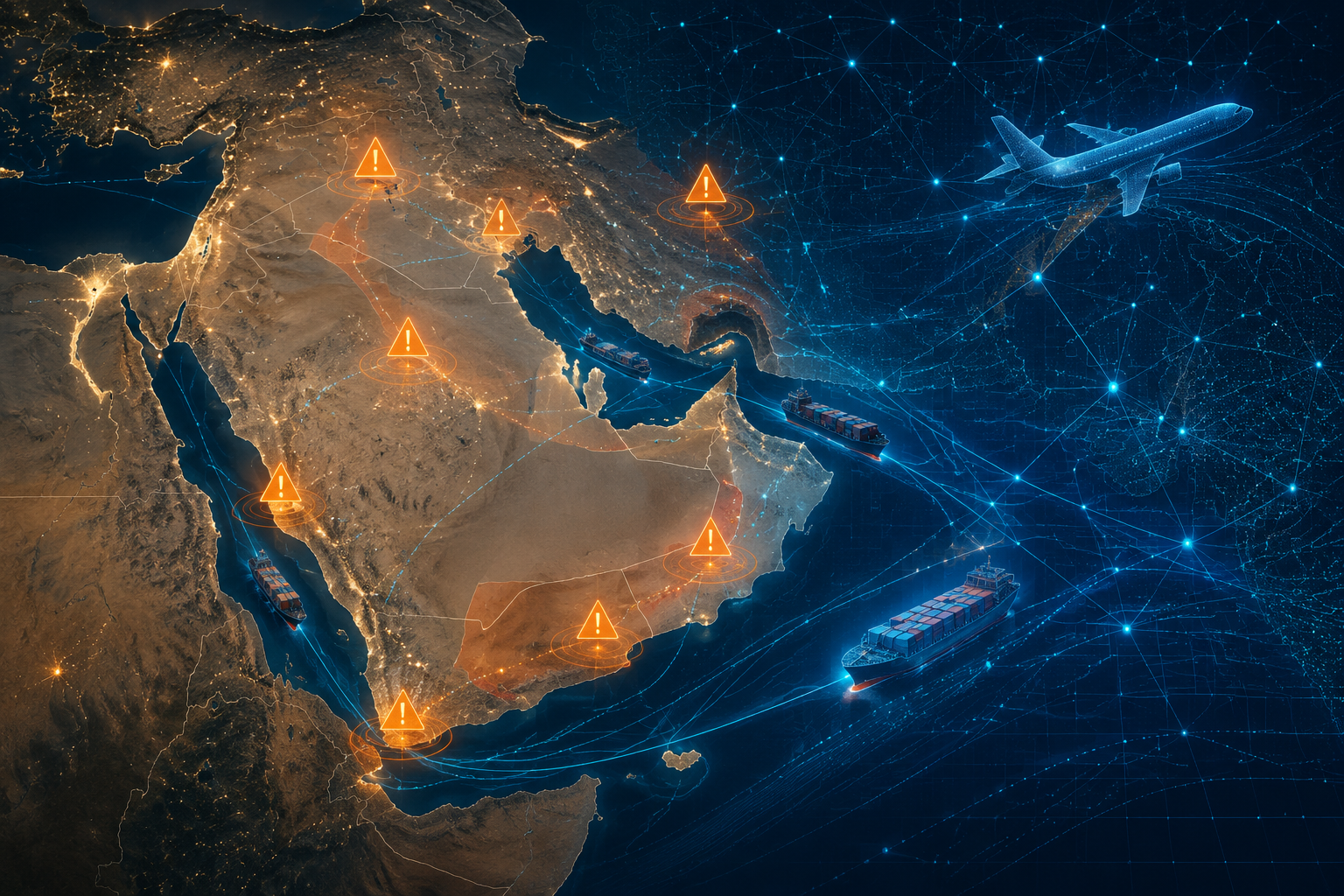
That is where the practical case for AI supply chain risk monitoring around Middle East travel advisories begins. The value is not that an AI system reads a government alert faster than a person can open a browser. The value is that it can read the advisory alongside aviation notices, maritime alerts, vessel movements, carrier surcharge changes, insurance signals, and port indicators, then map the result against the company’s own lanes, inventory, suppliers, and open orders.
The advisory is only the first signal
Manual monitoring usually starts with a simple handoff problem. Someone sees a government advisory. Someone else checks air cargo bookings. A regional logistics manager asks whether ocean freight is also affected. Procurement wants to know which suppliers sit inside the exposure map. Finance asks whether a surcharge is temporary or needs approval. By the time those questions move through email, the useful booking window may already have narrowed.
AI risk intelligence platforms try to shorten that interval by treating the advisory as one input in a live signal set, not as a standalone notice. A Gulf airspace advisory matters more when IATA NOTAMs show route restrictions, carrier service alerts announce war-risk surcharges, AIS data shows changing vessel transit patterns through Hormuz, UKMTO or JMIC alerts indicate maritime security risk, satellite imagery suggests port congestion, and war-risk premium pricing begins to move. None of those feeds tells the full story alone. Together, they turn a safety advisory into a logistics exposure question.
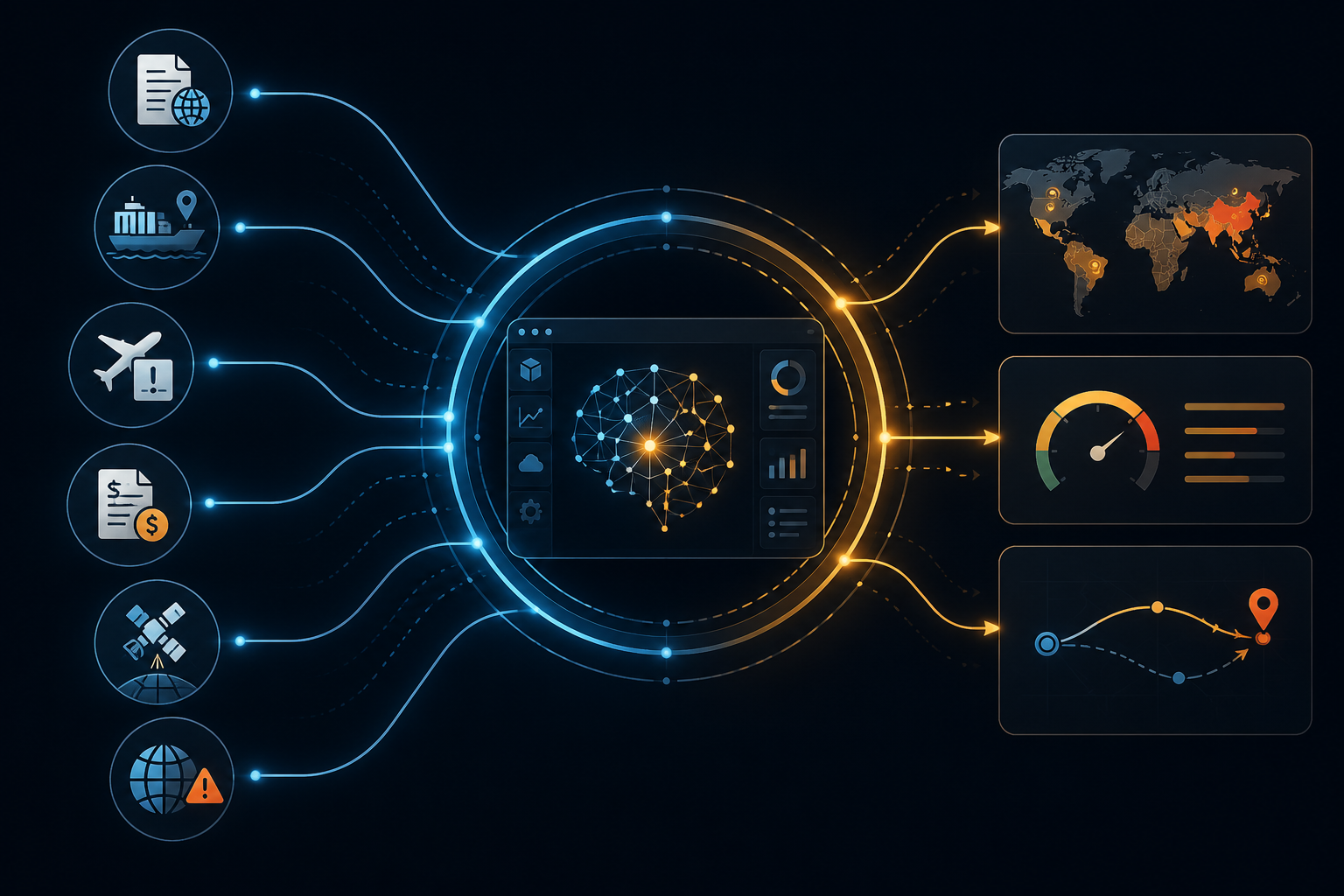
The important distinction is between alerting and operational relevance. A travel advisory may describe aviation risk for travelers. A supply chain platform has to answer a different set of questions: which booked shipments are routed through affected airspace, which suppliers depend on the same corridor, whether lead times are still compatible with production schedules, and whether inventory buffers can absorb a delay.
| Signal | What it can indicate operationally | What still needs verification |
|---|---|---|
| Smartraveller or other government advisory | Potential route restrictions, personnel movement limits, or escalation of regional risk | Applicability to specific lanes, sites, and carrier routings |
| IATA NOTAMs and aviation notices | Airspace closures, route changes, longer flight times, or reduced air cargo options | Carrier-specific acceptance, cutoffs, and available uplift |
| UKMTO/JMIC maritime alerts | Security risk near sea lanes, ports, or chokepoints | Whether booked vessels, feeder services, or transshipment ports are exposed |
| AIS vessel data | Route deviations, slowed transits, anchorage buildup, or reduced traffic through a corridor | Whether changes are disruption-driven or routine operational variation |
| Carrier surcharges and war-risk premiums | Cost pressure, risk repricing, or carrier reluctance to serve a lane | Contract impact, approval thresholds, and alternative capacity |
| Satellite imagery | Port congestion, queue buildup, infrastructure changes, or unusual activity | Cause, severity, and expected duration |
This is also why broad claims about AI adoption should be handled carefully. A company may have deployed AI or machine learning somewhere in the enterprise and still have no direct AI workflow for travel-advisory monitoring. The relevant question for a logistics director is narrower: does the platform ingest the right public, commercial, and internal feeds; does it resolve locations and entities accurately; and does it connect those signals to the lanes and suppliers that matter?
From detection to action, the workflow has to be traceable
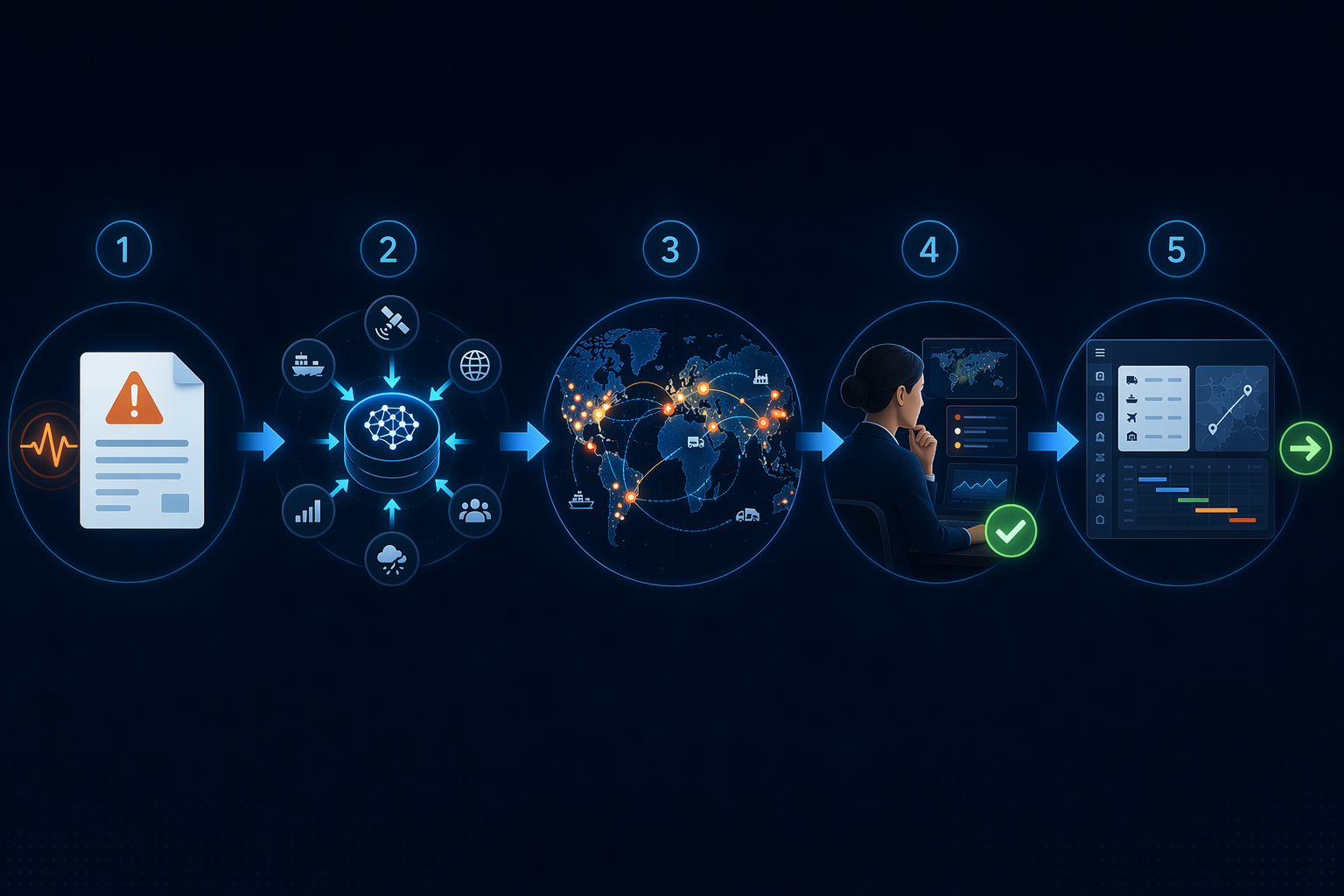
The useful workflow is not complicated in theory. It is hard in practice because each handoff crosses a different team boundary. A defensible AI-supported process usually looks like this:
- A travel advisory or aviation security update enters the monitoring environment.
- The platform correlates it with NOTAMs, maritime alerts, AIS movements, carrier announcements, insurance signals, and satellite indicators.
- The system maps potential exposure against the company’s booked shipments, contracted lanes, supplier locations, purchase orders, and inventory positions.
- A risk analyst or regional owner verifies whether the signal is material, duplicated, stale, or misclassified.
- The recommendation moves into the TMS, SCM, procurement, or control tower workflow where someone can reroute, rebook, expedite, hold, or escalate.
The fourth step is not a courtesy step. Bloomberg’s supply chain risk framework, described by SDCExec, emphasizes a “risk intelligence trifecta” of human analysts, interoperable data, and AI/ML detection.[3] That framing is useful because it resists the easy mistake of treating automated detection as automated judgment. AI can cluster weak signals and surface anomalies. It cannot own the escalation threshold, call a supplier relationship, or decide whether a plant should absorb the cost of a premium routing.
This is where buyers evaluating vendors should spend more time than most demos allow. A dashboard that flashes red across the Gulf is not enough. A logistics team needs to know whether the alert is tied to actual shipment references, whether the underlying sources can be inspected, whether the model distinguishes a country-level advisory from a lane-specific restriction, and whether the recommendation can be handed to the person who controls the shipment plan. For a deeper vendor-screening lens, the evaluation criteria in Choosing an AI Platform for Geopolitical Supply Chain Risk are the right place to pressure-test claims about coverage, explainability, integrations, and analyst support.
The July 2026 airspace shock is a useful stress test
The July 2026 disruption shows why speed matters, but also why speed has to be connected to execution. A 21,300-plus cancellation count is a strong market signal, yet it does not tell a shipper which purchase orders are at risk.[1] A 52% reduction in outbound Middle East-to-Europe air cargo capacity is sharper, but still does not decide whether the correct response is a different air gateway, a sea-air option, a production resequencing decision, or a customer-allocation call.[2]
An AI-supported process can make the first hour more useful. It can flag that a booked lane depends on exposed airspace, identify shipments with no inventory cover at destination, compare the lane against carrier service alerts, and pull in supplier locations that sit within the same regional risk envelope. That does not settle the response. It gives the regional logistics owner and procurement lead a shorter, cleaner list of decisions.
The most valuable output is often not a single recommendation. It is a ranked work queue: shipments already tendered but not uplifted, orders tied to constrained production lines, suppliers without alternate origin options, customer commitments with contractual penalties, and lanes where capacity is still available but cost approval is needed. In a disruption, that queue is more useful than a polished risk score with no owner.
Supplier exposure deserves its own check because corridor risk and supplier risk are related but not identical. A supplier can be physically outside the immediate advisory area and still depend on a Gulf-connected air export lane, a regional transshipment hub, or a sub-tier component flow. Moving from corridor-level monitoring to entity-level exposure requires supplier records that are clean enough to map, classify, and update. The comparison in Procurement AI Supplier Risk Scoring: Methods Compared is useful here because the scoring method changes what procurement can trust during a live escalation.
What current outcome evidence can and cannot prove
The outcome evidence points in the right direction, but it should not be read as independent proof that every enterprise will see the same gains. Everstream Analytics reports client outcomes including a 5% reduction in expedited freight, a 10% improvement in on-time performance, and a 30% reduction in revenue losses from disruption.[4] The same vendor material says companies using AI risk monitoring report a 50–70% reduction in time to identify and assess disruption impact.[4]
Those figures are useful as directional evidence, especially for teams building a business case, but they come from vendor marketing materials rather than independent audits. The safer reading is that AI risk monitoring can reduce the assessment burden when it is connected to relevant data and workflow systems. It is not evidence that a platform purchase, by itself, reduces freight cost or protects revenue.
The same caveat applies to adoption context. HSBC’s April 2026 survey, fielded in mid-March, found that 60% of Saudi and UAE firms considered access to critical AI technologies a major strategic influence, while 94% expected trade to become more regional and 98% of Saudi businesses and 95% of UAE businesses saw international growth opportunities from reconfiguring supply chains.[5] That is a strong signal that AI and supply chain redesign are board-level topics in the region. It is not direct evidence that those firms are using AI specifically to monitor travel advisories.
For logistics risk teams, the better benchmark is operational: how much time passes between advisory publication and a documented decision? If the answer is still measured in scattered emails, manually refreshed websites, and calls that begin with “has anyone checked the carrier yet,” then there is room for compression. If the answer is already a controlled workflow with verified sources, named decision rights, and TMS execution, the platform has to prove it improves that workflow rather than duplicating it.
The practical ROI case belongs with broader logistics risk assessment, not with AI enthusiasm in the abstract. The evidence and limits discussed in What AI for Risk Assessment in Logistics Actually Delivers are especially relevant when a team has to defend why faster detection should reduce expedited freight, missed service commitments, or disruption-related revenue exposure.
Integration is where alerts become decisions
A risk alert has limited value if it stops at the risk team. The decision usually lives somewhere else: in a TMS booking screen, an SCM planning run, a procurement escalation, a supplier call, a customer allocation meeting, or a finance approval for premium freight. The AI platform has to move the risk assessment into those systems without stripping away source evidence and analyst context.
A useful integration should let teams do specific work: identify shipments on exposed lanes, see which orders miss required arrival dates under revised transit assumptions, compare alternate gateways or modes, flag suppliers requiring outreach, and attach the risk rationale to the decision record. If the platform recommends rerouting but cannot show whether capacity is available or whether the order margin supports the surcharge, the recommendation remains advisory rather than executable.
Control tower patterns from other disruption domains are relevant because the handoffs are similar even when the hazard is different. The wildfire logistics example in How AI control towers keep logistics running during wildfire disruptions shows the same basic requirement: risk signals need to land inside shipment, capacity, and exception-management workflows, not just inside a monitoring dashboard.
Governance is the other half of integration. Before a Middle East advisory triggers action, the organization should know which risk level allows automatic monitoring, which level requires analyst verification, which level permits pre-approved rerouting, and which level needs executive or finance approval. Without those thresholds, a faster alert can simply create a faster argument.
The human review point should be explicit
Human-in-the-loop verification is not a weakness in this use case. It is a control. Analysts check whether a maritime alert is relevant to the company’s actual vessels, whether a satellite-derived congestion signal has a benign explanation, whether a carrier surcharge applies to contracted lanes, and whether a government advisory has changed since the platform first ingested it. Smartraveller’s Middle East page was updated on 21 July 2026, and country-level advice can change quickly.[1]
The risk is not that AI will miss every important signal. The risk is that teams will over-trust a fused signal without checking source quality, timing, geography, and business exposure. The discussion in The Limits of AI for Geopolitical Supply Chain Risk is the right companion to any platform shortlist because geopolitical interpretation still requires judgment about intent, escalation, credibility, and supplier relationships.
What a defensible response looks like
A defensible AI-assisted response to a Middle East travel advisory does not need to be dramatic. It needs to be documented. The team should be able to show when the advisory entered the system, which corroborating signals were reviewed, which shipments and suppliers were mapped as exposed, who verified the risk, what options were considered, and who approved the final action.
In some cases, the right action will be immediate rebooking before alternate air capacity tightens. In others, it will be a hold decision because inventory cover is sufficient and premium freight would only move cost without protecting service. Procurement may need to ask a supplier for alternate export routing, or planning may need to resequence production around components with weaker lane options. The common thread is not the action itself; it is that the action follows from visible signals and mapped exposure.
That is the practical boundary for AI risk intelligence in this corridor. It can compress the detection-to-action cycle for Middle East travel-advisory disruptions from days to hours when it fuses government alerts, aviation and maritime data, carrier signals, insurance pricing, satellite indicators, and internal supply chain records. It earns its place when verified analysts and integrated systems turn that faster signal into a decision someone can audit and own.
References
- Travel and security impacts of conflict in the Middle East, Smartraveller, updated 21 July 2026
- Middle East disruption ripples through global supply chains, Metro Global
- Geopolitical Risk in Supply Chain Management is Entering a New Era of Human and AI Intelligence, SDCExec
- Artificial Intelligence Role in Supply Chain Risk Management, Everstream Analytics
- Saudi, UAE firms prioritise AI and supply chain redesign: HSBC Survey, TradeArabia, April 2026
Comments
Join the discussion with an anonymous comment.