
The practical answer to the AI data center supply chain impact question is not that AI projects lack ambition, capital, or executive approval. It is that deployment schedules now run through five constraint families that do not clear in the same order: chip packaging and memory, power transformers and grid interconnection, critical minerals, skilled labor, and construction logistics. A site can have compute allocation and still wait for high-voltage equipment. It can have a utility agreement and still lack electrical crews. It can secure land and permits, then discover that copper, switchgear, backup generation, or local labor has become the actual calendar.
That is why the AI data center buildout keeps moving from a board-approved project into a multi-year supply chain exercise. The limiting question is no longer simply, “Do we have GPUs?” It is, “Which constraint becomes binding first for this site, in this region, this quarter?”

| Constraint | What It Delays | Why It Matters Operationally |
|---|---|---|
| Chip packaging and memory | Accelerator availability, HBM supply, server integration | Compute can be purchased before it can be delivered, integrated, and powered at scale. |
| Power transformers and interconnection | Substation equipment, generator step-up transformers, utility energization | The longest electrical items can push a ready building into a waiting asset. |
| Critical minerals | Transformer windings, electrical wiring, grid equipment, selected electronics inputs | Copper and specialty materials appear in several queues at once, not in one isolated bill of materials. |
| Skilled labor | Factory output, site electrical work, commissioning, utility-side upgrades | Equipment on site does not create capacity until qualified crews install and energize it. |
| Construction logistics | Sequencing, laydown space, heavy equipment movement, cost and schedule control | A large project portfolio competes for the same suppliers, crews, and delivery windows. |
The Chip Constraint Is Real, But It Is Not the Whole Schedule
Semiconductors still deserve an early place in the plan. Accuris reported that semiconductor lead times reached 40 weeks in March 2026, and said data centers were consuming about 70% of global memory output, citing industry sources. The same Accuris analysis said high-bandwidth memory had moved to 23% of total DRAM wafer capacity, up from single digits two years earlier.[1]
Those figures come from a vendor blog, so they should be read as commercially situated rather than neutral market statistics. They are still useful for a procurement team because they point to the right operational exposure: AI servers are not constrained only by the headline accelerator. Packaging, HBM, DRAM, substrates, and integration slots all sit between an allocation decision and a deployable rack.
The common mistake is treating chip allocation as the finish line. In a conventional IT procurement cycle, that might be close enough. In an AI data center project, compute delivery can land in the middle of an electrical and construction sequence that is already governed by longer-lead assets. A procurement calendar that begins with GPUs and adds power later is not a calendar; it is a hope that the slower parts will somehow arrive on the faster part’s schedule.
Power Equipment Turns Months Into Years
The sharpest schedule break sits in power infrastructure. IndustrialSage, citing Wood Mackenzie Q2 2025 data, reported average power transformer lead times of 128 weeks and generator step-up transformer lead times of 144 weeks, with demand up 274% since 2019.[2] The date matters: by Q3 2026, those numbers may already be trailing indicators. But even as a lagging snapshot, they change the planning unit from quarters to years.
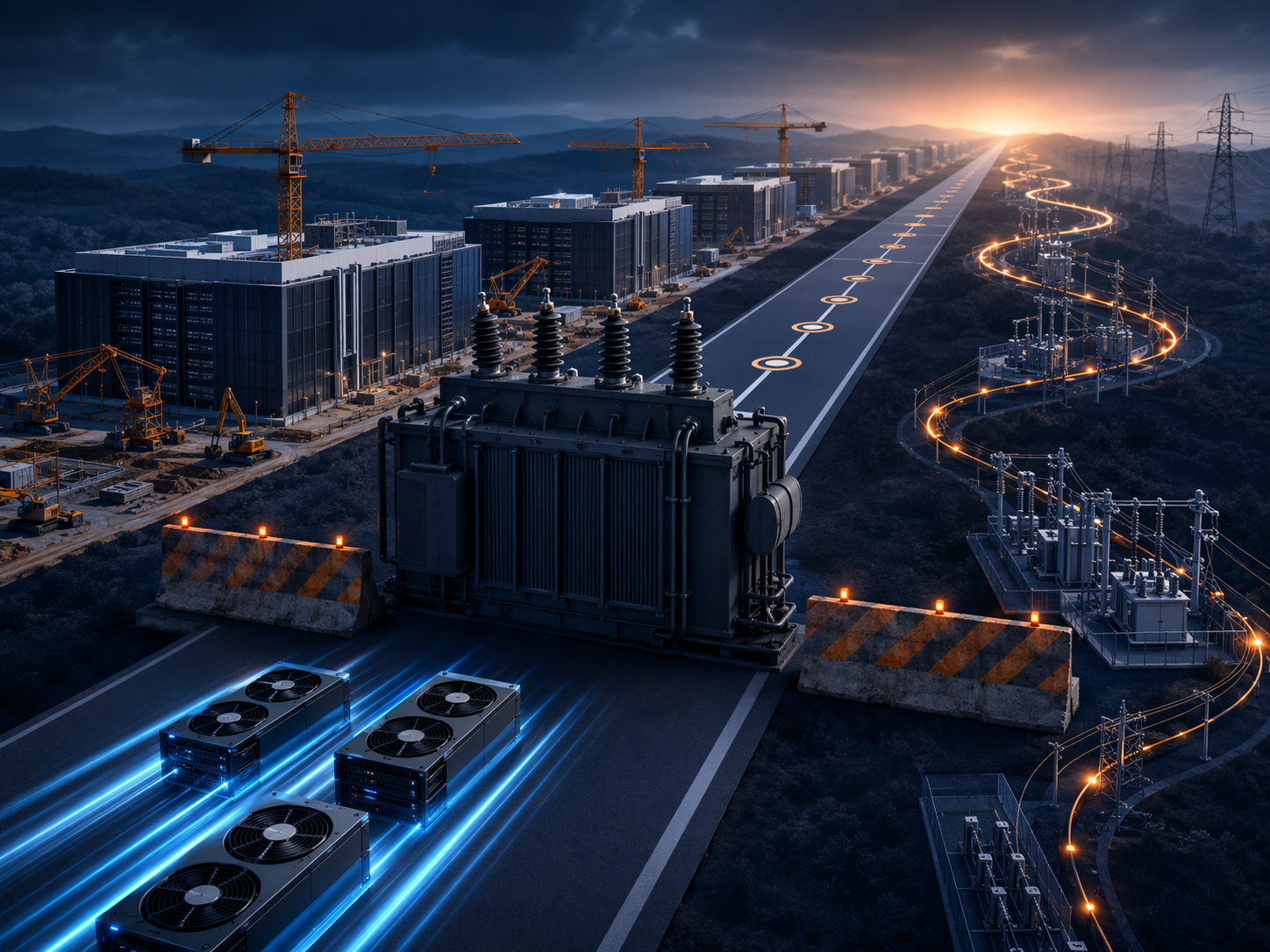
A 128-week transformer is not just a procurement inconvenience. It determines when a substation can be completed, when testing can begin, when utility-side upgrades become useful, and whether installed compute becomes productive capacity or stranded inventory. It also changes the risk of late design changes. If the load profile, voltage requirement, or site configuration moves after long-lead equipment is ordered, the schedule may not have a clean recovery path.
Interconnection adds another calendar. JLL’s 2026 outlook describes utility interconnection queues of three to five years in constrained markets such as PJM and ERCOT, and CBRE’s 2026 global data center trends point to similar pressure around power availability and grid access.[3][4] This is not the same bottleneck as buying a transformer. It is the queue for permission, grid studies, upgrades, and energization. A project can be ready to build before the grid is ready to serve it.
Developers then look behind the meter: gas turbines, fuel cells, or other dedicated generation. That can be a rational workaround for a specific site, and ChainSignal has separately examined Bloom Energy’s role in the AI data center power bottleneck through its case study and vendor profile. But behind-the-meter power does not erase the supply chain problem. It often substitutes one queue for several others: turbines or fuel cells, generator step-up transformers, fuel infrastructure, air permits, local approvals, controls integration, and field labor.
Minerals Tie the Electrical System Together
Critical minerals are easy to discuss abstractly and hard to manage in a project schedule. Copper is the clearest example because it crosses categories. It shows up in transformer windings, electrical distribution, site wiring, grid upgrades, and broader electrification demand. The University of Chicago’s Sustainability Dialogue cites a projected copper deficit of roughly 6 million metric tons by 2035 and notes that new copper mines can take up to 17 years to reach production.[5]
That does not mean every AI data center project will be stopped by copper in 2026. It does mean copper exposure cannot be left inside separate supplier conversations. The transformer buyer, the electrical contractor, the utility team, and the construction scheduler may all believe they are managing different problems while drawing from the same constrained material base.
The same logic applies to specialized transformer inputs such as grain-oriented electrical steel. The University of Chicago analysis flags concentrated supply for GOES as a transformer vulnerability.[5] A procurement team that treats transformers as finished goods only sees the supplier’s delivery date. A better view asks which upstream materials can move that date, and whether the supplier has allocation power or merely a place in someone else’s queue.
Labor Shortages Hit Both the Factory and the Field
Labor is not a soft constraint when the schedule depends on electrical installation, commissioning, and utility coordination. Rabobank reported that the construction industry needs about 500,000 additional workers in 2026.[6] JLL and Rabobank also point to skilled electrical labor conditions that include unemployment under 3% and wages 25% to 30% above norms.[3][6]
IndustrialSage gives the demographic problem a blunt ratio: for every five workers retiring, only one new worker enters the trades.[2] The exact severity will vary by region and trade, but the consequence is familiar on capital projects. A delayed crew can make delivered equipment sit idle. A missing commissioning specialist can hold back energization after installation. A utility-side labor shortage can slow upgrades even when the data center developer has its own contractors lined up.
This is where labor links the factory and the field. Transformer production needs skilled manufacturing labor. Data center construction needs electricians, controls technicians, welders, equipment operators, and commissioning teams. Utility upgrades need their own qualified crews. Hiring more people at the site boundary does not automatically solve the labor embedded inside upstream equipment production.
Construction Logistics Become the Place Where All Prior Mistakes Arrive
Construction is often where earlier optimism becomes visible. Rabobank and JLL project that 30% to 50% of planned 2026 AI data center capacity could slip to 2028, though this should be read as a projection rather than a confirmed outcome, and analysts do not always define “planned capacity” the same way.[6][3]
The spending pressure is already large. McKinsey reported that U.S. data center construction spending reached $45.1 billion monthly by December 2025, up 85% in two years and above office construction.[7] JLL reported global construction costs rising from $7.7 million per megawatt in 2020 to $10.7 million per megawatt in 2025, with a forecast of $11.3 million per megawatt in 2026, a 7% compound annual growth rate.[3]
Those cost figures do not prove that every project is uneconomic. They show money chasing constrained inputs: land with power access, long-lead electrical equipment, qualified contractors, heavy-haul capacity, substations, switchgear, backup systems, cooling components, and sequencing space. A project can pay more and still wait if the scarce item is not price-responsive in the required window.
SCMR’s framing is useful here: AI runs on compute, but scaling it runs on logistics.[8] That is not a slogan for warehouse efficiency. It is a warning that the physical flow of equipment, crews, permits, inspections, utility work, and commissioning gates determines when digital capacity becomes usable.
The Bottlenecks Do Not Wait Their Turn

The five constraints are usually presented as separate shortage stories. That is tidy and misleading. They interact through shared inputs, shared labor pools, and schedule substitutions.
- Copper links minerals to both transformer production and site electrical work, so a material shortage can tighten two different parts of the same project plan.
- Labor links upstream manufacturing to field execution; more equipment orders can increase factory pressure while more site starts increase commissioning pressure.
- Interconnection delays push some developers toward behind-the-meter power, which then creates demand for generation equipment, transformers, permits, and fuel infrastructure.
- Memory and packaging constraints can delay server availability, but an early server delivery can still become stranded if power equipment or crews are late.
- Construction acceleration can worsen congestion if it pulls scarce contractors, cranes, switchgear, and inspection capacity away from other projects in the same region.
A hypothetical project makes the sequencing problem clearer. Suppose a developer secures accelerator allocation early and signs a lease on a power-adjacent site. If the transformer order is placed after design finalization, the transformer may set the energization date. If utility interconnection slips, the developer may pursue on-site generation, which introduces another equipment and permitting path. If that alternative arrives, the project may still wait for electrical crews to install and commission the system. No single missed purchase order explains the delay. The delay comes from treating linked constraints as if they were independent workstreams.
What Changes for Procurement Teams
The useful procurement unit is not the component. It is the deployment path. For each site, the team needs a dated map of semiconductor allocation, rack integration, transformer orders, interconnection milestones, mineral exposure, electrical labor, construction sequencing, backup power options, and commissioning capacity.
That changes several decisions. Long-lead electrical equipment has to move earlier in site selection, not after a power design is considered mature. Supplier qualification has to include upstream material exposure, not only quoted lead time. Labor availability has to be checked across manufacturing, construction, utility, and commissioning scopes. Behind-the-meter power has to be evaluated as a second supply chain, not merely as an escape from the utility queue.
Capital strength still matters. Hyperscaler AI spending is not a passing inventory cycle, and ChainSignal has covered Berkshire’s Alphabet position as one signal of how seriously long-term capital is treating AI infrastructure exposure in its analysis of AI supply chain stocks. But spending capacity is not deployment capacity. A purchase order can reserve a place in a queue; it does not make the queue disappear.
Tariffs on steel, aluminum, copper, semiconductors, or related equipment can also change cost and allocation decisions quickly. They belong in the risk register, but they should not be folded into the five-bottleneck model as if policy were just another fixed input. Tariff exposure is a moving overlay on top of already constrained markets.
The advantage now belongs to teams that coordinate semiconductor allocation, electrical equipment, minerals exposure, labor availability, and site logistics as one procurement system. Integration will not remove the bottlenecks. It will reduce the chance of discovering them one at a time, after the schedule has already failed.
References
- How AI Data Centers Are Reshaping Electronic Component Supply in 2026, AccurisTech
- Power Transformer Lead Times Hit 128 Weeks in 2026, IndustrialSage
- Data Center Outlook, JLL
- Global Data Center Trends 2026, CBRE
- Rethinking the AI Infrastructure Supply Chain: Energy and Material Bottlenecks Threaten Data Center Expansion, UChicago Sustainability Dialogue
- Supply chain constraints are curbing US data center development, Rabobank
- The cost of compute: A $7 trillion race to scale data centers, McKinsey
- AI runs on compute; scaling it runs on logistics, Supply Chain Management Review
Comments
Join the discussion with an anonymous comment.