
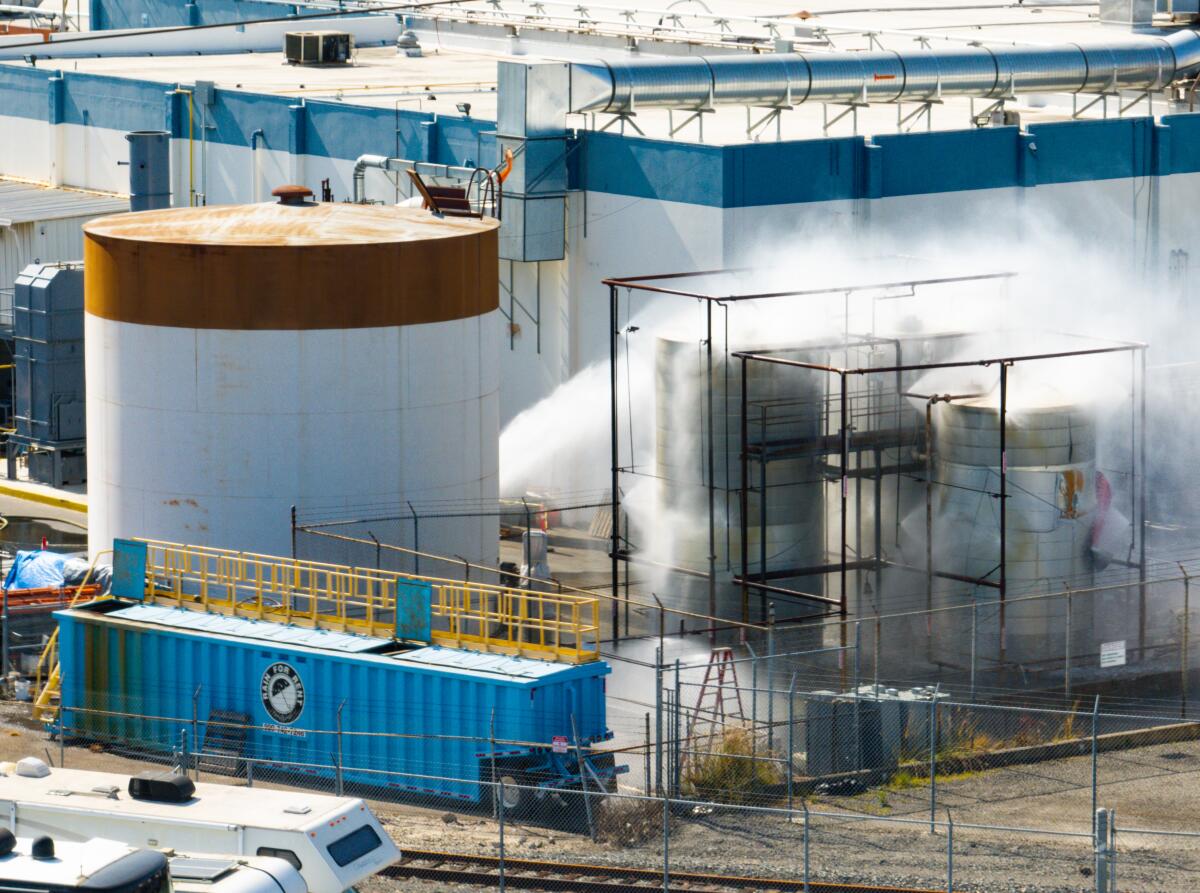
The Garden Grove chemical leak was not a port shutdown. That distinction matters. The May 2026 emergency began at GKN Aerospace's inland facility in Orange County, where about 7,000 gallons of methyl methacrylate became the center of a thermal runaway and BLEVE threat after a cooling-system failure. The consequences quickly moved beyond the plant fence: roughly 50,000 people were evacuated, I-5 and SR-22 were closed, a state of emergency was declared on May 23, and a federal disaster declaration followed.[1]
For supply chain leaders, the uncomfortable part is not that a chemical incident happened. It is that the operating facts were knowable enough to plan around: a hazardous material with a recognized runaway-reaction failure mode, a cooling and refrigeration dependency, and an aerospace site tied to critical aircraft components. The facility generated about $182.3 million in site revenue and was identified in reporting as a sole supplier for F-35 canopies and Boeing 737 MAX passenger windows.[1]
The better question for AI supply chain disruption planning in a port-adjacent chemical leak is narrow and operational: what should a prepared planning system have known before May 2026 that procurement teams, emergency managers, and executives were forced to learn during the crisis?
What made Garden Grove larger than a site incident
Methyl methacrylate is not an ordinary inventory item when temperature control fails. Los Angeles Times reporting said the chemical industry had known for years about runaway-reaction dangers, and the Orange County Fire Authority identified cooling-system failure as the trigger in Garden Grove.[2] That means the first supply chain lesson is not abstract resilience. It is refrigeration, maintenance condition, chemical inventory, emergency thresholds, and the speed at which a localized process deviation can become a community evacuation.
The second lesson is that geography should be drawn by dependency, not by fence lines. Garden Grove is about 35 miles inland from the Port of Long Beach; it was not physically sitting on a berth, terminal, or container yard.[3] Still, a facility feeding aerospace production and connected to Southern California logistics belongs on a port-adjacent risk map. If the same region carries hazmat production, qualified aerospace suppliers, freeway corridors, and port flows, the disruption surface is shared even when the ignition point is inland.
The third lesson is that financial and legal signals are exposure signals, not the whole story. After the emergency, Garden Grove leaders demanded answers from the company, and the incident became the subject of lawsuits and compensation pledges that remained unresolved claims rather than settled findings.[4] Melrose Industries, GKN's parent, also saw reported share-price pressure in the aftermath.[3] Those facts matter because they show how quickly a process-safety event can become an investor, customer, regulator, and procurement problem at the same time.
None of this proves that software would have stopped the leak. It does show that the failure modes were specific enough to model. A credible AI planning system would not promise immunity. It would pull together maintenance signals, chemical hazard thresholds, supplier qualification constraints, logistics exposure, and escalation playbooks early enough that people were not assembling the picture while residents were leaving their homes.
The missed planning system was not one tool
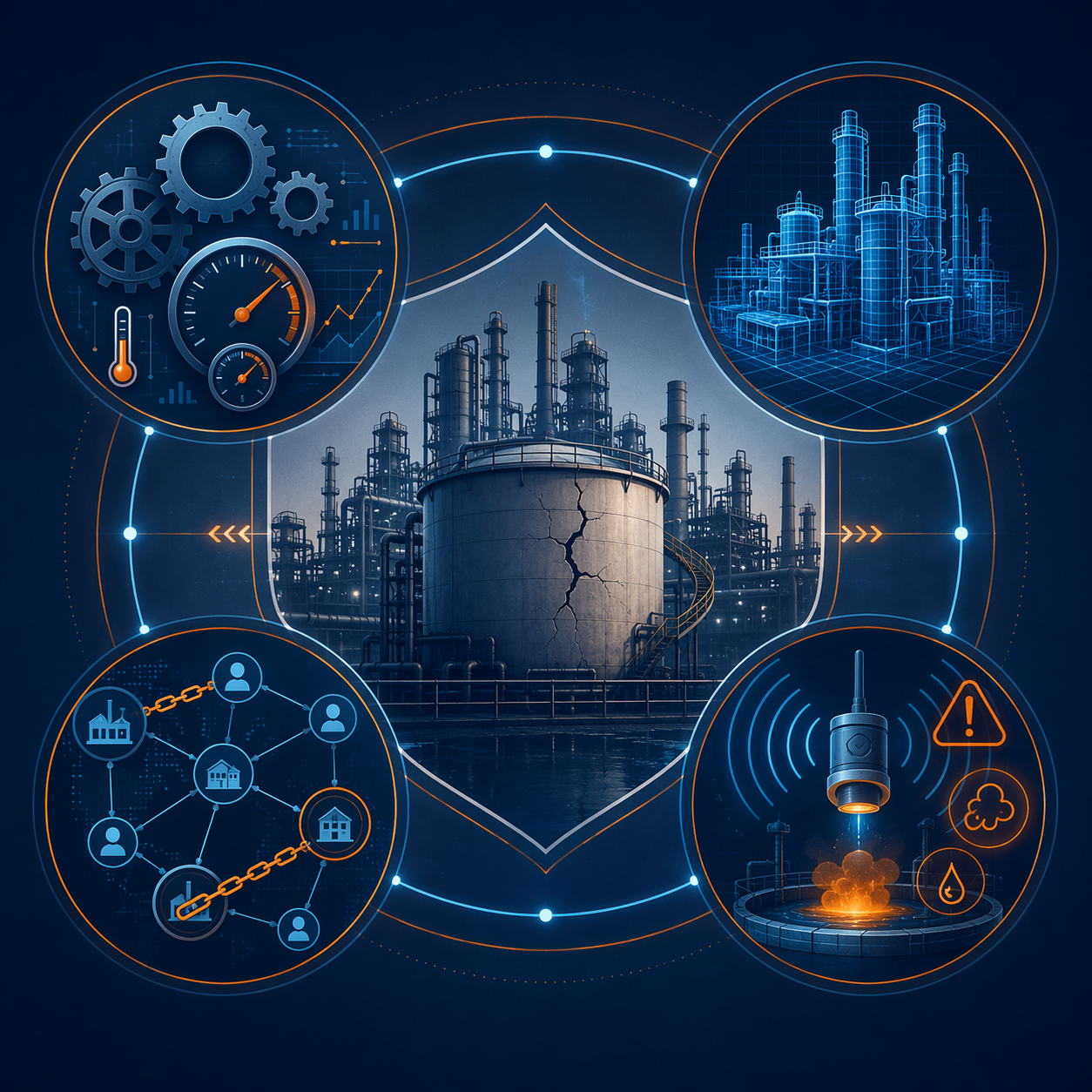
The Garden Grove case points to four AI capabilities that should have been working together. They are often sold separately, but the incident needed them as a connected operating layer: predictive maintenance for the cooling system, digital twin simulation for chemical escalation, supplier risk scoring for single-source aerospace exposure, and real-time hazmat monitoring for faster alerts.
| AI capability | Garden Grove exposure it addresses | Decision it should improve |
|---|---|---|
| Predictive maintenance | Cooling and refrigeration failure before chemical instability | Repair, shutdown, inventory reduction, or escalation before runaway conditions |
| Digital twin simulation | Thermal runaway and BLEVE escalation paths | Pre-tested emergency thresholds, evacuation assumptions, and containment options |
| Supplier risk scoring | Sole-source F-35 canopy and Boeing window dependency | Qualification priorities, buffer strategy, and customer communication |
| Real-time hazmat monitoring | Anomalous temperature, pressure, or inventory conditions | Control-tower alerts and cross-functional response before crisis widening |
Predictive maintenance should have been looking at refrigeration as a supply risk
Cooling equipment is easy to misclassify as plant maintenance until the dependent material has runaway-reaction potential. In Garden Grove, the reported trigger was not a distant geopolitical shock or an unknown supplier bankruptcy. It was a cooling-system failure tied to a known hazard class.[2] That is exactly the kind of asset condition that should be promoted from maintenance backlog to supply continuity risk.
An AI maintenance model would not need to know the future. It would need to watch degradation patterns, work-order history, operating temperature variance, alarm frequency, spare-part availability, and the material hazard tied to the asset. The important output would not be a colorful dashboard; it would be a ranked intervention: inspect now, reduce tank inventory, move production, notify emergency planning, or shut down a process before instability becomes a community incident.
Apexon's agentic AI supply chain risk proof of concept is useful here because it frames the benefit in timing. The validated pilot projected EUR9 million to EUR25 million in annual risk protection across EUR300 million to EUR500 million in supply spend, with disruption identification accelerated by 24 to 48 hours and manual monitoring effort reduced by about 40%.[5] Those are projected pilot figures, not proof of realized production savings. Still, the timing claim is the relevant one for Garden Grove. In a chemical escalation, a day earlier is not a reporting improvement; it can change which options are still available.
Digital twins should have made the escalation path visible before responders needed it
A tabletop exercise that asks whether a site has a chemical emergency plan is not the same as simulating how a cooling failure develops under different tank levels, ambient conditions, response times, road closures, and evacuation boundaries. A digital twin does not have to be perfect to be useful. It has to expose which assumptions break first.
In this case, the relevant scenarios were not exotic. What happens if refrigeration fails overnight? How quickly does temperature rise under plausible inventory levels? Which alarms must trigger an automatic escalation outside the site? How does a BLEVE threat affect freeway access, plant staffing, emergency ingress, and outbound customer commitments? Which aircraft programs become exposed after one day, three days, or a longer shutdown?
Fusion Risk Management argues that AI scenario planning can test thousands of permutations, compared with the three to five scenarios commonly used in traditional tabletop exercises.[6] The number matters less than the coverage. Garden Grove did not require imagination about every possible disaster. It required enough modeled combinations to show that a cooling-system deviation could become a hazmat emergency, a freeway disruption, and a sole-source aerospace issue in the same event chain.
Everstream Analytics gives a related chemicals-sector example: a hurricane scenario model for a $10 billion chemicals company estimated $750,000 to $9 million per disruption event depending on severity, using earlier McKinsey 2020 model assumptions.[7] That figure should not be transplanted mechanically onto Garden Grove or inflated into a 2026 certainty. Its value is methodological. Scenario models force a company to price response gaps before the disruption, not after the executive team asks why no one had a costed option.
Supplier risk scoring should have treated sole-source as a condition, not a label
The phrase "alternate supplier" often does too much work in executive risk reviews. Aerospace qualification cycles make that obvious. A drawing package, a capable shop, and a commercial relationship do not automatically create a qualified source for defense and passenger-aircraft components. If GKN's Garden Grove facility was a sole supplier for F-35 canopies and Boeing passenger windows, the realistic planning question was not whether someone else could theoretically make something similar. It was what approvals, tooling, testing, customer signoffs, inventory positions, and lead times stood between disruption and usable supply.[1]
This is where AI risk scoring needs deeper structure than supplier name, spend, and country. A planning model should map the product to the site, the site to the process, the process to the hazardous material, the hazardous material to the cooling asset, and the finished component to aircraft programs and customers. That is a dependency graph, not a spreadsheet. For teams building this kind of multi-tier view, knowledge graph-based supply chain visibility is the right reference point because it follows relationships traditional supplier lists miss.
A useful score would not simply mark Garden Grove red because it handles chemicals. It would separate several questions: Is the material hazardous? Is the controlling asset fragile or aging? Is the output qualified to one site? Are alternate processes already validated? Are customer approvals pre-cleared? Are logistics routes exposed to the same regional emergency? If the answer chain ends in "we would figure that out during the event," the score should be high even if recent delivery performance looks clean.
KPMG has reported that AI-integrated planning can improve service levels by 400 basis points and gross margin by 5.5%.[8] Those are broad planning outcomes, not evidence specific to methyl methacrylate or aerospace supply. The relevance is that integrated planning changes the decision surface. It connects operational constraints, financial tradeoffs, and service exposure early enough for leaders to choose between bad options before those options become worse.
Real-time hazmat monitoring should have escalated outside the plant sooner
Hazmat monitoring is not only an environmental, health, and safety function when the site feeds constrained aerospace supply. Temperature, pressure, refrigeration status, tank level, ventilation, local weather, alarm state, and emergency access all become supply chain signals once a facility has sole-source exposure.
The control-tower version of this is not a room full of screens waiting for a public emergency alert. It is an exception-management layer that watches site conditions and supplier dependencies together. If a refrigeration anomaly appears at a hazardous-material site tied to a critical aircraft program, the alert should reach plant operations, EHS, procurement, customer program management, logistics, and crisis leadership with different recommended actions. For a practical distinction between monitoring models, see control tower models that actually deliver ROI.
This is also where AI adoption enthusiasm should be kept in proportion. ABI Research reported that 65% of supply chain leaders rate AI or generative AI as important for technology purchase decisions.[9] That indicates budget attention, not operational readiness. A company can buy AI and still fail to connect tank telemetry to supplier qualification files. The hard work is data integration, threshold design, accountability, and rehearsed authority to act.
What a prepared system would have known before May
Before the crisis widened, a mature disruption-planning system should have been able to answer a few concrete questions. Which cooling assets controlled methyl methacrylate stability? Which failure patterns required shutdown or inventory drawdown? Which emergency scenarios had been simulated with BLEVE assumptions? Which customers and aircraft programs depended on output from the site? Which alternate suppliers were qualified, partially qualified, or only aspirational? Which road, port, and regional logistics assumptions would fail if the incident forced evacuation or closures?
That system would still leave difficult choices. Shutting down production early carries cost. Reducing tank inventory may affect schedules. Qualifying a second aerospace source can take funding, engineering time, and customer cooperation long before anyone sees an emergency. Local responders still own the immediate public-safety problem. Chemical safety management still has to work at the physical site.
But the timing changes. Instead of asking during a crisis whether a component is sole-source, procurement already knows. Instead of debating whether an alternate is real, the qualification status is visible. Instead of discovering that a refrigeration failure has enterprise consequences, the asset is already tagged as supply-critical. Instead of treating an inland facility as irrelevant to port-adjacent planning, the risk model shows how Southern California logistics, aerospace production, and hazardous materials overlap.
The standard after Garden Grove
Any aerospace, chemical, or industrial manufacturer with hazardous materials, qualified single-source suppliers, or port-adjacent logistics exposure should now be able to answer four questions without forming a special project team.
- Which assets are monitored because their failure can create both a safety incident and a supply disruption?
- Which escalation scenarios have been simulated beyond the normal tabletop exercise?
- Which customer programs, qualified parts, and logistics routes are connected to each hazardous or high-risk site?
- Which alternate options have already been analyzed, funded, and validated far enough to matter?
Garden Grove was not an unforeseeable black swan. It was a specific failure at a specific facility with specific chemical, community, and aerospace consequences. AI disruption planning would not have made it harmless. Used well, it could have made the weak signals visible earlier, shown the escalation paths before the emergency, and put credible mitigation options in front of decision-makers while there was still time to use them.
References
- Garden Grove chemical leak plant faces lawsuits, supply disruption, Los Angeles Times, May 28, 2026
- Industry was warned for years about chemical runaway dangers. Then came near-catastrophe in O.C., Los Angeles Times, May 27, 2026
- Garden Grove chemical leak, Wikipedia
- Garden Grove Leaders Demand Answers From Aerospace Company After Chemical Tank Emergency, Voice of OC, June 2026
- Agentic AI-Driven Supply Chain Risk Intelligence with Quantified Business Impact, Apexon
- AI for Scenario Planning & Simulation, Fusion Risk Management
- Technology Lowers Risk for Chemical Supply Chain Management, Everstream Analytics
- Navigate supply chain disruptions with integrated AI planning, KPMG, 2024
- Supply Chain Disruptions 2026: How to Build Resilience with AI and Automation, ABI Research
Comments
Join the discussion with an anonymous comment.