
When the April 2024 tornado destroyed Dollar Tree’s Marietta, Oklahoma distribution center, the problem was not only lost square footage. A discount retailer lost a node in a network that already had fresh memory of how quickly freight exposure can run through earnings. In the 2021 freight crisis, Dollar Tree faced an estimated $1.50 to $1.60 per-share EPS drag and $185 million to $200 million in incremental freight spend, according to FreightFlow Advisor’s analysis, a baseline that makes later freight discipline more than a transportation-side improvement story.[1][2]
That is why the useful question behind this Dollar Tree delivery supply chain AI case is not whether the company adopted AI. Many retailers can buy planning software, visibility tools, or an automation pilot. The harder question is whether Dollar Tree changed enough of the operating structure around freight, inventory, distribution capacity, store unloading, and last-mile reach for the technology to show up in margin and service outcomes.
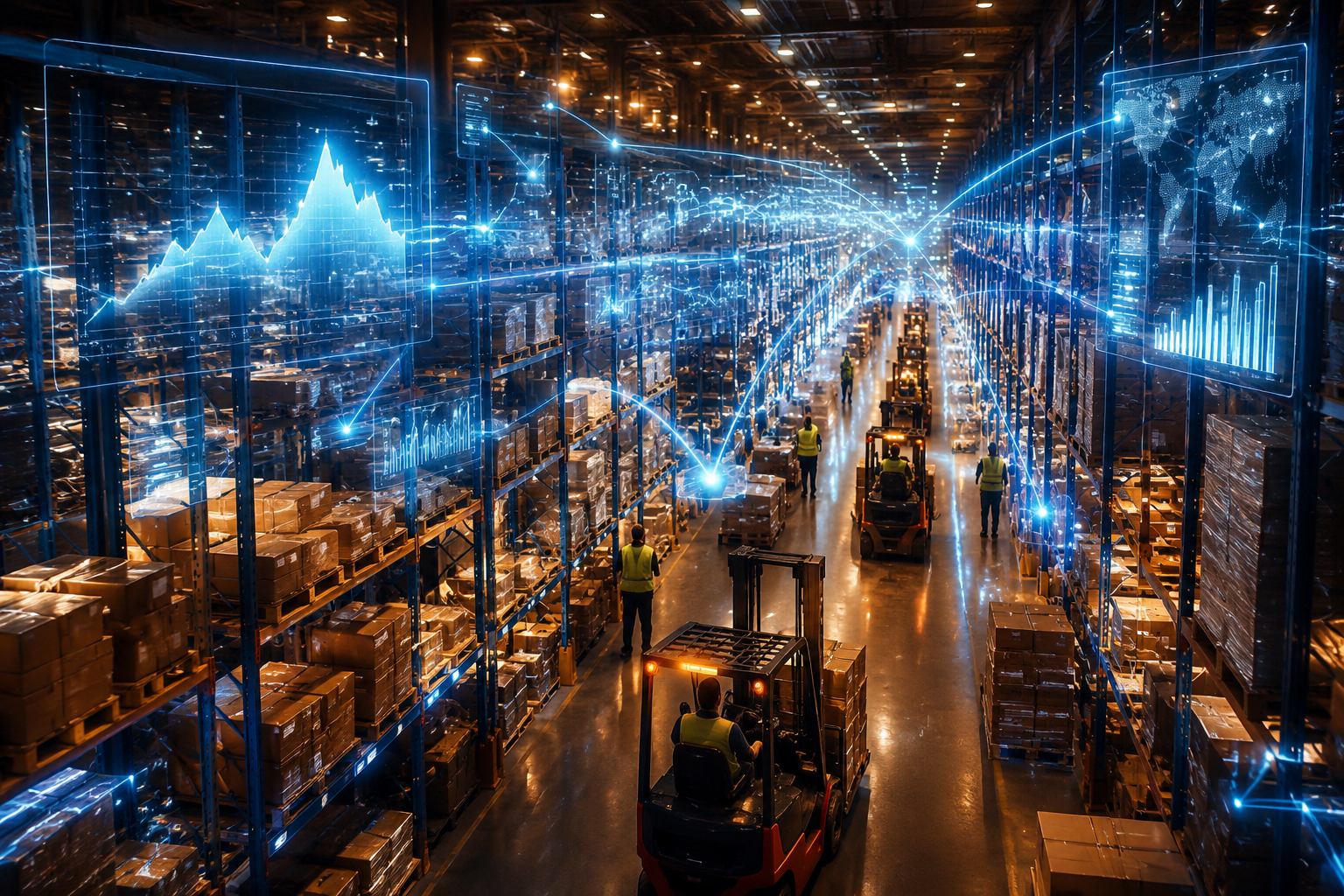
The company’s own language became more direct after the disruption. CEO Michael Creedon described a shift “from underinvestment in technology to an AI-enabled enterprise,” a phrase that matters only if it survives the dock-door test: fewer emergency freight decisions, cleaner replenishment, less store labor friction, and systems that operators can govern at scale.[3]
The old freight problem came first
Freight is often where discount retail transformation claims become real or fall apart. When a retailer depends on low price points and high unit movement, a small percentage shift in contracted volume, spot exposure, detention, or late routing can eat what store teams worked all week to protect.
Dollar Tree’s reported freight reset therefore deserves more attention than the generic AI label. The company moved roughly 75% of freight volume under multi-year contracts and kept spot exposure near 2%, according to the available case materials.[2] Those two numbers describe a different risk posture. Multi-year coverage gives procurement and transportation leaders more predictable cost and capacity; low spot exposure reduces the number of loads priced at the worst possible moment.
AI can help here, but not as magic rate negotiation. Its practical value is in making better use of lane history, demand expectations, carrier performance, seasonal pressure, and contract timing. The executive argument is not that an algorithm replaced transportation judgment. It is that the company had better information and a better contracting structure before the next disruption forced buying capacity one expensive load at a time.
Forecasting only matters if it reaches the DC and the store
The replenishment layer started before the tornado. In October 2021, Dollar Tree and Family Dollar selected RELEX for integrated forecasting and replenishment across more than 15,800 stores and 26 distribution centers.[4] That scope needs a post-divestiture asterisk. Family Dollar was later sold, so the 15,800-store number should not be treated as the current Dollar Tree-only deployment footprint without confirmation.
Even with that caveat, the role of forecasting in this case is clear. If the forecast improves but the warehouse management system, yard process, trailer plan, and store receiving model stay old, the benefit leaks away in manual workarounds. A forecast is not inventory discipline until it changes what is ordered, where it is staged, how it is loaded, and when a store has labor available to receive it.
That is the important distinction in Dollar Tree’s rebuild. The company did not simply replace a destroyed building and call the new node modern. It paired distribution expansion with cloud-based warehouse and yard management modernization, forecasting, procurement automation, and store-delivery execution changes.[1] The pieces depend on each other. Forecasting helps decide the flow; WMS and YMS modernization help execute it; freight contracting determines how expensive the movement becomes; store unloading determines whether the benefit arrives as usable labor relief or as another backroom burden.
| Operating layer | What changed | Why it matters |
|---|---|---|
| Freight contracting | Roughly 75% of volume under multi-year contracts and about 2% spot exposure | Reduces exposure to emergency-priced capacity and helps earnings predictability |
| Forecasting and replenishment | RELEX selected for integrated forecasting and replenishment across the pre-divestiture Dollar Tree and Family Dollar network | Improves the quality of inventory decisions, with current Dollar Tree-only scope requiring confirmation |
| Warehouse and yard systems | Cloud-based WMS/YMS modernization tied to distribution upgrades | Turns planning signals into controlled trailer, yard, and dock execution |
| Store delivery | Rotacart rollout with liftgate trailers and shorter unloading windows | Reduces receiving friction for store teams and makes delivery execution measurable |
| Last mile | DoorDash availability across 9,000+ U.S. Dollar Tree stores and 10,000+ SKUs | Externalizes on-demand delivery capability rather than building a store-by-store delivery fleet |
Store delivery is where headquarters promises become labor
Rotacart is one of the more concrete parts of the case because it touches the store. Dollar Tree reported roughly one-hour unload times with the system and planned to expand it to more than 3,000 stores, supported by more than 900 new liftgate trailers.[5] For a store manager, that is not an innovation headline. It is the difference between tying up labor around a difficult delivery and having a more predictable receiving window.
This matters because discount stores rarely have spare hands waiting for a truck. When replenishment arrives in a format that requires too much sorting, lifting, or exception handling, the cost has merely moved from transportation into store payroll and lost selling time. A one-hour unload claim is operationally meaningful because it identifies the work step being compressed.
It also gives supply chain leaders a better way to defend investment. A CFO may not care that a delivery process is more elegant. A CFO will care if trailer equipment, delivery format, and store receiving design reduce labor friction, improve shelf availability, and limit the hidden cost of pushing complexity downstream.
New capacity made the software story credible
The physical rebuild remains the backbone. Dollar Tree opened a 1.25 million-square-foot distribution center in Litchfield Park, Arizona in May 2026, designed to serve roughly 700 stores and create more than 400 jobs.[6] A replacement Marietta distribution center is expected in spring 2027 and is also expected to serve about 700 stores.[1]
Those buildings keep the AI story honest. Forecasting and routing improvements need capacity to land somewhere. If the network is short a major node, planning tools spend too much of their value managing scarcity. The new DCs give Dollar Tree a chance to rebuild with different systems, different yard discipline, different trailer flows, and a clearer service design for stores.
That does not mean every benefit can be credited to AI. Some of the improvement comes from capacity, process standardization, freight contracting, and ordinary operating discipline. In a low-margin retailer, that distinction is not academic. It is how an investment case survives the next budget review.
DoorDash changed the delivery promise without making stores run delivery
The DoorDash rollout sits later in the chain, after the store base is clearer. In 2026, Dollar Tree added more than 9,000 U.S. stores and over 10,000 SKUs to the DoorDash on-demand delivery platform.[7] That differs from earlier delivery footprints that included Family Dollar. After the Family Dollar sale, the DoorDash figure is the cleaner Dollar Tree-only marker.
For the delivery supply chain, the strategic point is externalization. Dollar Tree did not have to build a dense last-mile fleet store by store to offer broader on-demand access. It used a marketplace partner to add delivery reach while keeping the core network focused on replenishing stores.
That does not make DoorDash the center of the rebuild. It is a downstream capability layered on top of store inventory, store execution, and digital ordering availability. If the shelf is wrong or replenishment is late, a last-mile partner cannot fix the promise. But once the store network is cleaner, DoorDash turns those stores into local fulfillment points without forcing Dollar Tree to carry the full delivery operating model itself.
The financial results are strong, but attribution needs discipline
Dollar Tree’s reported Q4 FY2025 outcomes give the case its weight: gross margin expanded 150 basis points to 39.1%, EPS grew 21.3%, and inventory declined 7% while sales rose 9%.[1] Those are the kinds of deltas operators can take into a capital meeting. They are also the numbers most likely to be overclaimed if the case is simplified into “AI expanded margins.”
A more defensible reading is narrower and stronger. Freight contracting likely helped reduce cost volatility. Forecasting and replenishment discipline likely supported the inventory-to-sales spread. WMS/YMS modernization and new DC capacity likely improved the company’s ability to execute the plan. Rotacart likely reduced store receiving friction where deployed. DoorDash likely expanded customer delivery access by using an external last-mile network.
The word “likely” is doing necessary work. The research materials support a connection between the operating changes and the financial outcomes, but they do not isolate every basis point of margin expansion by technology module. Weather disruption, banner mix, pricing, merchandising, shrink, procurement, labor, and distribution productivity can all move the same financial lines. The useful case is not a clean laboratory proof. It is an operating record where multiple changes pointed in the same direction and the reported numbers improved.
The enterprise AI signals are real, but secondary
Dollar Tree’s AI posture extended beyond freight and replenishment. BrainBox AI reported 7,980,916 kWh and $1,028,159 in energy savings across 616 stores, with expansion to more than 2,000 stores.[8] Zip reported $125 million in savings, a 70% procurement cycle-time reduction, and procurement influence rising from 13% to 40% of more than $5 billion in spend.[9]
Those are useful signals that the company’s AI program was not confined to one supply chain pilot. They should not crowd out the delivery supply chain story. Energy optimization can lower store operating cost. Procurement automation can improve spend control. Neither explains trailer turns, store unloading, or replenishment execution as directly as freight contracting, forecasting, WMS/YMS modernization, and delivery process changes.
The same caution applies to agentic AI hiring. Creedon’s comments about automating early hiring screening show the broader enterprise direction, but the available materials do not confirm mature supply chain ROI from that work.[3] It belongs in the perimeter of the case, not at the center of the operating claim.
What travels to another retailer
Dollar Tree is a useful case for supply chain leaders because the company had a clear disruption trigger, a known freight-cost baseline, executive sponsorship, network investment, and operating changes that reached from contract structure to store receiving. That combination is harder to dismiss than a software pilot with no effect on inventory, freight, or labor.
The case travels best when another retailer can answer five questions before promising ROI:
- What disruption, cost baseline, or service failure is the investment meant to correct?
- Which physical constraints in the DC, yard, trailer fleet, or store receiving process must change at the same time?
- What is the verified deployment scope, especially after acquisitions, divestitures, or banner changes?
- Which outcome belongs to freight contracting, forecasting, labor design, last-mile externalization, or ordinary operating discipline?
- Can the finance team trace the result without assigning every margin point to AI?
That is the practical lesson from Dollar Tree’s rebuild. AI gains became credible because technology moved with infrastructure and operating design. The tornado forced the capacity question into the open, but the margin case depended on what Dollar Tree changed after the debris was cleared: freight exposure, planning discipline, warehouse systems, store delivery execution, and last-mile partnership choices that could be measured in the language of cost, inventory, labor, and earnings.
References
- Dollar Tree makes distribution, tech upgrades, Supply Chain Dive
- Dollar Tree is building a freight, FreightFlow Advisor
- Dollar Tree CEO tech AI adoption, Retail Dive
- Dollar Tree and Family Dollar Select RELEX for Integrated Forecasting and Replenishment, BusinessWire, October 2021
- Dollar Tree eyes Rotacart deliveries at 600 stores, Supply Chain Dive
- Dollar Tree Announces New Distribution Center in Litchfield, Dollar Tree, May 2026
- Dollar Tree goes all in on DoorDash as retailer adds 9,000+ US stores to on-demand delivery platform, Retail Technology Innovation Hub, May 28, 2026
- Dollar Tree unlocks major energy and emissions savings with BrainBox AI, BrainBox AI
- Dollar Tree, Zip
Comments
Join the discussion with an anonymous comment.