
The warning sign in Q3 2026 is not just that HBM is tight. Most OEM programs never buy HBM directly. The warning sign is that ordinary DRAM, NAND, FPGAs, optoelectronics, and controller silicon are behaving as if a much larger buyer has already spoken for the factory calendar. That is the part of today’s ai semiconductor supply chain trends discussion that matters to procurement teams: the shortage is showing up inside standard BOMs, not only inside AI accelerator racks.
Supplyframe’s Commodity IQ data shows how sharp the move has become. DRAM contract prices rose 58% to 63% in Q2 2026, while the DRAM demand index increased 30.74% month over month and the pricing index reached 157.43, the highest reading among major semiconductor categories in that dataset. The same signal is no longer confined to memory: FPGA demand rose 52% month over month, and optoelectronics increased 29.7%.[1]
That is not the pattern of a clean, isolated memory cycle. It is the pattern of supplier attention, wafer starts, and allocation discipline moving toward AI infrastructure, then dragging the rest of the component stack behind it.
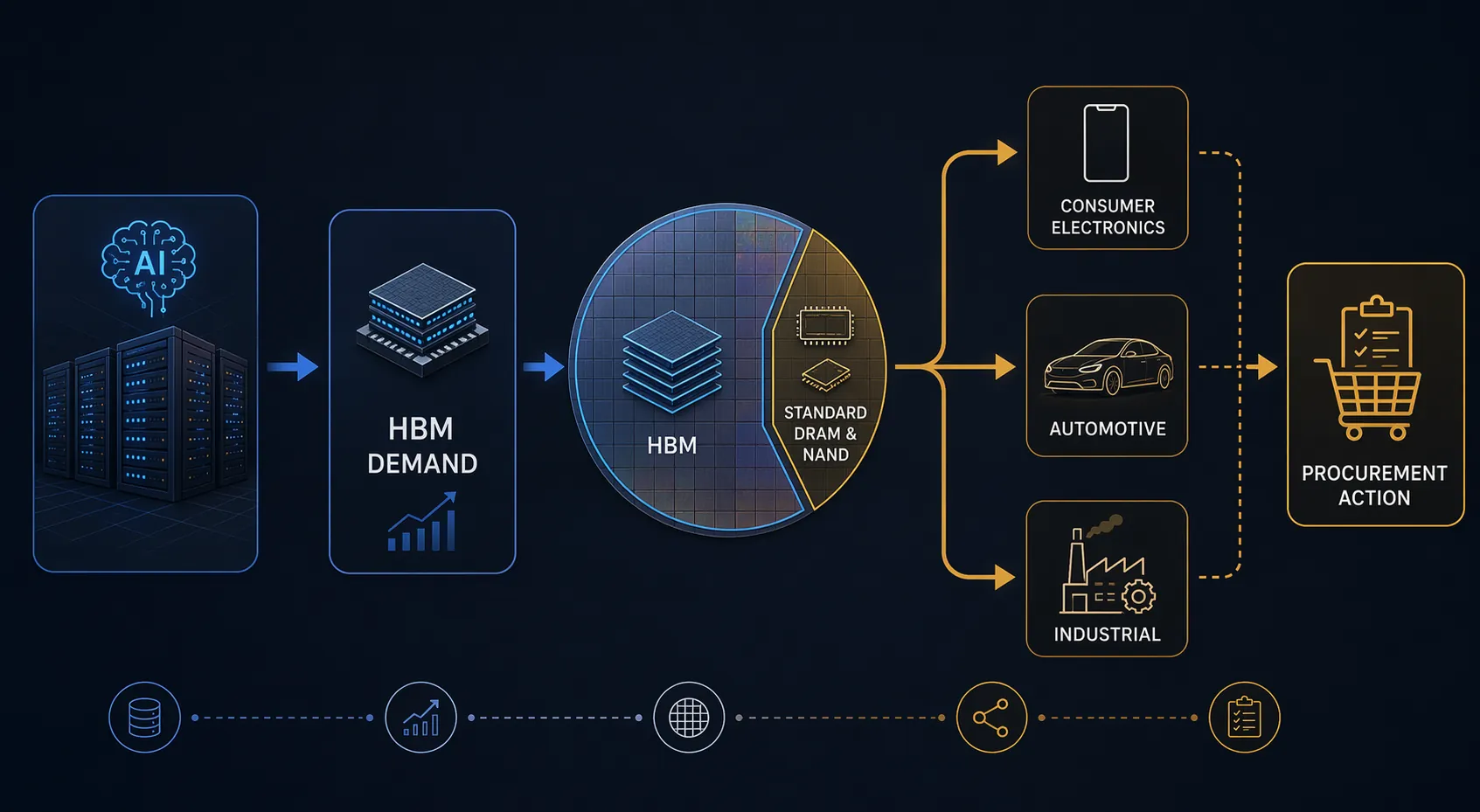
Why HBM Tightness Becomes Everyone Else’s Memory Problem
HBM is not simply another DRAM product with a better growth rate. It consumes manufacturing capacity differently. The key planning fact is that HBM requires roughly 3 to 4 times as many wafers per gigabyte as standard DRAM.[1] Once that ratio is on the table, a headline about AI memory demand becomes a factory-capacity problem.
A conventional buyer may look at its forecast and see the same cache DRAM, LPDDR, eMMC, managed NAND, or industrial storage device it has used for years. The memory supplier sees something else: every wafer start assigned to a lower-margin standard product is a wafer start not serving sold-forward AI demand. When the largest AI infrastructure buyers are pushing for HBM allocation, the old assumption that standard memory supply will loosen after a few quarters becomes much less useful.
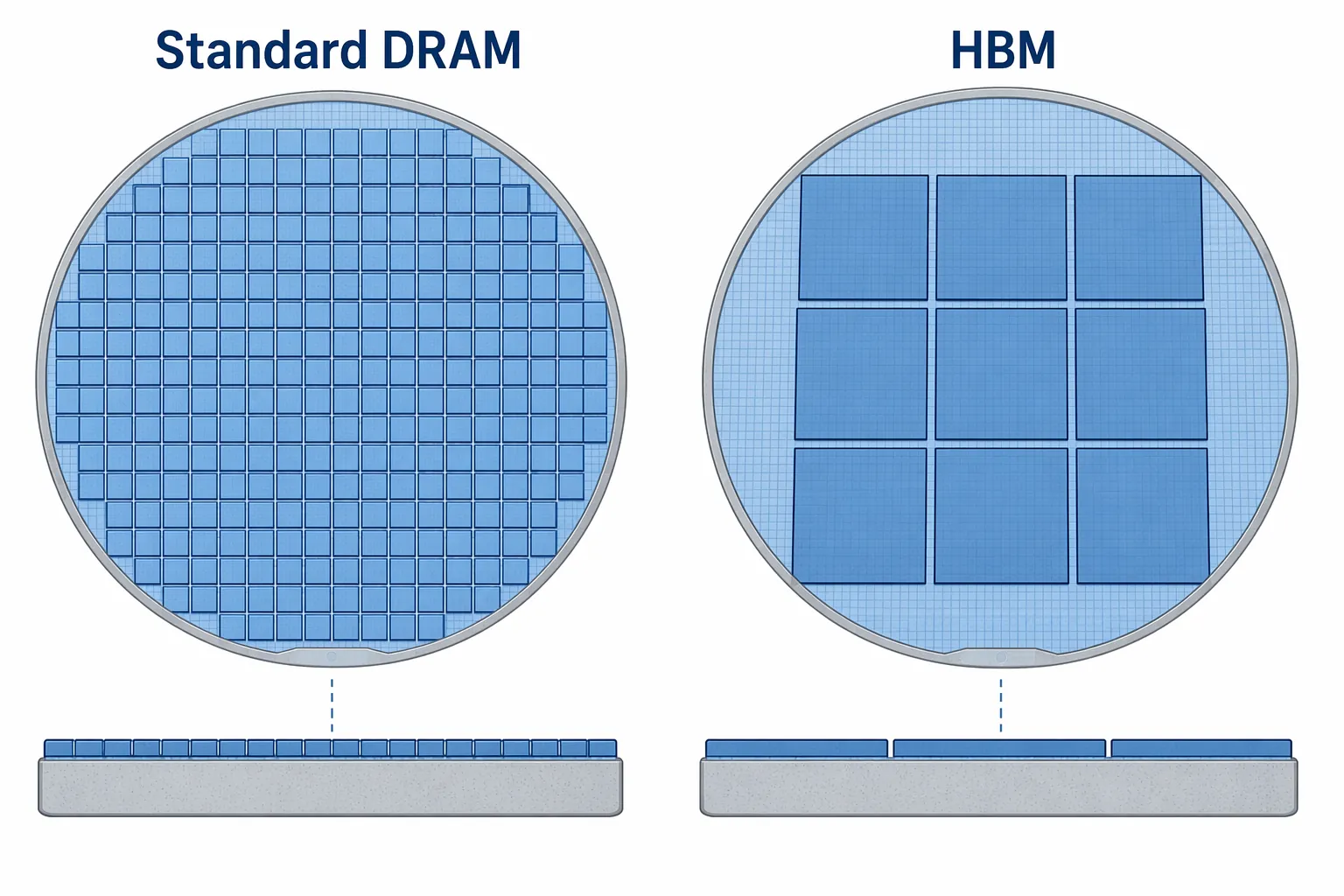
The mechanism matters because it explains why a buyer of ordinary components can be punished by a product it never specified. If HBM takes more wafer capacity per gigabyte, then a supplier can grow AI memory revenue while still leaving fewer equivalent gigabytes available for standard DRAM programs. If the supplier has already committed 2026 HBM output, the bargaining power shifts further away from smaller or less strategic accounts. Supplyframe reports that the three HBM suppliers — SK Hynix, Samsung, and Micron — have pre-sold 100% of 2026 HBM output, with analyst-sourced gross-margin estimates of 60% to 70%.[1]
Those margin figures should be handled with care because they are not manufacturer disclosures in the material provided. Still, the direction of incentive is hard to miss. When scarce wafers can be directed toward a pre-sold AI product with superior economics, standard DRAM and NAND customers are no longer competing only with each other. They are competing with the supplier’s best use of capacity.
The Price Signal Is Already Operational, Not Theoretical
There are broad forecasts around this market, but the operating signal is closer to the purchase order. Supplyframe cites Gartner’s April 2026 forecast for worldwide semiconductor revenue exceeding $1.3 trillion in 2026, a 60% increase from 2025 driven almost entirely by AI infrastructure.[1] That number is directionally useful, though it may reflect a broader definition of semiconductor-derived revenue than many buyers use in day-to-day category planning.
For sourcing teams, the more actionable evidence is the index movement and contract-price behavior. A 58% to 63% quarterly increase in DRAM contract pricing does not stay inside the memory line item. It changes whether an industrial controller still meets margin, whether a consumer device refresh keeps its launch price, and whether an automotive module can hold a contracted cost-down schedule.[1]
The CNAS report adds useful historical severity. It reports that DRAM prices increased more than 600% in 2025 and NAND Flash prices increased more than 300%, and it states that AI now accounts for the majority of DRAM demand.[2] That is a policy-oriented source, so its export-control framing should not be treated as a universal industry view. But the price figures line up with what buyers are now seeing: memory is not merely firm; it is being reprioritized around AI infrastructure.
This is why the Micron executive’s 25-year severity comment resonates even without dressing it up. The described condition — the most significant demand-supply disconnect in magnitude and time horizon in a 25-year industry career — matches the behavior in the channel: earlier allocation discussions, less confidence in spot relief, and more supplier pressure to commit before the next design milestone.[1]
How The Squeeze Travels Through A Non-AI BOM
The cascade usually does not arrive as a clean memo saying “HBM consumed your capacity.” It shows up as a familiar but more stubborn set of symptoms: a preferred DRAM density goes on allocation, a NAND package loses quote validity, an FPGA lead time stretches, an optical component gets pulled into a higher-priority program, or a controller supplier asks for a longer forecast horizon than the customer’s launch calendar normally supports.
Consumer electronics feel the squeeze first because many designs depend on high-volume memory and storage parts with aggressive cost targets. If allocation shifts toward AI customers, a smartphone, tablet, PC, router, or peripheral does not need to contain an AI accelerator to be exposed. The exposed items are the standard memory and storage components that once benefited from scale and supplier competition.
Automotive and industrial buyers face a different version of the same problem. They often need longer product availability, stricter qualification discipline, and slower change control. That makes a late memory substitution more expensive than the part delta suggests. A DRAM or NAND shortage can force board revalidation, firmware work, thermal review, or customer approval. The component may be cheap compared with the system, but the redesign delay is not.
FPGAs and optoelectronics make the cascade easier to see. Supplyframe’s Commodity IQ shows FPGA demand up 52% month over month and optoelectronics up 29.7%.[1] Those are not proof that every FPGA or optical part is short for the same reason as DRAM. They do show that the pressure around AI infrastructure is spreading into adjacent categories used in data center, networking, test, industrial, and embedded systems. When buyers chase memory buffers, acceleration cards, networking gear, and power/cooling infrastructure at the same time, the shortage stops behaving like a single-commodity issue.
| BOM Area | How HBM Pressure Can Show Up | Procurement Consequence |
|---|---|---|
| Standard DRAM | Wafer starts and supplier priority move toward HBM programs | Higher contract prices, shorter quote validity, tighter allocation |
| NAND and managed storage | Memory suppliers favor AI-linked capacity and higher-return commitments | Earlier forecast requests and fewer easy substitutions |
| FPGAs | AI infrastructure and adjacent system demand absorb available supply | Longer planning windows and stronger need for second-source strategy |
| Optoelectronics | Data center buildouts increase pressure on networking and optical components | Lead-time risk spreads outside the memory line item |
| Controller silicon | Memory availability changes pull controller decisions forward | Late controller changes can trigger firmware and board-level rework |
The Planning Mistake Is Waiting For A Normal Downcycle
Memory buyers are used to cyclicality. Many have survived enough DRAM and NAND swings to know that panic buying can be as damaging as shortage itself. The dangerous assumption in 2026 is that this cycle will normalize on the old cadence simply because prices have already moved sharply.
HBM changes the waiting game. When standard DRAM demand weakens in a typical cycle, suppliers can rebalance output, clear inventory, and reprice. When AI HBM demand is already absorbing constrained wafer capacity, the standard-memory customer may not get the same relief. The issue is not only how many bits the market wants; it is which bits suppliers are economically and contractually motivated to make.
Projection data should be used as a stress indicator rather than a settled outcome. The research material points to possible 2026 PC and smartphone volume shrinkage of 11% and 13%, respectively, as allocation shifts toward AI.[1] Those figures are projections, not measured results. Their procurement value is not that they guarantee a demand collapse in end markets. Their value is that they show where standard electronics demand can be sacrificed when the supply base reallocates capacity.
A useful companion read is What Semiconductor ETF Volatility Means for AI Hardware Procurement, because financial-market volatility often shows up earlier than formal allocation letters. It should not replace supplier-level confirmation, but it can help sourcing teams decide when a category has moved from routine monitoring to active risk review.
What Procurement Teams Can Actually Change
No procurement tactic can create HBM wafer capacity. The point is to reduce the number of launch-critical decisions that depend on a single memory supplier, a single controller, or a late-stage qualification shortcut. The useful moves are hedges against allocation risk, not guarantees of insulation.
Qualify second sources while the schematic is still negotiable
The cheapest time to add memory flexibility is before layout, firmware, thermal assumptions, and compliance documentation have hardened. If a design can support more than one DRAM vendor, package option, density path, or managed NAND family, that work belongs at schematic time. Waiting until allocation has already hit turns a sourcing problem into an engineering-change problem.
The second source does not need to be a perfect commercial substitute on day one. It needs to be real enough that the design team has checked pinout, timing, firmware support, qualification burden, and supplier roadmap risk. A paper alternate that has never been brought up on the board will not help when the preferred part is cut back.
Build safety stock around cache DRAM and memory-adjacent parts
Safety stock is most useful when it protects a bottleneck that can stop a build disproportionate to its dollar value. Cache DRAM, boot memory, small managed NAND devices, and controller-adjacent components often fit that description. A shortage in one low-cost device can hold finished goods hostage while higher-value mechanicals, displays, power devices, and boards sit idle.
The buffer should be tied to launch exposure, not a generic desire to own more inventory. Programs entering pilot, regulatory builds, customer qualification, or seasonal ramps deserve different treatment from mature products with flexible ship dates. The question is not “how much memory can we buy?” It is “which shortage would strand the most expensive committed work?”
Use EEPROM alternatives where the application allows it
For less critical storage functions, teams should revisit whether every memory choice still needs the originally selected device class. In some applications, EEPROM alternatives may reduce exposure to the tightest NAND-linked paths. That is not a blanket substitution rule. Endurance, write frequency, retention, software behavior, board area, and qualification requirements still decide whether the change is sensible.
This is especially relevant for designs that use more capable memory than the use case truly requires. A conservative original selection may have been harmless when availability was easy. Under allocation, over-specification becomes a sourcing liability.
Lock controller silicon earlier than the old lead-time habit
The practical planning window is blunt: controller silicon should be locked in 9 to 12 months earlier than traditional lead-time habits would suggest. The reason is that the controller often determines which memory options remain viable. Change it late, and the team may inherit firmware changes, board rework, validation retesting, or supplier approval delays.
Controller planning also forces a more honest memory forecast. If the controller vendor needs a longer commitment horizon, the memory forecast cannot remain a loose placeholder until late procurement review. BOM engineers and sourcing managers need to treat memory-controller pairings as a joined risk item, not two independent line items that can be optimized separately.
For teams tracking manufacturer-level dynamics, Micron's Role in the AI Memory Supply Chain is useful context on one supplier’s HBM constraints and fulfillment gap. The immediate procurement lesson is broader than any single supplier: if the memory vendor’s most strategic capacity is committed elsewhere, the downstream buyer needs design flexibility before the shortage reaches the AVL.
Relief Depends On Ramps, Not Announcements
Capacity expansions matter, but they are not a clean Q3 2026 answer. Available supplier and market reports point to new HBM production capacity, including SK Hynix M15X and Samsung P4, as potential relief variables for 2027 and 2028.[1] The word “variables” is doing work. A fab or line expansion only helps standard-memory buyers after equipment, yield, qualification, packaging, customer commitments, and product mix all move in the right direction.
There is also no guarantee that new capacity flows back evenly into commodity DRAM or NAND. If AI infrastructure demand keeps absorbing the highest-return output, suppliers may use new capacity to serve HBM commitments first. That would still be rational supplier behavior, even if it leaves non-AI OEMs dealing with longer allocation discipline than they expected.
This is why broad investment stories need to be translated before they enter a launch plan. What AI Chip Supply Chain Investment Trends Mean for Procurement can frame the capital backdrop, and Why the CHIPS Act Can't Keep Up with AI Chip Demand adds context on structural bottlenecks. Neither changes the near-term sourcing discipline: capacity announcements are not the same thing as qualified, allocated, ship-ready parts.
The Q3 2026 Operating Stance
The cleanest mistake now is to label this as ordinary memory volatility. The sharper reading is that AI HBM demand has changed the capacity math for standard memory customers. HBM’s 3 to 4 times wafer-capacity requirement per gigabyte, pre-sold 2026 output across the main suppliers, and live DRAM pricing pressure explain why non-AI BOMs are seeing stress that feels larger than their own demand changes would justify.[1]
Procurement teams do not need to predict the exact recovery quarter to act well. They need source qualification earlier in the design cycle, explicit buffers around memory and memory-adjacent bottlenecks, and controller-silicon decisions pulled far enough forward that a late allocation cut does not force a board or firmware scramble. Until new HBM capacity ramps successfully and standard memory allocation normalizes, the safer launch plan is the one that assumes memory risk is structural, visible, and already inside the BOM.
References
- Long-Term Outlook: AI Component Demand — Supplyframe
- American AI Companies Can’t Get Enough Chips — Center for a New American Security
Comments
Join the discussion with an anonymous comment.