
The most useful AI safety analysis in Tesla Autopilot crash investigations does not start with a futuristic argument about whether trucks should drive themselves. It starts with a narrower and more uncomfortable fact: federal investigators found that Tesla’s Full Self-Driving degradation detection system could fail to alert a driver under common visibility conditions, including glare, fog, and dust, until immediately before a crash. NHTSA’s March 2026 engineering analysis covered 3.2 million Tesla vehicles and connected perception degradation to real-world crash risk rather than a lab limitation or edge-case demo problem.[1]
For freight buyers, that is not a consumer-car footnote. Long-haul routes put vehicles through low sun, changing weather, construction dust, stalled traffic, shoulder hazards, emergency vehicles, and lane markings that disappear exactly when a delivery window is still ticking. A shipper or carrier evaluating autonomous trucking in 2026 or 2027 is not buying a belief system. It is accepting a route-level safety case, and the burden of a weak one will land on operations, legal, insurance, and customer service long after the vendor deck is gone.

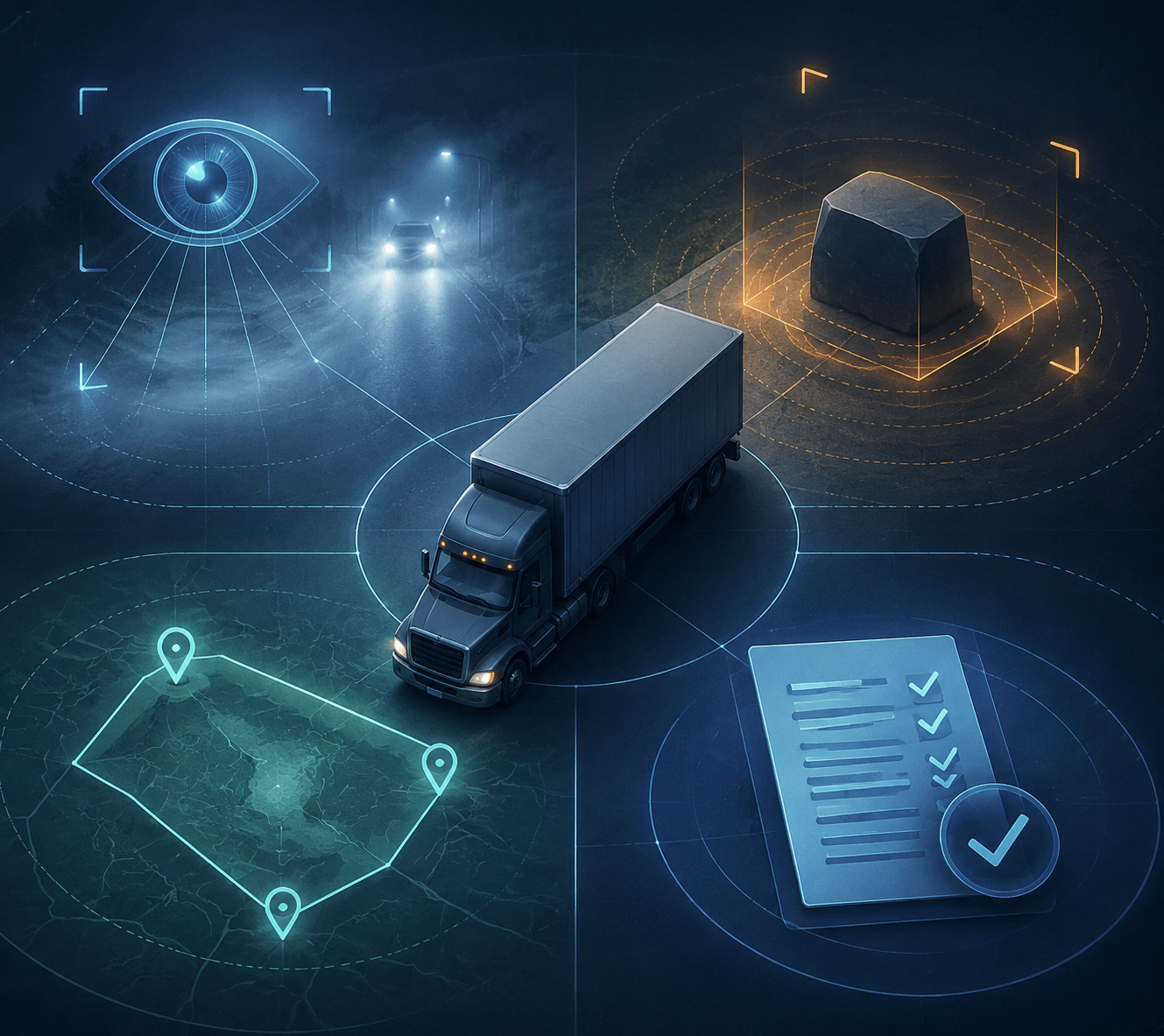
The Tesla record does not prove that autonomous trucking is unsafe as a category. It does something more useful for procurement: it identifies failure modes that a fleet team can turn into diligence questions before any pilot enters freight operations. Four deserve attention: camera-dominant perception degradation, stationary-object detection, weak operational design domain enforcement, and safety metrics that cannot be independently checked.
The Failure Mode That Should Change the First Vendor Meeting
A camera-based system that struggles in glare or dust is not automatically disqualifying. Human drivers struggle there too. The operational question is whether the system knows when its perception is degraded, whether it changes behavior soon enough, and whether the vendor can show evidence across the conditions that actually exist on the proposed route.
That distinction matters because a safety driver, remote monitor, or fallback protocol is not a magic eraser for late recognition. If the human receives a meaningful warning only in the final moment before impact, the system has shifted responsibility without giving the person time to use it. In trucking, where mass, stopping distance, and highway speed increase the consequence of a poor handoff, late degradation detection is not a UX problem. It is a safety case problem.
The first procurement question should therefore be plain: under what visibility conditions does the vehicle reduce speed, change following distance, request assistance, pull over, or refuse dispatch? A vendor that answers with “the model is improving” has not answered the fleet question. The fleet question is bounded behavior under known degradation.
| Documented failure mode | What it means in freight operations | Evidence a buyer should request |
|---|---|---|
| Perception degradation in glare, fog, or dust | The route may remain open while the vehicle’s sensing confidence falls below safe operating assumptions. | Condition-specific test results, fallback thresholds, sensor redundancy explanation, and degraded-visibility operating rules. |
| Stationary-object detection failures | Stopped vehicles, roadside equipment, work-zone objects, and disabled trucks may create high-consequence scenarios at highway speed. | Scenario coverage for stationary and partially occluded objects, near-miss data, and response timing at freight-relevant speeds. |
| Weak ODD enforcement | The system may operate outside the conditions that make its safety case valid. | Geofencing rules, weather and road-condition dispatch limits, disengagement criteria, and proof that constraints cannot be overridden casually. |
| Opaque safety metrics | Executives may approve a pilot based on comparisons that hide denominator, fleet-age, or crash-definition problems. | Audited safety cases, peer-reviewed methods, downloadable data where possible, and clear definitions of every crash metric. |
Camera-Only Confidence Is Not the Same as Route Readiness
Camera-heavy autonomy has real engineering appeal. Cameras are inexpensive relative to some sensor suites, scale well across vehicle platforms, and can capture rich scene information. The problem is not that cameras exist in the stack. The problem is treating camera performance under normal daylight as if it settles the question of operation through glare, fog, dust, heavy spray, or mixed lighting.
A freight buyer should ask whether LiDAR, radar, thermal sensing, map priors, or other redundancy exists not as a feature list but as a failure-management design. If one sensing mode is compromised, what independent channel remains? If the remaining channel is also uncertain, what does the vehicle do? If the vendor claims its perception model can infer enough from cameras alone, the next request should be the evidence package: test conditions, geographic scope, weather distribution, lighting distribution, and the minimum confidence threshold that triggers a safer state.
The phrase “common visibility conditions” is the operational hinge in NHTSA’s 2026 analysis. Glare, fog, and dust are not exotic laboratory traps. They are routine route variables. A pilot route from a distribution center to a highway hub cannot be evaluated only by lane complexity and traffic density. It also needs a visibility profile: seasonal fog, sunrise and sunset orientation, construction exposure, agricultural dust, mountain weather, and spray from adjacent traffic.
What the buyer should not accept
- A generic statement that the perception model was trained on adverse weather without route-specific evidence.
- A demo route that avoids the hardest lighting or weather windows while the commercial proposal assumes all-day operation.
- A safety-driver plan that does not define how much warning time the human receives before intervention is expected.
- A sensor architecture explanation that lists hardware but does not explain degraded-mode behavior.
Stationary Objects Are a Freight Problem Before They Are a Software Problem
Stationary-object detection sounds like a narrow perception task until it is placed on an interstate. A stopped vehicle in a lane, a crash scene, a work-zone attenuator, a disabled tractor-trailer on the shoulder, or a maintenance vehicle partly intruding into travel lanes can turn a classification delay into a severe-impact event. The question is not whether the model can label a clean obstacle in a curated dataset. It is whether the vehicle reacts correctly when the scene is ambiguous, partially occluded, or visually degraded.
Tesla passenger-vehicle investigations do not map perfectly onto autonomous trucking. Truck platforms have different sensor placements, operating domains, braking profiles, duty cycles, and fleet controls. But the failure mode transfers cleanly enough to demand evidence: if an AV cannot reliably separate a safe drivable corridor from a stationary hazard at speed, the fleet buyer needs to know before the pilot, not after the safety review board is reconstructing video.
The useful test request is not “show us your obstacle detection accuracy.” It is more specific: show performance against stopped vehicles, emergency scenes, construction equipment, lane-blocking debris, and shoulder objects across speed bands, lighting conditions, weather conditions, and road geometries similar to the route. The answer should include false negatives, false positives, braking behavior, evasive behavior, and minimum detection distance. A procurement team does not need to inspect every neural-network layer to ask for that.
ODD Enforcement Is Where a Safety Case Becomes a Dispatch Rule
Operational design domain language can look tidy in a presentation: certain roads, speeds, weather conditions, lighting conditions, and traffic environments are in scope; others are not. The freight version is messier. Dispatch wants the load moved. Weather changes after departure. Construction zones appear. A customer changes an appointment time. A carrier partner asks whether the vehicle can continue “just this once.”
That is why ODD enforcement matters more than ODD description. A vendor’s safety case should say how the system prevents operation outside its validated domain, not merely where it performs best. If fog crosses a threshold, is the route blocked before dispatch? If the vehicle encounters an unplanned construction configuration, does it slow, pull over, request remote assistance, or transfer control? If a map update is stale, who receives the exception and who has authority to release the vehicle?
The 2025 California DMV ruling against Tesla’s capability language is a reminder that naming and marketing are not harmless when they shape user expectations. An administrative law judge ruled that Tesla’s “Full Self-Driving” language was “actually, unambiguously false and counterfactual,” and Reuters reported that Tesla dropped the “Autopilot” name in January 2026.[2] For commercial buyers, the naming lesson is secondary. The practical lesson is that a capability claim must match the enforceable operating rule.
A fleet operations director should be able to turn the ODD into dispatch policy without translating vendor optimism into internal controls. That means the buyer needs written limits, machine-enforced limits, escalation paths, and records showing when the system refused to operate. A system that depends on informal restraint is not ready for the parts of logistics where pressure accumulates quietly: late freight, detention fees, missed production windows, and customer penalties.
The Denominator Problem in AV Safety Claims
The most dangerous safety metric is the one that sounds decisive while hiding what it counts. Reuters reported in May 2026 that Tesla’s “10x safer” claim was inflated by at least 3x through an apples-to-oranges comparison: airbag-deployment crashes for Tesla vehicles were compared against all tow-away crashes in broader U.S. data. Reuters also reported that Tesla vehicles averaged 4.1 years old compared with a 12.8-year U.S. fleet average, and that 10 safety researchers verified the flaw.[2]
That matters because freight executives often see safety claims before they see methodology. A crash rate per mile may look reassuring until the buyer asks what counts as a crash, what vehicle population is included, whether the comparison group is age-matched, whether the roads are comparable, how many miles are supervised, and whether miles with safety drivers are mixed with driver-out miles.
The Electrek analysis of Tesla’s Austin robotaxi data is useful here, but only with caution. Electrek reported that Tesla robotaxis crashed at about 1 per 55,000 miles with safety monitors present, compared with a human crash rate of about 1 per 500,000 miles, roughly 9x higher.[3] The methodological caveat is important: the analysis used NHTSA Standing General Order data, which captures a broader definition of “crash” than typical police-reported data and can distort direct comparisons.[3] Still, the logistics lesson survives the caveat. Supervised pilot performance and scaled driver-out performance are not the same claim.
A buyer should separate four mileage buckets before accepting any rate: simulation miles, closed-course miles, public-road supervised miles, and public-road driver-out commercial miles. Then the buyer should ask whether safety-critical interventions, remote-assistance events, fallback maneuvers, and disengagements are reported alongside crashes. Crash data alone can lag the risk signal, especially during early deployment when the exposure base is still small.
What Better Evidence Looks Like
The point is not that every AV vendor must use the same stack, publish the same paper, or disclose every proprietary detail. The point is that stronger evidence practices already exist. Waymo reports 82% fewer airbag-deployment crashes and 94% fewer serious-injury crashes versus human benchmarks across 220.6 million rider-only miles, with results published in peer-reviewed Traffic Injury Prevention papers and accompanied by downloadable raw data.[4] Those numbers still require scrutiny: the routes, vehicle types, operating domains, and comparison methods matter. But the disclosure standard gives a buyer something to interrogate.
That is the difference between a claim and an evidence package. A claim asks the buyer to trust a summary. An evidence package lets the buyer’s safety, legal, and insurance teams test the denominator, the operating domain, the crash definitions, and the exposure base. It also lets outsiders find weaknesses. That can be uncomfortable for vendors, but commercial deployment should be uncomfortable before it is irreversible.
Aurora’s Safety Case Framework points in the same direction for trucking. Aurora says its framework was validated through an independent third-party audit by Edge Case Research in June 2026 against NHTSA guidelines and industry standards.[5] That does not make Aurora’s system automatically safe on every lane, in every weather condition, or for every shipper. It does show the kind of structure a procurement team should expect: a safety argument, supporting evidence, independent review, and traceability between claims and controls.
Federal policy is also moving toward evidence-based commercial AV evaluation. The BUILD America 250 Act, reported in May 2026, created the first federal framework for autonomous commercial vehicles and moved oversight from a state patchwork toward performance-based safety standards requiring manufacturers to certify through evidence-based safety cases.[6] As of July 2026, the practical outcome is still developing, so buyers should not treat the law as a substitute for diligence. It is better read as a market signal: unsupported safety storytelling is becoming harder to defend.
A Route-Level Diligence Framework for Autonomous Trucking
The evaluation should begin with the lane, not the logo. A vendor may have a credible national roadmap and still be the wrong choice for a fog-prone route, a construction-heavy corridor, or a customer site with complicated yard movements. The buyer’s job is to make the vendor’s safety case collide with the actual route before freight does.
- Define the route and operating envelope: origin, destination, permitted roads, time windows, weather thresholds, lighting exposure, work-zone frequency, yard rules, and fallback locations.
- Map perception hazards: glare segments, fog zones, dust exposure, heavy spray, poor lane markings, shoulder activity, tunnels, ramps, and known construction patterns.
- Require stationary-object evidence: stopped vehicles, disabled trucks, lane-blocking debris, emergency scenes, construction equipment, and partially occluded hazards at route-relevant speeds.
- Test ODD enforcement: confirm how the system refuses dispatch, exits service, requests assistance, or reaches a minimal-risk condition when limits are breached.
- Audit the metrics: separate supervised from driver-out miles, define crash categories, request intervention data, and avoid comparisons that mix incompatible denominators.
- Assign internal ownership: safety approves the hazard case, legal reviews representations, operations controls dispatch exceptions, and procurement records the evidence used for approval.
This is not an anti-autonomy checklist. It is the kind of discipline that makes autonomy deployable. The weakest pilots tend to blur responsibility: the vendor owns the model, the carrier owns the load, the shipper owns the service promise, and everyone assumes someone else has interrogated the safety evidence. A serious pilot makes those boundaries explicit.
Questions that separate an evidence package from a sales deck
- Which parts of the route are inside the validated ODD, and which are excluded?
- What happens when visibility falls below the system’s safe operating threshold?
- How much warning time is provided before a human or remote operator is expected to intervene?
- Are public-road miles separated by supervised, remote-assisted, and driver-out operation?
- Can the vendor provide third-party audit results, peer-reviewed methods, or downloadable safety data?
- Who has authority to override a weather, construction, or map-related no-go decision?
Where Tesla Evidence Transfers—and Where It Does Not
Tesla’s passenger-vehicle crash probes should not be treated as a direct crash forecast for autonomous trucks. Trucking vendors may use different sensor suites, more restrictive geofences, professional fleet controls, remote operations centers, and narrower route plans. A driver-assistance system sold into consumer behavior is not the same as a driver-out commercial truck operating under a controlled ODD.
But the investigations are highly relevant to the way buyers evaluate claims. They show how quickly AI safety language can become operationally vague: the system performs well until visibility degrades; a driver is responsible but receives late warning; a capability name outruns actual use conditions; a safety statistic looks impressive until the denominator changes. Those are not Tesla-only risks. They are procurement risks wherever a technical claim must be converted into a route approval.
The better commercial AV vendors should welcome that scrutiny. If a system is safer within a bounded domain, the vendor should be able to show the domain, the evidence, the failure handling, and the audit trail. If the evidence is not ready, the pilot should either narrow the route, keep a meaningful safety layer in place, or wait.
The Practical Judgment for 2026–2027 Deployments
Autonomous trucking is not disqualified by Tesla’s crash probes. Freight networks have real problems that autonomy may help solve: driver availability, long-haul service variability, and brittle capacity planning. But the documented failures in Tesla investigations make one thing hard to excuse: treating degraded perception, stationary hazards, loose ODD limits, or unaudited safety metrics as details to be cleaned up after commercial launch.
A 2026–2027 deployment decision that accepts vague autonomy claims, uncheckable crash-rate comparisons, or perception evidence that does not cover glare, fog, dust, and stopped-object scenarios is not taking a calculated technology risk. It is turning a known AI safety failure mode into a procurement footnote.
References
- US agency upgrades probe into 3.2 million Tesla vehicles over FSD crashes, Reuters, March 19, 2026.
- Why Tesla's AI trainers don't trust its self-driving tech – or its safety stats, Reuters, May 28, 2026.
- Tesla's own Robotaxi data confirms crash rate 3x worse than humans even with monitor, Electrek, January 29, 2026.
- Waymo Safety Impact, Waymo.
- Welcome to Safety Case 101, Aurora.
- Federal AV Trucking Rules Move From Patchwork Oversight to National Framework, Logistics Viewpoints, May 20, 2026.
Comments
Join the discussion with an anonymous comment.