
SAP supply chain AI use cases are easiest to misread when they are treated as one product. In practice, the AI sits inside different SAP workflows: a planner sees it in IBP forecasting, a warehouse supervisor sees it in EWM labor planning, a transportation team may see Joule assisting with freight-rating questions, and a procurement lead may see it in Ariba category strategy or invoice processing. The business case changes with the module.
That distinction matters because the evidence is not evenly distributed. SAP has customer-facing metrics for some planning and procurement workflows, release-highlight estimates for warehousing and sustainability use cases, and community or announcement-level material for some transportation and orchestration scenarios. Those are all useful signals, but they should not be weighted the same way.
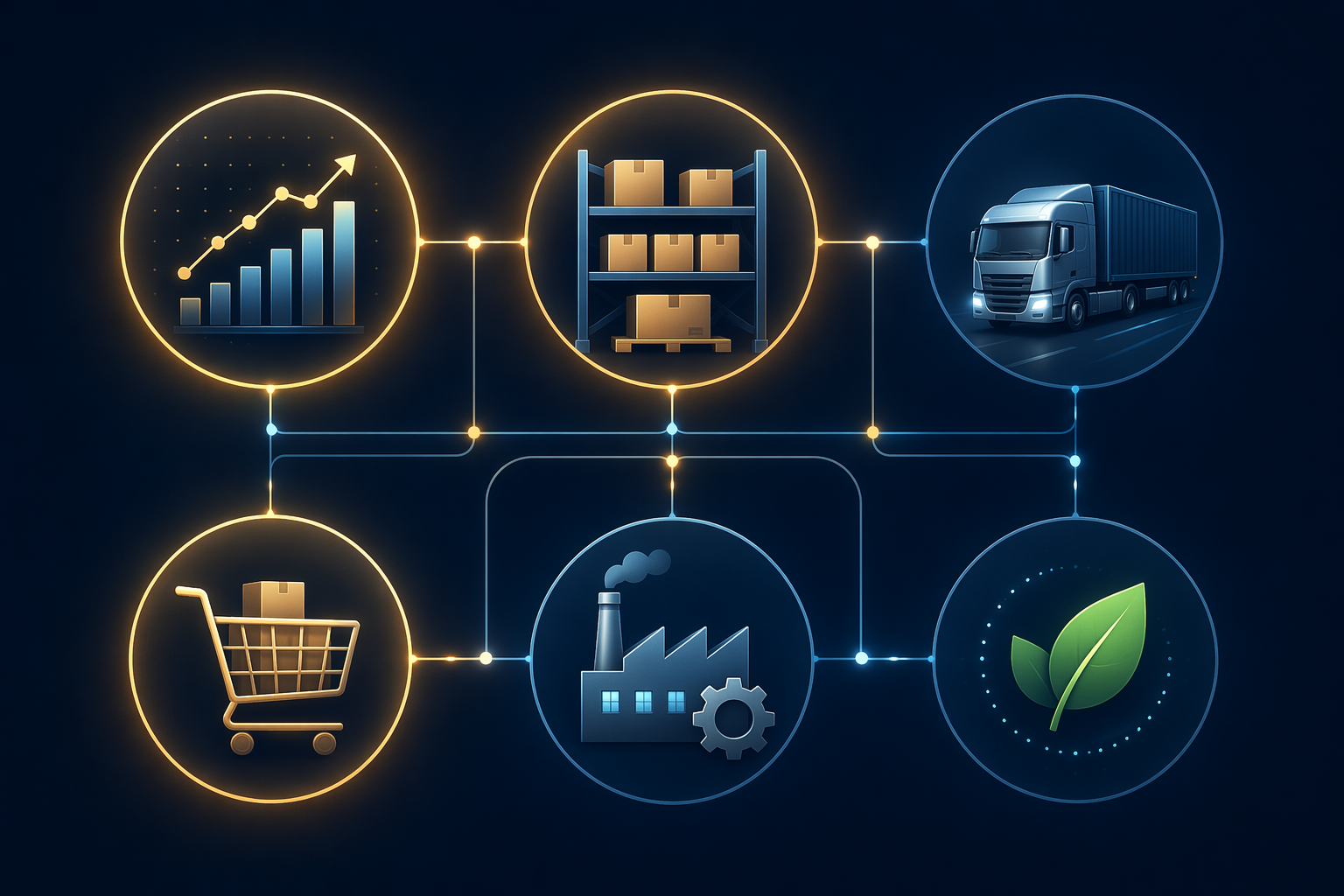
Module map: where SAP supply chain AI shows up
| SAP area | AI use cases to evaluate | Workflow owner | Availability or evidence stage | Representative metric or source type |
|---|---|---|---|---|
| SAP IBP | AI-assisted forecasting, demand sensing, multi-source demand signal integration | Demand planning, S&OP, supply planning | Operational customer evidence available | Coca-Cola Europacific Partners reported a 6% forecast accuracy improvement in SAP-published customer material [1] |
| SAP EWM | Predictive labor planning, predictive slotting, warehouse simulation themes | Warehouse operations, labor planning, shift supervision | Q1 2025 release-highlight evidence | SAP reported up to 50% higher warehouse supervisor productivity and up to 5% fewer shipment delays [2] |
| SAP TM | Joule freight-rating queries, what-if simulation, automated log analysis | Transportation planning, freight audit, carrier and route analysis | SAP Community use-case material rather than named customer metric | Community blog describes natural-language TM support and simulations without permanent master data changes [3] |
| SAP Ariba and procurement | AI-assisted category strategy, guided buying with Joule, invoice automation | Category management, procurement operations, accounts payable | Release-highlight and customer-story evidence | SAP reported up to 60% category management process efficiency improvement; Western Sugar reported 25% faster invoice processing and cost per invoice falling from $8 to $6 [2][1] |
| SAP Digital Manufacturing | Predictive quality, machine learning-based production optimization | Manufacturing execution, quality, production engineering | Capability-level coverage; less module-specific public metric depth in the provided material | Best treated as an evaluation area requiring proof from the customer’s own line, asset, and quality data |
| SAP Green Token | AI-assisted declaration image analysis for sustainability compliance | Sustainability reporting, product compliance, traceability | Q1 2025 release-highlight evidence | SAP reported up to 93% less time to review and post sustainability data for declaration image analysis [2] |
| Supply Chain Orchestration and agents | Cross-functional orchestration, emerging agentic planning and production support | Planning, operations control tower, production planning | 2026 watchlist items; verify current release status | Availability should be verified against the current release status before inclusion in a business case |
The map is the practical starting point. A forecast accuracy metric in IBP does not validate a warehouse labor use case. A release-highlight estimate for EWM does not prove transportation savings. A Joule scenario in TM may still be valuable, but it should be presented as workflow assistance unless there is a named deployment metric behind it.
IBP: forecasting is the strongest planning story
In SAP Integrated Business Planning, the AI case centers on better forecasts and faster interpretation of demand signals. The relevant workflows are familiar: baseline forecasting, demand sensing, exception handling, scenario review, and planner intervention. AI matters here when it reduces the amount of manual signal sorting before planners can make a decision.
The most concrete planning metric in the provided material is Coca-Cola Europacific Partners’ reported 6% improvement in forecast accuracy, published in SAP’s Business AI customer resource [1]. That is a useful proof point because it belongs to the planning problem itself. It should still be read as a selected customer story, not as a general benchmark for every IBP implementation.
For evaluators, the first question is not whether SAP has AI in planning. It is which forecast layer the AI affects. A demand sensing improvement has different implications from a consensus-planning assistant or a supply response recommendation. The former may change short-term forecast accuracy; the latter may change meeting cadence, exception prioritization, or planner productivity.
- Ask whether the AI output is used in statistical forecasting, demand sensing, planner explanation, scenario comparison, or exception prioritization.
- Check whether the measured gain is forecast accuracy, forecast bias, planner cycle time, service level, inventory position, or manual touch reduction.
- Separate adoption of Joule or embedded AI features from a proven improvement in the planning KPI.
- Use customer metrics as directional evidence, then test against the company’s own product volatility, promotion intensity, and data quality.
IBP is therefore one of the better-supported SAP supply chain AI use cases, but the business case still needs a planning-specific baseline. A company with fragmented demand history, weak master data, or frequent commercial overrides may see the value in different places than a company with stable replenishment patterns.
EWM: labor planning and warehouse supervision need their own evidence
SAP Extended Warehouse Management has a different AI profile. The important workflows are not forecast consensus or demand shaping; they are slotting decisions, labor demand planning, supervision, simulation, and delay prevention. The value proposition is operationally attractive because warehouse supervisors often make daily decisions with partial visibility into order waves, labor availability, dock constraints, and exception queues.
SAP’s Q1 2025 release highlights reported that predictive labor planning can increase warehouse supervisor productivity by up to 50% and reduce shipment delays by up to 5% [2]. The wording matters. “Up to” figures from release material are not the same as a named customer’s audited performance result. They are still relevant for scoping value, especially if the evaluator is building a hypothesis for a warehouse pilot, but they need local validation.
A credible EWM evaluation should look at where the supervisor’s work actually changes. If the AI predicts labor demand but staffing approvals still happen in a separate workforce system, the benefit may be limited to planning visibility. If the prediction feeds wave planning, task prioritization, and supervisor review in the same operating rhythm, the productivity claim becomes more plausible.
| EWM AI area | Operational question | Metric to request |
|---|---|---|
| Predictive labor planning | How many people are needed by shift, zone, or work type? | Supervisor planning time, overtime, temporary labor usage, delayed shipments |
| Predictive slotting | Which products should move to reduce travel, congestion, or replenishment friction? | Travel time, picks per labor hour, replenishment moves, congestion events |
| Warehouse simulation | What happens if order volume, labor, layout, or process rules change? | Scenario cycle time, dock utilization, throughput, service impact |
The strongest EWM use case is not a generic “AI warehouse.” It is a narrower question: can the system improve the supervisor’s decision window before congestion or labor mismatch creates shipment delays? That is where the release-highlight metrics should be tested.
Ariba: category strategy has a clearer AI workflow than most procurement claims
In SAP Ariba and adjacent procurement workflows, the AI story splits into three practical areas: category strategy, guided buying, and invoice automation. These should not be collapsed into one procurement benefit. Category strategy affects sourcing and supplier decisions. Guided buying affects requisitioner behavior. Invoice automation affects accounts payable throughput and exception handling.
SAP’s Q1 2025 release highlights reported that AI-assisted category strategy can improve category management process efficiency by up to 60% [2]. That claim is worth attention because category strategy is often a slow, research-heavy workflow: teams gather spend data, market inputs, supplier context, risk indicators, and internal requirements before producing a plan. AI assistance can plausibly reduce the assembly and drafting burden, even if final supplier and negotiation decisions remain human-owned.
The invoice side has a separate customer metric. Western Sugar Cooperative achieved 25% faster invoice processing and reduced cost per invoice from $8 to $6 in SAP’s Business AI customer material [1]. That is not evidence that category strategy improves by the same amount. It is evidence that procurement and finance automation can produce measurable processing benefits in a specific deployment.
For an Ariba business case, the cleanest approach is to avoid a single procurement ROI bucket. Build one case for category management effort, another for buying compliance or guided buying behavior, and another for invoice processing. The owners, baselines, and adoption barriers differ.
- Category strategy: measure analyst time, strategy cycle time, spend coverage, supplier research effort, and review workload.
- Guided buying with Joule: measure preferred-supplier usage, policy compliance, requisition rework, and user completion time.
- Invoice automation: measure touchless processing, exception rate, approval time, cost per invoice, and supplier inquiry volume.
TM: useful Joule scenarios, thinner metric support
SAP Transportation Management has a more cautious evidence profile in the provided material. The cited TM source is an SAP Community blog describing AI use cases such as natural-language freight rating queries, what-if simulations, and automated log analysis [3]. These are credible workflow-assistance scenarios, but they are not the same as a named customer result showing reduced freight cost, improved tender acceptance, or higher on-time performance.
The freight-rating scenario is still practically interesting. A planner or analyst can ask questions about rates without navigating every configuration object manually. What-if simulation is also useful if the team needs to test routing, charge, or carrier assumptions without permanently changing master data [3]. That can reduce analysis friction, especially in environments where transportation specialists depend on a small number of configuration experts.
ASR Group’s 95% freight prediction accuracy over 30-day horizons appears in SAP’s customer material and can support the broader point that SAP-related AI and analytics are being applied to freight prediction [1]. It should not be automatically assigned to every TM Joule scenario. Prediction accuracy, freight-rating assistance, and log analysis are different operating problems.
A TM evaluator should therefore ask for a demo tied to the exact transportation role: freight audit analyst, transportation planner, carrier manager, or SAP support team. Natural-language access is valuable when it shortens a real task, not when it merely adds a conversational layer over unresolved process complexity.
Digital Manufacturing: keep the proof close to the line
SAP Digital Manufacturing belongs in the module map because predictive quality and machine learning-based production optimization are part of the supply chain AI landscape. The public material in the provided research, however, does not provide the same module-specific customer metric depth as IBP, EWM, or Ariba.
That makes the evaluation standard simpler and stricter. Manufacturing AI should be tested against plant-level evidence: defect detection, quality escapes, scrap, rework, throughput, downtime, changeover stability, or production-plan adherence. A broad SAP AI portfolio claim does not establish that a model will work on a particular line, machine, recipe, or inspection regime.
If the use case depends on machine learning, the data boundary matters. The team should know which production signals are available, how labels are created, whether quality outcomes arrive in time to train useful models, and whether recommendations can be acted on before the next batch, shift, or production run.
Green Token: a strong metric for a narrow sustainability workflow
SAP Green Token is a useful reminder that supply chain AI is not limited to planning and execution. Sustainability and traceability teams also handle operationally heavy workflows, including collection and review of product and supplier declarations.
SAP’s Q1 2025 release highlights reported that AI-assisted declaration image analysis can reduce the time needed to review and post sustainability data by up to 93% [2]. That is a striking figure, but it belongs to a specific workflow: analyzing declaration images for sustainability data. It should not be generalized into proof that Green Token, or SAP supply chain AI overall, has achieved the same level of maturity across all traceability and compliance tasks.
The right business case is likely about review workload, posting time, compliance throughput, and data-entry quality. If the sustainability team’s bottleneck is supplier participation, missing upstream documentation, or unclear product lineage, image analysis may help only after those inputs arrive.
What SAP’s scale numbers do and do not prove
SAP’s broader AI portfolio gives useful context after the module-level view is clear. SAP had more than 200 embedded AI use cases available across its cloud portfolio by Q1 2025 and was targeting more than 400 by year-end, according to Technology Magazine’s coverage [4]. That scale indicates product investment and breadth. It does not say which use cases are mature, which are deeply embedded, or which ones change a specific supply chain KPI.
For supply chain evaluators, the count should trigger inventory, not confidence. Which of those use cases sit inside IBP, EWM, TM, Ariba, Digital Manufacturing, or Green Token? Which are generally available? Which require a particular SAP cloud edition, data foundation, or Joule entitlement? Which are assistive features rather than optimization engines? Those questions turn a portfolio number into a procurement checklist.

2026 watchlist: orchestration and planning agents
The next evaluation layer is orchestration. SAP’s 2025 supply chain update material pointed toward newer supply chain management capabilities, while SAP’s 2026 resilience messaging emphasized more connected, adaptive supply chain operations [5][6]. The research brief also identifies Supply Chain Orchestration for H1 2026 and a Production Planning Agent for Q1 2026 as planned items in the source material. Because those dates now sit inside 2026, evaluators should verify current SAP release status before treating them as available functionality.
The evaluation question for orchestration is different from the question for a single module. Embedded IBP AI can improve a planning task; embedded EWM AI can improve a warehouse supervision task. Orchestration has to prove that it can coordinate across planning, manufacturing, logistics, procurement, or exception management without creating another layer that users must reconcile manually.
Until those capabilities are generally available and supported by deployment evidence, they belong in a roadmap section of the business case rather than the committed benefits section. That does not make them unimportant. It simply keeps planned agentic capabilities from subsidizing today’s ROI claim.
How to build the business case without overclaiming
The safest evaluation structure is module first, use case second, metric third. Start with the workflow owner and the operational decision being changed. Then identify whether the evidence is a named customer result, a release-highlight estimate, a community scenario, a partner claim, or a planned roadmap item.
| Evidence type | How to use it | What not to do |
|---|---|---|
| Named customer metric | Use as directional proof that a similar workflow has produced measurable results | Do not assume the same result without matching data, process, and operating context |
| SAP release-highlight metric | Use to scope a value hypothesis and define pilot KPIs | Do not present “up to” figures as guaranteed savings |
| SAP Community use case | Use to understand possible workflow patterns and demo requirements | Do not treat it as customer ROI evidence |
| Portfolio-scale AI count | Use to understand SAP’s investment breadth | Do not use it as proof of value in a specific warehouse, lane, category, or plant |
| Planned 2026 capability | Use in roadmap planning and architecture discussions | Do not include it in committed benefits until availability is confirmed |
This approach also helps internal stakeholders avoid talking past each other. The SAP architect may care about where Joule is embedded. The warehouse director may care about labor planning and shipment delays. The procurement lead may care about category strategy cycle time. The sustainability owner may care about declaration review workload. One SAP AI narrative will not answer all of those questions.
SAP’s supply chain AI value is credible but uneven by module. The strongest current cases in the provided material sit where AI is embedded in established workflows: forecasting in IBP, labor planning in EWM, and category strategy or invoice automation in Ariba. TM, Digital Manufacturing, Green Token, and emerging orchestration can still matter, but each requires narrower claims and cleaner availability checks. The business case should be built around the module and the use case, not around the size of SAP’s overall AI portfolio.
References
- SAP Business AI customers in action, SAP.
- SAP Business AI Release Highlights Q1 2025, SAP News Center, April 2025.
- AI Use Cases in SAP S/4 Transportation Management, SAP Community.
- SAP to deliver 400 AI use cases by end of 2025, Technology Magazine.
- SAP Connect: Innovative Updates in Supply Chain Management, SAP News, October 2025.
- Blueprint for Supply Chain Resilience in 2026, SAP News, February 2026.
Comments
Join the discussion with an anonymous comment.