
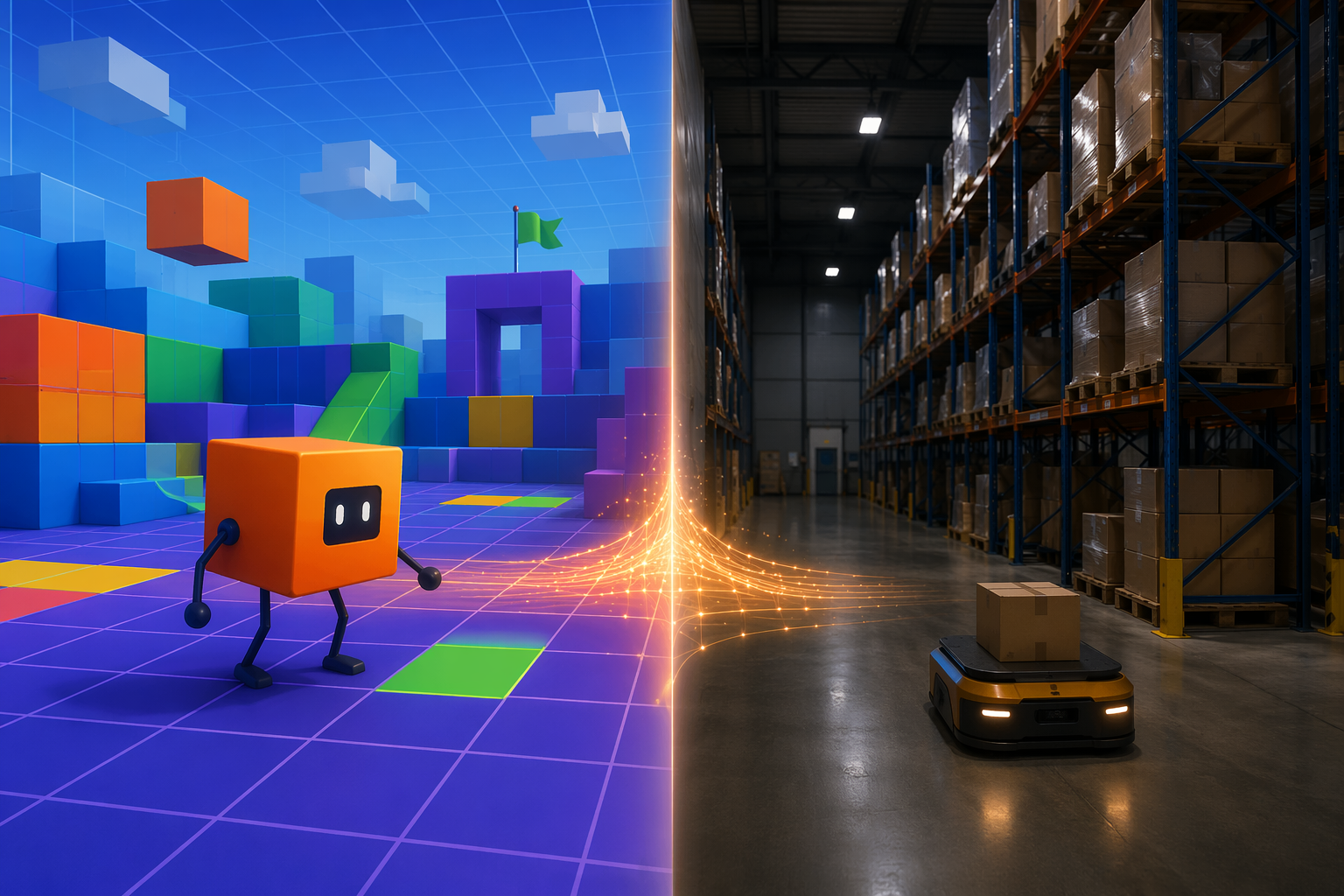
The appeal of AI Warehouse Albert is easy to understand if you have ever watched a robot fail in public. The orange cube stumbles, overcorrects, discovers a slightly better movement, then eventually turns the mess into something that looks like walking. On the AI Warehouse YouTube channel, that loop has turned into a recognizable internet object: a channel launched in October 2022 with third-party estimates of 828,000 subscribers, more than 96.4 million total views, and 21 videos as of June 2026.[1]
Albert works because the demonstration makes deep reinforcement learning visible. The agent is not handed a complete walking script. It tries actions in a Unity ML-Agents environment, receives rewards or penalties, and improves its policy over many attempts. The channel profile links the creator to the University of Toronto Machine Intelligence Student Team, and coverage of the walking demo describes Albert as trained with Proximal Policy Optimization, or PPO.[2][3] The best-known example, “AI Learns to Walk,” has drawn 13.4 million views, not because viewers need another animation of a cube, but because trial, failure, reward, and policy improvement are suddenly legible.[1]
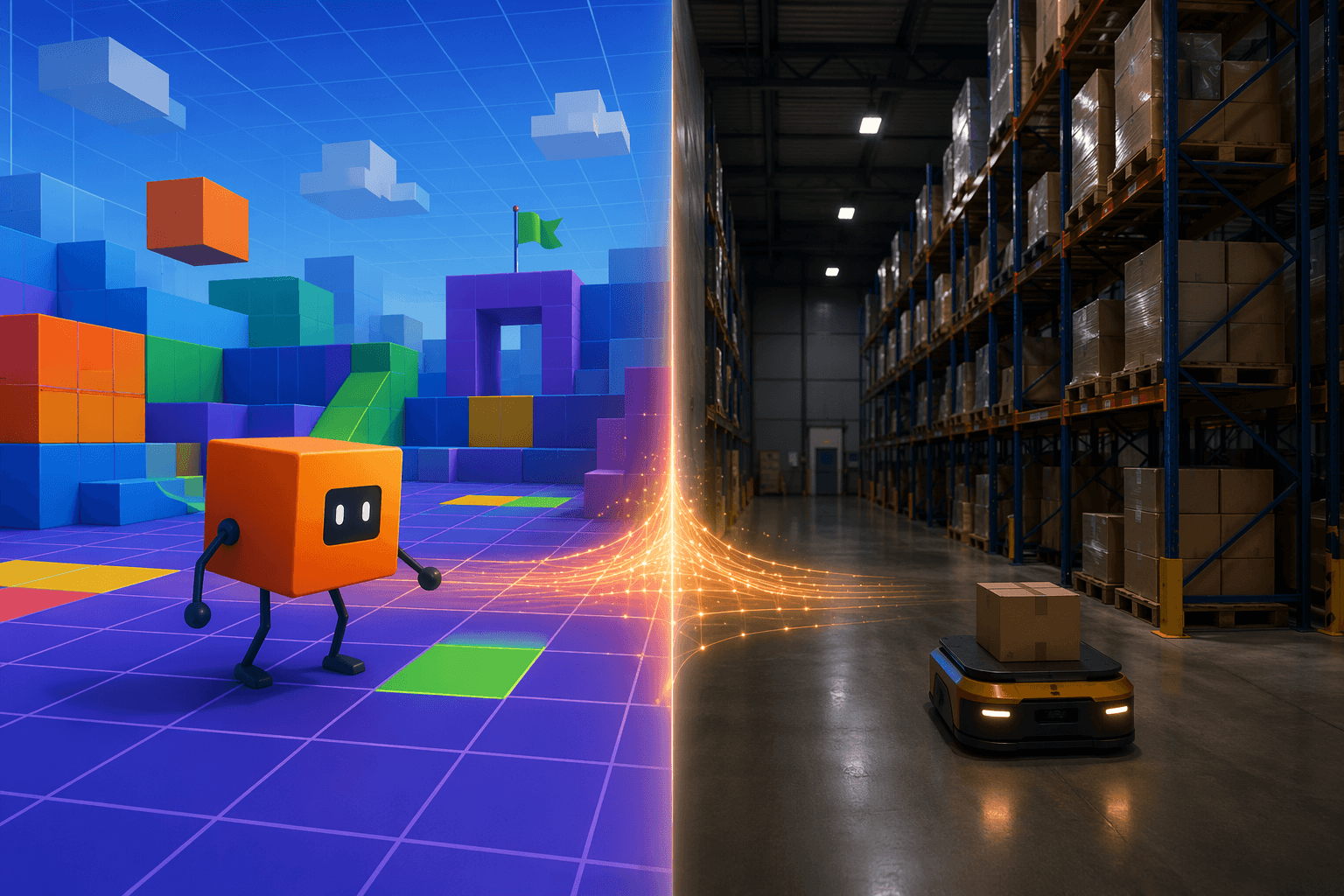
That is a useful doorway. It is not yet a warehouse business case. A distribution center does not care whether an agent looks charming while learning. It cares whether waves leave on time, pickers avoid wasted travel, robots do not gridlock at aisle intersections, and exception handling does not fall back onto supervisors at the worst possible hour.
So the serious question behind AI Warehouse Albert is narrower than the demo suggests: what survives when this kind of learning leaves a clean simulation and meets warehouse operations?
The warehouse problem that actually fits reinforcement learning
Dynamic order picking is one of the better tests for this technology because it is not a toy problem dressed up in warehouse language. Orders arrive while work is already underway. Priorities shift. Travel time eats capacity. A decision that looks efficient at one moment can make the next few orders worse. Static dispatching rules can be perfectly sensible under normal load and still degrade when arrival pressure rises.
That is why the 2025 dynamic order picking work by Mahmoudinazlou et al. deserves more attention than the average “AI in warehouse” claim. The study modeled a single autonomous picker in a single-block warehouse with 10 aisles, 15 locations per side, and a picker capacity of 20 items.[4] This is not a full distribution center with multiple zones, mixed human labor, conveyors, replenishment constraints, and robot charging queues. But it is concrete enough to inspect.
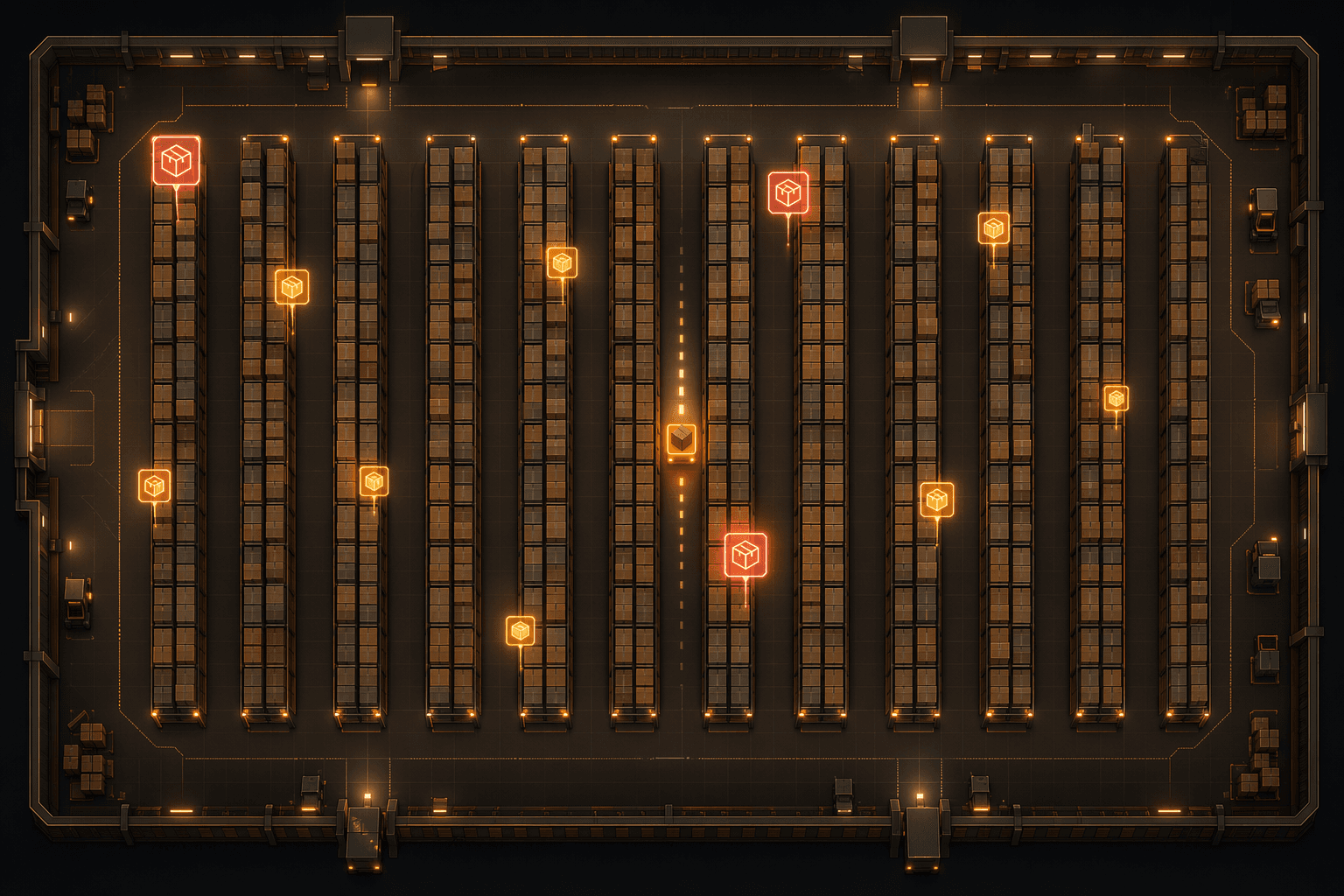
In plain operational terms, the agent had to decide what to pick and when to travel while orders continued entering the system. The warehouse shape mattered because travel distance was not abstract. The 20-item picker capacity mattered because every route decision had an opportunity cost. The arrival-rate condition mattered because a method that performs nicely under light load can be useless when the order queue thickens.
At the high-arrival-rate condition reported as λ=0.09, the deep reinforcement learning model achieved about a 98% order fulfillment rate, compared with 82% for benchmark algorithms.[4] The authors also reported an approximately 420% reduction in order throughput time compared with baseline methods and found that the trained models generalized to out-of-sample arrival-rate scenarios.[4]
Those numbers are the first point in this story where Albert’s learning loop starts to look operationally relevant. The agent is not learning to be cute. It is learning a policy for sequencing work under uncertainty. In a warehouse, that distinction matters. If a picker commits too early to a route, new orders may wait. If it keeps chasing every new high-priority order, travel can explode. A learned policy can, under the modeled conditions, discover tradeoffs that rigid rules miss.
The boundary is just as important as the result. The study does not prove that a PPO-style agent can run a live, multi-picker, multi-block warehouse. It does not settle human-robot interaction. It does not show how the system behaves when scanners fail, a tote is missing, a replenishment task blocks an aisle, or a supervisor freezes part of the floor for a carrier cutoff. It shows that in a defined single-picker, single-block, modeled environment, deep reinforcement learning can outperform benchmark decision rules on fulfillment rate and throughput time.
| Evidence point | What it supports | What it does not prove |
|---|---|---|
| Single autonomous picker in a 10-aisle, single-block warehouse | DRL can be tested against a recognizable order-picking structure | General performance in multi-picker or multi-zone operations |
| 20-item picker capacity | The policy must manage route and capacity tradeoffs | Performance under all labor, equipment, and replenishment constraints |
| About 98% fulfillment at λ=0.09 versus 82% for benchmarks | Measurable improvement under the study’s high-arrival-rate condition | Guaranteed improvement in a live warehouse |
| Out-of-sample arrival-rate generalization | Some robustness beyond the exact training scenarios | Full sim-to-real transfer |
Traffic is a different warehouse bottleneck
Order picking asks whether an agent can make better task decisions while demand changes. Robot traffic coordination asks a different question: can many autonomous machines move through shared space without quietly destroying each other’s productivity?
That second question is where the MIT and Symbotic work becomes interesting. Researchers developed a hybrid system using a graph neural network with reinforcement learning to coordinate more than 100 warehouse robots, reporting roughly a 25% throughput improvement over heuristic-based traffic management in simulated warehouse environments.[5]
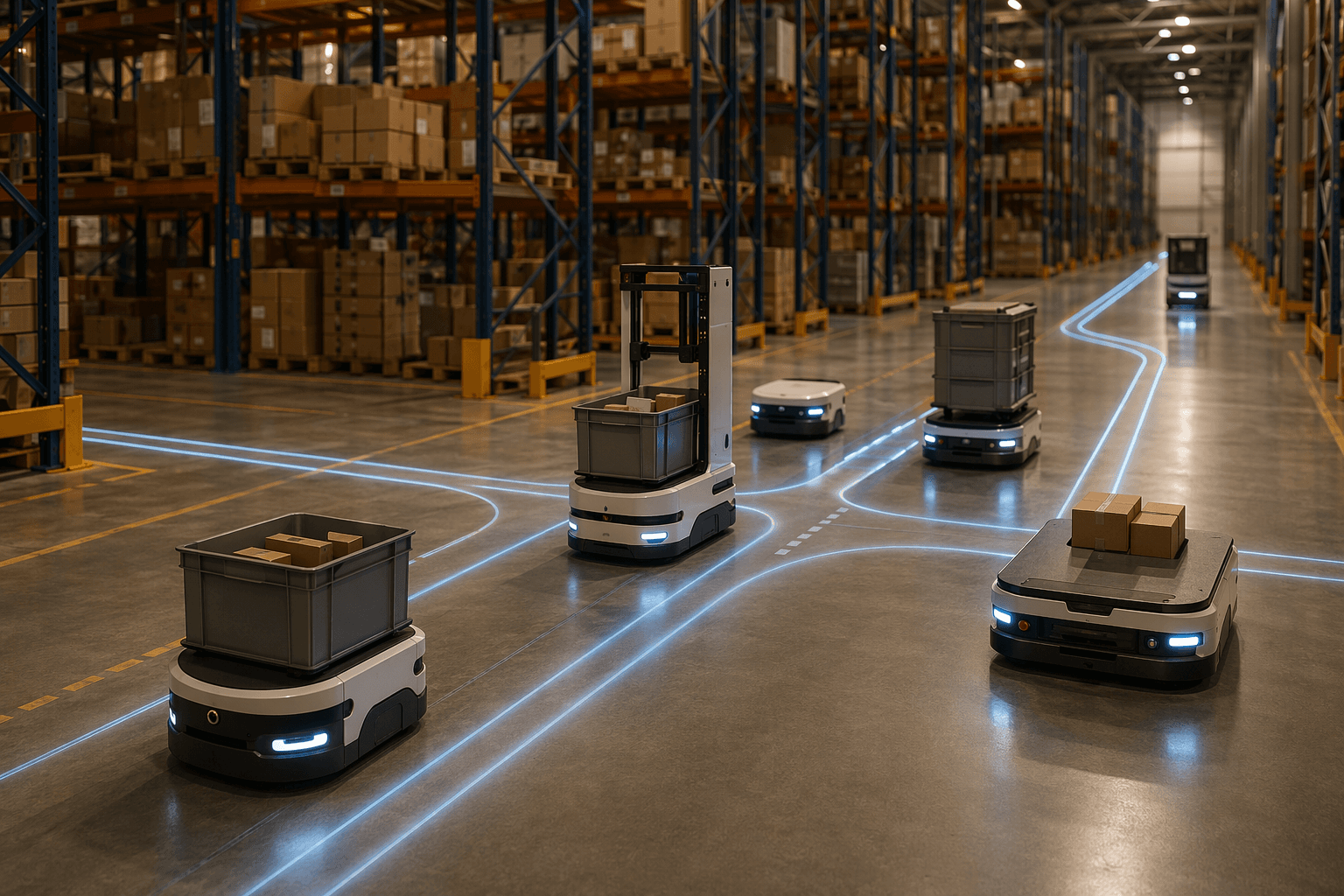
This is close to a real pain point. Once a facility has enough robots, the bottleneck shifts from whether one unit can navigate to whether the fleet can avoid congestion, dead time, and path conflicts. A rule that works for a few bots can become clumsy when intersections are busy and every reroute changes the next robot’s best option.
The graph neural network component is important because warehouses are spatial systems. Robots, aisles, intersections, and destinations form a changing network. Reinforcement learning is then used not simply to pick a next move for one machine, but to improve traffic decisions across the fleet structure. That is a more warehouse-shaped problem than making a simulated character walk.
But the word “simulated” has to stay attached to the 25% figure. The result was reported for simulated warehouse environments, not as production deployment evidence.[5] That does not make it unimportant. Simulation is a reasonable place to train and stress-test traffic policies before anyone risks a live floor. It does mean a buyer should not treat the number as a guaranteed throughput lift for an existing facility.
Where the evidence widens, and where it thins
There are other signs that reinforcement-learning-adjacent warehouse technology is broadening. A 2024 Computers & Industrial Engineering paper presented an IACPPO model for warehouse inventory decisions and reported effectiveness for dynamic inventory replenishment decisions.[6] That matters because replenishment is another place where timing, uncertainty, and downstream consequences collide.
Still, inventory replenishment is not the same operational problem as dynamic order picking, and it is not proof that Albert-like agents are broadly deployed to control warehouse execution. The useful takeaway is more modest: researchers are applying deep reinforcement learning beyond games and walking demos to warehouse decision problems where actions have delayed consequences.
Physical robot deployment evidence also needs careful handling. Brain Corp reported more than 40,000 AI-powered robots deployed across six continents on its BrainOS platform, with capabilities involving autonomous navigation and shelf scanning, and announced SOC 2 Type II certification in April 2026.[7] That is real scale, and it is relevant to anyone evaluating whether AI-enabled mobile robots can survive outside a lab.
It is not, however, the same claim as “deep reinforcement learning now runs warehouse picking.” Brain Corp’s profile is primarily retail and in-store autonomy, not pure warehouse picking. Computer vision plus autonomous navigation is a different application shape than a PPO agent learning warehouse order policies. Useful evidence, wrong shortcut.
The due diligence questions Albert should trigger
A good demo can start the conversation. It should not finish it. When a vendor, research group, or internal innovation team uses reinforcement learning language around warehouse automation, the first questions should be about scope, not adjectives.
- What exact warehouse decision is the agent making: pick sequencing, routing, batching, replenishment, traffic control, charging, or something else?
- Was the result produced in simulation, a pilot, or a production facility?
- How many pickers, robots, aisles, zones, SKUs, and order-arrival conditions were included?
- Which metric improved: fulfillment rate, throughput time, robot utilization, congestion, labor travel, missed waves, or service level?
- What was the benchmark: a simple rule, a strong heuristic, an existing WMS/WES logic layer, or a human dispatcher?
- What happens when the environment changes: demand spike, blocked aisle, replenishment shortage, robot fault, layout change, or new SKU mix?
The answer may still be impressive. The dynamic order picking and robot traffic studies are not empty hype. They show measurable improvements against defined benchmarks. But warehouse buyers should keep the evidence matched to the operating condition that produced it.
For readers who need a primer on where reinforcement learning sits inside the larger AI vocabulary, the glossary entry on artificial intelligence and machine learning in supply chain is the cleaner starting point. For adjacent production examples outside the narrow DRL evidence base, see AI logistics company deployments with measured outcomes and the broader look at autonomous AI agents in supply chain.
So is AI Warehouse Albert real warehouse technology?
As a direct representation of what runs a distribution center today, no. Albert is a simulation character trained in a controlled environment, and the jump from “learned to walk in Unity” to “can run your DC” is exactly where bad automation buying decisions begin.
As a visible, accessible example of the learning method behind emerging warehouse research, yes. Deep reinforcement learning has moved into serious warehouse problems: dynamic order picking with measured fulfillment and throughput improvements in a defined single-picker model, simulated multi-robot coordination with reported throughput gains, and related work in replenishment decisions.
The honest answer is bounded. Deep reinforcement learning is now a real warehouse research and limited-application technology. It is not yet general proof that production warehouses can replace established heuristics, supervised systems, WMS/WES logic, or engineered control layers with free-roaming DRL agents. Albert is a good way to see how learning happens. The warehouse evidence tells us where that learning has started to earn its keep, and where it still has to prove itself on the floor.
References
- AI Warehouse YouTube Stats — vidIQ, June 25, 2026.
- AI Warehouse channel profile — Grokipedia.
- AI Teaches Itself to Walk Using Deep Reinforcement Learning — 80.lv.
- Deep Reinforcement Learning for Dynamic Order Picking in Warehouse Operations — Mahmoudinazlou et al., arXiv 2408.01656v2 / Computers & Operations Research, 2025.
- AI system learns to keep warehouse robot traffic running smoothly — MIT Schwarzman College of Computing, March 2026.
- IACPPO model for warehouse inventory — Computers & Industrial Engineering, 2024.
- Brain Corp press releases — PRNewswire, April 2026.
Comments
Join the discussion with an anonymous comment.