
IBM’s AI supply chain strategy is easiest to misread if it is treated as another planning-suite pitch. The stronger reading starts inside IBM’s own operating model: the company says it ran AI across a global supply chain of more than $4.5 billion, reported $160 million in supply chain cost savings, cut logistics costs by 30%, saved 26,000 annual procurement hours, and reduced part-shortage mitigation from hours to seconds.[1][2] Those are not audited category benchmarks, and they should not be used that way. They are IBM-published proof points. Still, for a large enterprise buyer, they are more useful than a clean demo of an optimization engine that has never had to survive a global architecture board, a procurement policy exception, and a skeptical operations VP in the same quarter.
That distinction matters because IBM’s AI strategy for supply chain applications is less about replacing every specialist planning system and more about orchestrating work across the systems, teams, data controls, and governance routines that already exist. Its strongest case is in procurement, supplier risk, support automation, and cross-functional workflow. Its weaker case, based on the public evidence available now, is as the primary engine for advanced supply chain planning, warehouse execution, or transportation optimization.

The Client Zero Case Is the Load-Bearing Evidence
IBM’s Client Zero story deserves attention because it starts with a constraint that enterprise buyers recognize: before selling transformation externally, IBM had to apply the same machinery to its own complex back office and supply chain. In the company’s own case materials, the internal deployment is not framed as a small pilot. IBM ties it to a broad productivity agenda, with $4.5 billion in enterprise-wide productivity gains attributed to AI and automation, alongside specific supply chain results such as $160 million in cost savings and 15.6% hardware supply chain productivity savings.[1][2]
The operational claims are concrete enough to be worth separating. A 30% logistics cost reduction is a logistics outcome, not a generic AI adoption statistic. A 100% fulfillment rate during pandemic disruptions speaks to continuity under stress, though the public case material does not make it a controlled comparison against a counterfactual. Saving 26,000 annual procurement hours is a workflow and labor-capacity claim. Moving part-shortage mitigation from hours to seconds is a decision-cycle claim.[1][2] Each points to a different kind of enterprise value, and none should be collapsed into the vague statement that “AI improved the supply chain.”
The caveat is equally important: these figures come from IBM’s own case studies. They are not independently verified audit findings, and they do not prove that another manufacturer, distributor, healthcare system, or retailer would achieve the same percentages. What they do establish is narrower but still useful. IBM has operated AI and automation against the kind of fragmented, policy-heavy, global enterprise environment that many vendors only encounter after the contract is signed.
That is why the Client Zero evidence is a credible buying signal, but not a complete buying case. It tells a CIO or chief supply chain officer that IBM understands the mess between strategy and execution: legacy applications, exception-heavy procurement, shared-service queues, supplier-data gaps, and the operational drag of getting humans to trust automated recommendations. It does not, by itself, prove that IBM has the deepest demand-sensing model, the best inventory optimization engine, or the most mature transportation-routing intelligence.
What IBM Appears to Be Productizing
The product direction that follows from Client Zero is not a single supply chain application. IBM is productizing a pattern: use watsonx Orchestrate and related assets to coordinate work across enterprise systems, expose agents for repeatable tasks, connect risk and supplier intelligence, and support deployment in hybrid cloud environments. In supply chain terms, that makes IBM more credible around the work that surrounds decisions than around every domain-specific calculation inside a planning suite.
IBM’s public procurement-agent material points to use cases such as supplier discovery, purchase request handling, contract and sourcing support, and workflow automation in procurement operations.[3] Those are meaningful applications because procurement is full of handoffs: a requester submits something incomplete, a buyer checks policy, a sourcing manager looks for supplier options, legal reviews terms, finance checks budget, and someone eventually asks why the cycle took so long. An agent does not need to “run the supply chain” to remove friction from that chain of work.
The Sterling Suite also matters in this picture because IBM has long used it as part of its supply chain and B2B integration story. IBM’s 2026 supply chain transformation positioning ties AI adoption to end-to-end process modernization rather than a narrow point-solution replacement.[4] That framing will appeal to enterprises with a large installed base of ERP, procurement, order management, supplier collaboration, and integration platforms. It will be less satisfying to buyers who are primarily shopping for a best-of-breed planning brain with rich category benchmarks and deep scenario-planning references.
| Where IBM’s evidence is stronger | What the evidence supports | Where buyers should ask harder questions |
|---|---|---|
| Procurement workflow automation | IBM-published hours saved and procurement-agent use cases | Depth of sourcing-category intelligence and realized savings outside IBM |
| Cross-system orchestration | watsonx Orchestrate positioning and Client Zero operating evidence | How agents behave across non-IBM applications and exception-heavy processes |
| Supplier risk intelligence | S&P Global data integration into IBM agents | How risk signals change sourcing, allocation, or continuity decisions |
| Services-led transformation | IDC services leadership across supply chain services categories | Cost, timeline, and internal capability transfer after implementation |
| Planning and logistics execution | Limited public supply-chain-specific proof in the current materials | Comparison against specialist platforms in demand, inventory, warehouse, and transport use cases |
The Agent Strategy Is Real, but Its Supply Chain Depth Is Uneven
IBM’s agentic AI pivot is now central to how the company talks about enterprise automation. At Think 2026, IBM said enterprises would deploy more than 1,600 AI agents on average by the end of 2026, and cited survey data that 7 in 10 executives say their AI governance is not fit for purpose.[5] Those claims come from IBM’s own keynote and IBV survey framing, so they should be read as market-positioning signals rather than neutral market measurement. But the direction is consistent with what large enterprises are asking vendors to solve: not one clever chatbot, but fleets of controlled agents that can operate inside permissioned workflows.
IBM says watsonx Orchestrate includes a catalog of more than 500 pre-built agents.[5] Inside IBM, the company points to AskHR resolving 94% of inquiries autonomously and AI agents handling 86% of IT queries.[5] The 2025 watsonx Challenge generated 15,000 employee-submitted AI agent ideas, which gives IBM a useful internal laboratory for finding repetitive work that can be redesigned around agents.[5] This is strong enterprise-automation evidence. It is not the same as proof that IBM agents can autonomously rebalance a constrained production network, optimize multi-echelon inventory, or dispatch freight under real-world transportation constraints.
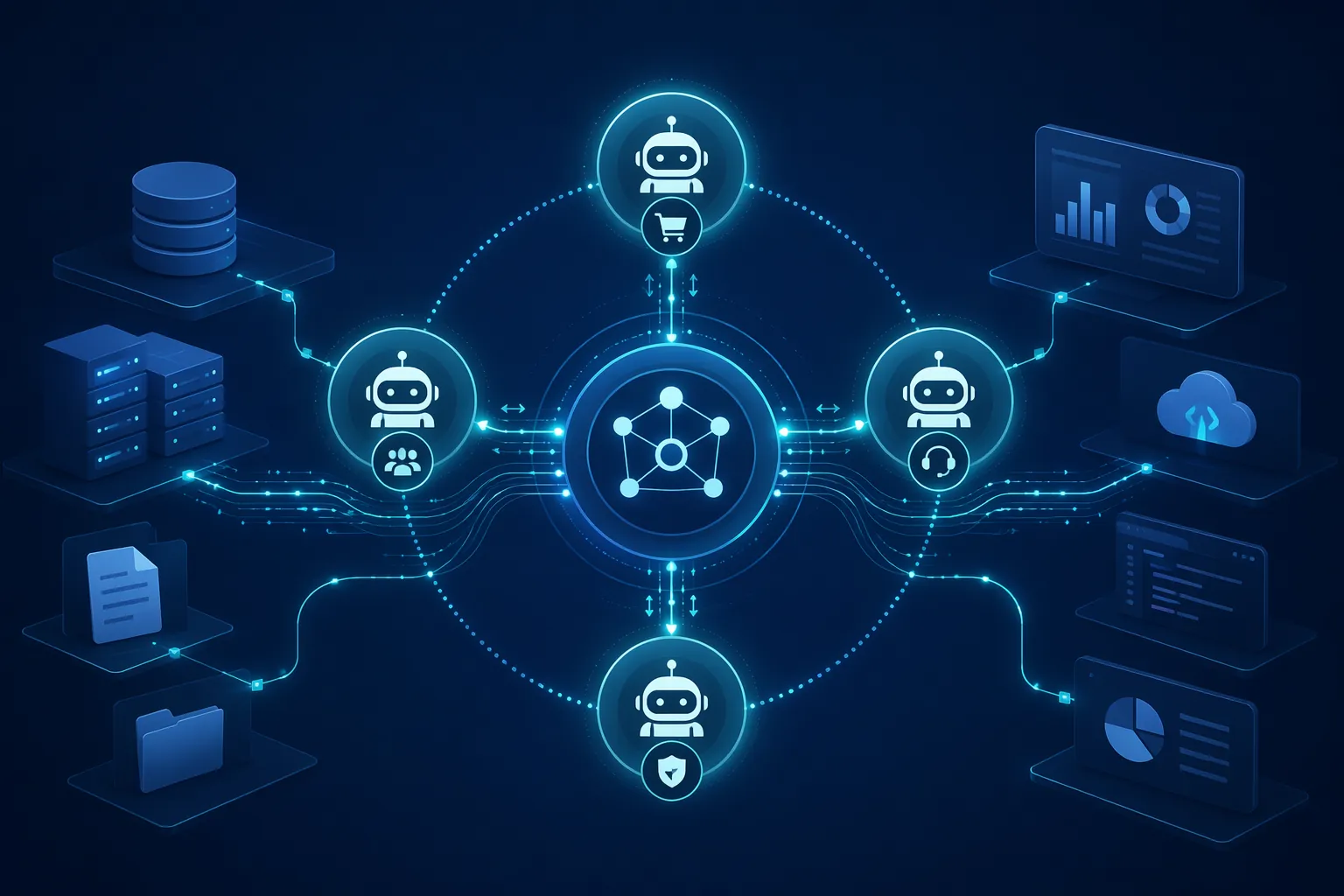
This is where the practical evaluation should stay disciplined. Agents that coordinate enterprise work can be valuable even when they are not deep supply chain optimizers. A procurement agent can gather supplier options, draft communications, summarize risk signals, check policy, and route approvals. A support agent can reduce queue volume for procurement or supply chain shared services. An orchestration layer can keep work moving across ERP, supplier portals, ticketing systems, and document repositories. Those are real improvements if they reduce cycle time, rework, and waiting.
The open question is whether IBM’s supply chain agents are mostly coordinating work around the supply chain or making domain-specific supply chain decisions at specialist depth. IBM’s public materials are more convincing on the first point. The proof points cluster in procurement, HR, IT support, and enterprise operations. The published evidence is thinner for physical logistics execution, warehouse operations, transportation routing, and advanced planning. Buyers should not punish IBM for being good at orchestration; they should simply buy it for the right job.
Supplier Risk Is Where the S&P Global Partnership Sharpens the Story
The October 2025 partnership with S&P Global is one of the more substantive moves in IBM’s supply chain AI strategy because it adds proprietary supplier risk, trade, and country intelligence into watsonx Orchestrate agents.[6] That matters because many AI workflow tools are only as useful as the data they can safely reach. In supplier risk, the hard problem is not just producing a fluent summary. It is connecting credible external intelligence to the sourcing, procurement, and supplier-management moments where someone can actually act.
This puts IBM closer to the territory occupied by supply chain risk specialists such as Resilinc and Everstream Analytics, though the comparison should stay precise. The S&P Global integration strengthens IBM’s data and agent story for risk-informed procurement and enterprise operations. It does not automatically prove parity with vendors that specialize in supply chain risk monitoring, event detection, and operational response playbooks across specific industries. The value will depend on how the intelligence is embedded: does it merely surface a risk score, or does it change supplier selection, contracting, allocation, escalation, and continuity planning?
For sourcing leaders, this is still an important development. A supplier risk signal becomes more useful when it appears before an award decision, during a contract review, or inside an exception workflow rather than as another dashboard to check. IBM’s advantage is not necessarily that it owns the richest supply chain risk dataset. The advantage is the possibility of putting S&P Global intelligence into governed enterprise workflows that already touch procurement, finance, legal, and supplier management.
Confluent Gives IBM a Better Data Foundation, Not Yet a Supply Chain Win
IBM’s acquisition of Confluent, which closed in March 2026, is strategically important because real-time data streaming is a missing layer in many legacy supply chain architectures.[4] Supply chain teams often talk about visibility as if the only issue is dashboard design. In practice, the harder issue is latency and fragmentation: order events, inventory updates, supplier messages, logistics milestones, quality exceptions, and external risk signals move through different systems at different speeds.
A streaming fabric can make agentic orchestration more plausible. If an agent is expected to intervene in a procurement or supply disruption workflow, it needs timely context. If it is acting on stale data, it becomes another polished interface over yesterday’s operating picture. Confluent therefore fits IBM’s strategy at the architecture level.
The restraint is that the published supply-chain-specific outcomes are not yet there. The acquisition creates a plausible foundation for real-time supply chain use cases, but the current public record does not show a documented logistics, warehouse, planning, or supplier-response case that proves the impact in supply chain operations. For now, Confluent should be treated as an enabling capability, not as evidence that IBM has already closed the gap with specialist execution or planning platforms.
The Market Signals Support Services More Than Software Dominance
IBM’s services position is a real asset in this category. IDC named IBM a Leader across all four supply chain services categories in its 2025-2026 MarketScape coverage.[4] That supports the version of the IBM case that large enterprises are most likely to buy: a transformation partner that can help with architecture, governance, integration, process redesign, and change management, not just a software SKU.
The software-market signals are more mixed. Gartner Peer Insights counts cited in the available market snapshot show IBM at 4.7 stars from 5 reviews, compared with o9 at 4.8 stars from 180 reviews and Blue Yonder at 4.6 stars from 40 reviews. Review counts are not a quality ranking, and they can reflect category fit, customer mix, and listing maturity. But the gap is directionally useful: IBM does not appear to have the same visible supply-chain-specific software footprint as the specialist planning vendors in this comparison.
Viewpoint Analysis’s 2026 buyer guide covers 10 AI-native supply chain platforms and omits IBM entirely.[7] That omission should not be overplayed; it reflects one analyst firm’s scope and criteria. Still, it is a useful counterweight to IBM’s broader enterprise AI narrative. In a supply-chain-software-first evaluation, IBM is not being discussed in the same way as o9, Kinaxis, Blue Yonder, and other specialist platforms that buyers associate with planning depth.
This is not a contradiction. It is the shape of IBM’s position. The company can be highly relevant to supply chain transformation while still not being the default primary planning platform. Many large programs need both: a specialist system for planning intelligence and an enterprise orchestration layer that can move decisions, exceptions, data, and approvals through the rest of the organization.
Where IBM Belongs on the Shortlist
IBM belongs in the conversation when the buyer’s problem is not just better forecasting or planning optimization, but the operating environment around those decisions. That includes procurement automation, supplier risk intelligence, hybrid deployment, B2B integration, governed agent workflows, and multi-year transformation work where services depth matters. It is especially relevant when the enterprise already has a mixed application landscape and needs AI to coordinate work across systems rather than replace every system at once.
A practical evaluation should ask IBM to show exactly where the agents sit in the process. Which systems can they read from and write to? What approvals remain human-controlled? How are policy exceptions handled? What happens when supplier data conflicts across systems? How are recommendations logged, challenged, and audited? Who owns the workflow after the consulting team leaves? These questions matter more than whether an agent demo can produce a clean summary of a disruption scenario.
For advanced planning, the burden of proof is different. If the priority is demand planning, supply planning, multi-echelon inventory optimization, scenario modeling, transportation routing, or warehouse execution, IBM should be compared directly against specialist platforms with deeper supply-chain-specific software recognition. o9, Kinaxis, Blue Yonder, and similar vendors have stronger category association in those domains. IBM may still play an important role around integration, data, governance, and agentic workflow, but that is not the same as being the planning system of record.
The cleanest buyer-fit conclusion is therefore not that IBM wins or loses the supply chain AI category. IBM’s evidence is strongest as an enterprise AI orchestration and transformation partner with credible internal operating proof. It is less compelling as a universal replacement for specialist planning and logistics execution platforms. For enterprises that need procurement automation, supplier risk intelligence, governed agents, hybrid deployment, and cross-system execution discipline, IBM should be on the shortlist. For enterprises looking primarily for the deepest planning engine, it should more often be evaluated as a complement.
References
- IBM as Client Zero — Productivity with AI and innovation — IBM
- IBM Supply Chain — IBM builds its first cognitive supply chain — IBM
- AI agents for supply chain and procurement — IBM watsonx Orchestrate — IBM
- IBM empowers organizations to evolve from AI exploration to high-impact, end-to-end supply chain transformation — IBM
- Shaping the next era of agentic AI at Think 2026 — IBM
- S&P Global and IBM Deploy Agentic AI to Improve Enterprise Operations — IBM Newsroom, October 8, 2025
- Supply Chain AI Software Options 2026: Our Buyer Guide — Viewpoint Analysis
Comments
Join the discussion with an anonymous comment.