
AI for thunderstorm-related supply chain disruption is useful only if it gets past the easy part: saying a storm is coming. The harder part is deciding whether a planner should move freight early, hold a trailer, shift inventory, or commit to capacity while the forecast is still changing.
That distinction matters because thunderstorms often sit in the wrong mental bucket. Hurricanes get playbooks. Blizzards get exception rooms. Thunderstorms get treated as ordinary noise until carrier ETAs start slipping and the purchase orders tied to those loads are already late. NOAA’s 2024 billion-dollar disaster data makes that habit look careless: 17 of 27 U.S. billion-dollar climate disaster events were severe storms, a category that includes thunderstorms, hail, tornadoes, and straight-line winds.[1]
The caveat should come early. The best public cost data usually does not isolate a clean “thunderstorm-only” line item. It is often reported under severe convective storms, where thunderstorm systems bring hail, tornado risk, flash flooding, and damaging straight-line winds. That broader category is still the right operational frame for many supply chains, because the truck, warehouse, rail ramp, and supplier dock do not experience those hazards as separate accounting codes.
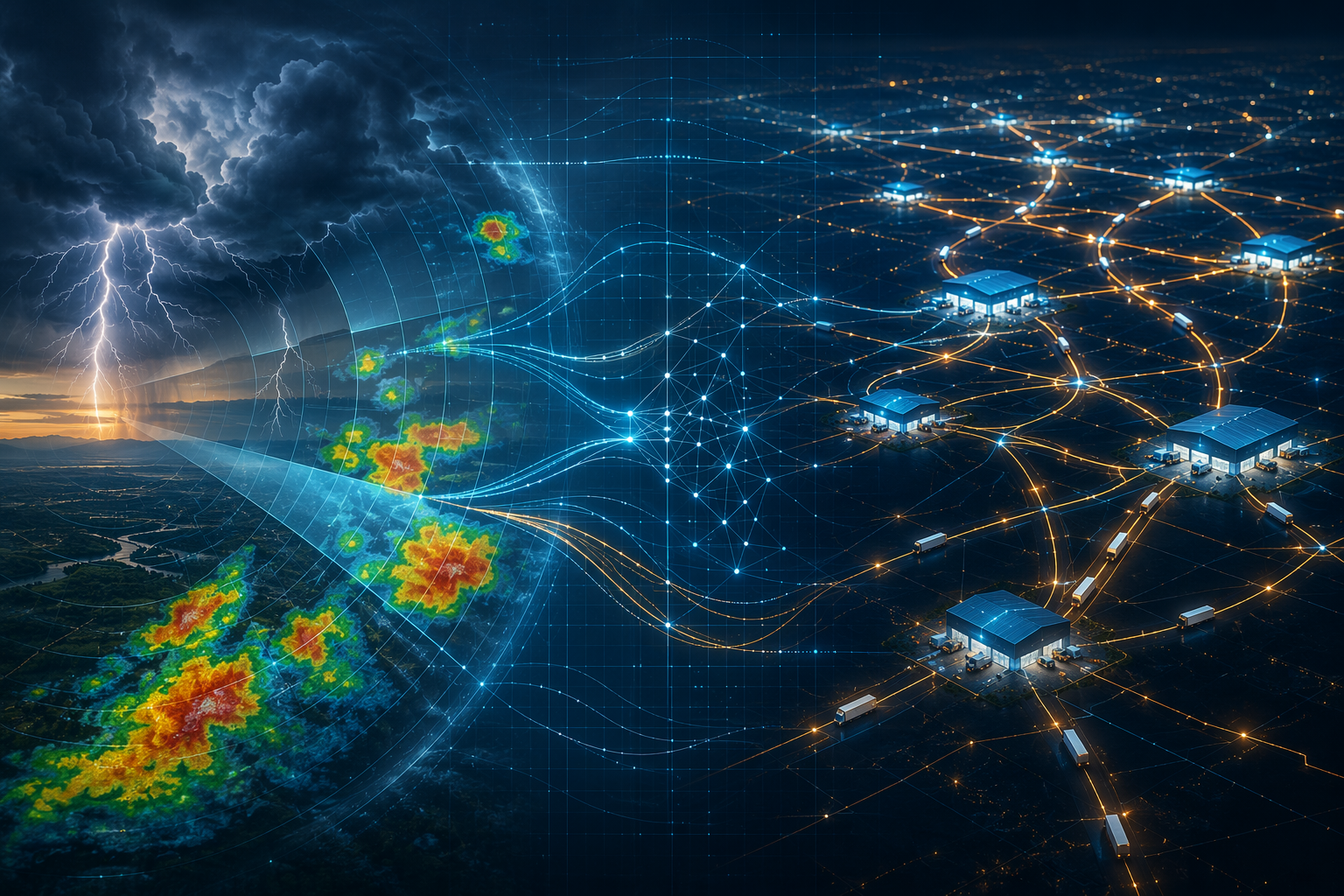
Why thunderstorms need a different operating rhythm
A hurricane usually gives teams time to stage a response. A convective storm may give them a narrow window, uneven local impact, and just enough uncertainty to make every mitigation decision feel premature. If a route is changed and the storm misses, transportation pays for the detour. If nothing is changed and the storm hits, customer service, inventory, and procurement inherit the delay.
Road freight shows the exposure clearly. FHWA figures cited by Everstream Analytics attribute 23% of all U.S. road delays to weather, with annual costs to trucking companies estimated at $2 billion to $3.5 billion.[2] Not all of that is thunderstorms, but severe convective weather is exactly the kind of short-lead-time disruption that turns a normal route plan into a sequence of exception calls.
This is where generic weather awareness starts to underperform. A forecast map can tell a team that a line of storms may cross a region. A supply chain decision system has to translate that into which lanes, sites, suppliers, customer commitments, and inventory positions are exposed during the relevant lead-time window.
The useful unit is not the storm; it is the decision window
The better AI weather tools do not ask planners to worship a model output. They turn weather signals into a ranked set of operational choices. The sequence usually looks like this:
| Weather intelligence layer | Supply chain translation | Operational move |
|---|---|---|
| Real-time and ensemble forecasts | Where convective risk overlaps with lanes, facilities, suppliers, or customer regions | Monitor, reroute, resequence appointments, or hold dispatch |
| Probabilistic risk scoring | How likely the disruption is, how severe it may be, and when it may arrive | Set thresholds for intervention instead of waiting for certainty |
| Timing, duration, and magnitude estimates | How long demand or supply conditions may differ from plan | Build inventory, accelerate replenishment, or secure carrier capacity early |
| Network-level exposure mapping | Which nodes create downstream consequences if delayed | Prioritize action where disruption propagates fastest |
That last column is the whole point. A transportation planner does not need a poetic description of hail risk. She needs to know whether the Dallas-to-Memphis lane should move before the afternoon line develops, whether a cross-dock appointment should be resequenced, and whether the added miles are cheaper than a missed retail delivery window.
Probabilities are not a weakness in this setting. They are the honest format. ClimateAi’s data science lead has acknowledged that chaos theory limits weather prediction and that forecasts must be handled as probabilities rather than certainties.[3] For supply chain work, that is more credible than pretending an AI model can remove the mess from convective weather. The question is whether the probability arrives early enough, in the right workflow, to justify a reversible but costly action.
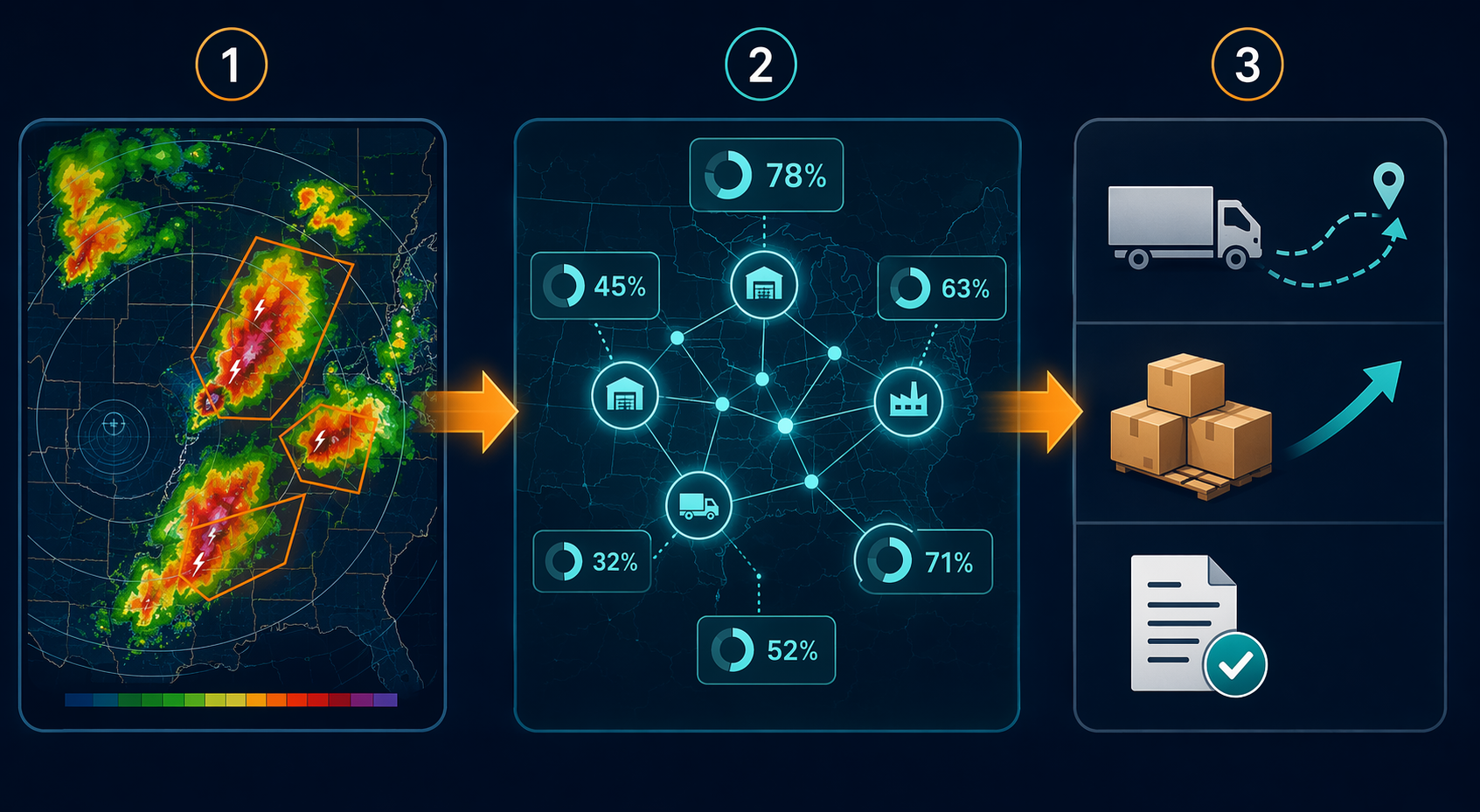
From forecast feed to route change
Everstream Analytics is a useful example because it describes the translation layer, not just the meteorology. The company says it processes 20 billion weather data points daily from sources including NOAA GFS/GEFS and European ECMWF models, then produces 14-day risk scores across supply chain networks.[2] For a logistics team, the important detail is not the size of the data pipeline by itself. It is the fact that the output is expressed as network risk over a planning horizon that matches freight decisions.
A 14-day score will not tell a dispatcher exactly which thunderstorm cell will block a specific road at a specific minute. It can, however, flag that a cluster of lanes, facilities, or supplier regions is entering a higher-risk window. That supports earlier conversations with carriers, appointment teams, and customer service before the exception is already visible in the TMS.
The operational value comes from thresholds. A team might decide that a low-probability storm risk only triggers monitoring, while a higher score on a high-consequence lane triggers pre-approved alternate routing. Another score might prompt procurement to pull forward a supplier shipment because a delayed inbound component would stop a production run. The model does not make the business tradeoff disappear; it gives the tradeoff a consistent trigger.
Demand spikes matter as much as delayed trucks
Thunderstorm mitigation is often discussed as avoidance: keep drivers safe, keep freight moving, avoid late deliveries. That is too narrow. Severe weather also changes demand. Building materials, generators, bottled water, repair parts, and emergency supplies can all see local demand move before or after a storm, depending on the product and region.
ClimateAi’s FICE model is relevant here because it is described as quantifying the timing, duration, and magnitude of weather-related demand spikes and supply disruptions, rather than producing a binary storm/no-storm alert.[4] Those three variables are exactly what inventory and procurement teams need. Timing affects when to build or move stock. Duration affects how much safety stock is justified. Magnitude affects whether the response belongs in normal replenishment or in an exception process.
ClimateAi’s roofing manufacturer case shows the upside of weather intelligence, though it should not be mislabeled as a thunderstorm case. The company reports that a roofing manufacturer captured $15 million in incremental sales by anticipating hurricane-driven demand for materials.[5] The lesson for convective storms is narrower but still useful: weather AI can support revenue capture when it helps a company position inventory before demand becomes obvious to everyone else.
That is a different decision from rerouting a truck. It may involve committing inventory to one region sooner, asking a supplier for earlier release, or booking capacity before spot rates tighten. The risk is also different: the storm may weaken, move, or fail to produce the expected demand. The practical standard is not perfect foresight. It is whether the expected value of acting early beats the cost of waiting.
Procurement is part of the storm playbook
Weather AI is easiest to picture at the route level, but some of the more durable value sits upstream. ClimateAi says Hitachi built a global supply chain risk model using seasonal forecasts with a six-month procurement horizon.[6] That is not thunderstorm dispatching, and it should not be treated as proof that a six-month forecast can resolve a convective event. It does show that weather risk can enter sourcing and procurement calendars before it becomes a transportation emergency.
For severe storm exposure, procurement teams can use AI weather intelligence to identify supplier regions where recurring seasonal risk may justify alternate sources, earlier purchase commitments, or different inventory posture. The near-term forecast still governs storm-week execution. The longer-horizon model helps decide whether the network is repeatedly asking the same fragile lane or supplier cluster to absorb the same kind of weather risk.
Better sensing helps, but it does not settle the business decision
Tomorrow.io illustrates why supply chain teams are paying attention to weather infrastructure itself. The company describes its Tomorrow-R1 and Tomorrow-R2 radar satellites as part of the first commercial weather radar satellite constellation, and it positions Gale, its generative AI weather assistant, for hyperlocal logistics and transportation forecasting.[7] More frequent and more localized observations can matter when a convective storm line is developing near a terminal, yard, port, or final-mile zone.
Still, better sensing is not the same as a guaranteed business outcome. A hyperlocal alert becomes supply chain control only when it is connected to rules, authority, and execution systems. Someone must know whether a driver can be held, whether the receiver will accept an early arrival, whether customer service can reset expectations, and whether the alternate carrier has usable capacity.
This is where many weather projects either become useful or stall. If the output lives in a separate dashboard, planners may see the risk and still work the exception manually. If the risk score appears inside the planning rhythm—TMS review, inventory planning, carrier procurement, supplier escalation—it can change the move before the storm arrives.
What a thunderstorm AI playbook actually changes
The playbook does not need to be elaborate. It needs to be explicit. Severe convective weather creates fast, uneven disruption, so the useful controls are the ones that can be triggered quickly and reversed when needed.
- Route adjustment: reroute or resequence loads when the risk score crosses a lane-specific threshold and the service impact justifies added cost.
- Preventive inventory build: move or allocate stock ahead of expected demand or supply interruption when timing, duration, and magnitude estimates support the decision.
- Pre-storm carrier commitment: secure capacity early on exposed lanes before weather-driven demand tightens the market.
- Supplier escalation: contact suppliers in exposed regions before production or shipping delays reach the customer promise.
- Exception prioritization: focus planners on the shipments, sites, and materials where a storm delay propagates into the largest downstream consequence.
The difference between this and ordinary monitoring is accountability. A red weather polygon on a map asks a planner to interpret. A risk-triggered workflow says which lane is exposed, which customer or production order is tied to it, who owns the decision, and what action is approved at that threshold.
The market is moving, but adoption is not proof of effectiveness
The broader market context supports the direction without proving every claim made by vendors. Interos.ai reported a 48% year-over-year increase in businesses at extreme weather risk, with 94.5 million total businesses at risk in 2025 versus 2024.[8] The Weather Company also reported that 92% of executives planned to increase or maintain investment in weather intelligence, while describing its IBM GRAF model for global high-resolution atmospheric forecasting.[9]
Those figures show attention and exposure. They do not, by themselves, prove that a given AI system reduces late loads, stockouts, or expediting cost. Supply chain teams should separate three questions that often get blended together: whether severe weather risk is increasing across business networks, whether companies intend to invest in weather intelligence, and whether a specific implementation changes decisions early enough to improve outcomes.
The decision standard
Thunderstorms justify their own AI playbook because frequency changes the planning problem. A single storm may not look strategic. A season of repeated convective disruptions across lanes, supplier regions, and demand pockets becomes a measurable operating pattern, especially when the same teams keep making expensive calls under short lead times.
The right test for AI weather intelligence is not whether it predicts thunderstorms with certainty. It cannot. The right test is whether it changes a concrete operational move before the storm arrives: a route adjusted, a carrier committed, inventory positioned, a supplier contacted, or a customer promise protected. Anything less is weather awareness with a better interface.
References
- U.S. Billion-Dollar Weather and Climate Disasters Time Series, NOAA National Centers for Environmental Information, https://www.ncei.noaa.gov/access/billions/time-series
- Applying NOAA and AI Weather Forecasting Models to Supply Chains, Everstream Analytics, https://www.everstream.ai/articles/applying-noaa-and-ai-weather-forecasting-models-to-supply-chains/
- ClimateAi on the Limits of Weather Prediction, SupplyChainBrain, August 2025, https://www.supplychainbrain.com/
- Climate Risk: An Essential Element of Supply Chain Risk Mapping in 2026, ClimateAi, https://climate.ai/blog/climate-risk-an-essential-element-of-supply-chain-risk-mapping-in-2026/
- Roofing Manufacturer Case Study, ClimateAi, https://climate.ai/case-studies/
- Hitachi Case Study, ClimateAi, https://climate.ai/case-studies/
- Using Weather AI to Improve Logistics and Transportation, Tomorrow.io, https://www.tomorrow.io/blog/using-weather-ai-to-improve-logistics-and-transportation/
- Extreme Weather Risk Report, Interos.ai, https://www.interos.ai/
- Managing Supply Chain Weather Risks with Predictive Analytics and Real-Time Insights, The Weather Company, https://www.weathercompany.com/blog/managing-supply-chain-weather-risks-with-predictive-analytics-and-real-time-insights/
Comments
Join the discussion with an anonymous comment.