
The uncomfortable supply chain impact of AI regulation is that it is arriving at the same time as the capital cycle. Supply chain leaders are not debating AI from a safe distance anymore. In a Prologis/Harris Poll survey reported by Forbes, 75% of companies ranked AI as their top capital investment for 2026, and 70% said they were already well along with AI deployment.[1] That means regulatory differences are no longer a future legal variable. They are colliding with budget approvals, vendor shortlists, model architecture, data movement, and the location of pilots.
The cost curve is moving in the same direction. SCMR cites a Gartner projection that global AI governance spending will reach $492 million in 2026 and nearly double to $1 billion by 2030.[2] That figure does not give a full global cost model for every jurisdiction, and it should not be treated as one. It does, however, make one thing hard to dismiss: governance is becoming a real operating expense, not a policy footnote.
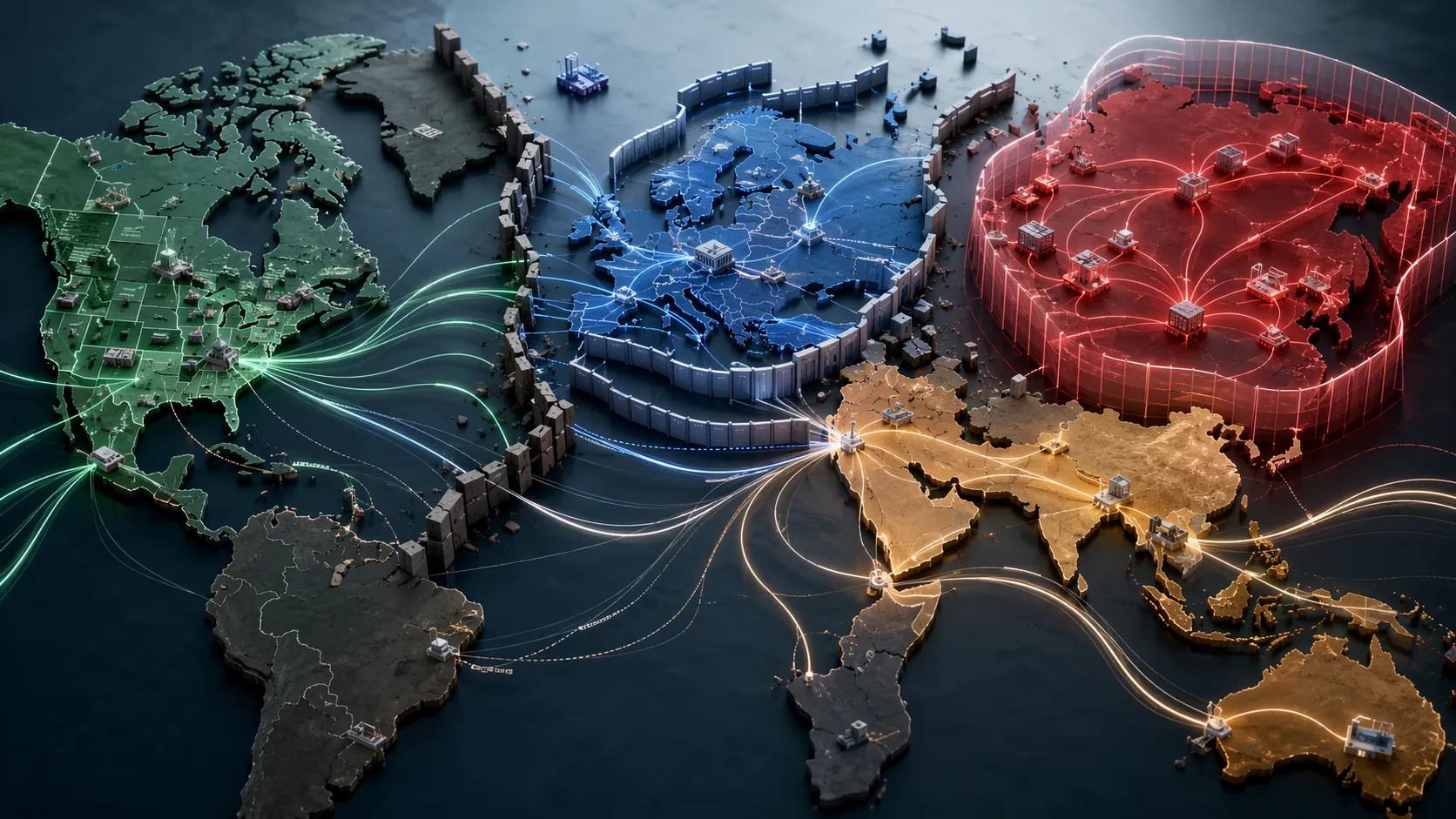
That is where the competitive divide begins. Two manufacturers can buy similar forecasting tools, test similar procurement copilots, and chase similar inventory gains. One may be able to pilot quickly in a permissive environment, keep its core model portable, and add jurisdiction-specific controls at the edge. The other may discover that a single global design creates delays in Europe, data-transfer problems in China, procurement hesitation in the United States, and a governance backlog everywhere.
Regulation Is Becoming Part of the Operating Model
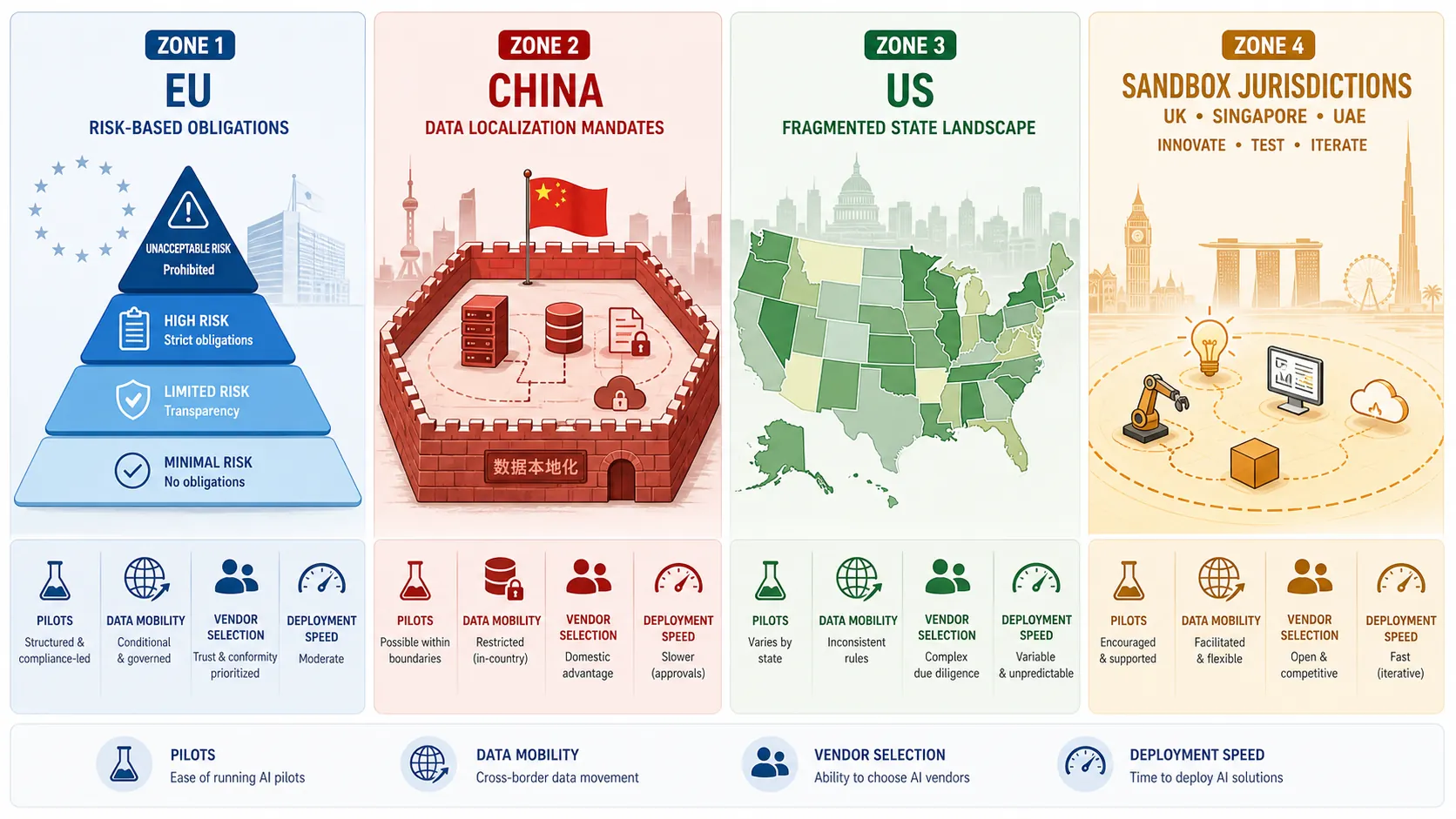
A useful way to read the current landscape is not as a single global AI rulebook in different stages of maturity, but as four operating environments that pull supply chain AI in different directions. SCMR describes a divergence across the EU, China, the US, and pro-innovation sandbox jurisdictions such as the UK, Singapore, and the UAE.[2] The framework is helpful because it describes the friction executives actually feel: different deployment gates, different data assumptions, different documentation expectations, and different pilot economics.
It is also worth reading that framework with source discipline. SCMR’s article is a synthesis, and some AI governance commentary in the market comes from consulting or solution-provider ecosystems with commercial reasons to emphasize urgency. That does not make the divergence unreal. It does mean supply chain leaders should use the framework as a practical map, not as a settled cost comparison across the world. No source in the available material gives that complete global comparison.
| Regime | What changes for supply chain AI | Operational consequence |
|---|---|---|
| EU | Risk-tier obligations and compliance tasks for businesses using AI across the supply chain | More upfront classification, documentation, vendor scrutiny, and audit preparation |
| China | Localization constraints around data and AI operations | Less freedom to centralize data flows and model operations in a single global stack |
| US | A state-level patchwork rather than one uniform national AI compliance path | Procurement and deployment teams must track uneven obligations across operating locations |
| UK, Singapore, UAE and similar sandbox jurisdictions | More room for controlled experimentation | Faster learning cycles, with the caveat that sandbox success does not equal global deployability |
The EU Slows the Shortcut, Not Necessarily the Strategy
The EU case is often reduced to a compliance checklist, which misses the business point. Risk classification changes the sequence of work. A supply chain AI tool that touches planning, procurement, workforce allocation, supplier decisions, or logistics execution may need classification analysis before a pilot can become a deployment. Legal review moves earlier. Vendor questions become more technical. Documentation stops being something written after go-live and becomes a condition for moving through the gate.
Reed Smith notes that the EU AI Act adds new compliance tasks for businesses along the supply chain, including obligations that can affect companies depending on their role in the AI system.[3] For a detailed breakdown of high-risk classification obligations, see our companion piece on EU AI Act supply chain compliance. The larger competitive issue here is not whether the EU is right or wrong to demand accountability. It is that EU exposure can change the cadence of AI deployment compared with regions where a similar workflow can be tested with fewer upfront constraints.
That cadence matters. Forecasting improvements, procurement automation, exception management, and warehouse labor planning tend to compound through use. A company that runs ten learning cycles before a competitor completes two compliance reviews may not need a better algorithm to pull ahead. It may simply get more operational feedback into the system sooner.
China Turns Data Movement Into a Design Constraint
China’s localization posture creates a different kind of pressure. The issue is less about whether a supply chain AI use case is classified into a particular risk tier and more about where data can sit, where model operations can run, and how much of a global AI workflow can be centralized. SCMR identifies localization mandates in China as one of the core sources of regulatory divergence affecting global supply chains.[2]
That changes architecture decisions that used to look purely technical. A global demand-sensing model may want regional sales, inventory, supplier, and logistics signals in one training environment. A localization constraint forces the organization to ask whether the model can be split, whether regional inference can happen locally, whether aggregated outputs can move even when raw data cannot, and whether the global center of excellence has enough visibility to manage performance without violating local constraints.
The awkward budget consequence is duplication. Teams may need regional data pipelines, local monitoring, separate vendor arrangements, or additional controls for model access. Some duplication is prudent. Some is waste created by late design decisions. The difference often shows up after procurement, when the business discovers that the AI platform selected for global elegance was not built for regional separation.
The US Patchwork Makes Uniform Rollout Harder Than It Looks
The US problem is not usually described as localization. It is fragmentation. SCMR characterizes the US environment as a state-level patchwork, which means companies cannot assume a single domestic compliance answer will remain sufficient across every operating location.[2] For supply chain organizations with plants, warehouses, suppliers, labor pools, and customer commitments spread across states, that patchwork can turn a national AI rollout into a rolling exception process.
The operational risk is subtle. Headquarters approves a planning assistant, a supplier-risk scoring workflow, or a warehouse scheduling tool. A regional legal or HR review then raises local concerns. Procurement pauses. The vendor is asked for additional assurances. The architecture team adds a control. Another region asks for a different control. The tool still launches, but the deployment calendar no longer resembles the business case.
This is where AI regulation starts behaving like tax, trade, and labor regulation: not one rule that stops the enterprise, but many regional variations that change the cost of standardization. A tidy global policy may satisfy an executive review. It may still fail the warehouse manager waiting for a staffing model, the procurement lead trying to triage supplier risk, or the planning team that needs an exception workflow before peak season.
Sandboxes Create Speed, Not Immunity
The sandbox jurisdictions matter because they change the price of learning. SCMR groups the UK, Singapore, and the UAE as more pro-innovation environments where controlled experimentation can move faster.[2] For supply chain AI, that can be valuable. A company can test a forecasting model, a procurement document assistant, or a logistics exception engine in a setting that allows more practical iteration before committing to a heavier global rollout.
The mistake is treating sandbox freedom as if it transfers cleanly into every market. It does not. A successful pilot in a flexible jurisdiction proves something about operational value, user adoption, model behavior, and integration requirements. It does not prove that the same workflow is compliant in the EU, deployable under Chinese localization constraints, or uncomplicated across US state regimes.
Used well, a sandbox is a learning engine. Used badly, it becomes a demo factory that creates expectations the rest of the operating model cannot meet.
The Distortion Is Already Visible, Though Not Universal
The strongest evidence of competitive distortion comes from the German manufacturing context. A proALPHA study reported that 38% of manufacturing companies see the EU AI Act as an innovation barrier, and 34% are considering relocating production.[4] Those numbers should land with force, but with boundaries. The study is about German SMEs, not every global enterprise, and relocation consideration is not the same as actual relocation.
Even with that caveat, the signal matters. When more than a third of surveyed manufacturers in that context see AI regulation as an innovation barrier, the concern is no longer theoretical.[4] It suggests that regulation is entering location strategy, not just legal review. If a plant, shared service center, planning hub, or analytics team sits in a higher-friction environment, the company may need to justify the location not only on labor, tax, and customer proximity, but also on AI deployment speed.
That does not mean every company should move AI work out of heavily regulated jurisdictions. For some organizations, the trust, auditability, and governance discipline required in those markets may become an asset. The point is narrower and more practical: regulation now affects where AI capability is cheapest to build, easiest to validate, and fastest to scale.
Vendor Selection Now Has a Regulatory Dimension
For years, supply chain technology selection leaned heavily on functionality, integration, total cost, and vendor stability. Those still matter. AI adds another filter: whether the model, platform, and vendor operating model can survive different regulatory environments without forcing the buyer into a full rebuild.
The right question is not simply which model performs best on a benchmark. It is whether the model can support the governance, data residency, audit, explainability, and deployment controls required by the workflow and the jurisdiction. A model used for internal document summarization in a procurement team has a different risk profile from one used to recommend supplier actions, prioritize orders, or influence labor scheduling. Model choice can therefore become part of regulatory fit, not only technical preference. For one practical comparison in supply chain AI workflows, see our Kimi K3 vs GPT-4.1 analysis.
Procurement teams should expect AI vendor evaluation to become less linear. A vendor may be attractive for sandbox experimentation but weak for EU documentation. Another may support enterprise auditability but create problems in localized data environments. A third may fit one region well and create governance drag elsewhere. The cheapest vendor on a global contract can become expensive if it forces regional exceptions after implementation.
What Multi-Regime Architecture Actually Means
The practical response is not to wait for harmonization. It is to stop building supply chain AI as if one clean global compliance answer will arrive in time for the next budget cycle. A multi-regime architecture separates the parts of AI capability that should be common from the parts that must adapt.
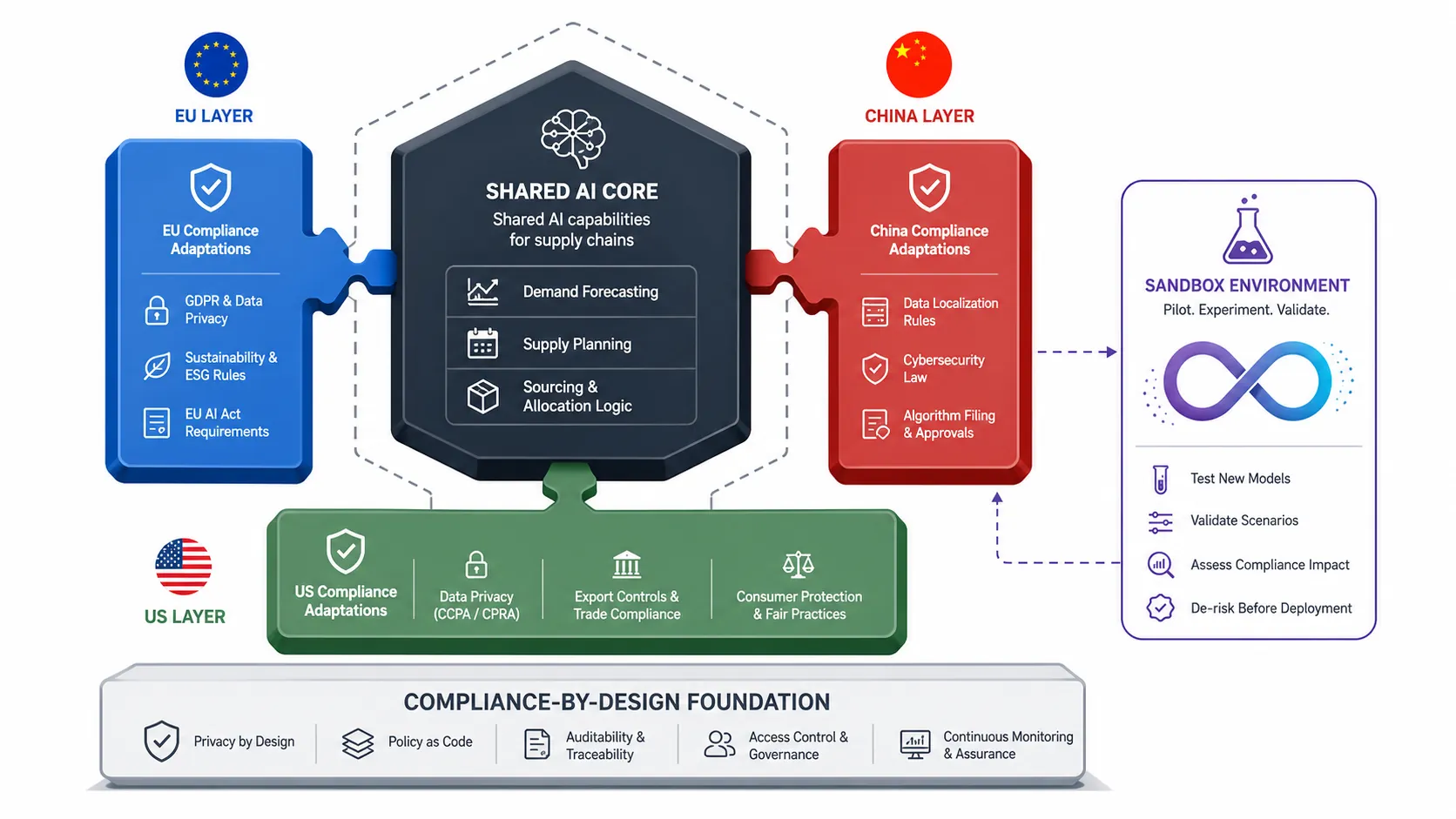
The shared core can include common process logic, model evaluation standards, integration patterns, monitoring principles, and business outcome measures. The regional layer handles risk classification, data localization, documentation, audit evidence, access controls, human review, and vendor obligations. That separation is not architectural decoration. It is what prevents every regulatory change from becoming a global systems rewrite.
- Map AI workflows by jurisdictional exposure, not just by function or business unit.
- Separate global model capabilities from regional compliance controls wherever the workflow allows it.
- Design data pipelines with localization, aggregation, and access restrictions in mind before vendor selection.
- Use sandbox jurisdictions to test operational value and integration behavior, while planning separately for regulated-market deployment.
- Require vendors to explain how documentation, audit support, and regional deployment constraints are handled in practice.
This approach is less elegant than a single enterprise standard. Smaller organizations may reasonably prefer simplicity, especially if they operate in fewer jurisdictions or have limited AI surface area. But global supply chains rarely get simplicity for free. If AI is embedded in planning, procurement, logistics, warehouse execution, and supplier management, regional variation will eventually find the brittle point in the design.
Compliance-by-Design Beats Documentation After the Fact
Retrofitted compliance usually looks efficient until the first serious review. The team launches a pilot, proves value, builds executive demand, and then asks compliance to bless the rollout. At that point, the documentation may not match the model behavior, the vendor contract may not cover the needed audit support, the data flow may cross a boundary it should not cross, or the human review process may exist only in a slide deck.
Compliance-by-design changes the sequence. Before a workflow is piloted, the team identifies which decisions the AI influences, which jurisdictions are touched, what data moves, who reviews the output, what evidence must be retained, and what happens when the model is wrong. That does not require turning every pilot into a legal seminar. It requires enough structure that a successful pilot can scale without being rebuilt.
In supply chain terms, this is a resilience problem. The same organization that would never single-source a critical component without a contingency plan should be cautious about single-sourcing its AI operating model to one regulatory assumption.
The Decision Frame for 2026
The capital commitment is already underway. The governance cost curve is rising. Major regimes are not behaving like temporary variations on one path. Some manufacturers in high-friction environments are already reporting concern about innovation barriers and even considering relocation, within the limits of the available survey evidence.[4] The executive decision is therefore not whether AI regulation will affect supply chains. It is where that effect will be absorbed: in architecture, in delayed deployment, in duplicated regional work, or in lost learning cycles.
For supply chain leaders, the working assumption should be that divergence persists. Map AI workflows by jurisdictional exposure. Keep core AI capabilities portable. Build regional compliance layers that can change without breaking the whole system. Pilot in flexible environments when that accelerates learning, but do not confuse a permissive pilot with global readiness. The companies that treat regulation as an operating design constraint will move differently from those that wait for legal to reconcile the world.
References
- Supply Chains, 2026: Less Globalization, More AI — Forbes, October 2025
- The AI regulation gap: Risk, cost, and competitive advantage — SCMR, June 2026
- EU's AI Act adds new compliance tasks on businesses along the supply chain — Reed Smith
- Supply Chain Act and EU AI Act Slow Down the Manufacturing Industry — proALPHA, June 2024
Comments
Join the discussion with an anonymous comment.