
§ 41 — Use-case analysis
Why Image Prompt Injection Matters for Supply Chain AI
Image-based prompt injection is a confirmed attack vector that bypasses text-layer defenses, with documented success rates against multimodal models. This article explains how supply-chain AI platforms processing visual inputs—supplier catalogs, invoices, camera feeds—face risks that vendor security documentation does not currently address, and what evaluation teams should ask.
- Function
- procurement-automation
- AI technique
- computer-vision
- Failure pattern
- image-prompt-injection
- Evidence source
- CSA AI Safety Initiative, Shen et al., CrossMPI
A supply-chain AI workflow rarely begins with a pristine prompt. It begins with an invoice PDF from a supplier, a revised product catalog, a pallet photo, a spec sheet, a warehouse camera frame, or a document bundle pushed through a supplier portal. The platform reads it, extracts the relevant fields, reconciles it against master data, and may hand the result to an agent that drafts a claim, updates a forecast assumption, opens a ticket, or asks another system for approval.
That is exactly why image prompt injection deserves a more serious place in 2026 supply-chain AI security evaluations. The attack does not require an attacker to type instructions into a chatbot. Malicious instructions can be embedded inside the visual material that supply-chain systems already treat as routine business input. A text filter may never see the instruction as text. The model may still respond to it.

There is an important boundary at the outset: public research has confirmed the capability of image-based prompt injection against multimodal models, but no confirmed real-world exploitation of o9, Blue Yonder, Kinaxis, RELEX, Anaplan, or another supply-chain planning platform has been publicly reported as of July 2026. The practical issue is not that these vendors are known to have failed. The issue is that the ingestion paths are plausible, the attack class is documented, and public security documentation has not yet given evaluation teams standard answers.
The Input Changed, but the Security Conversation Often Did Not
Prompt injection was easier to reason about when the model’s exposed surface looked like a chat box. The security team could talk about system prompts, user prompts, retrieval context, output handling, and text sanitization. That model already had problems, but at least the payload arrived as characters.
Multimodal systems break that comfort. A vision-language model does not merely OCR a picture and pass clean text downstream. Its vision encoder processes the image as a field of visual features: layout, contrast, marks, pixels, patterns, and objects. Text that appears inside an image is only one way to influence the model. Low-contrast lettering, visual perturbations, hidden encodings, and physical signs captured by a camera can all become part of the model’s input representation.
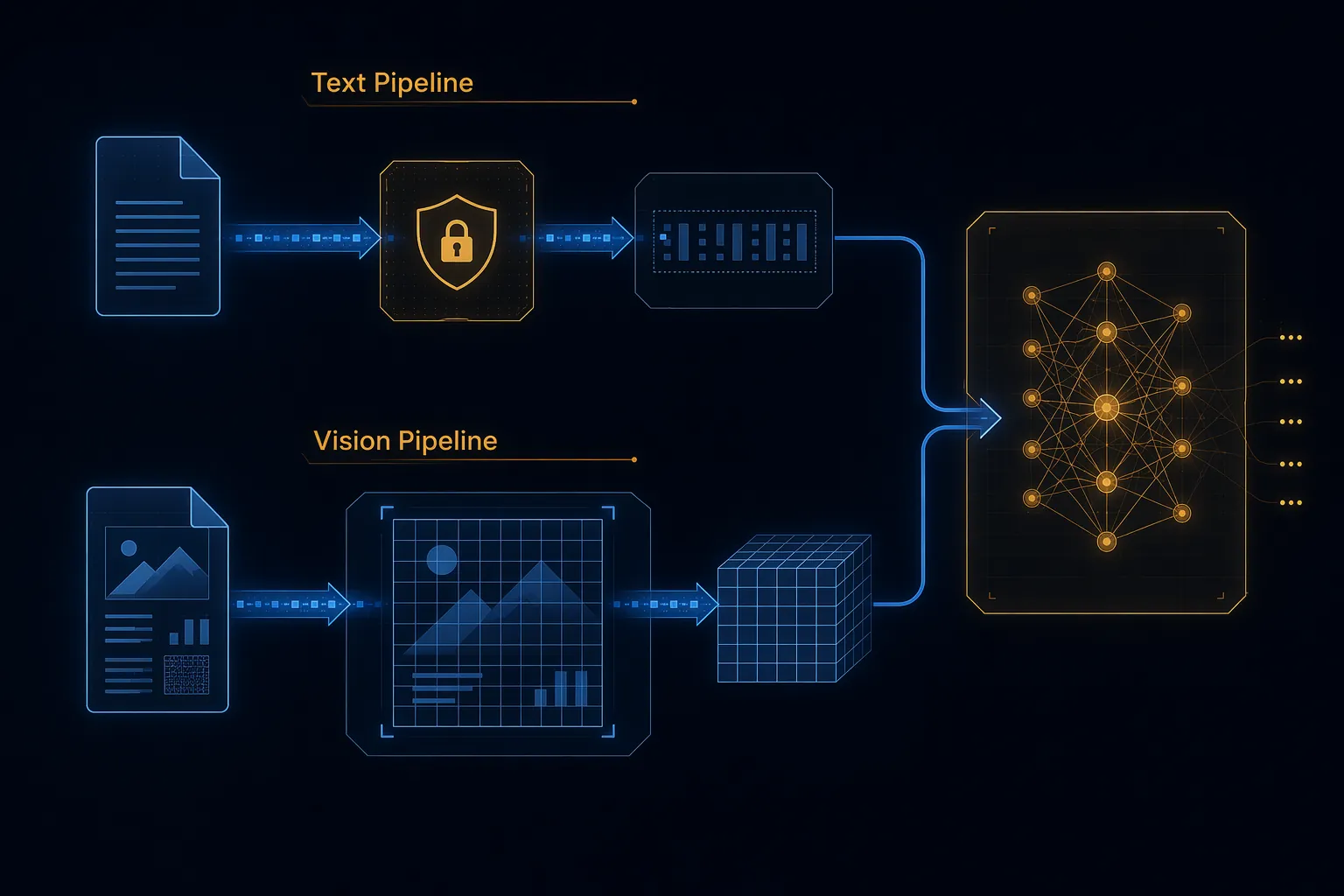
The Cloud Security Alliance’s AI Safety Initiative described four broad embedding techniques in March 2026: typographic text, steganographic encoding, adversarial perturbations, and physical-world signage.[1] Those categories matter because they do not share the same detection surface. A procurement document with tiny light-gray instructions in a footer is not the same problem as a visually indistinguishable steganographic payload. A sign in a warehouse camera frame is not the same problem as an adversarially perturbed product image.
Typographic injection is the easiest to picture. The attacker places instructions in the image itself: small text, low-contrast text, text hidden in a margin, text overlaid on a product photo, or text embedded inside a scanned document. It may be visible to a human who knows to zoom in, but missed during normal review. Shen et al. reported a 64% peak black-box attack success rate against GPT-4V, Claude 3, and Gemini under stealth constraints using small, low-contrast text that humans may overlook.[2]
Steganographic injection is less intuitive and more uncomfortable for document-heavy operations. The instruction is encoded into the image in a way that preserves normal appearance. The Invisible Injections paper reported mean PSNR of 38.4 dB with a standard deviation of 2.1 dB and SSIM of 0.945 with a standard deviation of 0.018, meaning the manipulated images were visually difficult to distinguish without dedicated steganalysis tools.[3] In a supplier-catalog workflow, that distinction matters: a human approver may see a normal page; the model may receive a manipulated visual signal.
Adversarial perturbations operate through small pixel-level changes designed to alter model behavior. CrossInject, published at ACM Multimedia 2025, reported a 30.1% improvement over prior adversarial perturbation methods and emphasized black-box transferability.[4] CrossMPI, from Xidian University in May 2026, reported a 66.36% attack success rate across multiple large vision-language models.[5] These are controlled research results against specific model versions and test conditions, not enterprise incident rates. They still show why security controls that only inspect extracted text are misaligned with the actual attack surface.
Why Supplier Data Is the Uncomfortable Path
Supply-chain systems are unusually exposed to untrusted but business-critical documents. A company can lock down employee chat access and still ingest thousands of supplier-provided files. The supplier is not always malicious; the file can pass through resellers, brokers, marketplaces, freight partners, or compromised document systems before it reaches the buyer. The receiving organization still needs to process it because operations depend on it.
Questa AI described a supplier-data prompt-injection vector in April 2026: an AI agent processing vendor invoices can be manipulated by a supplier who embeds prompt-injection instructions in the documentation.[6] That scenario is not proof of a public supply-chain platform breach. It is a useful operational pattern because it follows a normal path: supplier sends document, automation reads document, agent interprets document, downstream workflow acts on interpretation.
The risk is different from ordinary bad data. If a supplier sends the wrong price, the controls are familiar: tolerance checks, three-way match, approval thresholds, vendor-master governance. Image prompt injection attempts to influence the model’s instructions, not merely the business fields. A hidden instruction could try to make the model ignore previous rules, classify the document as approved, route the exception away from review, summarize selectively, or pass a tainted instruction to another tool.
Most current controls were not designed for that distinction. OCR confidence, file-type validation, antivirus scanning, duplicate detection, and invoice matching all still matter. They do not answer whether a vision model was exposed to an embedded instruction inside the image layer, whether that instruction affected reasoning, or whether the affected output was allowed to trigger action.
Agentic Pipelines Make One Bad Image Travel Farther
The image itself is only the first step. The more serious design question is what happens after the model reads it. A multimodal assistant that extracts product attributes for human review has one risk profile. A multimodal agent that updates supplier records, opens exceptions, triggers replenishment changes, or asks another agent to resolve discrepancies has another.
CSA warned that multi-agent systems are particularly exposed because a malicious image processed by one agent can propagate adversarial instructions to downstream agents when inter-agent trust boundaries are not enforced.[1] In a planning stack, that could mean the document-reading agent passes a compromised summary to a procurement agent, which passes a recommendation to an approval workflow, which leaves an audit trail that looks like normal automation rather than a direct external command.
This is where image injection connects to the broader agentic security problem without becoming the whole story. ChainSignal’s discussion of autonomous agents breaking supply-chain security and its framework for six new agentic AI risks in supply-chain planning cover the broader control problem. Image prompt injection is one concrete mechanism that can feed those failures, especially when visual inputs are treated as ordinary evidence rather than untrusted instructions.
The Vendor Documentation Gap Is Public, Not Definitive
The uncomfortable part for evaluation teams is not that major supply-chain AI vendors have publicly disclosed weak controls. The uncomfortable part is narrower: no publicly available security documentation from o9, Blue Yonder, Kinaxis, RELEX, or Anaplan systematically addresses image-based prompt injection as of July 2026, based on the available public record. That absence is an inferred public-documentation gap, not evidence of negligent engineering or missing internal testing.
This distinction matters in procurement. A vendor may have private red-team results, model-provider controls, document-isolation patterns, internal evals, or deployment-specific mitigations that are not published. The buyer cannot score what it cannot see. Standard security questionnaires often ask about encryption, access control, audit logs, vulnerability management, data retention, SOC reports, and sometimes prompt injection. They rarely force the next question: which prompt-injection tests cover image, PDF, scanned-document, camera, and catalog inputs?
OWASP’s 2025 GenAI guidance kept prompt injection as LLM01 and explicitly extended the classification to multimodal injection vectors.[7] That helps establish the category, but it does not give a supply-chain buyer enough detail to evaluate a planning platform that ingests supplier PDFs and hands extracted claims to an agent. OWASP guidance also does not imply that a single mitigation can neutralize every image-based variant.
The market direction makes this harder to ignore. Apeksha Kaushik of Gartner, cited by CSO Online in May 2026, said 80% of enterprise software will be multimodal by 2030, up from 1% in 2024, and that security controls designed for unimodal systems are insufficient.[8] That statistic should be verified against Gartner’s original research before it becomes the centerpiece of a business case. It is still directionally consistent with what buyers already see: more software is reading documents, images, and screens, not just text.
For broader vendor landscape work, ChainSignal’s AI supply-chain companies directory is the better place to compare categories. For this issue, the dividing line is simpler: any platform that ingests visual or document inputs into AI reasoning needs a multimodal security answer, not only an LLM security answer.
Controls Need to Match the Technique
There is no clean control map where one product feature defeats image prompt injection. The techniques differ too much. Text hidden in a scanned invoice might be caught by OCR-plus-policy inspection. A steganographic payload may require steganalysis. Adversarial perturbations may need model-specific robustness testing. Physical-world signage may require camera-zone rules, scene filtering, and downstream action limits.
Provenance-aware defense is one promising line of work. A December 2025 paper reported 94% detection accuracy, but it was not evaluated against the full range of image-injection techniques.[9] That is a useful result, not a license to collapse the problem into a single detection score. A defense tested against typographic prompts may not cover steganography. A defense tested on benchmark images may not cover degraded supplier scans, merged PDFs, or camera frames from a warehouse floor.
| Technique | What it looks like in a supply-chain workflow | What evaluators should avoid assuming |
|---|---|---|
| Typographic text | Small or low-contrast instructions in invoices, catalogs, product images, or PDF margins | That ordinary document review or text filtering will always catch it |
| Steganographic encoding | A normal-looking supplier image or catalog page carrying hidden instructions | That visual inspection is enough |
| Adversarial perturbation | Pixel-level changes to product images or document images that influence model behavior | That OCR sanitation addresses the model’s visual representation |
| Physical-world signage | A sign, label, screen, or printed sheet captured by a warehouse or inspection camera | That camera input is only observational data |
The operational control is usually layered: isolate untrusted inputs, preserve provenance, inspect both extracted text and source images, restrict what a model can do after reading visual material, require human review before consequential actions, and test the exact pipeline rather than the base model alone. Those controls overlap with broader AI model supply-chain risk work, but the image-specific point is where the control is applied. If the only inspection point is after OCR or after the model summary, the system may already have consumed the malicious visual signal.
Questions to Add Before the Platform Contract Is Signed
Evaluation teams do not need to turn every procurement cycle into a computer-vision research review. They do need to stop treating “supports PDFs and images” as a UX feature with only access-control implications. The questions belong beside the usual vendor-security work, not after go-live. They also extend the standard supply-chain AI vendor evaluation checklist because the attack surface is specific to multimodal ingestion.
- Which image, PDF, scanned-document, catalog, and camera inputs can reach a multimodal model or AI agent?
- Does the vendor test typographic, steganographic, adversarial-perturbation, and physical-world image prompt injection, or only text prompt injection?
- Are visual inputs sanitized or isolated before model processing, and are the original image, OCR output, extracted fields, and model reasoning kept separately in logs?
- Can an instruction inferred from an image alter system prompts, tool permissions, approval routing, supplier records, forecasts, or exception handling?
- Where are inter-agent trust boundaries enforced when one agent summarizes or transforms a supplier document for another agent?
- Which mitigations are provenance-aware, which are content filters, which are model-provider controls, and which have been validated against the buyer’s deployment architecture?
- How are mitigations retested when the underlying model, OCR engine, document parser, agent framework, or workflow permissions change?
The last question is easy to skip and expensive to rediscover. A model update can change how the system reads low-contrast text. A parser change can alter which parts of a PDF are rendered as images. An agent rollout can turn a previously advisory output into a workflow action. A supplier-portal integration can expand who is allowed to submit visual material into the system.
This is also where adoption reality intrudes. Many organizations are planning AI bots faster than they are hardening the pipelines those bots will use. ChainSignal’s AI bot adoption reality check covers that broader implementation gap. Image prompt injection is one of the places where the gap becomes concrete: the bot may be useful, the document flow may be valuable, and the security model may still be text-only.
The practical conclusion is not to avoid multimodal supply-chain AI. Document-heavy procurement, warehouse inspection, catalog enrichment, claims handling, and exception management all have real reasons to use visual inputs. The conclusion is narrower and more actionable: in 2026, do not evaluate a multimodal supply-chain platform with a text-only security model.
References
- CSA AI Safety Initiative research note, Cloud Security Alliance, March 2026
- arXiv:2603.03637, arXiv, March 2026
- Invisible Injections, arXiv, July 2025
- CrossInject, ACM Multimedia 2025
- CrossMPI, Xidian University, May 2026
- Prompt-injection-via-supplier-data vector, Questa AI, April 2026
- OWASP Top 10 for LLM Applications 2025, OWASP Gen AI Security Project, 2025
- Gartner analyst: Multimodal AI will dominate enterprise software by 2030, CSO Online, May 18 2026
- arXiv:2512.23557, arXiv, December 2025
§ 42 — Cited evidence
Flag an inaccuracy or submit a comparable account — Contribute or read how claims are verified in Methodology.