§ 41 — Use-case analysis
Why 94% of Supply Chains Plan AI Bots but Few Deliver
This article examines the gap between supply chain companies' plans to deploy AI bots and actual production adoption rates. Readers will learn the key statistics — 88% of AI agent pilots never reach production — and the structural factors that separate the 12% that succeeds from the rest.
- Function
- supply chain planning
- AI technique
- generative AI
- Failure pattern
- unclear business value
- Evidence source
- AI Agent Adoption 2026: Enterprise Data Points (Digital Applied, 2026)
The practical question about AI bots in supply chain is not whether a demo can show an agent rerouting freight, suggesting a supplier substitution, or drafting a procurement action. The question is whether that bot is still making accountable recommendations when the month-end plan is late, the supplier feed is incomplete, the ERP update is lagging, and a category manager disagrees with the suggested move.
That is where the numbers start to bite. In 2025, 94% of supply chain companies planned to deploy AI or GenAI for decision support within two years, while only 23% had a formal AI strategy.[1] Across enterprise AI agent pilots, 88% never reach production; within supply chain and logistics, production adoption sits at 22%, among the lowest enterprise-function rates reported in the same 2026 data set.[2] Gartner also forecast that more than 40% of agentic AI projects would be canceled by the end of 2027, with unclear business value and inadequate data quality named as leading causes.[3]
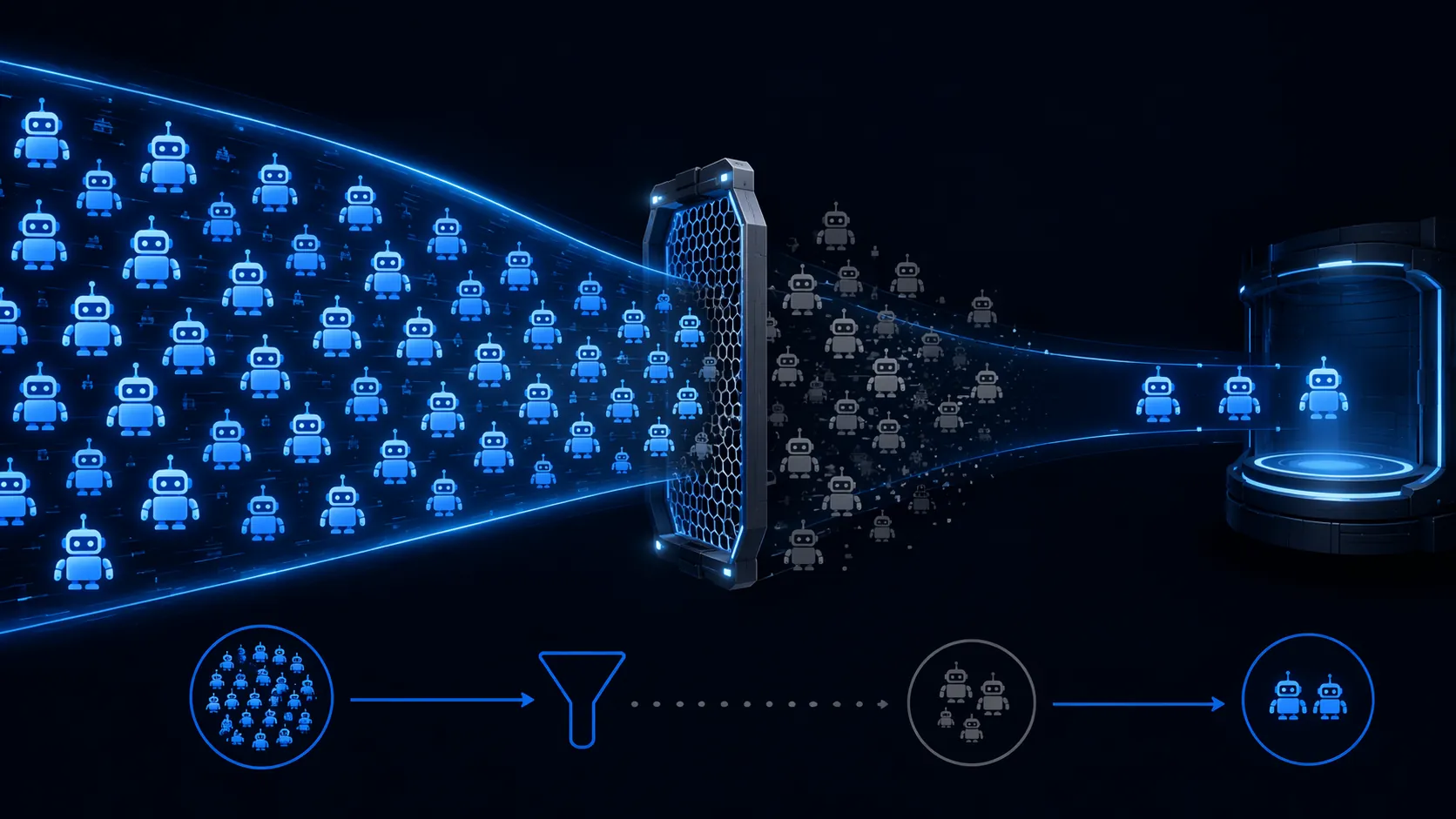
Those figures do not say AI bots are irrelevant. They say the path from intent to operating use is much narrower than the planning decks imply. A company can be serious about AI and still lack the ownership model, data quality, integration discipline, or financial definition needed to move a bot out of the pilot stage.
Here, “AI bots” means the enterprise agents and agentic AI systems now appearing in supply chain software roadmaps: tools that do more than answer a prompt, and instead monitor conditions, recommend actions, trigger workflows, or coordinate across planning, procurement, logistics, and service operations. The definition matters, but it is not the hard part. The hard part is deciding when such a system is allowed to affect an operating decision, who owns the decision, and what happens when the system is wrong.
The Planning Gap Is Already Measurable
The 94% intent figure is easy to misread. It measures planned deployment for AI or GenAI decision support within a two-year window, not confirmed production performance. The 23% strategy figure measures whether companies have a formal AI strategy, not whether they have no AI activity at all.[1] Put together, the two numbers describe a familiar operating condition: many teams are being asked to move quickly before the governance, data, and value architecture has caught up.
That gap is not just a strategy-deck concern. A supply chain AI bot sits in the middle of decisions that already have owners: planners, buyers, transport managers, finance partners, commercial teams, and sometimes suppliers. If the bot recommends increasing inventory before a promotion, procurement may need to place orders earlier. If it recommends a carrier change, logistics needs to act. If it recommends a supplier switch, quality, compliance, and contract terms may enter the room. A pilot can route these questions to a project team. Production cannot.
This is why the cross-industry 88% pilot-to-production failure benchmark is useful, but only if it is handled carefully. It is not a supply-chain-only failure rate. It is a broader enterprise AI agent conversion signal.[2] The supply-chain-specific warning is the 22% production-adoption rate for supply chain and logistics in that same reporting, which suggests this function is not an easy landing zone for agents simply because the workflows are rich with exceptions.[2]
For readers tracking the strategy dimension more closely, the related analysis on why supply chains plan AI while few have a strategy goes deeper into the 94% versus 23% discontinuity. The same discontinuity also appears in adjacent resilience planning, where AI ambition can outrun operational readiness.
Why Pilots Die Before They Become Operating Systems
The two leading cancellation causes in Gartner’s forecast are not exotic: unclear business value at 41% and inadequate data quality at 39%.[3] Both are ordinary enough to be underestimated during selection. They also explain why a proof of concept can look impressive and still fail to survive implementation.
Unclear business value usually begins with a bot being described by capability rather than by decision consequence. “Autonomous exception management” sounds useful. But which exception? A late inbound container, a supplier allocation change, a demand spike, a forecast override, a short shipment, a quality hold, or a production-line constraint? The decision owner, economic value, review path, and failure mode differ in each case.
A cleaner business-value statement looks less glamorous. It names the decision, the current delay or cost, the user who acts, the threshold for intervention, and the financial mechanism. A bot that reduces manual review time for a defined class of replenishment exceptions has a different implementation burden than a bot that claims to optimize end-to-end supply chain risk. The first can be tested against queue time, planner touches, service outcomes, and override rates. The second may never escape the language of transformation.
Data quality is the less fashionable problem, and often the more decisive one. Supply chain data is not merely “messy” in the abstract. Lead times may differ between contract terms and actual receipts. Supplier minimums may sit outside the planning system. Substitute items may be known to buyers but not modeled cleanly. Transportation milestones may arrive after the decision window has closed. Master data can be good enough for reporting and still inadequate for an agent expected to recommend action.
This is where many demos and pilots part company. A demo can run on curated data and a neat exception. A pilot can run on a limited lane, product group, or planning cell with project support around it. Production means the bot encounters stale records, missing events, calendar mismatches, ambiguous ownership, and users who are busy with the work the bot is supposed to improve.
| Pilot Question | Production Question |
|---|---|
| Can the AI bot produce a plausible recommendation? | Can the recommendation be acted on inside the existing operating calendar? |
| Does the workflow work on a curated data set? | Does it tolerate missing, late, or conflicting data feeds? |
| Can users review the output during the project? | Who owns review after the project team leaves? |
| Is the use case interesting? | Is the value measurable enough for finance and operations to defend? |
| Did the pilot show potential? | Did the system change a decision, cost, service level, or cycle time? |
For a more tactical build path, the framework on why AI agent pilots fail in supply chain is most useful after the business-value and data-quality questions have been made explicit. Without that narrowing, pilot guidance tends to become another checklist looking for a use case.
The 12% That Reaches Production Usually Has an Owner
One statistic deserves more attention than it usually gets in vendor conversations: organizations with a named AI agent owner have 2.7 times higher production-conversion rates.[2] That is not a vague culture point. It is an observable operating condition.
A named owner is not the same as an executive sponsor who approved the budget. The owner is the person or role accountable for what the agent is allowed to do, when a human must review it, how exceptions are escalated, how performance is measured, and when the bot should be paused or changed. In a supply chain context, that owner also has to live with planner overrides, buyer judgment, commercial priorities, and finance scrutiny.
Consider a hypothetical supply planning agent that recommends expediting inventory when projected service drops below a threshold. In a pilot, the team may celebrate that the agent identifies risk earlier than the current process. In production, the important questions are sharper: who approves the expedite cost, which constraints are visible to the agent, whether the recommendation competes with allocation rules, how often planners override it, and whether those overrides are treated as noise or as feedback.
The same pattern appears in procurement. A bot that drafts supplier follow-ups or recommends alternate suppliers may reduce administrative work, but the accountable owner still needs to define which suppliers are eligible, what contract terms are binding, whether supplier-risk signals are current, and when human review is mandatory. The agent does not remove accountability. It moves accountability closer to the workflow.
This is also why “change management” is too soft a label for the problem. The production issue is not simply whether users like AI. It is whether the organization has assigned authority over a new decision actor. If no one can answer who gets called when the bot’s recommendation conflicts with a planner override, the system is not ready for production no matter how well it performed in a sandbox.

Payback Numbers Can Be True Without Proving Broad Success
The ROI data looks contradictory only if every metric is treated as measuring the same thing. Supply chain AI investments are reported with a 7.6-month median payback period, while only 36% of deployments report positive ROI within 12 months.[2] Both can be true.
Median payback describes the midpoint among investments that have a payback measurement. Positive ROI within 12 months describes a broader share of deployments reporting returns in that time window. A narrow, well-scoped use case can pay back quickly while many other deployments fail to generate positive ROI within the first year. Fast payback in the surviving or measurable cases does not erase the conversion problem.
This distinction matters during vendor evaluation. A supplier may point to a short payback period from selected implementations. That is useful evidence, but it does not answer whether the buyer’s data, ownership model, integration stack, and operating calendar can reproduce the conditions behind that payback. The correct follow-up is not disbelief; it is traceability.
- Which workflow generated the payback: planning, procurement, logistics, inventory, or service?
- Was the result measured after production deployment or during a supported pilot?
- Which costs were counted: software, integration, data cleanup, user time, and support?
- Which operating metric moved before the financial benefit was claimed?
- Who signed off that the result was attributable to the AI bot rather than parallel process changes?
The spending-versus-outcome problem is broad enough that it deserves its own evidence base. Readers comparing budget commitments with realized value may want the related analysis on where supply chain AI delivers measurable ROI and why record AI investment is not paying off yet.
Vendor Roadmaps Are Evidence of Direction, Not Production Proof
Blue Yonder and Kinaxis are visible examples of supply chain technology providers positioning around agentic AI capabilities. That visibility matters because buyers need to understand where major platforms are moving. It does not, by itself, answer the production question.
The public evidence base is uneven. Some vendors publish more detailed AI-agent narratives, some emphasize embedded intelligence or planning automation rather than agentic terminology, and some have thinner publicly sourced outcome data. A symmetrical feature-by-feature comparison can therefore create a false sense of precision. The more useful evaluation is to separate three things: product capability, implementation readiness, and independently defensible outcomes.
Vendor-adjacent performance claims, especially around forecasting-error reduction or productivity improvement, should not be ignored. They should be labeled correctly. A claim made in a promotional context can be directionally useful and still require buyer diligence: source, date, implementation scope, baseline, measurement period, and whether the result came from a live production environment.
For example, a planning platform may demonstrate an agent that detects demand-supply imbalance, explains the likely cause, proposes an inventory move, and drafts messages to affected teams. That is a credible capability pattern. The buyer still needs to know whether the agent can read the relevant data with production latency, whether it respects approval policies, whether it logs the recommendation for audit, and whether planners can challenge or override it without breaking the workflow.
Readers looking specifically at Blue Yonder can use the Blue Yonder supply chain AI platform profile as a vendor-specific companion. The cross-market lesson remains the same: a roadmap shows intent and investment, while production evidence shows whether the operating model has caught up.
What Evaluators Should Ask Before Believing the Bot Roadmap
A credible AI bot roadmap for supply chain does not need to promise autonomy everywhere. It needs to show where autonomy is bounded, where human approval remains, which data sources are authoritative, and how value will be measured after the pilot team leaves.
- Decision scope: Which exact decisions can the bot recommend, draft, trigger, or execute?
- Named ownership: Who owns the agent in production, and who can pause or change it?
- Data readiness: Which feeds must be complete, current, and reconciled before the bot is trusted?
- Exception handling: What happens when the bot conflicts with a planner, buyer, supplier update, or ERP record?
- Measurement: Which operating metric moves first, and how does that connect to financial value?
- Conversion path: What must be true at the end of the pilot for the system to enter production?
These questions are not meant to slow evaluation for its own sake. They are meant to expose whether the supplier, buyer, and implementation team are discussing the same object. A bot that assists planners with prioritized exceptions is not the same object as a bot that executes replenishment changes. A bot that drafts supplier communications is not the same object as a bot that negotiates or commits volume. The operating risk changes as the action boundary moves.
The most revealing vendor answers are usually specific rather than grand. They identify the first production workflow, the minimum viable data set, the integration dependencies, the review queue, the audit trail, the override policy, and the owner. If those answers are missing, the roadmap may still be strategically interesting, but it is not yet a production plan.
AI bots are not too immature to matter in supply chain. The successful minority proves that some organizations are already finding production paths. But the measurable bottleneck in 2026 is not imagination. It is business ownership, data readiness, and production accountability. Evaluators who need a structured diligence path can use the supply chain AI vendor evaluation checklist or the broader buyer’s guide to evaluating supply chain AI software before treating any bot roadmap as deployment-ready.
References
- Supply Chain AI Statistics, Open Sky Group, 2025.
- AI Agent Adoption 2026: Enterprise Data Points, Digital Applied, 2026.
- Agentic AI Adoption Statistics, First Page Sage, 2026.
§ 42 — Cited evidence
Flag an inaccuracy or submit a comparable account — Contribute or read how claims are verified in Methodology.