
Ford’s Bronco Sport recall is uncomfortable because both halves of the AI supply chain story are true. Ford had one of the most visible factory AI inspection programs in the auto industry, with more than 900 AI cameras across factories, and it still booked an estimated $570 million charge tied to a fuel injector recall affecting about 858,000 vehicles.[1] Charles Poon, Ford’s global director of production engineering and virtual manufacturing, later put the governance problem plainly: the company had “mistakenly thought that by just introducing AI and ingesting design requirements, that would produce a high-quality product.”[1]
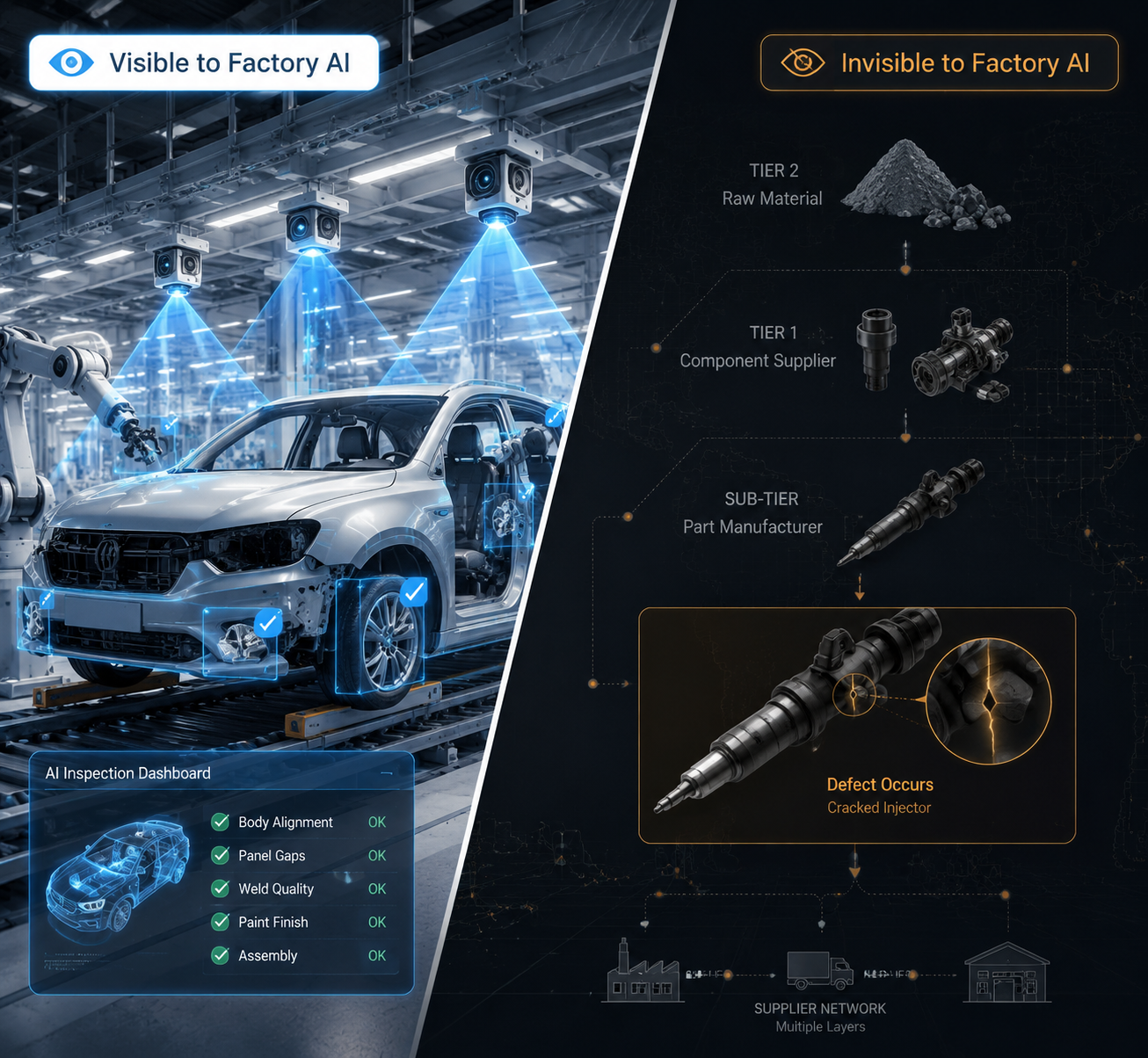
That does not mean the cameras failed to find cracked injectors. The timeline matters. Ford’s AiTriz and MAIVS systems were deployed after the relevant injector defect was already in the field, and they were built for in-process factory inspection, not for predicting corrosion-driven cracking behavior in a supplier component over time.[1][2] The sharper lesson is less convenient than either celebration or blame: Ford’s AI appears to have worked inside its assigned boundary, while the failure that drove the recall lived outside that boundary.
The Recall Chain Ran Upstream, Not Along the Camera Line
The fuel injector problem did not arrive as a single clean event. It moved through three recall iterations: 22S73, then 24S16, then 25S76.[2] Each step matters because the remedy problem expanded. A field issue that might first look containable became a broader quality-management problem, with regulators, vehicle owners, dealers, engineers, and supplier teams all pulled into a longer loop.
NHTSA’s Part 573 documentation for the later recall identified corrosion as a contributing factor to injector cracking.[3] That detail changes the inspection question. A camera over an assembly station can verify whether a part is present, aligned, seated, connected, routed, clipped, or visibly damaged. It cannot, by looking at a completed station, reconstruct supplier material history, coating performance, process variation, or the field conditions under which a fuel injector may crack later.
This is where the phrase “AI quality control” becomes too blunt to be useful. The same term can describe a vision system checking millimeter-scale assembly alignment and a supplier-risk model trying to connect material batches, tooling changes, process excursions, warranty claims, and design assumptions. Those are not the same job. They do not use the same evidence, and they do not give managers the same authority to stop production, quarantine inventory, redesign a component, or re-source a supplier.
| Factory AI Can Inspect | The Injector Recall Required Visibility Into |
|---|---|
| Visible part presence and placement | Supplier material behavior over time |
| Assembly alignment and task completion | Corrosion contribution to cracking risk |
| Localized visible defects at a station | Process variation outside Ford’s plant |
| Repeatable operator or automation misses | Multi-tier traceability and containment scope |
| Known defect patterns after training | Design governance and supplier-quality escalation |
The table is not a knock on vision inspection. It is a boundary map. If a supplier component contains a latent weakness that becomes a field failure after exposure, the first question is not whether the line camera had enough pixels. The first question is whether the quality system had enough upstream evidence, and whether anyone had the authority to act on it before vehicles reached customers.
Ford’s AI Wins Were Real, But Narrow
Ford’s factory AI program had credible plant-floor proof points. AiTriz was deployed in December 2024 across 35 stations for millimeter-scale alignment inspection, while MAIVS was deployed in January 2024 across more than 700 stations and 463 task types.[1][4] Together, the systems gave Ford a large visual inspection layer over repetitive production work that human inspectors can miss after enough cycles.
The strongest example is not abstract. MAIVS reduced squish tube defects at one plant from about 40 per month to zero.[5] That is the kind of result plant quality teams rightly care about: a specific defect, at a specific process point, with a before-and-after measure that changes rework and customer risk.
But a squish tube is the kind of defect a station-level visual system can own. It has a visible condition, a repeatable inspection point, and a clear process correction. A corrosion-linked injector cracking problem belongs to a different chain of evidence. The defect pathway may begin before the component arrives at final assembly and may not present as a visible assembly miss at all.
Calling the camera program a failure would be too easy and not especially accurate. Treating it as proof that quality governance was covered would be worse. The recall showed that the company could improve the line’s ability to see without yet giving the enterprise enough visibility into the upstream conditions that create some of the most expensive failures.
The Missing Layer Was Judgment, Traceability, and Authority
Ford’s response is more instructive than the camera count. The company reportedly brought back 300 to 350 veteran engineers to help retrain its AI tools after recognizing that it had lost experienced engineering knowledge before the AI systems were deployed.[5][6] That number lingers because it says something executives often avoid saying out loud: tacit engineering judgment was not a decorative layer around the system. It became part of the recovery mechanism.
AI models can classify patterns they are trained to recognize. Experienced engineers often know which pattern is worth teaching, which anomaly is a nuisance, which supplier deviation deserves containment, and which design assumption has become fragile. In quality work, that difference shows up in meetings before it shows up in dashboards. Someone has to decide that a field complaint, a process change, a supplier notice, or a lab result is not noise.
Ford also changed the organization around the technology. The company replaced about two-thirds of senior leaders across its industrial system and created a unified Engineering, Supply Chain, and Quality structure.[7] That is not the same as buying another software module. It changes who sees the same facts, who can challenge a launch plan, and who is accountable when supplier risk and design risk overlap.
Chief Supply Chain Officer Liz Door’s early supplier integration work is part of the same pattern. Ford said that early supplier engagement helped cut launch issues by 30% year over year.[7] The claim should be read carefully: launch-issue reduction is not proof that older recalled vehicles were fixed retroactively. It does, however, point toward the right operating direction. Supplier quality has to move earlier, before a defect becomes a dealer bulletin, a regulator file, and a warranty reserve.
What the Recall Cost Actually Measures
The reported $570 million estimate, roughly $800 per affected vehicle, is often the headline number.[1][4] It is useful, but it is a late-stage measurement. By the time a defect becomes that visible, the system is no longer paying only for a bad component. It is paying for diagnosis, remedy development, regulatory handling, dealer labor, customer disruption, field containment, software or hardware updates where applicable, and the organizational time spent rebuilding confidence.
That distinction matters for procurement and supply chain leaders because supplier savings are usually booked early, while supplier-quality failures are recognized late. A single-source component can look efficient until a latent defect forces the company to ask which vehicles received which parts, which supplier lots are implicated, which plants and build dates are exposed, and whether the initial remedy is enough.
The recall sequence from 22S73 to 24S16 to 25S76 shows how expensive uncertainty can become.[2] When traceability is incomplete or the defect mechanism is still being narrowed, containment boundaries tend to widen. More vehicles enter the population of concern, more owners require communication, and more engineering work is needed to separate actual risk from administrative caution.
Why This Is Not Just a Ford Story
The broader industry context is moving in the same direction. Supply Chain Management Review reported that automotive recall scope in Q3 2025 increased 60% compared with the first half of 2025, with pressure tied to single-source EV components and concentrated Tier-2 supply chains.[8] That does not mean every manufacturer has Ford’s specific injector problem. It does mean recall exposure is increasingly shaped by supplier concentration, component complexity, and the depth of traceability below the direct supplier.
Factory AI is attractive in that environment because it gives leaders something concrete to fund. Cameras can be installed. Stations can be counted. Defect rates can be shown on a screen. Supplier governance is less photogenic. It requires part genealogy, material and process data, disciplined change control, escalation rules, cross-functional design reviews, and contracts that require data access before a crisis.
None of that makes plant-floor AI optional. It makes the buying decision more demanding. A manufacturer that funds inspection without funding supplier traceability may reduce visible assembly defects while leaving expensive upstream failure modes untouched. A procurement team that rewards single-source efficiency without testing failure isolation is accepting a quality risk that cameras at final assembly cannot unwind.
The Better Investment Question
Ford’s more recent quality indicators suggest that the broader transformation may be producing results. The company said it reached No. 1 among mainstream brands in J.D. Power Initial Quality in 2026, up from No. 15 in 2023, and CEO Jim Farley pointed to “hundreds of millions” in warranty savings.[7] Those are meaningful signals, with an important boundary: initial quality rankings for new vehicles do not retroactively change the risk profile of older model years involved in the recall.
The investment lesson is not to slow down AI inspection. It is to stop treating inspection as a substitute for quality governance. Before adding another layer of cameras, supply chain leaders should be able to answer a few harder questions.
- Can the company trace affected components by supplier lot, plant, build date, material batch, and engineering revision quickly enough to contain risk?
- Does supplier data flow into quality and engineering reviews before launch, or only after warranty claims begin to accumulate?
- Who has authority to stop shipment, widen containment, require redesign, or challenge a supplier process change?
- Are experienced engineers training the AI system continuously, or was their judgment removed and then rediscovered after defects escaped?
- Where does single-source exposure sit in the quality risk model, and how quickly can the company isolate a failure if that source is implicated?
Those questions are less tidy than a camera deployment count, but they are closer to where the Bronco Sport recall lived. The defect did not need a better public narrative. It needed earlier visibility into supplier and design risk, faster containment logic, and enough engineering authority to act before the field population grew.
For supply chain executives, the purchasing implication is direct. If the budget buys cameras but not upstream data architecture, supplier traceability, design governance, single-source risk management, and expert-in-the-loop learning, it buys better inspection at the wrong boundary.
References
- Ford Uses AI Cameras in Factories to Prevent Costly Recalls, Rework, Business Insider, August 2025.
- 25S76: Fuel Injector May Crack and Leak Fuel, Ford.
- Part 573 Safety Recall Report, National Highway Traffic Safety Administration.
- Ford’s Most Expensive Recall This Year Costs $570 Million, Road & Track, June 2026.
- Ford rehires human engineers after AI fails to match quality checks, BBC.
- Ford Rehires Hundreds of Veteran Engineers to Retrain AI, Yahoo Finance / Quartz.
- Ford Quality Transformation Update, Ford From the Road.
- Automotive recall scope rises amid single-source EV component and Tier-2 concentration risks, Supply Chain Management Review.
Comments
Join the discussion with an anonymous comment.