
§ 41 — Use-case analysis
How Chile's Flood Revealed AI's Supply Chain Deployment Gap
The July 2026 Chile floods caused severe copper supply chain disruptions despite being forecastable 5–7 days in advance. This post-mortem examines why existing AI tools — from port congestion prediction to mine-haulage optimization — were not deployed, and what the gap means for resilience planning in critical-mineral supply chains.
- Function
- supply chain resilience
- AI technique
- forecasting, disruption detection
- Failure pattern
- integration and organizational readiness gap
- Evidence source
- INFORMS (Han et al. 2025), Skillings, Reuters
The first useful date in Chile's July 2026 copper disruption is not the day a mine stopped or the day a port closed. It is July 14, when an atmospheric river was forecast over Chile's copper region, putting the industry on flood alert several days before the worst operational damage appeared.[1] That matters because the question behind Chile flood supply-chain disruption and AI resilience is not whether the storm was severe. It was. The question is whether a forecastable disruption moved through the system faster than planning, dispatch, inventory, port, road, grid, and executive-response layers could act together.
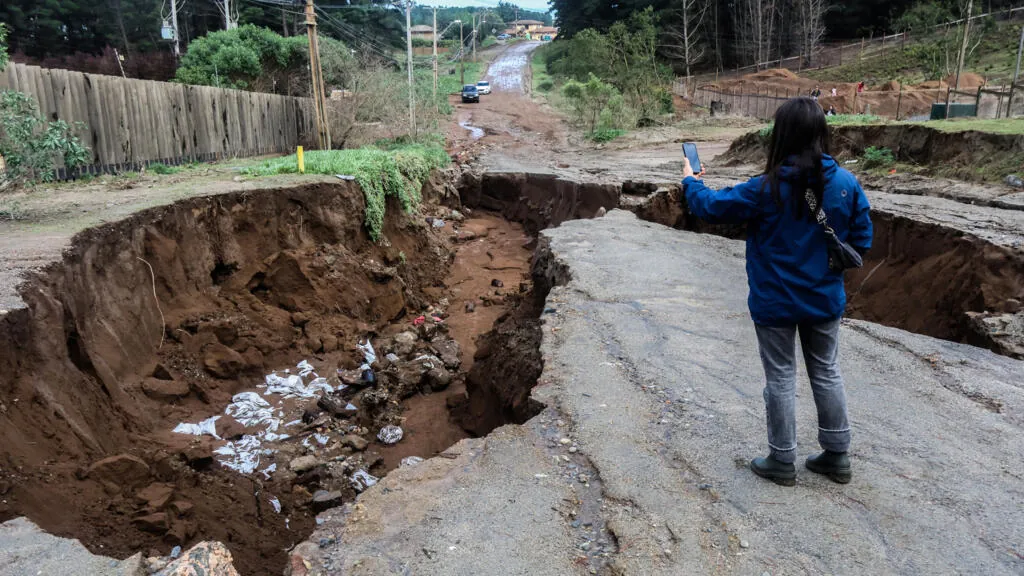
By July 17, Reuters was reporting three deaths, hundreds displaced, and heavier rains still expected.[2] On July 18, Lundin Mining suspended Caserones operations while Candelaria continued operating using stockpiles; the company said it was maintaining full-year guidance, but the operating fact is more interesting than the reassurance: inventory carried the continuity plan.[3] On July 21, Route 5 had damage and sinkholes across the km 512–657 and km 674–731 stretches, with damage also reported on the C-46 road to Huasco ports.[4] Bloomberg reported the storm had blocked a key highway and left tens of thousands isolated.[5] Port operations were also hit: Lirquén ceased operations, Valparaíso had limitations, and Quintero was reported closed.[6][7] By July 22, the human toll had risen to 13 dead and seven missing; more than 257,000 customers had lost power, and 87,000 remained without electricity more than five days after the storm began.[8] The same day, BNamericas reported Codelco's Andina surface operations halted, a tailings overflow issue at Los Pelambres, and more than 600 small miners left in limbo after the storms.[9]
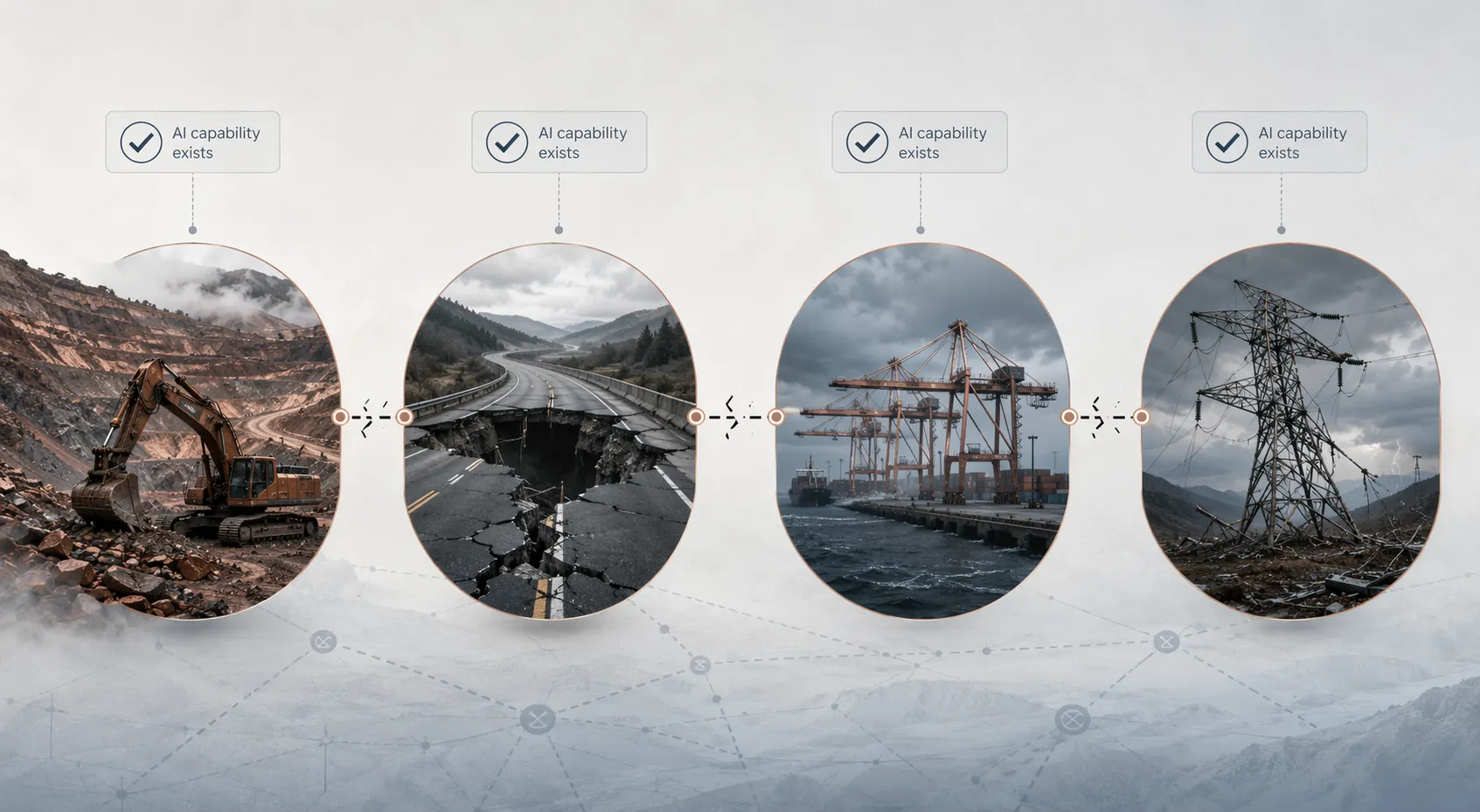
That is the sequence to keep in view: forecast, casualties, mine suspension, highway severance, port constraints, power outages, surface mine halts, tailings trouble, and smaller operators stuck behind the larger companies' continuity buffers. It is not a clean single-point failure. It is a propagation chain across nodes that normally sit in different planning rooms.
| Date | Observed disruption | Supply-chain node |
|---|---|---|
| Jul 14 | Atmospheric river forecast over Chile's copper region | Weather-to-planning trigger |
| Jul 17 | Deaths, displacement, heavier rains expected | Emergency escalation |
| Jul 18 | Caserones suspended; Candelaria operated on stockpiles | Mine operations and inventory |
| Jul 21 | Route 5 and C-46 road damage reported | Road logistics |
| Jul 21 | Port closures or limitations reported at Lirquén, Valparaíso, and Quintero | Marine export and import scheduling |
| Jul 22 | Major power outages continued; Andina surface halt and Los Pelambres tailings issue reported | Grid, mine operations, and environmental controls |
The Forecast Was Early Enough to Matter
A 5–7 day weather warning is not enough time to redesign a copper supply chain. It is enough time to change loading priorities, freeze nonessential moves, pre-stage critical spares, review stockpile drawdown assumptions, test alternate road paths, alert port slots, and decide which smaller contractors are likely to be stranded if the main corridor goes first. Those are not dramatic AI promises. They are dispatch and planning decisions that either happen before water cuts the road or become expensive improvisation afterward.
The available reporting does not prove that no operator used AI privately during the storm. A mine, port, carrier, or grid operator could have run models that never appeared in public filings or press coverage. The narrower and safer conclusion is still uncomfortable: the public record shows no evidence of an integrated mine-road-port-grid AI deployment that converted the July 14 warning into coordinated cross-node action.
That distinction is important. The issue is not whether an algorithm somewhere could forecast rain. The weather signal existed. The issue is whether that signal reached the operating variables that decide what gets hauled, what waits at port, which power assets get priority, which tailings risks receive attention, and which smaller miners get routed into a shared contingency plan rather than being left to wait.
Where the Deployment Gap Showed Up
The mine node is the easiest place to mistake buffer for intelligence. Lundin's update said Caserones was suspended and Candelaria continued operating using stockpiles, while full-year guidance remained unchanged.[3] That is good continuity practice. It is not, by itself, evidence that AI resilience worked. A stockpile is a physical hedge; an AI-enabled planning layer would be judged by whether it changed the stockpile drawdown schedule, contractor dispatch, concentrate movement, maintenance timing, or port allocation before the storm closed options.
Operations forecasting tools are relevant here because they can connect weather, production plans, inventory positions, workforce access, equipment availability, and downstream logistics constraints. Directional claims about AI improving forecast accuracy in operations are useful only with caveats: broad improvement ranges from consulting or vendor channels are not Chile-mining-specific proof. The operational test is narrower: did the model change a mine plan early enough that the dispatch office, mill, warehouse, port scheduler, and commercial desk acted from the same forecast?
Autonomous haulage also deserves a more precise role than it usually gets in resilience discussions. It can reduce exposure for people in dangerous conditions and, where deployed at scale, help maintain some movement under constrained labor access. But Skillings treated autonomous haulage in this storm as more of a safety case than a system-wide continuity answer, and the available material does not show that autonomous systems were widespread enough to keep ore movement stable across the affected network.[10] For this event, autonomy was not the missing master key. Integrated planning was.
The road node was a different kind of failure. Route 5 is not just a line on a map; for mine logistics it is a timing assumption embedded in truck plans, port bookings, workforce access, fuel supply, spares delivery, and emergency response. Once Data Portuaria reported sinkholes and damage across the km 512–657 and km 674–731 stretches, plus damage on the C-46 road to Huasco ports, the planning variable was no longer rain intensity. It was route availability by segment.[4]
This is where natural-language processing and disruption-detection systems could have been useful, at least in principle. AI tools that scan official notices, road reports, local updates, carrier messages, and weather feeds can surface closure signals before they have moved through formal reporting channels; Bronson.ai describes this kind of supply-chain disruption forecasting capability.[12] But a road-closure alert has limited value if it sits in a risk dashboard while dispatchers, port schedulers, mine planners, and procurement teams keep separate exception lists. The system has to convert a closure signal into a reroute, a load cancellation, a revised port ETA, or a decision to hold material at the mine.
The port node exposed the same pattern. Splash247 reported bad weather forcing port closures in Chile, while STU Supply Chain reported Lirquén had completely ceased operations, Valparaíso had limitations, and Quintero was closed.[6][7] Port congestion prediction systems already exist as a category: they can combine weather forecasts, vessel schedules, shipping logs, berth status, and sometimes satellite or AIS-derived signals to estimate which calls will bunch, which cargoes should be advanced, and which bookings should be delayed. The public reporting on Chile's July storm does not show port operators publishing evidence of pre-storm AI scheduling or shared mine-port reprioritization.
Port AI is often discussed as if predicting congestion were the hard part. In a storm sequence like this, prediction is only one piece. A model may know that a berth will close or that a backlog will form. The harder operational question is who has authority to move a shipment forward, pull a truck slot, redirect a carrier, protect reagents or critical spares, or tell a sales team that a promised copper movement is no longer the right priority. Without that authority, prediction becomes a better timestamp on the same delay.
The grid node is where resilience language becomes especially slippery. Reuters reported that more than 257,000 customers lost power and 87,000 still lacked power more than five days later.[8] Predictive grid management can help utilities and large industrial users prioritize inspection, vegetation and flood-risk exposure, crew staging, backup-power positioning, and restoration sequencing. But the public record supports only an inferred capability gap from the outcome and the absence of public evidence of integrated deployment; it cannot prove a specific grid model was not used or that a particular AI system would have reduced the outage count.
That restraint matters because grid recovery is constrained by physical access, safety, weather, equipment damage, and crew availability. AI can rank work and expose dependencies; it cannot make a washed-out road passable or replace field crews. Still, from a mine-supply-chain standpoint, the grid outage should not be treated as a separate utility problem. Power availability affects pumping, processing, communications, worker access, security, and environmental controls. In a truly integrated resilience model, grid risk is one of the inputs that changes mine and logistics decisions before the outage becomes a status report.
Commercial Pressure Was Real, but It Was Not the Main Lesson
The tonnage risk is large enough to justify attention without turning the event into a price story. Skillings estimated the storms put about 1.5–2% of Chile's Q3 2026 copper output at risk, or roughly 80,000–106,000 tonnes, in a market it described as already running a structural deficit.[10] The same source cited Cochilco data showing Chile's copper output was already down 9.04% year over year in March 2026, which means the flood arrived on top of existing production pressure rather than into a comfortable surplus.[10]
Those figures are estimates, not audited final production losses. The event was still unfolding as of July 26, 2026, so casualty figures, damage totals, and output effects can still be revised. But the commercial signal is clear enough: when a climate shock hits the country that supplies a major share of critical-mineral flows, the cost of fragmented planning is not confined to a flooded road or a single suspended pit.
The asymmetry between larger and smaller operators also matters. Lundin could point to stockpiles and guidance.[3] BNamericas reported more than 600 small miners in limbo after the storms.[9] That is not a criticism of stockpiling; buffers are necessary. It is a reminder that resilience built only inside the balance sheets and warehouses of larger operators does not automatically become system resilience. Smaller miners, contractors, and regional service providers often discover the real contingency plan only after the main corridor has failed.
The AI Evidence Points to Organization, Not Model Novelty
The most useful AI study for this event is not a mining case study. Han et al.'s 2025 Information Systems Research paper, published by INFORMS, provides causal evidence that AI investment is associated with greater firm resilience under natural disaster shocks, but the effect depends on complementary organizational design, including data-sharing protocols and integrated command structures.[11] That caveat is the bridge from Chile's July chronology to the broader AI-resilience question.
The study should not be stretched beyond what it says. It is not proof that a specific Chilean copper operator would have avoided a specific suspension if it had bought a particular platform. It is evidence for a mechanism: AI investment helps under disaster shock when the organization is built to use the signal. Without shared data definitions, escalation rights, and cross-functional command, an AI forecast can become another isolated artifact, alongside the port notice, the mining update, the road closure post, and the executive continuity memo.
That mechanism fits the July sequence uncomfortably well. The storm warning existed. Road, port, mine, and grid failures were identifiable by date and node. AI categories existed that could plausibly support forecasting, detection, routing, inventory decisions, congestion prediction, grid prioritization, and scenario planning. What is missing from the public record is the connective tissue: one operating picture that decides which forecast changes which action, across which node, under whose authority.
This is also why comparisons to other disruption types are useful only if they sharpen the operating question. Port-risk patterns in the Houthi crisis, geopolitical-risk planning, flash-flood routing, and oil-price scenario modeling all show that AI resilience depends on converting early signals into authorized operational moves, not on collecting more impressive dashboards. For readers comparing cases, the same pattern appears in AI responses to the Houthi supply-chain threat, AI planning for geopolitical disruptions, NYC flash-flood supply-chain planning, and oil-price scenario planning.
The Practical Test for Critical-Mineral Resilience
The point is not to ask whether the storm was bad enough to excuse the outcome. July's floods killed people, damaged infrastructure, interrupted operations, and left communities and miners exposed. The operational question is different: when the July 14 warning appeared, which decisions changed before the July 17–22 cascade?
For a copper producer, port operator, carrier, utility, or government logistics coordinator, the test is not "do we have AI?" It is: when a 5–7 day warning arrives, which model changes which decision, who sees it, and what cross-node action is authorized before roads, ports, mines, and power fail together?
Chile's July 2026 flood exposed a deployment gap between point AI capabilities and integrated operational readiness in critical-mineral supply chains. The models matter, but the handoff matters more. A forecast that does not reach dispatch is a weather note. A port prediction that cannot move a shipment is a calendar annotation. A grid-risk score that does not change mine sequencing is a risk register entry. The next resilience plan should be judged at those handoff points.
References
- Rare Storm Puts Chile Copper Region on Flood Alert, Briefs.co, Jul 14, 2026.
- Chile storms kill three, displace hundreds, Reuters, Jul 17, 2026.
- Lundin Mining Provides Update on Chile Operations Following Severe Winter Storm, Lundin Mining, 2026.
- Storm Causes Multiple Damages on Route 5, Data Portuaria, 2026.
- Chile Storm Blocks Highway, Floods Regions, Bloomberg, Jul 21, 2026.
- Bad weather forces closure of ports in Chile, Splash247, 2026.
- Chile Declares National State of Catastrophe, STU Supply Chain, 2026.
- Chile rains leave 13 dead, 7 missing, Reuters, Jul 22, 2026.
- Mining rescues, operational suspension and technical problems, BNamericas, 2026.
- Copper at $14,000/Ton: Assessing the Impact of Chile's Monster Storms on Supply Chains, Skillings, 2026.
- Artificial Intelligence and Firm Resilience: Empirical Evidence from Natural Disaster Shocks, INFORMS, 2025.
- AI in Supply Chain Resilience: Forecasting Disruptions, Bronson.ai.
§ 42 — Cited evidence
Flag an inaccuracy or submit a comparable account — Contribute or read how claims are verified in Methodology.