
§ 41 — Use-case analysis
How AI Helped Supply Chains Survive the Houthi Threat
The Houthi disruption produced a thin set of verifiable AI outcomes. This analysis examines the strongest evidence—including a $220M loss avoidance, vendor screening at scale, and port-level congestion prediction—and reveals where platform claims still lack independent verification.
The Houthi attack threat made AI supply chain resilience sound less like a transformation slogan and more like a Monday-morning planning problem. At the peak of the Red Sea disruption, roughly $6 billion in trade was affected each week, Suez Canal volume dropped 57.5%, Asia-Europe container rates carried a 25-40% premium, and war-risk insurance for Red Sea transit reached 0.5-1.0% of cargo value, typically outside standard policies.[1] By July 2026, one freight-forwarder benchmark still showed contract rates running 15-25% below spot on disrupted Asia-Europe lanes, a reminder that the crisis did not just add miles; it changed the cost of being wrong.[2]
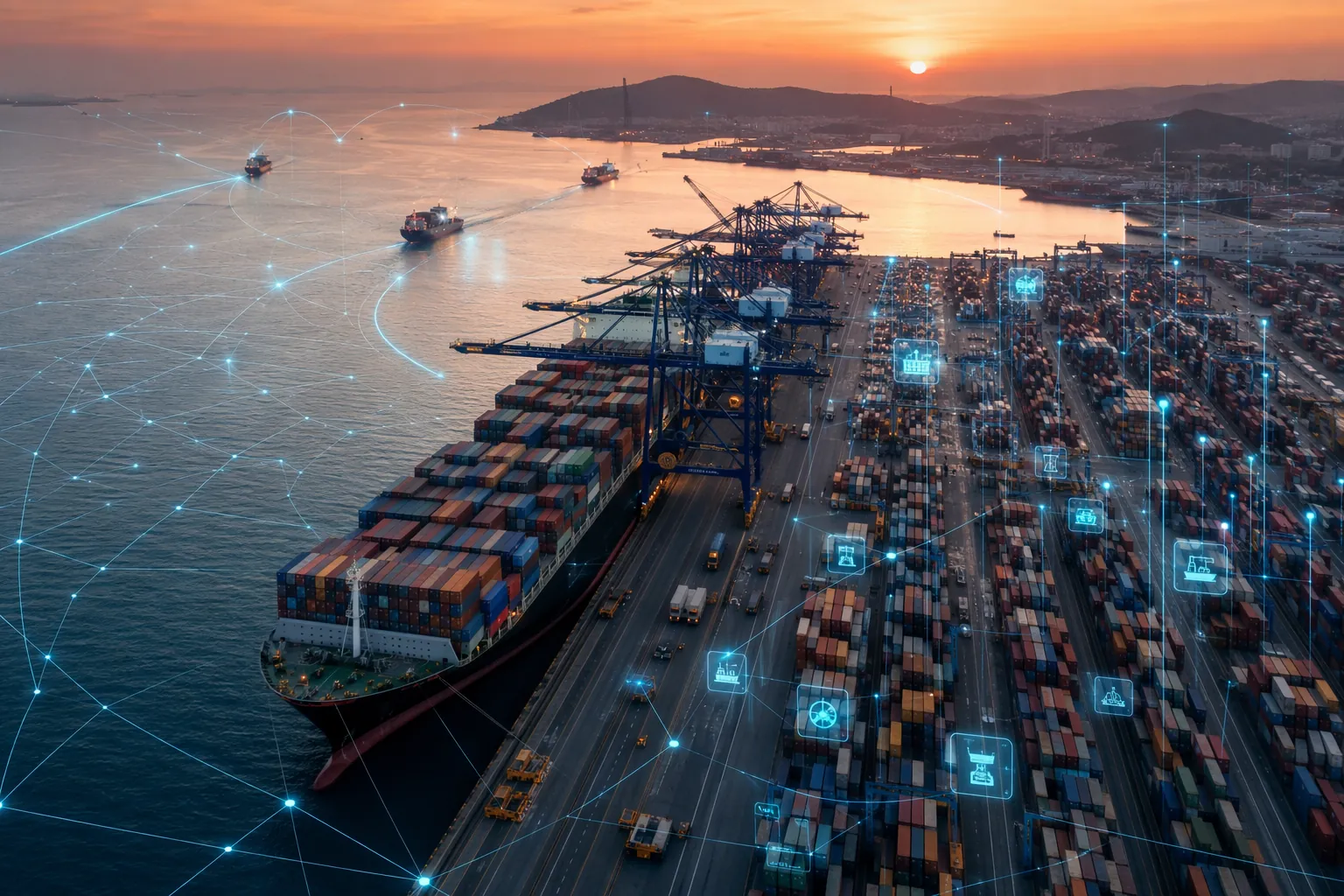
That is the right opening size for the problem, but the wrong size for judging software. A disruption can be huge while the evidence for any one AI tool remains narrow. The useful question is not whether AI sounded relevant during the Red Sea crisis. It is which AI-supported actions were documented well enough to help a planning, procurement, logistics, or finance leader build a function-level business case.
Three cases carry most of the weight: a Sensos-reported automaker reroute that claims $220 million in avoided losses; the U.S. Defense Logistics Agency's Business Decision Analytics model for supplier-risk screening; and a Portcast/Siemens congestion-prediction example that ties external data fusion to terminal-level decisions. They are not equal proof of the same thing. One is a vendor case with a very large financial claim. One is an official defense screening case with clear scale but a different risk problem. One is a logistics visibility case with the cleanest operating mechanism.
The $220 Million Claim Deserves Attention, Then Friction
The Sensos automaker case is the most eye-catching because it claims a result large enough to change an investment committee conversation. Sensos says its AI-enabled approach helped an automaker pre-map 12 alternative ports, using political-stability scoring and disruption analysis before the crisis forced a rushed reroute decision. The reported outcome was an estimated $220 million in avoided losses.[3]
There is real operational substance in the setup. Pre-mapped ports are not the same as a colored risk heat map. Someone has to compare port suitability, inland movement options, likely congestion, carrier alternatives, insurance exposure, and customer-service consequences before the exception arrives. If political-stability scoring was one input among those routing choices, then the tool was doing something planners actually need: narrowing the decision space before everyone is waiting for an answer.
The caveat is equally material. The $220 million figure comes from Sensos, not from the automaker, a public filing, or an independent audit.[3] That does not make it false. It does mean the figure should be treated as a vendor-sourced case-study claim rather than an independently verified benchmark. For an internal business case, the responsible use of this example is to ask whether a similar organization can document the same chain of causality: what would have happened without the pre-mapped ports, what action changed, which costs were avoided, and who signed off on the counterfactual.
The strongest lesson from the case is not the dollar amount by itself. It is the preparation pattern: geopolitical risk was translated into named alternative ports before a reroute became urgent. That is a defensible capability to investigate. It is not, on its own, a defensible reason to select any full-suite planning platform.
Supplier-Risk Screening Has Better Public Evidence, But a Different Use Case
The Defense Logistics Agency's Business Decision Analytics model offers a cleaner public evidence trail. According to the DLA, the model analyzed 43,000 vendors and flagged more than 19,000 as high-risk. The same official account connects the screening work to at least one criminal guilty plea involving false certification of U.S.-made parts.[4]
That matters because supplier-risk AI often fails the specificity test. It is easy to say a model monitors the supply base. It is more useful to know how many vendors were screened, what kind of risk was being surfaced, and whether an enforcement or sourcing action followed. On those terms, the DLA case is stronger than most generic resilience claims.
It also has a hard boundary. The DLA model was aimed at defense-specific concerns such as counterfeit, nonconformant, and overpriced parts.[4] That is adjacent to commercial supplier-risk scoring, not identical to a Red Sea routing engine or a geopolitical logistics optimizer. A food manufacturer, electronics brand, or automotive Tier 1 can learn from the screening architecture, but should not paste the DLA result into a commercial ROI model as if the same risk definitions, data access, and enforcement leverage apply.
For teams evaluating this capability area, the practical comparison set is narrower than “AI resilience.” It is supplier-risk monitoring: entity resolution, sanctions and ownership signals, counterfeit indicators, location exposure, shipment dependencies, and explainable alerts. A useful next stop is a structured view of the 2026 AI Supplier Risk Monitoring Vendor Directory, followed by a closer look at autonomous procurement AI supplier risk scoring when the buying organization wants to connect risk signals to sourcing decisions.
The Portcast/Siemens Example Shows the Operational Mechanism
The Portcast/Siemens case is less dramatic than a nine-figure avoided-loss claim, but it is easier to inspect as a workflow. Siemens describes an AI-enabled sea-freight approach that fuses more than 200 data sources, including satellite, weather, carrier, and port data, to predict congestion at terminal-level granularity.[5]
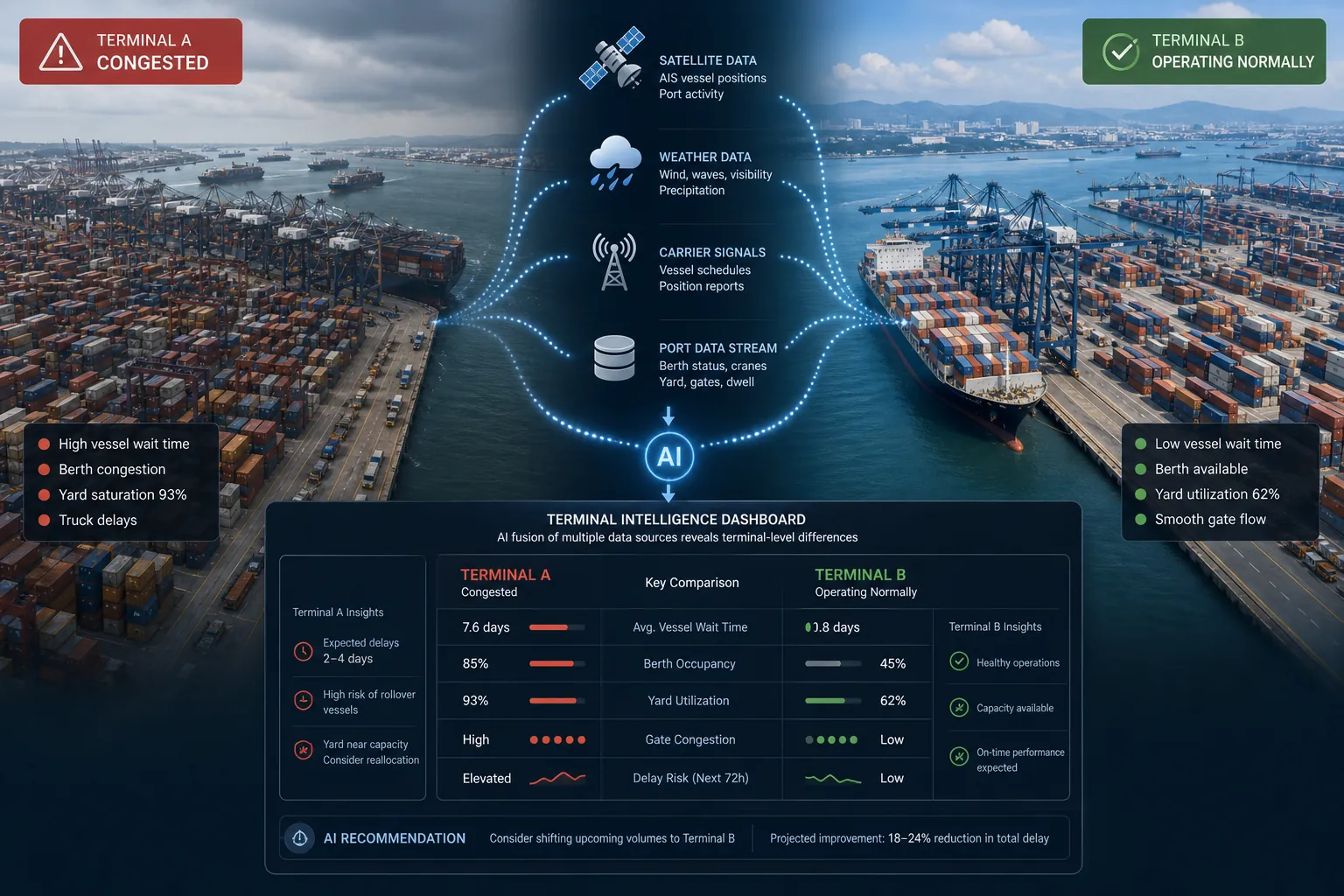
The terminal-level detail is the part worth slowing down for. In the Le Havre example, one terminal showed 85-90% yard utilization while another had clear berthing conditions.[5] A port-level alert would flatten that difference into “Le Havre is congested” or “Le Havre is available.” A terminal-level model gives the planner a more useful question: can the shipment be routed, scheduled, or negotiated toward the less constrained terminal before demurrage and expedite decisions start stacking up?
The reported outcomes map directly to the work planners complain about because they affect exception handling, cost leakage, and late corrective action. Siemens reports 80% fewer manual updates, 15% lower demurrage charges, and 5% fewer expedited-freight orders from the Portcast-supported approach.[5] Those are not proofs that every AI visibility deployment will pay back. They are credible operating metrics to request in a pilot: update workload, avoidable demurrage, expedite frequency, forecast-error reduction, and decision lead time.
This is also where “AI” becomes a less useful label than the underlying design. The valuable capability is not that the interface uses machine learning. It is that ugly external signals are merged into a decision that is granular enough to change a booking, a port call, a yard plan, or an expedite request. A dashboard that notices the Red Sea is risky after rates have already moved is late. A system that distinguishes congestion across terminals, compares contract exposure against spot pressure, and gives a planner an explainable alternative is doing work.
Rate Exposure Is Part of the AI Case, Not a Separate Finance Footnote
The July 2026 Suaid Global update adds a finance angle that planning teams should not leave until the budget review. Its benchmark showed contract rates 15-25% below spot on disrupted Asia-Europe lanes.[2] That spread does not prove that AI automatically captures arbitrage. It does show why disruption-aware planning tools need to connect routing options to rate exposure, not just ETA confidence.
A planner deciding between a slower contracted routing option and a faster spot-market alternative is not making a pure logistics decision. Procurement may be defending committed volumes. Finance may be watching premium freight burn. Sales may be asking which customer order gets protected. The AI output has to make those tradeoffs visible enough that the meeting can move from blame to choice.
The broader Middle East disruption context reinforces that point. Oliver Wyman reported that GCC fertilizer prices rose 26% in two weeks after the Strait of Hormuz closure, a different event but a useful reminder that geopolitical shocks can move commodity and logistics economics quickly, not only vessel schedules.[6] For a business case, that supports scenario modeling and exposure monitoring. It does not validate any specific Red Sea AI platform.
What the Stronger Cases Have in Common
Across the documented cases, the useful systems share a few traits. They ingest signals that are messy and external. They preserve enough detail to support a specific action. They explain the output in terms a planner, buyer, or logistics manager can use before the exception becomes irreversible.
| Capability | Documented Evidence | Useful Business-Case Question |
|---|---|---|
| Disruption-aware routing | Sensos-reported automaker case with 12 pre-mapped alternative ports and claimed $220M avoided loss | Can the vendor show named alternatives, decision timing, cost counterfactuals, and customer verification? |
| Supplier-risk screening | DLA BDA model screened 43,000 vendors and flagged 19,000+ high-risk vendors | Do the risk definitions match commercial sourcing exposure, or are they defense-specific? |
| Port and terminal congestion prediction | Portcast/Siemens fused 200+ sources and reported fewer manual updates, lower demurrage, and fewer expedited-freight orders | Can the pilot measure terminal-level decisions, not just visibility improvements? |
| Rate-aware disruption planning | Suaid Global reported 15-25% contract-vs-spot spread on disrupted Asia-Europe lanes | Does the tool compare routing choices against contract, spot, demurrage, expedite, and insurance exposure? |
The academic literature is directionally consistent with this pattern: AI can support resilience under geopolitical risk when it improves sensing, prediction, and decision support rather than merely automating a static plan.[7] That is a framework, not an outcome audit. It helps explain why these cases are plausible; it does not fill the proof gaps around vendor performance.
Where the Evidence Stops
The evidence does not support a broad claim that AI platforms, as a category, were proven for geopolitical resilience during the Houthi crisis. It supports a narrower claim: certain AI-enabled capabilities have documented results in routing preparation, supplier-risk screening, and congestion prediction, with different levels of verification.
There is no published vendor-neutral head-to-head benchmark comparing o9, Blue Yonder, Kinaxis, RELEX, Anaplan, or other major platforms on Red Sea disruption response. That absence matters. Separate vendor stories can show what is possible, but they cannot answer which platform performs better on the same lanes, the same data latency, the same service constraints, and the same cost objectives.
The Sensos case also illustrates the verification problem at the high end of the claims range. A $220 million avoided-loss figure is too important to ignore and too large to accept casually when it is vendor-sourced.[3] A procurement team should ask for named-customer validation, pre-crisis and post-crisis decision logs, assumptions behind avoided-loss calculations, and evidence that the AI output changed the action rather than merely documented a decision the organization was already likely to make.
The Portcast/Siemens figures are more operationally testable. A pilot can measure manual update volume, demurrage, expedite orders, and terminal-level forecast accuracy before and after deployment.[5] Even there, the buyer still needs to separate software contribution from process redesign, carrier behavior, lane mix, and disruption severity during the measurement window.
A sensible evaluation does not begin with a platform beauty contest. It begins with the function under pressure. Supplier-risk teams should test screening coverage and false-positive handling. Logistics teams should test port and terminal prediction against live execution decisions. Planning teams should test scenario recommendations against service, inventory, and cost tradeoffs. Finance should insist that avoided-cost claims survive counterfactual review.
That is also why comparative methods matter. The same discipline used in a lane- or hazard-specific platform comparison, such as ChainSignal's AI wildfire smoke supply-chain comparison, is the kind of structure geopolitical AI tools still need: same scenario, same evaluation criteria, same evidence standard, and no credit for claims that cannot be traced to an action.
The Business Case These Results Actually Support
The Houthi crisis produced enough evidence to justify targeted AI exploration. It did not produce enough evidence to justify vendor selection by resilience narrative.
A function-level business case can reasonably focus on three areas: disruption-aware routing with pre-approved alternatives, supplier-risk screening with explainable flags, and port or terminal congestion prediction tied to execution decisions. The documented cases show that these are not fantasy capabilities. They also show that proof quality varies sharply by source, use case, and measurement design.
The strongest buying posture is therefore specific and demanding: ask for independent audits where financial outcomes are claimed, named-customer verification where case studies carry large numbers, and head-to-head benchmarks before treating any platform as proven for geopolitical resilience. The Red Sea disruption made the need visible. It did not remove the buyer's job.
References
- Another Hormuz? The Red Sea's Threat to the Global Economy — Council on Foreign Relations, June 24, 2026.
- Red Sea Shipping Crisis 2026: Impact on Your Supply Chain — Suaid Global, July 13, 2026.
- Navigating Geopolitics and AI | Stabilizing Supply Chains in Turbulent Times — Sensos.io.
- Utilization of Artificial Intelligence (AI) to Illuminate Supply Chain Risk — Defense Logistics Agency.
- When sea freight gets smarter: How AI is turning supply chain chaos into competitive advantage — Siemens Digital Logistics, September 2025.
- How conflict in the Middle East affects global supply chains — Oliver Wyman, March 2026.
- Enhanced supply chain resilience under geopolitical risks: The role of artificial intelligence — ScienceDirect, 2025.
§ 42 — Cited evidence
Flag an inaccuracy or submit a comparable account — Contribute or read how claims are verified in Methodology.