

Why This Comparison Matters in 2026
Every major supply chain software vendor is making a simultaneous bet on agentic AI in 2026. Blue Yonder is building specialized AI agents through a partnership with NVIDIA. Manhattan is giving users a no-code toolkit to build their own agents. Oracle is shipping role-based agentic applications directly inside its Fusion UI. These are not incremental feature releases — they represent fundamentally different theories about how AI should be delivered in enterprise supply chain operations.
All three vendors hold Gartner Magic Quadrant Leader positions in 2026. That shared recognition makes the selection decision harder, not easier. When every shortlisted vendor is a Leader, the differentiators shift from capability checklists to architectural philosophy, ERP ecosystem fit, and organizational readiness.
This is also the cycle where the platform naming question has practical consequences for evaluation teams. Blue Yonder's "Luminate" brand — previously the primary platform identity — is de-emphasized in 2026 materials. The platform is now positioned primarily as the Blue Yonder Platform, with Cognitive Solutions as the AI layer. Evaluation teams who last assessed Blue Yonder under the Luminate name should treat this as a substantive repositioning, not just a rebrand.
Comparison Scope and Editorial Boundaries
This is a full-suite architectural comparison across planning, WMS, TMS, OMS, procurement, and agentic AI capabilities. It is not a WMS-only or planning-only comparison.
The article is scoped to enterprise organizations — $500M+ revenue — in active vendor selection. The target reader is a CSCO, VP Supply Chain, VP Operations, enterprise IT lead, or supply chain transformation program director who needs a cross-vendor architectural trade-off framework, not a feature checklist.
- For WMS AI methodology depth (slotting optimization, labor planning algorithms, robotics integration) across Manhattan and Blue Yonder, see the Körber vs. Manhattan Associates vs. Blue Yonder WMS comparison.
- For IBP and demand planning methodology depth across Blue Yonder, Kinaxis, and o9, see the Kinaxis vs. o9 vs. Blue Yonder demand planning comparison.
- For Manhattan Active WM deployment conditions, AI methodology, and total cost of ownership, see the Manhattan Associates Active WM vendor profile.
This article covers the cross-vendor trade-offs that none of those articles address: how each platform's architecture shapes the full-suite buying decision, how the three agentic AI approaches differ in practice, and which organizational profiles each vendor actually fits.
Vendor Snapshots: Three Architecturally Distinct Leaders
The three vendors share Gartner Leader status but are built on different architectural premises. Understanding those premises is the foundation of a sound selection process.
Blue Yonder: AI-First Common Data Cloud
Blue Yonder positions itself as "the AI company for supply chain." The platform is built on a common data cloud that the company reports delivers over 20 billion AI and ML predictions daily. That shared data layer is the architectural bet: planning, execution, and workforce decisions run on a unified model rather than being stitched together across separate systems.
The 2026 platform positioning centers on two announcements: the development of a Model Training Factory in partnership with NVIDIA to accelerate specialized AI agents for autonomous supply chain operations, and the launch of Cognitive Solutions — the AI layer providing enhanced decision-making and productivity capabilities across the full suite. Buyers evaluating these capabilities should verify the general availability status of specific features, as both initiatives were announced in 2026 and detailed specifications were not fully accessible from public product pages at the time of this evaluation.
The functional suite spans supply chain planning, retail planning and category management, order management, returns management, WMS, TMS, workforce and labor management, and a Supply Chain Command Center. Blue Yonder serves over 3,000 customers, with particular depth in retail, consumer goods, automotive, life sciences, and logistics service providers. The company holds Gartner Magic Quadrant Leader positions in three reports.
Manhattan Active Supply Chain: Cloud-Native Microservices on Google Cloud
Manhattan's ActivePlatform is the architectural outlier in this comparison. It is the only platform in the group built as a fully cloud-native microservices suite running on Google Cloud. That architectural choice has direct operational consequences: updates deploy continuously every 90 days with zero downtime, and the upgrade overhead that historically consumed significant IT cycles is eliminated.
"Manhattan is the first and only... to rewrite WMS onto a microservices multi-tenant cloud architecture for composability, extensibility and zero upgrades... it's a unified platform." — Simon Tunstall, Senior Director Analyst, Gartner
The platform is API-first, publishing thousands of REST API endpoints, and supports no- and low-code customization of business logic, workflows, and UI. For agentic AI, Manhattan provides the Agent Foundry — a no-code environment where users design, build, and deploy custom AI agents using those open APIs. The execution-first orientation is reflected in the Gartner recognition record: 18 consecutive WMS Leader positions, a TMS Leader position (the only cloud-native vendor in the Leader Quadrant), and a Forrester OMS Wave Leader position in Q1 2025.
Oracle Fusion Cloud SCM: ERP-Native Agentic Suite
Oracle Fusion Cloud SCM is not a standalone supply chain platform — it is a module set within the broader Oracle Fusion ERP suite. That distinction matters for selection. The functional footprint is the broadest of the three: supply chain planning, inventory management, manufacturing (discrete, process, mixed-mode, project-driven, contract), maintenance, order management, logistics (TMS and WMS), product lifecycle management, source-to-pay procurement, and sustainability — all within a single Fusion data model.
Oracle's 2026 Gartner recognition is the most extensive of the three vendors: TMS Leader for the 19th time (positioned highest for Ability to Execute and furthest for Completeness of Vision as of March 2026), WMS Leader for the 11th consecutive year (April 2026), Supply Chain Planning Leader for both discrete and process industries (March 2026), and Source-to-Pay Suites Leader in 2026.
The 26B release, published May 2026, introduced role-based agentic applications built directly into the Fusion UI — no additional integrations or systems required. Specific capabilities include a Planning Stockout Advisor, backlog diagnostics, fair-share allocation, AI agents for inventory exception management, and a Design-to-Source agentic workflow. Buyers should verify the current general availability status of specific 26B features, as this release was very recent at the time of this evaluation.
| Dimension | Blue Yonder | Manhattan Active | Oracle Fusion Cloud SCM |
|---|---|---|---|
| Platform identity | Standalone AI-first supply chain suite | Cloud-native microservices execution platform | Module set within Oracle Fusion ERP |
| Architecture | Common data cloud with unified AI layer | Microservices, multi-tenant, Google Cloud | ERP-native, Fusion data model |
| AI positioning | Cognitive Solutions; NVIDIA Model Training Factory | No-code Agent Foundry for user-built agents | Pre-built role-based agentic apps in Fusion UI (26B) |
| Gartner MQ Leader positions (2026) | 3 reports | WMS (18x), TMS | TMS (19th), WMS (11th), SCP Discrete, SCP Process, S2P |
| Primary verticals | Retail, CPG, automotive, life sciences, LSPs | Retail, e-commerce, 3PL, manufacturing | Broad enterprise; manufacturing, public sector, financial services |
| Customer base | 3,000+ | Not publicly specified | Nearly 10,000 Fusion customers globally |
Architecture and Deployment: The Primary Decision Divide
Feature parity across enterprise supply chain platforms has narrowed enough that architecture — not individual capabilities — is now the primary long-term ownership differentiator. The three vendors represent three distinct architectural bets, and the right choice depends on which trade-offs align with the buyer's operational model.
Blue Yonder's common data cloud is designed to unify planning and execution under a single AI model. The architectural premise is that a shared data layer eliminates the latency and inconsistency that arise when planning decisions and execution signals travel through separate systems. The trade-off is that this architecture requires a significant data integration investment to realize the unified model — and user feedback consistently notes long setup cycles and customization complexity.
Manhattan's microservices architecture on Google Cloud is the most radical departure from traditional enterprise software delivery. Each functional component (WMS, TMS, OMS) is a composable microservice that can be updated independently, enabled incrementally, and extended via API without touching adjacent modules. The evergreen delivery model means that the upgrade project — historically a multi-year IT program for enterprise WMS customers — is replaced by continuous, operationally enabled updates. The trade-off: Google Cloud dependency is a real infrastructure alignment consideration, and the API-first model requires integration investment for non-Google-native environments.
Oracle's ERP-native architecture is a strength and a constraint simultaneously. For organizations already running Oracle Fusion ERP, the supply chain modules share the same data model, the same user interface, and the same security and compliance framework as finance, HR, and procurement. There is no middleware layer to design, no integration to maintain, and no data synchronization latency. For organizations on SAP, Microsoft Dynamics, or other ERP platforms, the same architecture creates significant adoption overhead — Oracle SCM as a standalone deployment outside the Fusion ERP context requires substantial integration work that partially offsets the native-integration advantage.
| Dimension | Blue Yonder | Manhattan Active | Oracle Fusion Cloud SCM |
|---|---|---|---|
| Cloud model | Multi-tenant SaaS; common data cloud | Cloud-native microservices; multi-tenant; Google Cloud | Cloud SaaS; Fusion ERP-embedded |
| Upgrade model | Scheduled release cadence | Evergreen; continuous updates every 90 days, zero downtime | Oracle Fusion release cadence (quarterly) |
| Composability | Suite-level; common data layer enables AI unification | Microservices-level; each module independently composable and extensible | Suite-level; Fusion modules share a single data model |
| ERP dependency | ERP-agnostic; documented SAP and broad connector ecosystem | ERP-agnostic; API-first; requires integration investment | Strongest for Oracle ERP; significant overhead for non-Oracle ERP |
| Extensibility model | Platform APIs; Cognitive Solutions AI layer | Thousands of REST endpoints; no-code customization of logic and UI | Fusion extensibility framework; no-code and low-code configuration |
| Infrastructure alignment | Cloud-agnostic | Google Cloud | Oracle Cloud Infrastructure (OCI) |
Agentic AI Capabilities: Three Different Bets
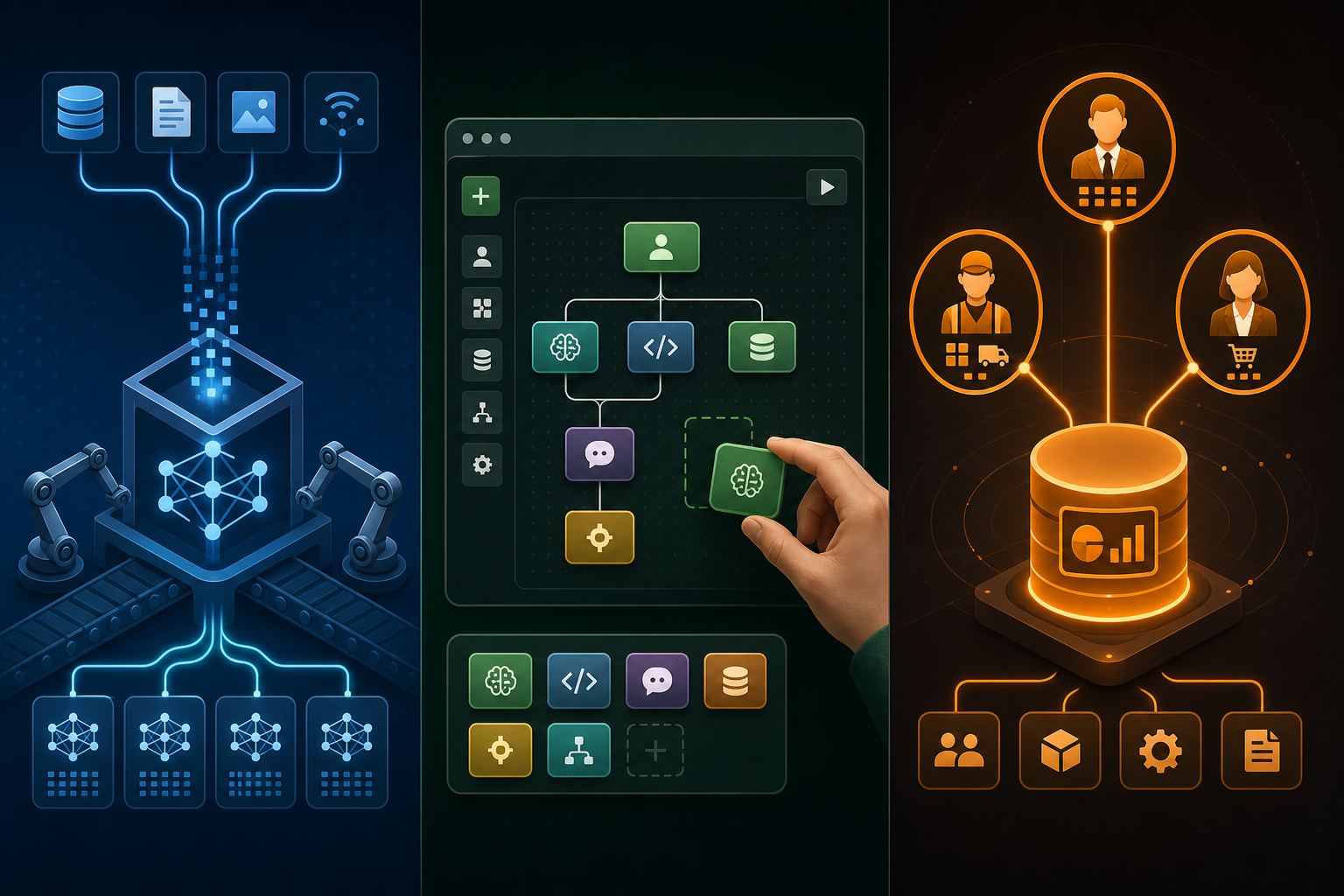
All three vendors are converging on agentic AI in 2026, but the delivery model, maturity level, and organizational fit of each approach differ substantially. The question is not which vendor has "more AI" — it is which AI delivery model matches the buyer's organizational AI maturity, IT governance model, and change management capacity.
Blue Yonder: Specialized Agents via NVIDIA Model Training Factory
Blue Yonder's agentic AI approach centers on building specialized AI agents through the NVIDIA Model Training Factory partnership. The premise is that supply chain AI agents require domain-specific training on supply chain data patterns — not general-purpose large language models — and that the NVIDIA partnership accelerates the development of those specialized models for autonomous supply chain decision-making.
Cognitive Solutions is the AI layer through which these agents surface in the platform, providing enhanced decision-making and productivity capabilities. The 20B+ daily predictions figure reflects the underlying AI infrastructure that these agents build on.
This approach is best suited for organizations that want vendor-built, domain-trained AI agents and are comfortable relying on the vendor's AI development roadmap rather than building their own agent configurations. It requires trust in Blue Yonder's AI model quality and roadmap execution.
Manhattan: User-Built Agents via No-Code Agent Foundry
Manhattan's Agent Foundry takes the opposite approach. Rather than delivering pre-built AI agents, it provides a no-code environment where supply chain teams design, build, and deploy their own agents using Manhattan's open APIs. The agents operate on top of the ActivePlatform's microservices architecture, which means they can be scoped to specific workflows — a replenishment exception agent, a carrier selection agent, a labor allocation agent — and updated independently without affecting other platform components.
The practical implication is significant: organizations that want to encode their own operational logic into AI agents, rather than adopting a vendor's interpretation of best practice, will find this model more flexible. Organizations that want a vendor to deliver ready-to-use AI capabilities without internal AI development capacity will find it requires more organizational investment.
Oracle: Pre-Built Role-Based Agentic Applications in Fusion UI
Oracle's 26B release represents the most immediately deployable agentic AI approach of the three. The agentic applications are built directly into the Fusion UI — no additional integrations, no separate AI platform, no agent configuration required. They are role-based: the Planning Stockout Advisor surfaces to planners, backlog diagnostics to order managers, fair-share allocation to supply planners, and the Design-to-Source workflow to procurement and product teams.
Specific 26B agentic capabilities include: the Planning Stockout Advisor (highlights high-value shortages and suggests resolutions), backlog diagnostics (identifies whether order delays are driven by materials, capacity, or supplier constraints), fair-share allocation (distributes limited supply across locations), AI agents for inventory exception management (including automated ASN creation from supplier emails), and a Design-to-Source workflow that moves from product design to supplier sourcing in a single agentic process.
For organizations already on Oracle Fusion ERP, this approach offers the lowest adoption friction of the three: the agents work within the existing UI, on the existing data model, without middleware or integration projects. For non-Oracle ERP organizations, the value of the embedded approach is partially offset by the integration overhead required to get supply chain data into Fusion in the first place.
| Dimension | Blue Yonder | Manhattan Active | Oracle Fusion Cloud SCM |
|---|---|---|---|
| Agentic AI model | Vendor-built specialized agents via NVIDIA Model Training Factory | User-built agents via no-code Agent Foundry | Pre-built role-based agentic apps in Fusion UI |
| Configuration required | Vendor-managed; buyer configures deployment parameters | Buyer designs and builds agents using open APIs and no-code tools | Minimal; agents are embedded in existing Fusion workflows |
| Integration required | Platform APIs; common data cloud | Open REST APIs; Google Cloud-native | None for Oracle ERP shops; significant for non-Oracle ERP |
| Best organizational fit | High AI maturity; trust in vendor AI roadmap; planning-heavy operations | High extensibility priority; internal AI/ops team capacity; custom workflow needs | Oracle ERP shops; broad functional scope needs; low integration overhead priority |
| 2026 release status | Announced 2026; verify GA status of specific features | Agent Foundry available; verify specific agent templates | 26B released May 2026; verify GA status of specific features |
Functional Coverage Matrix
The following matrix covers architectural positioning and coverage depth across major functional modules. It does not replicate the ML methodology analysis available in the dedicated WMS and planning comparisons linked above — the focus here is on how each module fits within the vendor's broader suite and what that means for buyers evaluating full-suite versus best-of-breed decisions.
| Module | Blue Yonder | Manhattan Active | Oracle Fusion Cloud SCM |
|---|---|---|---|
| Supply chain planning / demand management | Core strength; AI-driven demand sensing, IBP, S&OP; planning is the architectural center of the platform | Available but execution-first; planning capabilities are less mature than dedicated planning vendors | Gartner Leader in SCP for discrete and process industries; strong for manufacturing-integrated planning; ERP-native |
| WMS | Full-featured; integrated with planning via common data cloud; 2026 Gartner WMS Leader | Core strength; 18x Gartner WMS Leader; only cloud-native microservices WMS in Leader Quadrant | Gartner WMS Leader 11th consecutive year; ERP-native; strong for Oracle ERP shops |
| TMS | Full-featured; integrated with WMS and planning; Gartner TMS Leader | Gartner TMS Leader; cloud-native only vendor in Leader Quadrant; strong carrier and freight management | Gartner TMS Leader 19th time; highest Ability to Execute in 2026; broadest global carrier network support |
| OMS / order management | Available; integrated with planning and WMS | Core strength; Forrester OMS Wave Leader Q1 2025; unified with WMS and TMS on ActivePlatform | Full omnichannel OMS; native Fusion integration with finance and fulfillment |
| Procurement / source-to-pay | Limited native procurement; primarily integrates with third-party procurement systems | Not a core module; requires third-party procurement integration | Gartner S2P Suites Leader 2026; full source-to-pay native in Fusion; strongest of the three |
| Labor management | Available; workforce management module; rated best for labor management on SelectHub | Available; rated best for labor management on SelectHub | Available; task assignment aligned with employee availability and skills (26B) |
| Returns management | Dedicated returns management module | Available within unified execution suite | Available within Fusion order management |
| PLM / product lifecycle | Not a core module | Not a core module | Full PLM native in Fusion; Design-to-Source agentic workflow in 26B |
| Manufacturing integration | Integration via APIs; not a manufacturing system | Integration via APIs; not a manufacturing system | Full discrete, process, mixed-mode, project-driven, and contract manufacturing native in Fusion |
| Sustainability | Available | Not prominently featured | Native Fusion sustainability module |
ERP and Ecosystem Integration Fit
ERP ecosystem alignment is the single dimension most likely to determine total cost of ownership and implementation risk. It should be evaluated before any other selection criterion.
Oracle: Strongest for Oracle ERP Organizations
For organizations running Oracle Fusion ERP, Oracle SCM is the lowest-friction path to full-suite supply chain capability. The supply chain modules share the Fusion data model with finance, HR, and procurement. There is no integration project, no data synchronization architecture, and no middleware to maintain. The 26B agentic applications work directly on that shared data model.
For organizations on SAP, Microsoft Dynamics, or other ERP platforms, the picture changes substantially. Deploying Oracle SCM outside the Oracle Fusion ERP context requires building and maintaining the integration layer that the native architecture eliminates for Oracle shops. The functional breadth advantage can be partially offset by that integration complexity. User feedback notes that "the initial learning curve can be steep, and customization requires specialized expertise" — a signal that the platform rewards organizations with deep Oracle expertise.
Blue Yonder: ERP-Agnostic with Documented SAP Integration
Blue Yonder is designed to sit alongside existing ERP systems rather than replace them. The common data cloud architecture is intended to ingest data from SAP, Oracle, and other ERPs and provide AI-driven planning and execution on top of that foundation. For SAP-heavy organizations — which represent a significant share of the retail, CPG, and automotive verticals where Blue Yonder is strongest — this ERP-agnostic positioning is a genuine advantage.
The trade-off is implementation complexity. User feedback consistently surfaces that Blue Yonder "takes a long time to set up and needs constant support" and that customization is difficult. The common data cloud architecture requires a meaningful data integration investment to realize the unified AI model — organizations should plan for extended implementation timelines and budget for ongoing platform support.
Manhattan: ERP-Agnostic and Execution-First
Manhattan's API-first architecture is ERP-agnostic by design. The platform publishes thousands of REST endpoints and is built to integrate with any ERP through standard API patterns. The execution-first orientation means that most Manhattan deployments treat the ERP as the system of record for financial and master data while Manhattan owns the operational execution layer — WMS, TMS, OMS — above it.
The infrastructure alignment consideration that buyers often underestimate: Manhattan runs on Google Cloud. Organizations with existing AWS or Azure infrastructure commitments, or with enterprise agreements that create cost incentives for specific cloud providers, should factor Google Cloud alignment into the total cost of ownership analysis. This is not a disqualifying constraint for most buyers, but it is a real consideration that should appear in the infrastructure review.
| ERP Ecosystem | Blue Yonder fit | Manhattan Active fit | Oracle SCM fit |
|---|---|---|---|
| Oracle Fusion ERP | Moderate; ERP-agnostic, requires integration | Moderate; API-first, requires integration | Strongest; native Fusion, no middleware |
| SAP (S/4HANA or ECC) | Strong; documented SAP integration, retail/CPG depth | Good; API-first integration; no native SAP connector | Moderate; requires integration layer |
| Microsoft Dynamics | Moderate; connector ecosystem available | Moderate; API-first integration | Moderate; requires integration layer |
| Other / heterogeneous ERP | Good; ERP-agnostic design | Good; API-first design | Lower; Fusion-native advantage diminishes without Oracle ERP |
Gartner Magic Quadrant Positioning Summary, Q2 2026
All three vendors hold Gartner Magic Quadrant Leader positions as of Q2 2026. The following table summarizes the documented positions. MQ positioning should be treated as one input among many in vendor selection — it reflects Gartner's assessment of vision and execution capability at a point in time, not a ranking of fit for any specific buyer's requirements.
| MQ Report | Blue Yonder | Manhattan Active | Oracle Fusion Cloud SCM |
|---|---|---|---|
| Warehouse Management Systems (April 2026) | Leader | Leader (18th consecutive; 100% microservices cloud-native) | Leader (11th consecutive year) |
| Transportation Management Systems (March 2026) | Leader | Leader (cloud-native only vendor in Leader Quadrant) | Leader (19th time; highest Ability to Execute; furthest Completeness of Vision) |
| Supply Chain Planning — Discrete Industries (March 2026) | Leader | Not in Leader Quadrant | Leader |
| Supply Chain Planning — Process Industries (March 2026) | Leader | Not in Leader Quadrant | Leader |
| Source-to-Pay Suites (2026) | Not in Leader Quadrant | Not in Leader Quadrant | Leader |
| Forrester OMS Wave (Q1 2025) | Not cited | Leader | Not cited |
Ideal Buyer Profile for Each Vendor
No single vendor is the right answer without buyer-profile context. The following profiles are based on ERP ecosystem, vertical, operational emphasis, and AI maturity — not on overall platform quality.
Blue Yonder: Planning-Depth and Retail/CPG Vertical Fit
- Retail, consumer goods, automotive, or life sciences organizations with high-volume, high-SKU demand planning requirements.
- Organizations on SAP or operating in ERP-agnostic environments where a standalone supply chain platform sits alongside (rather than within) the ERP.
- Organizations that prioritize AI-driven planning depth — demand sensing, probabilistic forecasting, S&OP integration — as the primary value driver, with execution (WMS/TMS) as a secondary priority.
- Organizations with strong IT program management capacity and realistic multi-year implementation timelines; user feedback signals that Blue Yonder implementations are complex and require sustained support investment.
- Organizations willing to trust vendor-built AI agents rather than configuring their own — the NVIDIA Model Training Factory approach requires confidence in Blue Yonder's AI development roadmap.
Manhattan Active Supply Chain: Execution-First and High-Extensibility Fit
- Organizations that require best-in-class unified WMS, TMS, and OMS execution — particularly retailers, e-commerce fulfillment operations, and 3PLs where execution speed and operational agility are the primary competitive differentiators.
- Organizations with Google Cloud alignment or no strong infrastructure commitment to AWS or Azure.
- Organizations with internal operational technology or IT teams that can build and maintain custom AI agents via Agent Foundry — the no-code model is powerful but requires organizational capacity to use it effectively.
- Organizations that want to eliminate upgrade project cycles entirely — Manhattan's evergreen delivery is a genuine operational advantage for organizations that have historically spent significant IT budget on WMS upgrade programs.
- Organizations that do not require native procurement, PLM, or manufacturing integration within the supply chain platform.
Oracle Fusion Cloud SCM: Broadest Functional Scope and Oracle ERP Fit
- Organizations already running Oracle Fusion ERP or Oracle Cloud Infrastructure, where native integration eliminates middleware and the 26B agentic applications are immediately deployable.
- Organizations requiring the broadest functional footprint within a single vendor — particularly those that need manufacturing (discrete, process, mixed-mode), PLM, and source-to-pay procurement integrated with supply chain planning and execution.
- Organizations that want pre-built, role-based agentic AI without internal agent development capacity — Oracle's 26B approach requires the least organizational AI maturity to deploy.
- Global enterprises requiring multi-language, multi-currency, and multi-jurisdiction support within a single platform — Oracle's global reach and compliance framework is a genuine strength.
- Organizations with deep Oracle expertise in-house or with established Oracle implementation partners — the platform rewards Oracle-fluent organizations and creates steeper learning curves for those without that background.
Decision Framework: When to Choose Each Platform
The following questions are the primary discriminators. Working through them in order will narrow the shortlist before detailed vendor evaluation begins.
| Decision question | If the answer is... | Directional implication |
|---|---|---|
| What is the current ERP ecosystem? | Oracle Fusion ERP | Oracle SCM: native integration, lowest middleware cost |
| What is the current ERP ecosystem? | SAP or ERP-agnostic | Blue Yonder: documented SAP integration, planning depth; Manhattan: API-first, execution-first |
| What is the primary operational emphasis? | AI-driven planning, demand sensing, S&OP | Blue Yonder: planning is the architectural center |
| What is the primary operational emphasis? | Unified WMS/TMS/OMS execution agility | Manhattan: execution-first, evergreen, composable |
| What is the primary operational emphasis? | Broad functional scope including manufacturing, PLM, procurement | Oracle SCM: broadest native footprint |
| What is the agentic AI adoption strategy? | Deploy pre-built agents immediately, minimal configuration | Oracle 26B: role-based agents in Fusion UI, no integration required |
| What is the agentic AI adoption strategy? | Build custom agents configured to our workflows | Manhattan Agent Foundry: no-code, open API, user-built |
| What is the agentic AI adoption strategy? | Rely on vendor-built specialized AI agents | Blue Yonder Cognitive Solutions / NVIDIA Model Training Factory |
| What is the upgrade and change management tolerance? | Low tolerance for upgrade projects; want continuous delivery | Manhattan: evergreen, zero downtime updates |
| What is the infrastructure alignment? | Google Cloud preferred or agnostic | Manhattan: runs on Google Cloud |
| What is the infrastructure alignment? | Oracle Cloud Infrastructure preferred | Oracle SCM: OCI-native |
| Are manufacturing, PLM, and procurement integration required natively? | Yes, all three | Oracle SCM: only vendor with all three as native Fusion modules |
Pricing Context
Blue Yonder's publicly available starting price is approximately $100,000 annually for large enterprise deployments, per third-party analyst data. This is a floor estimate — it does not reflect total cost of ownership including implementation, integration, customization, and ongoing support, which for enterprise deployments typically exceeds license costs significantly.
Manhattan and Oracle are both custom-quote only. There is no publicly available pricing baseline for either vendor at enterprise scale. Buyers should seek vendor-specific quotes and request total cost of ownership modeling that includes implementation partner fees, integration development, training, and year-two-plus support costs — not just first-year license fees.
The Architectural Trade-Off Remains the Primary Discriminator
In 2026, all three vendors are capable of supporting enterprise supply chain operations at scale. The selection decision is not about which vendor is "best" in the abstract — it is about which architectural philosophy aligns with the buyer's ERP ecosystem, operational emphasis, and organizational capacity for implementation and ongoing change management.
Blue Yonder's common data cloud unifies AI across planning and execution — but requires a significant integration and setup investment to realize that unification. Manhattan's microservices evergreen architecture eliminates upgrade overhead and enables composable execution — but requires Google Cloud alignment and internal capacity to build custom agents. Oracle's ERP-native agentic suite delivers the broadest functional footprint and lowest adoption friction for Oracle shops — but creates meaningful overhead for organizations outside the Oracle ecosystem.
Buyers who shortlist based on feature parity will find all three vendors capable. Buyers who shortlist based on architectural fit to their operational profile and ERP ecosystem will make a more durable decision.
Comments
Join the discussion with an anonymous comment.