
The Alaska Airlines 787 logistics disruption starts with a simple planning problem that is rarely simple in execution: the aircraft assumed in the fleet plan are not available when the commercial schedule needs them. Boeing notified Alaska of delays affecting both 787-9 and 737 MAX deliveries, tightening the margin around a fleet transition that depends on new long-haul and narrowbody capacity arriving on time.[1] For an airline operations team, that does not stay inside a procurement file. It moves into route timing, spare aircraft coverage, crew readiness, maintenance intervals, and the small schedule compromises customers are never supposed to notice.
The 787 side is especially awkward because the upstream supply chain has not offered much slack. Forecast International reported that GEnx engine delays and premium seating bottlenecks contributed to 787 production slipping below 8 aircraft per month in Q1 2026, with delivery rates continuing to lag because Boeing lacked stored inventory to draw down.[2] That last point matters. If there is no parked buffer waiting to be delivered, a late production slot cannot be repaired by pulling forward a ready aircraft from storage.
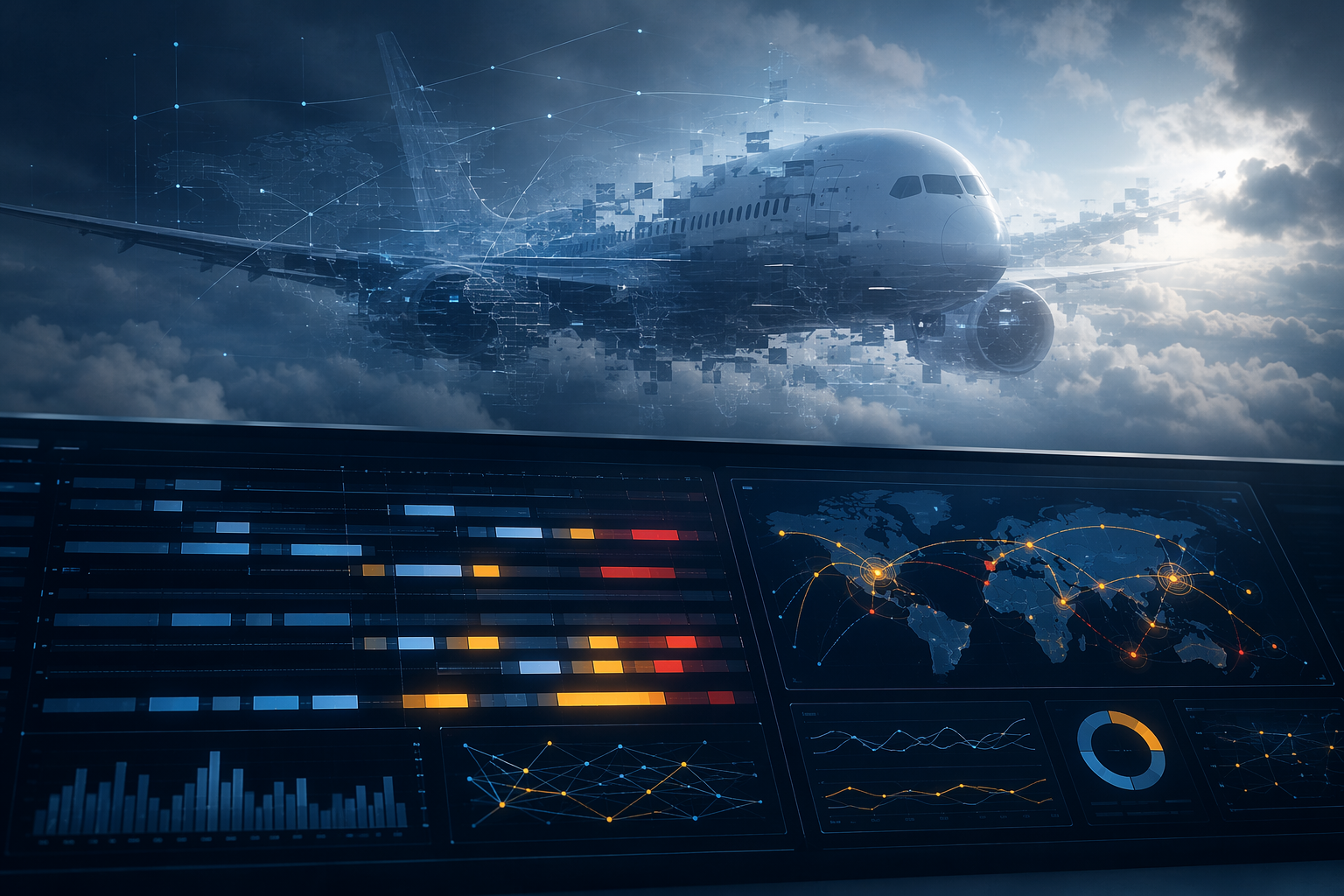
That is the useful entry point for AI in this case. Not AI as a boardroom promise, and not AI as a single platform that makes disruption disappear. The operational question is narrower: when the aircraft plan loses certainty, which decisions have to become faster, more explicit, and less dependent on intuition?
Where The Delivery Delay Actually Hits
A delayed 787-9 is not just a missing tail number. It can defer a route launch, force a different aircraft onto a mission it was not meant to cover, keep an older aircraft in service longer, or leave commercial teams selling a schedule whose operating assumptions are already eroding. A delayed 737 MAX can create similar pressure on domestic and connecting capacity, especially when aircraft rotations are built tightly around utilization.
The cascade usually spreads across four desks before the customer sees anything. Network planning has to decide whether the route still works with a substitute aircraft or a later start. Scheduling has to re-time flights without destroying revenue quality. Maintenance planning has to keep older or substitute aircraft legal, available, and positioned near the right facilities. Crew planning has to manage training and qualification assumptions that were tied to fleet availability.
Those desks do not fail because people lack spreadsheets. They fail because the constraint set changes faster than the planning cycle. An aircraft delay changes capacity. The capacity change changes the schedule. The schedule changes maintenance opportunities. Maintenance changes aircraft availability. Aircraft availability changes the schedule again.
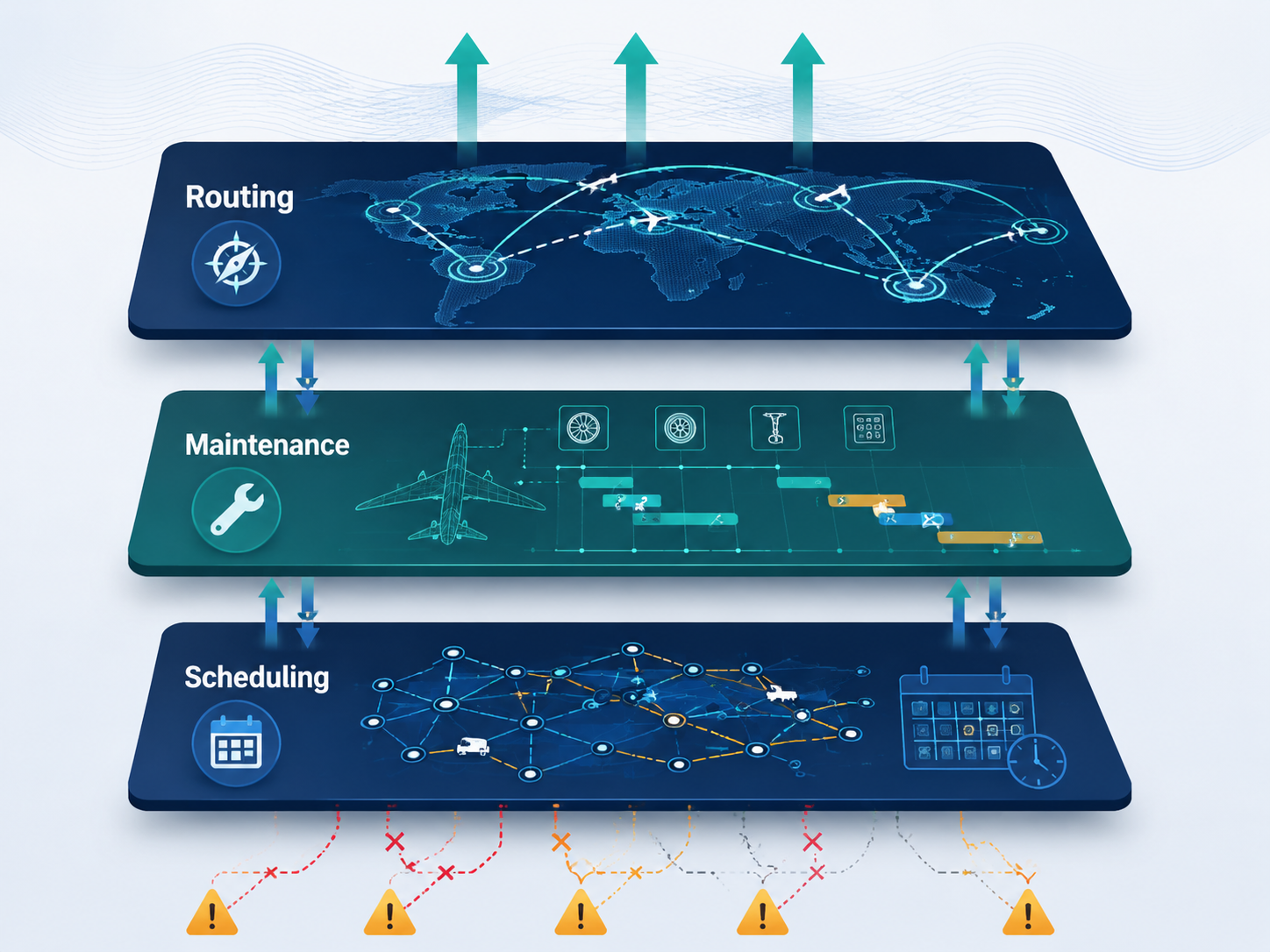
That is why Alaska's AI stack is more interesting as an operating pattern than as a technology announcement. Odysee addresses schedule economics, Tailsight addresses maintenance planning constraints, and Flyways addresses real-time routing efficiency. They were built with different partners and at different times, so treating them as one seamless platform would overstate the evidence. The stronger point is that each layer attacks a different place where OEM uncertainty turns into operational loss.
Scheduling Is Where A Capacity Gap Becomes Commercial Exposure
The first planning shock from a late aircraft is usually commercial. If the expected capacity is not there, the airline has to decide whether to delay a route, reduce frequency, change departure times, swap aircraft, or protect one market at the expense of another. These are not cosmetic moves. A departure that looks only slightly less convenient on a network map can change connections, fare mix, aircraft turns, and downstream utilization.
That is where Alaska's work with Odysee belongs. Alaska tested the AI scheduling tool on more than 700,000 historical flight segments, and the tool predicted revenue outcomes from schedule changes with 90% accuracy, according to a Simple Flying report citing UP.Labs CEO John Kuolt.[3] The same report said earlier human intuitive adjustments had caused double-digit margin declines on a single route after a one-hour schedule shift.[3]
The one-hour example is the useful part. It shows why airline schedule design is a fragile logistics problem, not just a demand-forecasting exercise. A small time shift can move a flight out of a profitable connection bank, expose it to stronger competition, reduce business traveler appeal, or create a poor aircraft turn later in the day. The operator still flies the route. The aircraft still leaves the gate. The damage appears in margin, reliability, or both.
For delivery-delay management, a tool like Odysee is valuable if it helps planners test substitution choices before those choices harden into the schedule. If a 787-9 arrival slips, the airline may need to ask which long-haul plan should be protected, which frequency should be deferred, and which departure time preserves the most revenue with the aircraft actually available. A model trained on historical schedule outcomes can make those tradeoffs visible earlier.
| Planning pressure | Decision that changes | Where AI can help |
|---|---|---|
| Delayed widebody delivery | Route start, aircraft assignment, frequency, departure time | Estimate revenue and margin impact of schedule alternatives |
| Delayed narrowbody delivery | Domestic capacity, connections, spare coverage, aircraft turns | Compare schedule changes before they create downstream reliability problems |
| Older aircraft kept in service longer | Maintenance windows, station positioning, spare aircraft assumptions | Expose conflicts between the commercial schedule and maintenance feasibility |
The caveat is important. The 90% figure came from historical testing against 2022-2023 data, and public reporting described Odysee as being tested in November 2024 with implementation expected in the first half of 2025.[3] The public record cited here does not confirm full production deployment or sustained live operating results. That does not make the scheduling evidence useless. It does mean the evidence supports tested predictive promise, not a completed transformation of Alaska's schedule-planning process.
Maintenance Planning Gets Harder When The Old Plan Has To Keep Flying
The maintenance burden of delivery delays is easy to understate from outside the operation. A missing new aircraft does not only reduce growth. It can extend the working life of aircraft that were expected to rotate out, raise the importance of overnight checks, and increase the number of times planners have to ask whether the right part, crew, station capability, and ground time will all be in the same place.
This is the part of the Alaska case that supply chain operators outside aviation should recognize immediately. The bottleneck is not one constraint. It is the collision between constraints. A maintenance planner may have a legal work package, an available aircraft, and a qualified technician, but still lose the plan because the aircraft arrives too late, the station cannot perform that task, or a required part is not positioned there.
Alaska became the first major airline to deploy Tailsight's AI maintenance planning platform in April 2026 after a two-year co-development and real-world validation process.[4] The platform connects maintenance systems, flight schedules, staffing, station capability rules, and parts availability into a constraint-aware planning environment intended to reduce aircraft-on-ground time.[4]
That description is more than vendor vocabulary. Maintenance planning is one of the places where delivery uncertainty becomes physical. If substitute aircraft cover longer than expected, utilization and check timing may drift away from the assumptions used when the annual plan was built. If a widebody arrival is deferred, the aircraft filling the gap may need tighter coordination around checks because there is less spare capacity to absorb a surprise grounding.
A constraint-aware maintenance environment helps if it stops planners from discovering conflicts too late. The useful output is not a prettier dashboard. It is an earlier warning that a schedule decision creates a maintenance miss, that a station lacks the rule authority or capability to perform planned work, or that parts availability does not support the aircraft rotation being proposed.
- Maintenance systems show what work is due and what has been deferred.
- Flight schedules show where the aircraft will actually be and how much ground time exists.
- Staffing data shows whether qualified labor is available during the window.
- Station rules show whether the work can be performed at that location.
- Parts availability shows whether the plan can be executed without waiting on material.
The evidence is still young. Tailsight launched in April 2026, and published ROI figures such as specific aircraft-on-ground reduction percentages are not yet available in the cited public sources.[4] That limits any claim about financial return. What can be said is narrower: the platform targets the right failure mode for delivery-delay conditions, because it joins the planning inputs that usually sit in separate systems until a disruption forces them together.
Routing Optimization Is The Mature Layer, But Not The Whole Answer
Flyways AI is the most mature production example in Alaska's stack, though it is less directly tied to Boeing delivery delays than scheduling or maintenance. Alaska has used the routing tool through its Airspace Intelligence partnership since 2021. In its first six months, Flyways saved 480,000 gallons of fuel and flagged routing improvements on 64% of flights, according to Alaska's newsroom.[5]
Those numbers matter because they are operating results, not a backtest. The tool reviews flight routing options and recommends more efficient paths when conditions support a change. In normal conditions, that creates fuel and efficiency gains. Under fleet stress, the benefit is more modest but still useful: better routing can protect block time, reduce fuel burn, and improve the odds that a tight aircraft rotation survives the day.
Still, fuel savings do not solve a missing aircraft. A routing engine cannot create a 787-9 seat map, open a maintenance bay, or train a crew. Its role is to reduce avoidable inefficiency once the schedule and aircraft assignment exist. That makes Flyways a proven operational layer, not the central answer to OEM delivery uncertainty.
The Real Integration Problem Is Organizational
The harder problem for airlines is that schedule, maintenance, routing, and crew decisions often sit in different planning rhythms. Industry research from OAG and Microsoft points to AI and trusted data as tools for building more resilient airline operations, and cites an IATA finding that 63% of airlines struggle with operational silos.[6] That statistic explains why delivery delays are so punishing: the first bad assumption may come from the OEM, but the losses multiply when internal functions respond separately.
For a supply chain operator evaluating the Alaska example, the lesson is not to copy the exact vendors. The transferable pattern is the division of work. Scheduling AI tests the commercial consequences of capacity choices. Maintenance AI tests whether the resulting aircraft plan can physically hold. Routing AI removes some waste from the operation once the aircraft is flying.
That separation also keeps the ROI conversation honest. Odysee has a large historical test and a striking margin-risk example, but the available public evidence does not establish long-running production impact. Tailsight is operationally well aimed at the delivery-delay problem, but it is too new for published ROI. Flyways has the strongest production outcome evidence, but its direct connection to OEM delivery disruption is weaker.
| Tool | Operational layer | Evidence maturity | Best-supported claim |
|---|---|---|---|
| Odysee | Schedule planning and revenue impact prediction | Historical testing reported publicly | Can evaluate schedule-change outcomes with reported 90% accuracy in tested historical data |
| Tailsight | Maintenance planning and AOG reduction | Launched April 2026 after co-development and validation | Connects maintenance, schedule, staffing, station, and parts constraints in one planning environment |
| Flyways AI | Real-time route optimization | Production operating results since 2021 | Saved 480,000 gallons in six months and flagged improvements on 64% of flights |
That uneven proof is not a weakness in the story. It is exactly how these systems usually mature. Routing decisions produce measurable fuel outcomes quickly. Schedule quality takes longer to validate because revenue, competitive conditions, and fleet availability all move together. Maintenance ROI takes longer still because avoided disruptions are harder to count than gallons saved.
What Alaska's Case Supports
Alaska's response to Boeing delivery delays supports a bounded but useful conclusion: AI can help absorb aircraft delivery uncertainty when it makes operational constraints visible across planning functions. It does not remove the need for aircraft. It does not turn a delayed 787-9 into equivalent capacity somewhere else in the system. It helps the airline make fewer blind substitutions while the fleet plan is moving underneath the schedule.
The strongest case for AI in the Alaska Airlines 787 logistics disruption is not a single application. It is the stack logic. Schedule decisions need revenue prediction before capacity changes are published. Maintenance plans need constraint checks before aircraft rotations become impossible. Routing decisions need real-time optimization after the aircraft is airborne. These layers do different work, and the evidence behind each layer should be judged separately.
For airline and fleet logistics leaders, the implementation lesson is practical: integration across planning functions matters more than buying something labeled as an AI platform. The useful question is not whether the model is impressive in isolation. It is whether the scheduler, maintenance planner, router, and operations controller are working from constraints that match the aircraft reality they have on Tuesday morning.
References
- Boeing Notifies Alaska Airlines Of 737 MAX & 787-9 Delivery Delays — Simple Flying
- 787 Instability Threatens Program's Ramp-Up Timeline — Forecast International
- Alaska Airlines Tests AI Scheduling Tool — Simple Flying
- Alaska Airlines and Tailsight launch AI-powered maintenance planning solution — PRNewswire, April 2026
- Alaska Airlines and Airspace Intelligence announce first-of-its-kind partnership — Alaska Airlines Newsroom
- AI and Trusted Data: Building Resilient Airline Operations — OAG
Comments
Join the discussion with an anonymous comment.