
By the time wildfire smoke is visible on a dock camera, a yard gate, or a regional traffic map, the planning calendar has already lost its cheapest options. Purchase orders are in motion. Carrier capacity has been awarded. Distribution center labor schedules are posted. The practical question for supply chain planning is not whether a model can name the exact fire that will interrupt a lane. It is whether the forecast arrives early enough to change a sourcing decision, an inventory placement, a route agreement, or a workforce contingency before those choices harden.
That is why seasonal wildfire forecasting matters. Per-person U.S. wildfire smoke exposure was four times higher in 2020–2024 than in 2006–2019, and every county in the contiguous United States now experiences at least 16 smoke days per year, according to analysis cited by Climate Central from Stanford ECHOLab data.[1] Smoke is no longer a Western exception that only certain regional planners need to bookmark. It has become a recurring operating condition for networks that move goods across ports, highways, rail ramps, warehouses, and stores.
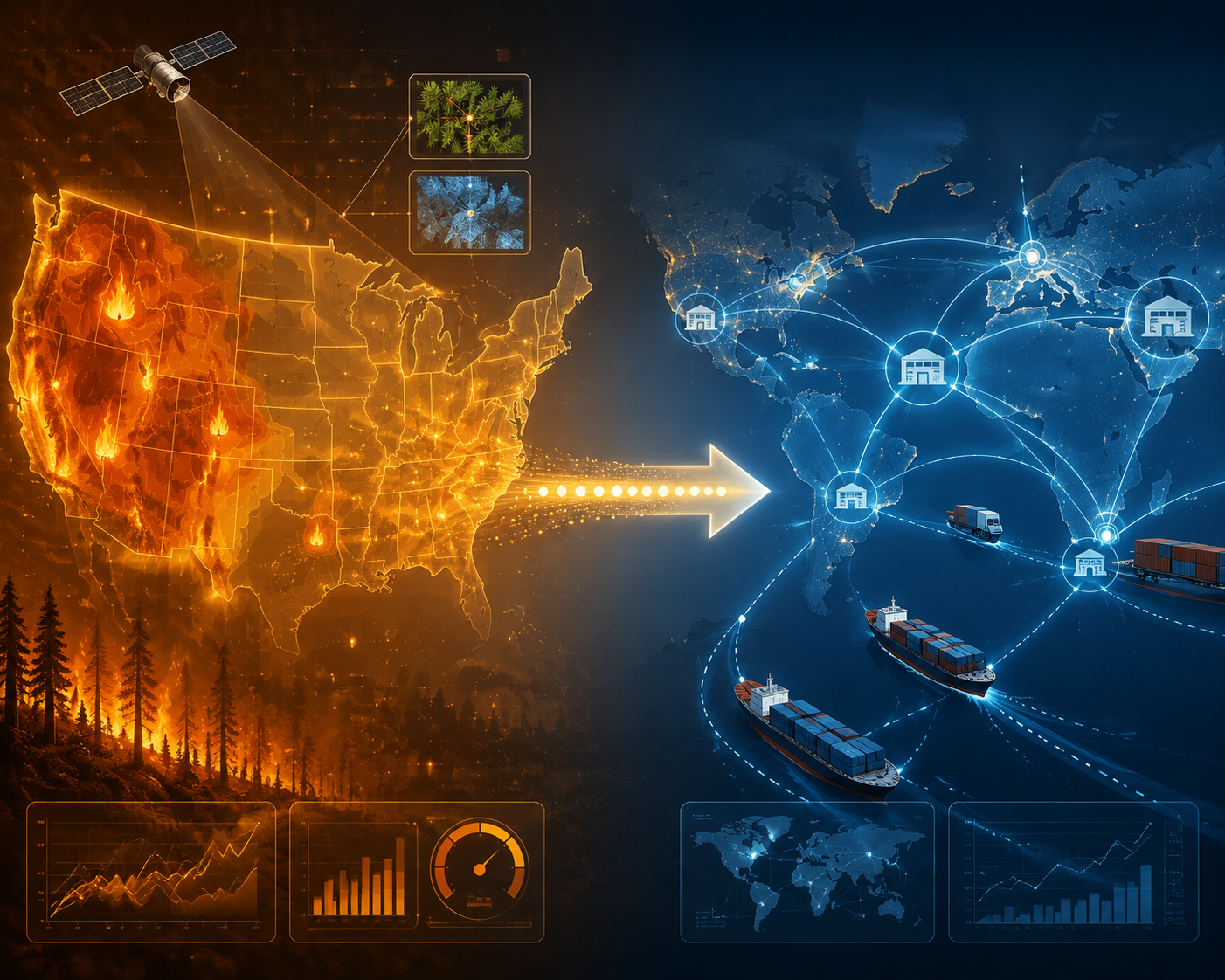
The useful promise of AI here is not event certainty. Seasonal wildfire forecasting can identify elevated ignition-risk conditions one to three months before ignition by combining weather forecasts, satellite vegetation observations, fuel moisture information, and physics-informed machine learning, according to ClimateAi.[2] That lead time is not a headline prediction. It is a planning input.
The Forecast Has To Arrive Before The Network Is Locked
Supply chain teams do not need seasonal wildfire models to tell them that smoke is bad for logistics. They need the signal while there is still time to do something dull and expensive: move inventory earlier, qualify a second source, reserve a different lane, change a temporary labor plan, or pre-approve an exception path for customer allocations.
A one-to-three-month window lands in a useful part of the S&OP cycle. It is long enough to influence supply review and inventory deployment, but close enough to the season that the signal can be tied to specific regions, categories, and logistics corridors. That is the difference between climate awareness and planning leverage.
The first operational move is to translate the seasonal signal into exposure. A forecast of elevated ignition conditions near a mountain region is not automatically a supply chain problem. It becomes one when the affected area overlaps with a critical supplier, a constrained transportation corridor, a port labor pool, a rail connection, a DC catchment area, or a customer market with little substitute capacity.
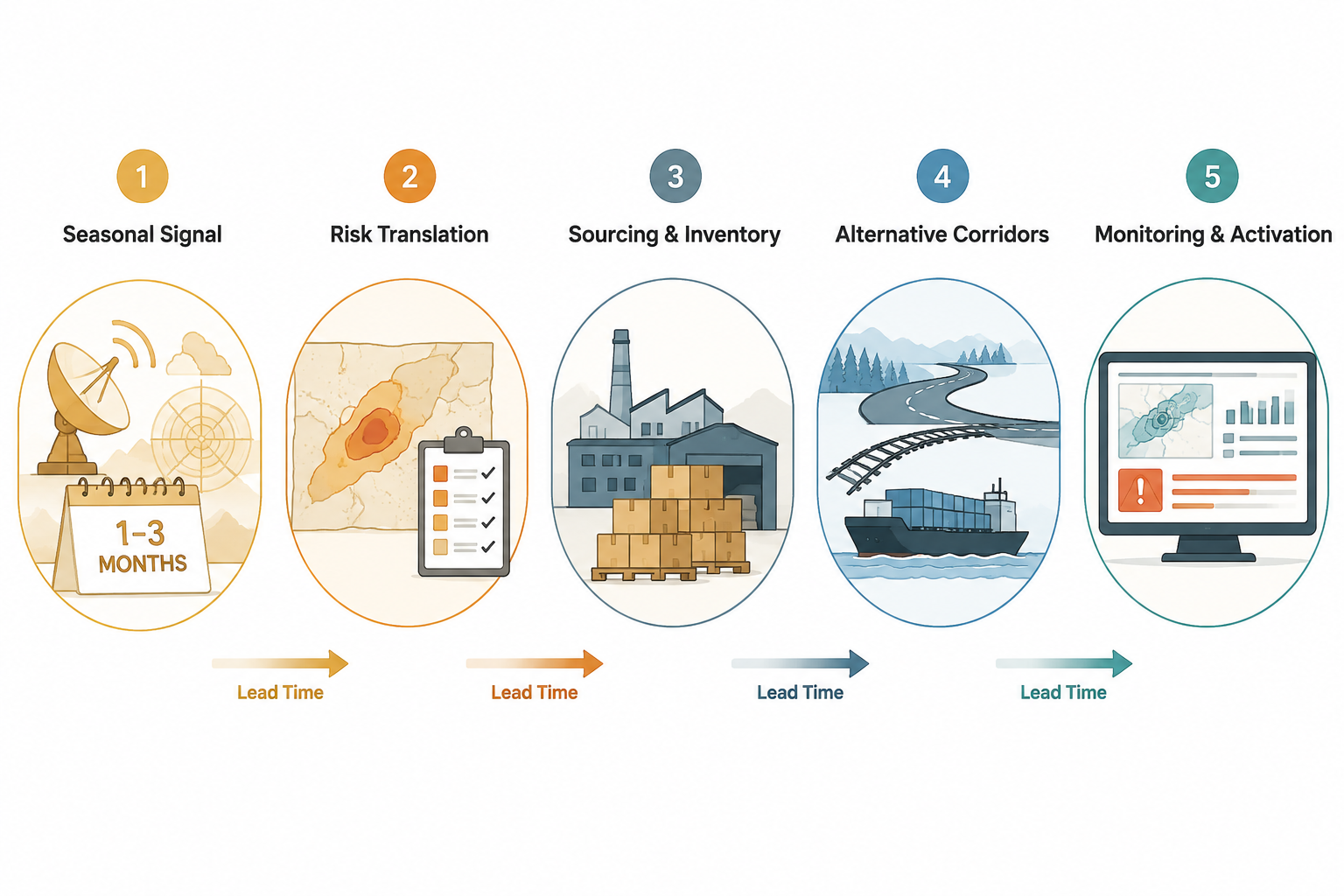
| Planning layer | What the forecast changes | Decision owner |
|---|---|---|
| Seasonal signal | Identifies regions with elevated ignition-risk conditions one to three months ahead | Planning, risk, procurement |
| Risk translation | Maps wildfire and smoke exposure to suppliers, lanes, ports, DCs, and labor pools | Supply chain intelligence, S&OP |
| Sourcing and inventory | Adjusts purchase timing, safety stock, substitute sources, and allocation rules | Procurement, supply planning, demand planning |
| Alternative corridors | Secures carrier options, port routings, intermodal alternatives, and exception playbooks | Logistics, transportation procurement |
| Monitoring and activation | Uses shorter-term fire, smoke, air quality, and road signals to trigger the pre-approved plan | Control tower, logistics operations, regional management |
This sequence matters because the seasonal forecast is not the activation trigger by itself. It is the reason the activation trigger exists before the smoke arrives.
Seasonal Forecasting Is Not Real-Time Detection
The fastest way to make seasonal AI forecasting useless inside a company is to sell it as a crystal ball. A seasonal model does not tell an operations manager that a specific warehouse will be under smoke on a specific Tuesday. It assesses whether the ingredients for ignition risk are becoming more favorable across a region: vegetation condition, fuel moisture, weather patterns, and related climate signals.[2]
That distinction protects the planner as much as the model. Seasonal forecasting supports pre-season decisions that tolerate uncertainty: whether to carry more inventory in an alternate DC, whether to split a supplier award, whether to secure optional truckload capacity, whether to pre-negotiate an intermodal fallback, or whether to create a smoke-day labor protocol. It should not be used as the sole basis for shutting a facility, rerouting all freight, or promising a customer that a disruption will occur.
Real-time detection and monitoring still matter. Once the season is underway, teams need current information on active fires, smoke movement, air quality, road closures, labor availability, and carrier performance. The seasonal layer expands the decision window; the short-term layer decides when the prepared plan goes live.
What One To Three Months Of Warning Actually Buys
The most important use of an early wildfire-risk signal is not a dashboard view. It is a calendar of commitments. Every week before the season starts gives planners a different class of option.
Sourcing: Reduce Dependence Before Expedites Begin
If a seasonal outlook flags elevated risk around a supplier cluster, the sourcing question is not simply whether that supplier might burn. Smoke can disrupt labor, roads, parcel handoffs, inspection visits, and outbound shipping even when the plant remains intact. A procurement team can use the signal to review single-source exposure, advance purchase timing for constrained materials, or qualify limited backup capacity before every buyer in the region starts making the same calls.
The discipline is to make the action proportional. A forecast of elevated conditions may justify shifting a portion of volume, not abandoning a supplier. It may justify earlier confirmation of production slots, not panic-buying. The point is to reduce the number of decisions that must be made under smoke-day pressure.
Inventory: Move Stock Before Capacity Gets Scarce
Inventory positioning is where seasonal lead time becomes visible on a balance sheet. If a region is likely to face elevated wildfire and smoke risk, planners can decide whether critical SKUs should be pulled forward into a less exposed DC, whether customer allocations need pre-approved rules, and whether slow-moving stock should be kept out of a facility that could become hard to operate during poor air quality.
This is not a generic argument for more safety stock. It is a case for placing the right buffer where it protects the service promise. Extra units sitting behind the same vulnerable road network do not add much resilience. A smaller buffer placed outside the smoke-prone corridor can be more useful than a larger one trapped inside it.
Logistics: Buy Optionality While It Is Still Affordable
Transportation teams usually pay for late uncertainty. If smoke closes roads, slows port labor, or pushes shipments into different lanes, spot decisions arrive at the worst moment. A seasonal forecast gives logistics teams a reason to negotiate optional capacity before the market feels the disruption.
That may mean identifying carriers willing to serve an alternate corridor, testing whether a shipment can move through a different port pair, pre-clearing rail or truckload substitutions, or setting demurrage escalation rules for containers at risk of sitting longer than planned. None of those decisions requires certainty about a specific fire. They require enough evidence that the cost of doing nothing is no longer negligible.
Workforce: Treat Smoke As An Operating Constraint
Smoke affects throughput through people. Warehouse employees, drivers, port workers, field technicians, and store teams may be unable or unwilling to work normal shifts when air quality deteriorates. Everstream Analytics identifies wildfire smoke delivery delays, worker health disruptions, and road closures among supply chain risks for 2026.[3]
A useful pre-season plan therefore includes labor thresholds, not just freight rules. Who decides whether an outdoor task stops? Which shifts need backup coverage? Which customers receive proactive communication if regional staffing falls below plan? Those answers are easier to set in June than during a week when managers are also dealing with late trucks and absenteeism.
The Port Disruption Is Often Smoke, Not Flame
The January 2025 Los Angeles wildfires show why planners should treat smoke as a logistics variable even when the fire perimeter is not touching a port, warehouse, or highway. Reporting from Profreight described poor air quality causing dockworker call-outs, which contributed to longer container dwell times and demurrage fees at the Ports of Los Angeles and Long Beach.[4] GoComet also described wildfire-related disruption to California supply chains and noted the importance of the LA and Long Beach port complex, which handles about 40% of U.S. imports.[5]
The operational chain is plain enough. Smoke reduces labor availability. Reduced labor slows container handling. Slower handling increases dwell time. Dwell time can turn into demurrage and missed downstream appointments. A retailer waiting on import containers does not need flames at the DC to miss a delivery window.
The same season also produced large economic loss figures. Munich Re data cited by UNDRR put 2025 Los Angeles wildfire economic losses at $53 billion, and UNDRR also cited 390 million hectares burned globally.[6] Those numbers are useful context, but the planning lesson is more specific: smoke can create cost and service failures through labor and logistics chokepoints before asset damage becomes the main issue.
The Clearest Pre-Positioning Case Comes From A Hurricane
The strongest available example of AI climate forecasting turning lead time into inventory value is not a wildfire case. It is a hurricane case, and that caveat matters.
ClimateAi describes a leading roofing manufacturer that used AI climate forecasting to anticipate Hurricane Ian weeks in advance, adjust supply timing, and pre-position inventory, resulting in $15 million in additional sales.[7] The case does not prove that the same revenue outcome will occur during wildfire season. It does show the commercial logic of acting on an early climate-risk signal before demand and logistics conditions tighten.
For wildfire smoke planning, the analogous move is not necessarily to flood a region with stock. It is to decide, before the season, which products must be available outside the highest-risk corridor, which customers will be protected first, and which transportation options are worth reserving. The upside may appear as revenue captured, service levels protected, expedite costs avoided, or demurrage exposure reduced. The exact benefit depends on the network.
Where Emerging Models Fit
NASA’s Wildfire Digital Twin points to where the field is heading. The prototype combines AI models and streaming data techniques to forecast fire and smoke, but it remains an emerging capability rather than a commercially available planning system that a supply chain team can simply connect to an ERP or transportation platform today.[8]
That maturity boundary is important. A planning team can start using seasonal wildfire intelligence without pretending the technology stack is finished. The near-term value comes from connecting available seasonal risk signals to existing planning routines: supply review, inventory deployment, transportation procurement, control-tower monitoring, and regional operating playbooks.
The more advanced digital-twin vision is attractive because it suggests a future in which seasonal risk, live fire behavior, smoke transport, inventory status, order priority, and transportation capacity can be evaluated together. But for current planning work, the safer implementation question is simpler: which decisions become better if the team receives a credible elevated-risk signal one to three months earlier?
A Practical Deployment Pattern
A supply chain team does not need to reorganize around wildfire models. It needs to place the forecast into the planning meetings where commitments are made.
- Before the season, define the exposed nodes: suppliers, DCs, ports, ramps, lanes, customer regions, and labor pools that would create meaningful service or cost risk if smoke reduced throughput.
- When the seasonal signal arrives, translate elevated ignition risk into business exposure instead of circulating a climate map without owners.
- In supply review, decide which materials need earlier buys, substitute sources, or adjusted allocation rules.
- In inventory planning, move only the stock that protects critical service promises or constrained demand.
- In transportation planning, secure alternate corridors and escalation rules before smoke affects capacity and labor.
- During the season, activate the plan through shorter-term fire, smoke, air quality, road, labor, and carrier signals.
The weakest version of this process is a dashboard that shows risk and leaves every function to interpret it separately. The stronger version assigns a decision to each threshold. A high-risk seasonal outlook might trigger a sourcing review. A worsening short-term smoke forecast might trigger a labor protocol. A road closure might trigger a pre-approved carrier shift. The value is in the handoff between signals and decisions.
AI seasonal wildfire forecasting should not replace real-time monitoring, and it should not be presented internally as event-level prediction. Its useful role is narrower and more operational: it gives supply chain teams a pre-season decision layer. Wildfire smoke becomes manageable only when that layer is connected to sourcing rules, inventory placement, route agreements, workforce contingencies, and activation thresholds before the season starts.
References
- Climate Change Worsens Wildfire Smoke 2025, Climate Central
- Forecasting Wildfire Risks, ClimateAi
- Are You Prepared for the Supply Chain Disruptions of 2026?, Everstream Analytics
- Wildfires Disrupt Los Angeles Ports: A Freight Forwarding Nightmare, Profreight
- California Wildfires Impact on Supply Chain, GoComet
- The Invisible Costs of Wildfire Disasters in 2025, UNDRR
- Climate Risk and Supply Chain Risk Mapping, ClimateAi
- NASA Wildfire Digital Twin Pioneers New AI Models and Streaming Data Techniques for Forecasting Fire and Smoke, NASA
Comments
Join the discussion with an anonymous comment.