
§ 41 — Use-case analysis
How AI Wildfire Detection Reshapes Supply Chain Risk Response
Supply chain leaders need to know if AI wildfire detection platforms actually shorten the time between ignition and protective action. Evidence from the 2025-2026 fire seasons shows measurable gains, but key metrics come from vendor-adjacent sources and the GAO warns inaccurate outputs can endanger property.
- Function
- risk management
- AI technique
- computer vision
- Failure pattern
- inaccurate outputs
- Evidence source
- Brown & Brown (2025), GAO (2025)
By late July 2026, California had already recorded 3,838 wildfires and 195,439 acres burned for the year, with the Biscar Fire alone listed at 69,355 acres and 89% contained as of July 22.[1] For a logistics control tower, that is not a seasonal backdrop. It is the operating environment in which a routing decision, warehouse staffing call, or expedited freight approval may depend on whether wildfire live updates arrive early enough to act on them.
The buying question is narrower than “does AI detect fires?” A detection that lands after a highway closure is already visible in public feeds may still be useful, but it is not a head-start. The practical test is whether AI monitoring shortens the interval between ignition, alert, logistics assessment, and protective action.
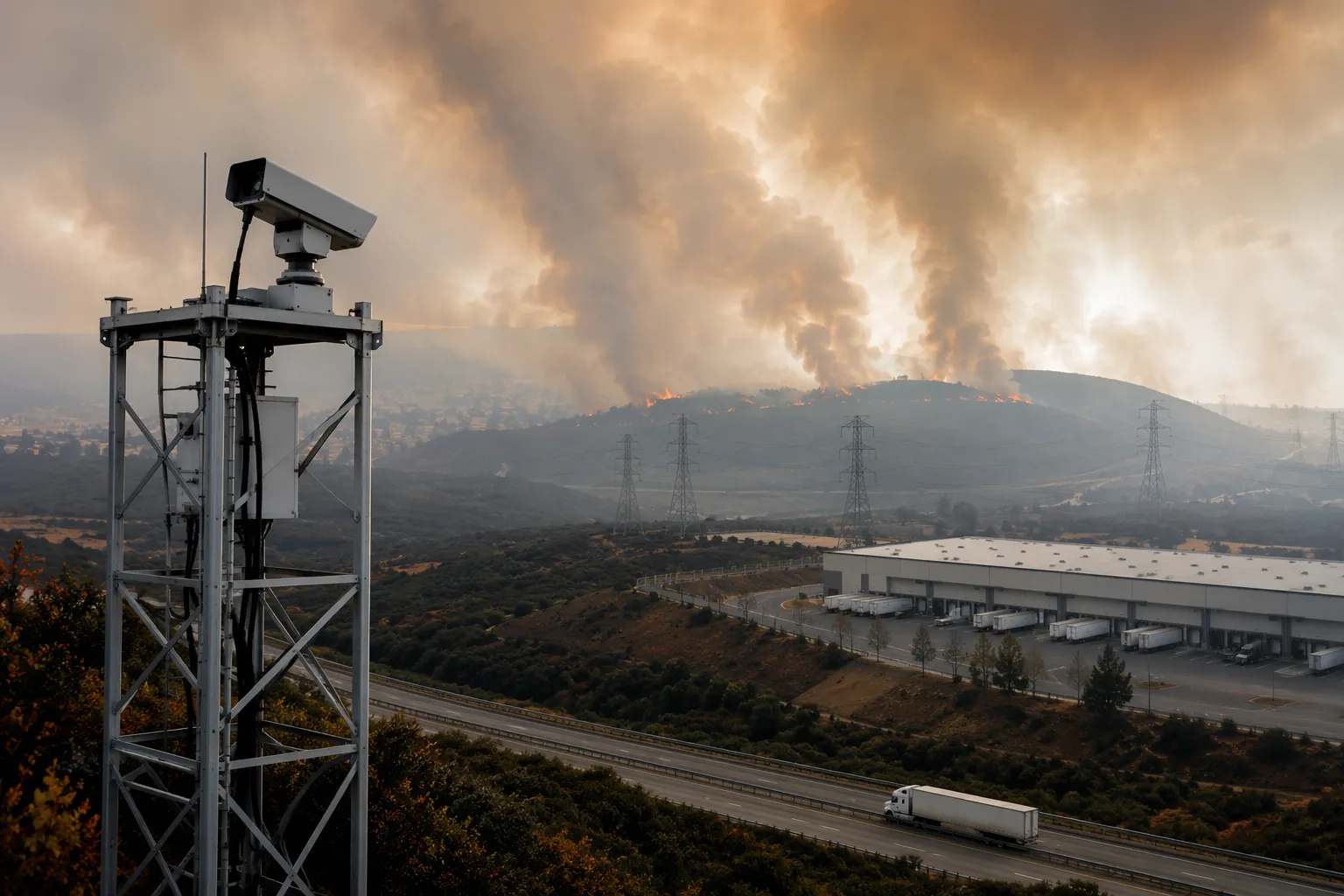
The 21-Minute Claim That Actually Matters
The most operationally useful claim in the current evidence set is Pano AI’s Wellington Fire example: its system reportedly delivered an alert 21 minutes before official dispatch.[2] The source is not neutral. It comes from a May 2025 Brown & Brown article co-authored with Pano AI’s chief commercial officer, so it should be treated as vendor-adjacent evidence rather than independently audited performance data.[2] Still, the claim is specific enough to examine.
Twenty-one minutes is not a magic number. It is barely enough time for a committee and plenty of time for an operations desk. A transportation lead can hold a truck at origin instead of releasing it toward a threatened corridor. A planner can check whether inbound inventory has a second viable lane. A DC manager can start watching smoke, power, and labor exposure before the problem turns into a customer-facing miss. A risk analyst can timestamp the alert and compare it with dispatch records, closure notices, tender changes, and later freight spend.
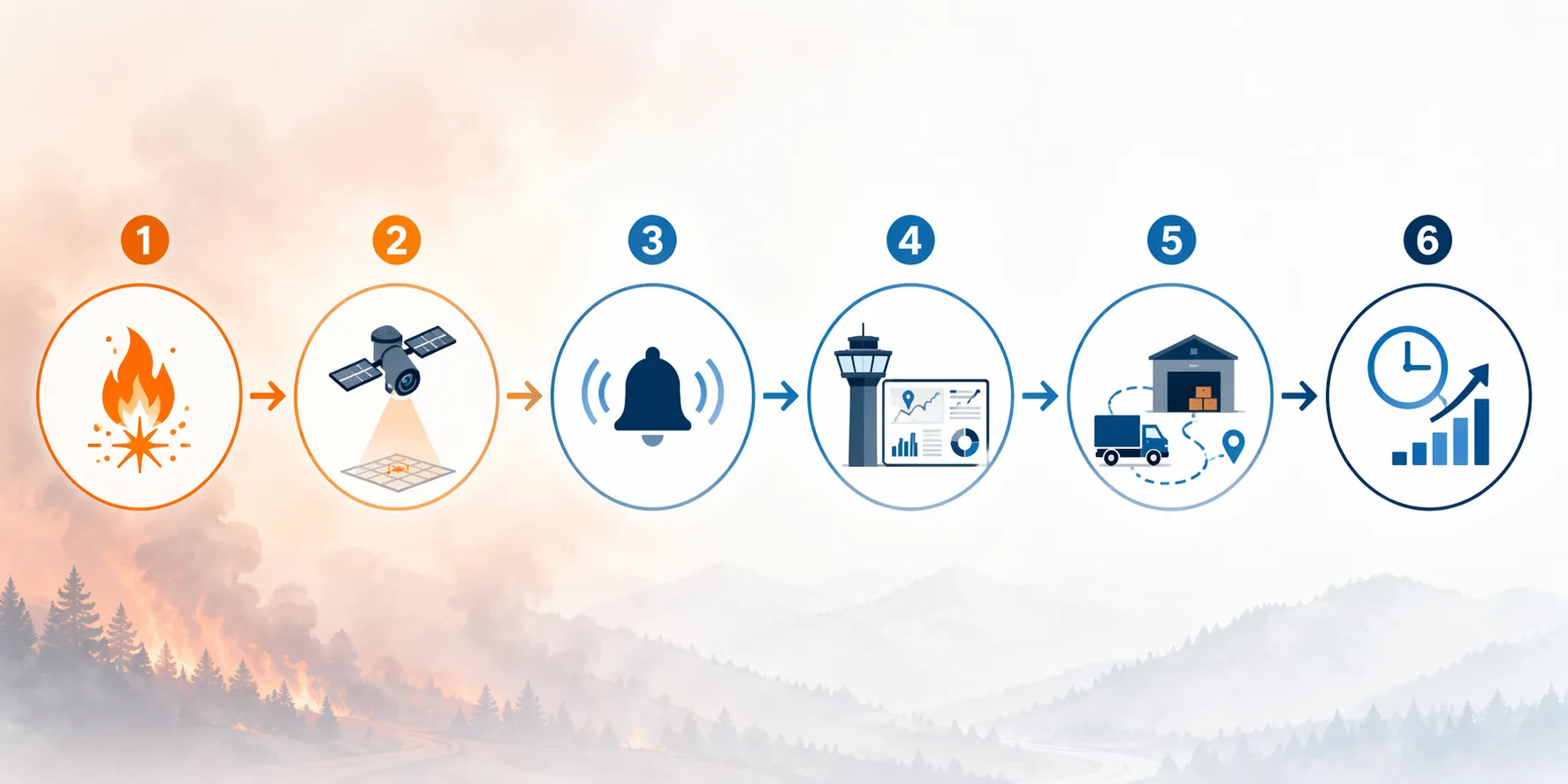
That last step is where many wildfire AI claims become thin. The alert itself is only the first handoff. For supply chain teams, the valuable record is the chain of custody: fire indication, AI detection, alert recipient, assessment, action, and measurable consequence. If the Wellington Fire alert reached a person or system with authority to change logistics behavior before official dispatch, it is the kind of head-start teams are trying to buy. If it sat in a separate dashboard until after operations already learned about the incident elsewhere, the value is smaller.
The same source says Pano AI detected more than 100 early-stage fires during the 2024 season.[2] That scale claim is useful context, but it does less work than the Wellington timing claim because “detected” does not by itself show whether a shipper rerouted, a carrier was warned, or a facility avoided a cost. For procurement, one dated incident with response timestamps can be more persuasive than a larger undifferentiated detection count.
Where Satellite Scale Helps, And Where It Does Not Yet Prove Action
OroraTech sits at a different point in the evidence chain. The company describes a platform using 14 low-Earth-orbit satellites fused with more than 35 data sources to monitor more than 500 million hectares, with near-real-time hotspot detection and fire-spread prediction capability.[3] For a multinational shipper, that scale matters because wildfire exposure rarely respects the neat boundaries of one county feed, one utility service territory, or one transportation mode.
The logistics value of satellite monitoring is coverage. A shipper with suppliers, ports, rail interchanges, and inland DCs spread across fire-prone regions needs detection that does not depend only on a fixed camera sightline. Satellite-derived hotspots can also help teams watch remote areas where a disruption may reach a lane before it reaches a facility.
But coverage is not the same as verified business impact. Hectares monitored, satellite count, and fused data sources describe capability. They do not show whether a logistics team received an alert earlier than it would have through public or agency channels, or whether that alert reduced dwell, prevented a missed appointment, or lowered premium freight. OroraTech’s scale belongs in an evaluation, but it should not be read as proof of supply chain ROI by itself.
Research Targets Are Not Field Metrics
USC’s Information Sciences Institute adds a useful benchmark for where satellite AI research is trying to go. A March 2025 USC Viterbi article describes work targeting a 95% wildfire detection rate with 0.1% false alarms.[4] Those numbers are worth noting because false alarms matter in logistics. A false positive can trigger unnecessary rerouting, extra linehaul miles, inventory movement, or facility disruption.
The boundary is just as important as the ambition. The USC figures are research targets, not deployed performance metrics for a commercial control-tower integration.[4] They should shape questions for vendors — detection rate against what baseline, false alarms over what geography, and latency measured from what timestamp — rather than be treated as proof that the current market has already reached those levels.
The Supply Chain Metrics Start With Assessment Speed
Everstream Analytics brings the discussion closer to the CFO and CIO case because its claims are framed around disruption management rather than detection infrastructure. In a vendor blog, Everstream says clients reported 50–70% faster disruption impact assessment and a 5% reduction in expedited freight costs.[5] Those are the numbers a supply chain leader can take into a budget conversation, provided they are labeled correctly.
A 50–70% faster assessment can matter even when the fire alert itself is only minutes earlier. In many organizations, the slower step is not seeing that an incident exists. It is translating that incident into affected SKUs, suppliers, purchase orders, carrier appointments, warehouse shifts, customer commitments, and cost exposure. If AI monitoring compresses that assessment window, it changes who gets called first and whether the team still has options besides expediting.
The 5% expedited freight reduction is the more financially legible claim.[5] Premium freight is where a delayed wildfire response often becomes visible after the fact: a lane is closed, a shipment misses its planned route, inventory needs to move faster, and the budget absorbs the difference. For a deeper treatment of how teams frame those savings, The ROI of AI Wildfire Forecasting for Supply Chains is the natural adjacent analysis.
The caveat is not a footnote. Everstream’s figures are client-reported in Everstream’s own article, which means the sample is likely shaped by who chose to report results and what outcomes were publishable.[5] The numbers are still useful as directional evidence. They are not yet the same as an independent benchmark across shippers, seasons, geographies, and freight profiles.
What A Logistics Team Should Verify In Its Own Pilot
The Government Accountability Office’s June 2025 wildfire technology report provides the right external check on the market’s claims. GAO found that AI tools can speed up forecasting data assimilation and flag inaccuracies in forecasts, but it also warned that AI-generated outputs may convey inaccurate information that could endanger life and property.[6] That is the correct tension for procurement: useful acceleration, real risk, and no excuse for blind automation.
A serious pilot should therefore measure the detection-to-action chain, not just dashboard activity. The team should define the facilities, lanes, suppliers, and customer commitments in scope before fire season. It should preserve timestamps from AI alerts, agency dispatches, public incident feeds, internal risk reviews, transportation management system changes, carrier communications, and freight invoices. Without that record, the team will be left arguing from vendor case studies when finance asks what changed.
| Pilot Evidence | Why It Matters |
|---|---|
| AI alert timestamp compared with official dispatch or agency update | Shows whether the system created a true head-start or only duplicated known information |
| Named alert recipient and escalation path | Shows whether the signal reached someone who could change a logistics decision |
| Affected lanes, facilities, SKUs, suppliers, or customer orders | Connects the fire signal to actual supply chain exposure |
| Protective action timestamp | Separates awareness from action, such as holding a truck, rerouting, repositioning inventory, or adjusting staffing |
| Cost and service outcome | Tests whether the action reduced premium freight, avoided delay, protected labor, or simply added noise |
That framework also keeps secondary disruption from being treated as an afterthought. Smoke can affect trucking visibility, outdoor work, warehouse ventilation decisions, and labor availability even when flames are not at the dock door. Teams that need to extend the same evidence discipline to smoke exposure can connect this evaluation with Why Logistics Needs AI for Wildfire Smoke Risk and How AI Protects Supply Chain Workers from Wildfire Smoke.
The current evidence supports a careful yes. AI wildfire detection and monitoring appear capable of giving logistics teams earlier alerts and faster disruption assessments. Pano AI’s Wellington Fire timing claim is the clearest incident-level example; OroraTech shows why wide-area monitoring coverage matters; USC ISI shows where accuracy targets are heading; Everstream connects monitoring to assessment speed and freight cost. The purchasing implication is also clear: treat those numbers as hypotheses to test against your own lanes, facilities, alert logs, response timestamps, and freight-cost outcomes before turning them into bankable ROI.
References
- 2026 Fire Season Incident Archive, CAL FIRE, 2026.
- How AI Fire Tech & Insurers Are Reinventing Wildfire Detection in 2025, Brown & Brown, May 2025.
- The Leading Wildfire Management Platform Globally, OroraTech, 2026.
- Detecting Wildfires with AI, USC Viterbi, March 2025.
- Artificial Intelligence's Role in Supply Chain Risk Management, Everstream Analytics.
- Wildfire Management: Technologies for Forecasting, Detection, Mitigation, and Response, GAO, June 2025.
§ 42 — Cited evidence
Flag an inaccuracy or submit a comparable account — Contribute or read how claims are verified in Methodology.