
A limited sneaker drop does not behave like ordinary e-commerce demand. In a normal replenishment cycle, a spike in product-page views or cart activity may be noisy, but it still usually points toward some usable commercial signal. In a high-heat launch, the first wave can be partly shoppers, partly automated scripts, partly account farms, and partly resale operators testing the gate. If that mixture is allowed to become orders, the warehouse does not receive demand. It receives a contaminated instruction set.
That is why, in footwear logistics, AI for a sneaker release starts earlier than picking, packing, route planning, or carrier handoff. The first logistics decision is access: which entries are real enough to compete for scarce inventory, and which should be filtered before they create allocations, labels, exceptions, cancellations, or returns.
Nike’s own SNKRS disclosures show the scale of the problem, while also requiring careful attribution. Nike says it blocks 12 billion bot calls per month globally and claims a 98% bot-removal rate from SNKRS drops; those are brand-reported figures, not independent audit results.[1] On the Travis Scott Jordan 1 “Reverse Mocha” launch, CNBC reported that roughly 1.9 million of 3.8 million total entries were estimated to be bots, meaning about half of the apparent demand was not ordinary customer demand at all.[2]
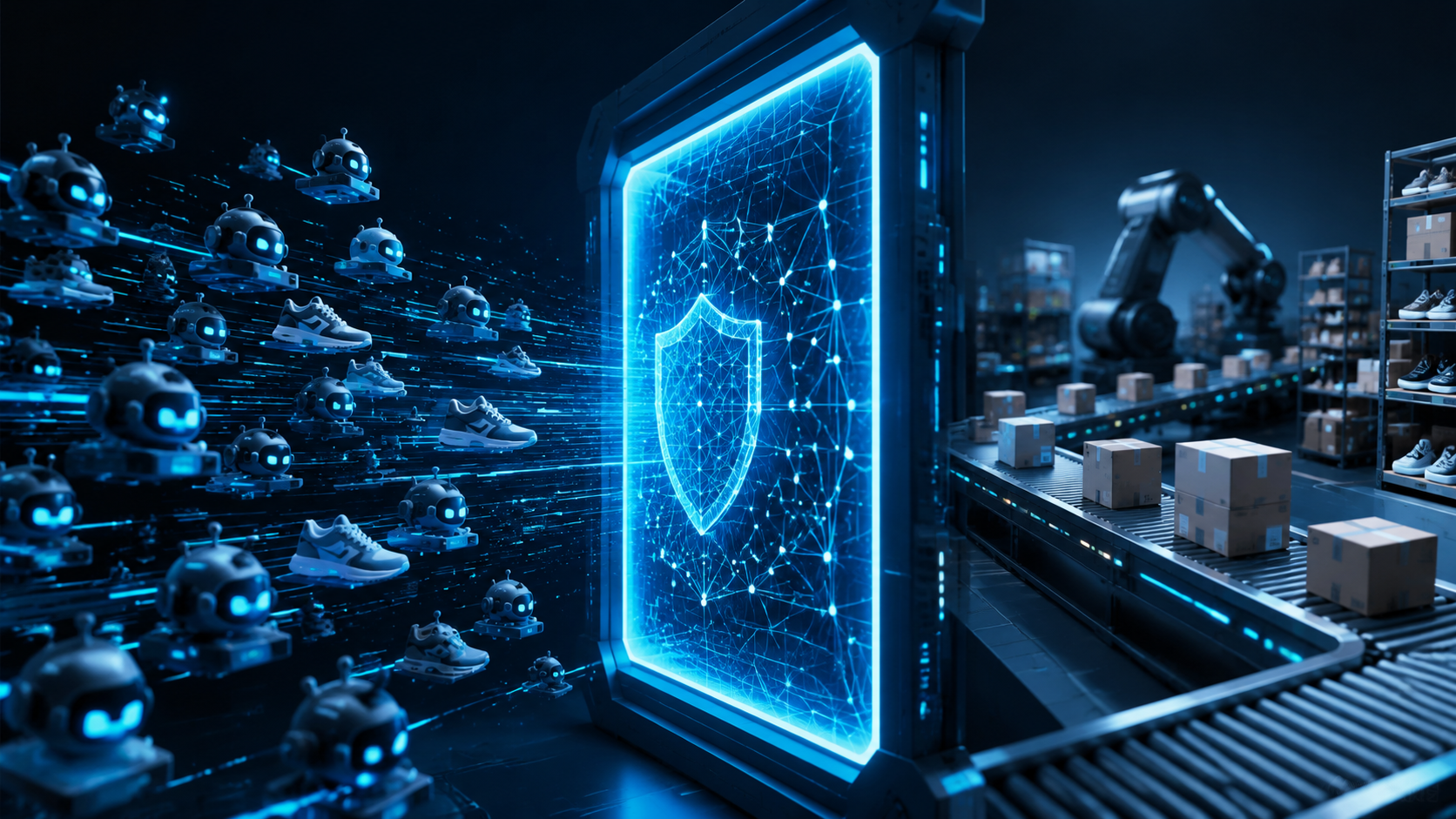
The Demand Signal Is Already Damaged Before Checkout
The operational trouble begins when teams treat launch traffic as if it were a rough version of retail demand. During a limited release, speed and scarcity change the meaning of every familiar metric. Entries can be generated at machine pace. Accounts can be coordinated. IP addresses can rotate. Devices can be masked. A customer who refreshes obsessively and a script that mimics hesitation may both appear in the same traffic window.
For allocation teams, that matters because the product is not sitting behind a long tail of replenishment. A few minutes of bad access control can decide who receives the available units. For fulfillment teams, it matters because a confirmed order is not just a line in a database; it becomes inventory reservation, wave planning, pick labor, pack materials, address validation, carrier commitment, customer-service exposure, and sometimes reverse logistics.
The resale incentive explains why the pressure keeps coming. DataDome describes sneaker bots as part of a broader resale economy and notes that bot software licenses can cost from $100 to more than $1,000 per subscription.[3] LogiNext cites estimates that the global sneaker resale market is valued at $6 billion to $8 billion, which gives automated buyers a reason to keep adapting when brands improve defenses.[4]
Those figures do not prove that every limited release is equally distorted. Bot ratios vary by drop. A routine Jordan release and a Travis Scott or Off-White collaboration are not the same operating environment. The practical lesson is narrower and more useful: for the launches that carry the most scarcity, visibility, and resale value, raw demand signals are unsafe inputs unless they have been screened.
What the AI Gatekeeper Actually Checks
The anti-bot layer is not one model looking for one obvious bad behavior. Nike describes a multi-layer approach that evaluates entries in real time with machine learning, IP reputation, behavioral analytics, device signals, and account history before inventory is released through SNKRS.[1] In logistics terms, this is a pre-fulfillment quality-control step for demand.
| Signal | What It Helps Separate | Logistics Consequence |
|---|---|---|
| Behavioral analytics | Human interaction patterns from scripted timing or repeated automation | Fewer automated entries advance into allocation |
| IP reputation | Known or suspicious traffic sources from ordinary access patterns | Less inventory is reserved against coordinated attack traffic |
| Device fingerprinting | Repeated account activity from the same or disguised device environment | Lower risk of one operator multiplying fulfillment demand |
| Account history | Established member behavior from newly created or thin accounts | Allocation can weigh persistence and prior participation, not only speed |
| ML verification models | Combinations of signals that are hard to judge with static rules | Cleaner order candidates move downstream |
None of those signals is perfect alone. A real customer may use a VPN. A bot operator may age accounts. A new buyer may have no purchase history. The value is in combining weak signals quickly enough that the drop can continue without asking the warehouse to absorb the uncertainty.
Waiting-room and bot-management vendors sit around the same problem from different angles. DataDome is positioned around bot detection, Queue-it around virtual waiting rooms, and Kasada around automated attack prevention; the important supply chain point is not which vendor category wins, but that access infrastructure has become part of release operations rather than a separate web-security accessory.[3]
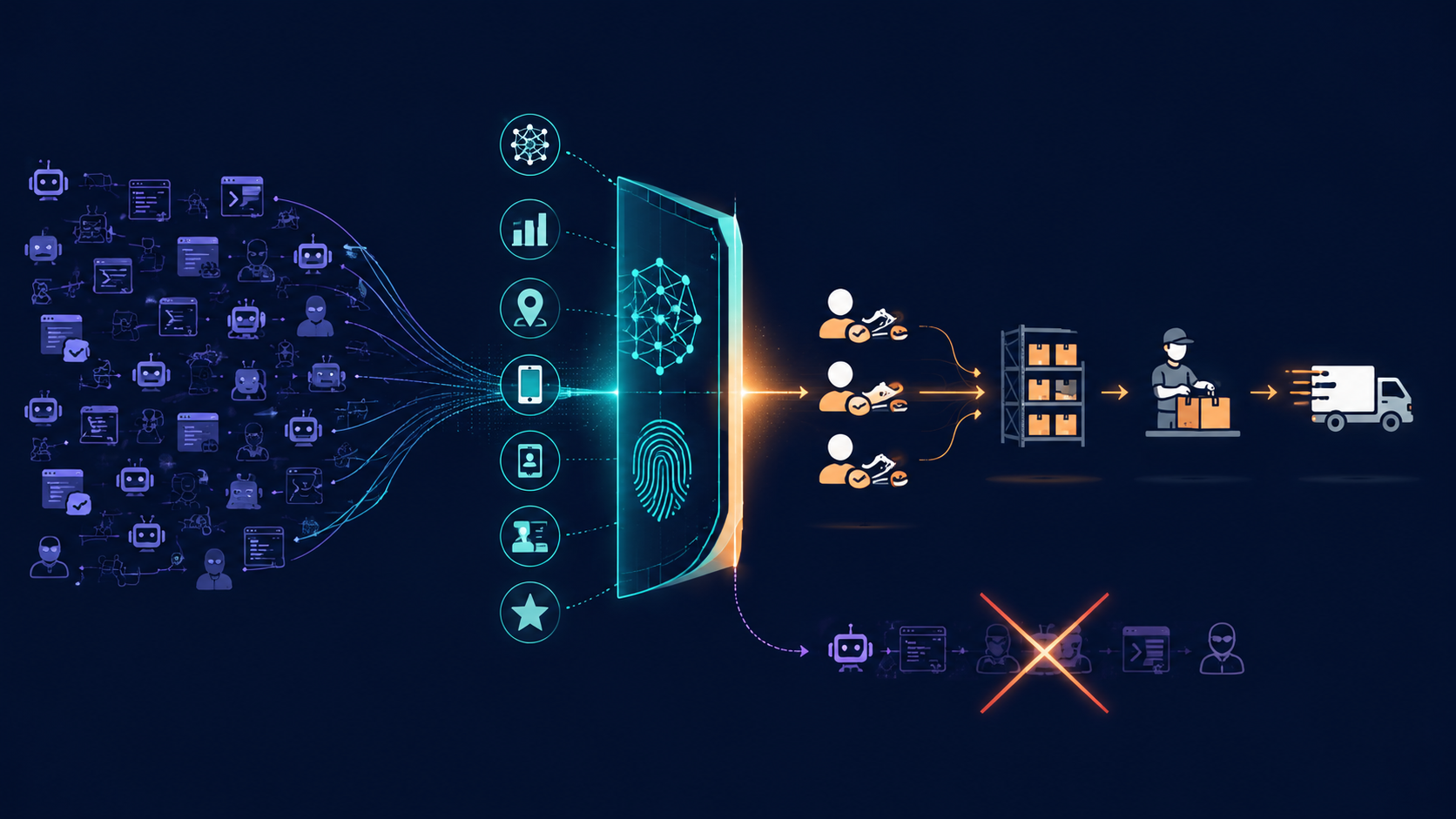
Filtering Fake Demand Before It Becomes Warehouse Work
The cleanest bot defense happens before an entry becomes an order. Once a fraudulent or automated entry receives inventory, the problem changes departments. Fraud operations may still catch it. Payment review may still block it. Customer service may still handle the fallout. But the fulfillment system has already started to believe something that was never a stable demand signal.
When AI screening works, the downstream changes are practical rather than glamorous. Scarce units are less likely to be over-allocated to fake or coordinated accounts. Warehouse teams receive a smaller set of order candidates that are more likely to ship. Pick waves are less exposed to cancellations after labor has been planned. Packing stations see fewer orders that later require fraud holds or address review. Last-mile planning is based on fewer shipments that will be intercepted, abandoned, resold through suspicious paths, or returned after a failed fraud process.
LogiNext’s discussion of hype-driven sneaker and collectibles supply chains frames this as a fulfillment problem, not only a shopper fairness problem: bot activity can distort demand, create misallocation, and add return-processing costs when questionable orders make it into delivery flows.[4] Zensar’s AI-powered drop model makes a similar operational point from the scarcity side, treating controlled access and allocation as part of the retail drop system rather than a feature bolted onto checkout.[5]
A hypothetical release makes the handoff clearer. If half of the first-minute entries are automated and the platform allocates inventory before filtering them, the warehouse plan can be built around false winners. If the platform scores and removes likely automation before allocation, fewer phantom orders reach the order-management system. The same physical inventory exists in both cases. What changes is whether the fulfillment operation is asked to execute against noise.
Allocation Is Where Fairness and Logistics Meet
Bot filtering blocks the obvious abuse. Allocation logic handles the harder question: among entries that pass the first gate, who should get access to a product that cannot satisfy demand?
Nike’s Exclusive Access example for the Off-White Dunk shows how this can work. Nike says 90% of Exclusive Access invites went to members who had previously lost draws, using engagement and prior unsuccessful participation as part of the allocation logic.[1] That is not the same as proving a universal fairness formula, but it does show a different operating principle from first-click speed: a persistent member who has repeatedly missed out can be weighted differently from a newly created account appearing only for the hottest release.
For logistics, that distinction has value. Allocation to more credible customers reduces the chance that scarce inventory is captured by accounts built for resale automation. It also gives demand planners and fulfillment supervisors a cleaner read on where real customers are, which sizes are genuinely pressured, and how much exception handling may follow the release.
The fairness cost should not be brushed aside. Loyalty or dedication scoring can make a new legitimate customer look less trustworthy than an established member. A buyer who recently discovered the brand, changed devices, moved locations, or lacks draw history may have fewer positive signals than a long-time account. Brands that rely on these scores need governance around what the model rewards, what it penalizes, and how often allocation outcomes are reviewed for unintended exclusion.
The Arms Race Does Not End at a 98% Claim
Nike’s reported 98% bot-removal rate is useful as a sign of ambition and scale, but it should not be read as a permanent operating condition.[1] Bot developers respond to defenses. They change traffic sources, mimic human interaction, age accounts, rotate devices, and test the edge cases that static rules miss. The better claim is that AI can reduce contaminated demand faster and more flexibly than manual review or fixed thresholds during a compressed launch window.
That still leaves work for people. Fraud teams need feedback loops from chargebacks, suspicious reshipments, address clustering, and post-drop investigations. Allocation teams need to know when a scoring rule is protecting genuine members and when it is simply rewarding old accounts. Warehouse and delivery teams need exception data to flow back upstream, because a release that looks clean at checkout can still reveal patterns after shipment.
The most durable role for AI in sneaker-drop logistics is therefore bounded. It is not a promise of bot-free launches. It is a control point that decides whether fulfillment systems receive usable demand or contaminated noise. In the highest-pressure drops, that decision shapes allocation accuracy, warehouse stability, and delivery predictability before a single pair is picked.
References
- Inside SNKRS Bot Protection — Nike
- Why bots make it so hard to buy Nikes — CNBC
- How to Detect, Block & Manage Sneaker Bots — DataDome
- The Hype Economy: Sneakers, Collectibles and the Evolution of Supply Chain Management — LogiNext
- AI-Powered Drop Model for Retail Scarcity: Rethinking Retail Scarcity — Zensar
Comments
Join the discussion with an anonymous comment.