
Short sellers have a habit procurement teams should study, even if nobody in supply chain wants to copy their motives. They watch the financial stress moving through customer-supplier networks before the stress becomes an operating failure. In one academic study, a one-standard-deviation drop in customer stock returns was associated with a 35% increase in abnormal short selling of supplier stocks, and the effect was stronger when investors were simultaneously downloading SEC filings for both the customer and supplier — a measure the authors call co-attention.[1]
That finding matters for AI-powered supply chain risk analysis because it reframes supplier health as a live signal problem, not a quarterly scorecard exercise. The market is already treating supplier distress as connected, time-sensitive, and exploitable. Procurement teams are often exposed to the same disruption pathway, but they usually need the signal for a different purpose: qualify alternates, reduce exposure, renegotiate terms, or prepare operations before a missed shipment makes the risk impossible to ignore.

What short sellers are really reading
A supplier rarely becomes fragile in a single clean event. The signals usually arrive as deterioration: cash gets tighter, receivables stretch, interest costs become harder to cover, trade credit terms change, insurers retreat, and customers begin to show weakness of their own. Short sellers have an incentive to connect those signals quickly because delay erodes the trade. Procurement has an equally practical incentive, but a different consequence for being late: expedited freight, emergency sourcing, line stoppages, or a sudden dependence on a supplier that can no longer finance its own production.
The Dai, Ng, and Zaiats evidence does not prove that every weak customer will drag down every supplier, and the data period used in the study runs through 2016.[1] Market plumbing has changed since then. The useful lesson is narrower and still important: informed market participants have shown that they can systematically read supplier risk through customer-supplier information channels before a formal failure event appears.
For a procurement risk lead, the defensive question is not whether to think like a hedge fund. It is whether the organization can monitor the same terrain continuously enough to act while there is still room to act.
The distress signals worth pulling out of the spreadsheet
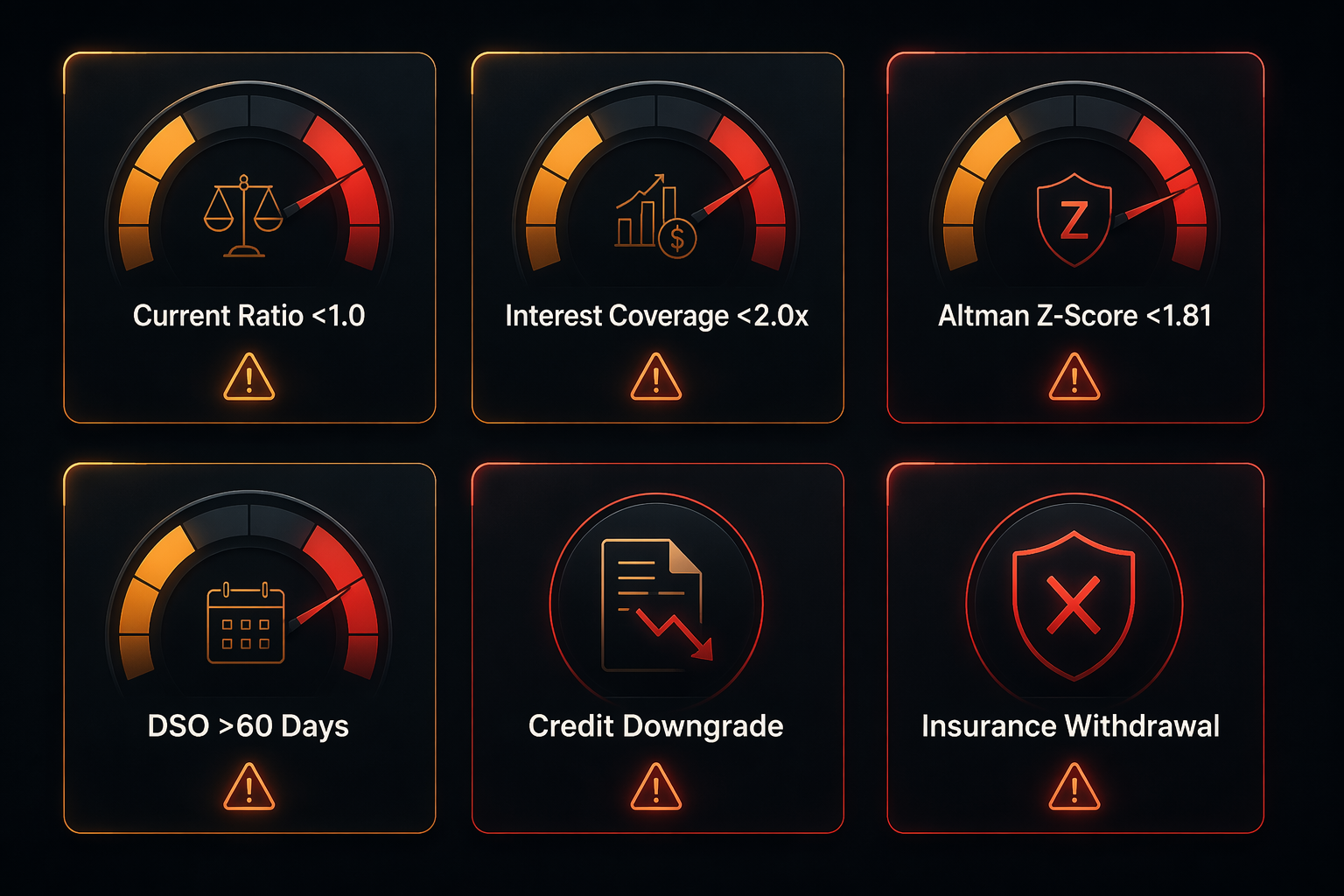
Several supplier financial signals deserve special treatment because they translate directly into operating risk. JAGGAER’s 2026 supplier financial risk guidance flags current ratio below 1.0, interest coverage below 2.0x, Altman Z-score below 1.81, days sales outstanding above 60 days, credit downgrades below investment grade, and trade credit insurance withdrawal as indicators procurement teams should monitor.[2] These are vendor-published thresholds, not a universal law of failure. Used carefully, they are still a practical way to move supplier review away from vague concern and toward specific questions.
| Signal | Why procurement should care | How to treat the alert |
|---|---|---|
| Current ratio below 1.0 | The supplier may not have enough current assets to cover near-term liabilities. | Review working-capital exposure, open orders, payment terms, and inventory buffers. |
| Interest coverage below 2.0x | Debt service may be consuming operating flexibility. | Check whether the supplier can still fund production, maintenance, and raw materials. |
| Altman Z-score below 1.81 | The supplier may fall into a distress zone under a widely used bankruptcy-risk model. | Escalate for financial review rather than treating the score as a standalone verdict. |
| DSO above 60 days | Customers are taking longer to pay, which can pressure cash conversion. | Ask whether receivables concentration, billing disputes, or customer weakness are driving the increase. |
| Credit downgrade below investment grade | External credit views may be deteriorating, raising financing costs or limiting access to capital. | Map affected spend, sole-source dependencies, and contract renewal timing. |
| Trade credit insurance withdrawal | Insurers may be reducing willingness to cover buyer or supplier payment risk. | Treat the change as an early warning that counterparties may already be adjusting exposure. |
Current ratio deterioration is often the first place a non-finance procurement team can see a liquidity problem in plain language. If the ratio drops below 1.0, the supplier’s short-term obligations exceed its short-term assets under that measure.[2] That does not mean bankruptcy is inevitable. It does mean the supplier may have less room to absorb a late-paying customer, a raw-material price spike, or a lender tightening availability.
Interest coverage below 2.0x carries a different warning. The issue is not just whether the supplier is profitable; it is whether operating earnings leave enough cushion after interest obligations.[2] A supplier can still be shipping on time while quietly losing the ability to invest in tooling, overtime, preventive maintenance, or safety stock. That is why a purely delivery-based supplier scorecard can look calm while the financial risk is worsening.
DSO above 60 days is especially easy to underweight because it sounds like an accounting metric.[2] Operationally, it may mean cash is trapped in receivables for longer than expected. If the supplier is also highly leveraged, that delay can show up later as missed raw-material purchases, requests for accelerated payment, or reduced willingness to accept volume upside.
Why quarterly reviews miss the useful window
Quarterly supplier health reviews are usually built for governance. They confirm that someone looked. They are less useful when a supplier’s condition changes between review cycles, when a customer shock appears first in market data, or when payment behavior starts changing before a public filing catches up.
The pressure around the system is not theoretical. JAGGAER cites RapidRatings data indicating that 30% of supply chain disruptions in 2025 exceeded $5 million in direct costs when financial warning signals went undetected.[2] Atradius reported that 42% of North American B2B credit sales were overdue in 2025.[3] The Kaplan Group reported in February 2026 that only 46% of U.S. manufacturers maintained debt-to-earnings below 1.5x.[4]
Those figures should not be mashed into a single claim that suppliers are broadly on the brink. They point to a more useful operating condition: more counterparties are carrying payment delay, leverage, or liquidity stress that may not surface first as an order failure. A quarterly review cadence is poorly matched to that kind of movement.
What AI adds, if the workflow is real
AI-powered supplier monitoring is useful when it compresses the work of watching many weak signals across many suppliers. It can scan financial statements, market movement, credit changes, news, payment indicators, insurance signals, and network relationships more continuously than a category team can. The point is not to produce a dramatic prediction. The point is to raise the right supplier early enough, with enough explanation, that a human team can decide whether the risk is tolerable.
A SupplyChainBrain article describing Craft’s work with a financial services firm gives the idea a concrete operating window: the firm detected supplier financial distress three months before bankruptcy by analyzing EBIT, EBIT margin, and net cash trends through AI monitoring.[5] Three months is not luxurious. It is, however, enough time to do more than react. A team can map open purchase orders, identify sole-source exposure, qualify alternates, adjust inventory decisions, review contractual rights, and prepare internal stakeholders for constrained supply.
Everstream Analytics reports client results including a 50–70% reduction in time to identify and assess disruption impact and 30% lower revenue losses from disruptions.[6] Those numbers are useful as directional evidence of what faster assessment can change, but they should be read as vendor-published client results rather than independently verified benchmarks. The important procurement lesson is still sound: speed matters most when it is connected to an impact model and an owner.
An alert is a trigger, not a verdict
The fastest way to make financial risk monitoring politically unusable is to treat every alert as a declaration that a supplier is failing. A current ratio below 1.0, DSO above 60 days, or a downgrade below investment grade may have context: seasonality, a large customer dispute, a recent acquisition, a temporary working-capital draw, or an industry-wide credit tightening. Procurement needs the alert to open a disciplined review, not to automatically terminate a relationship.
The review should answer operational questions in a specific order. What products, plants, customers, and revenue streams depend on this supplier? Which purchase orders would be exposed if capacity tightened over the next few weeks? Is the supplier sole-source, technically qualified but capacity-constrained, or readily replaceable? Would accelerated payment reduce risk or merely transfer liquidity pressure to the buyer? Who has authority to approve dual sourcing, inventory changes, or commercial concessions?
This is where the short-seller analogy has to stop. Investors can express a view and exit. Procurement has to live with the relationship, the tooling, the quality history, the switching cost, and sometimes a strategic supplier that cannot be replaced quickly. Early warning does not create sourcing flexibility by itself. It only exposes whether flexibility exists while there is still time to build some.
The response chain procurement actually needs
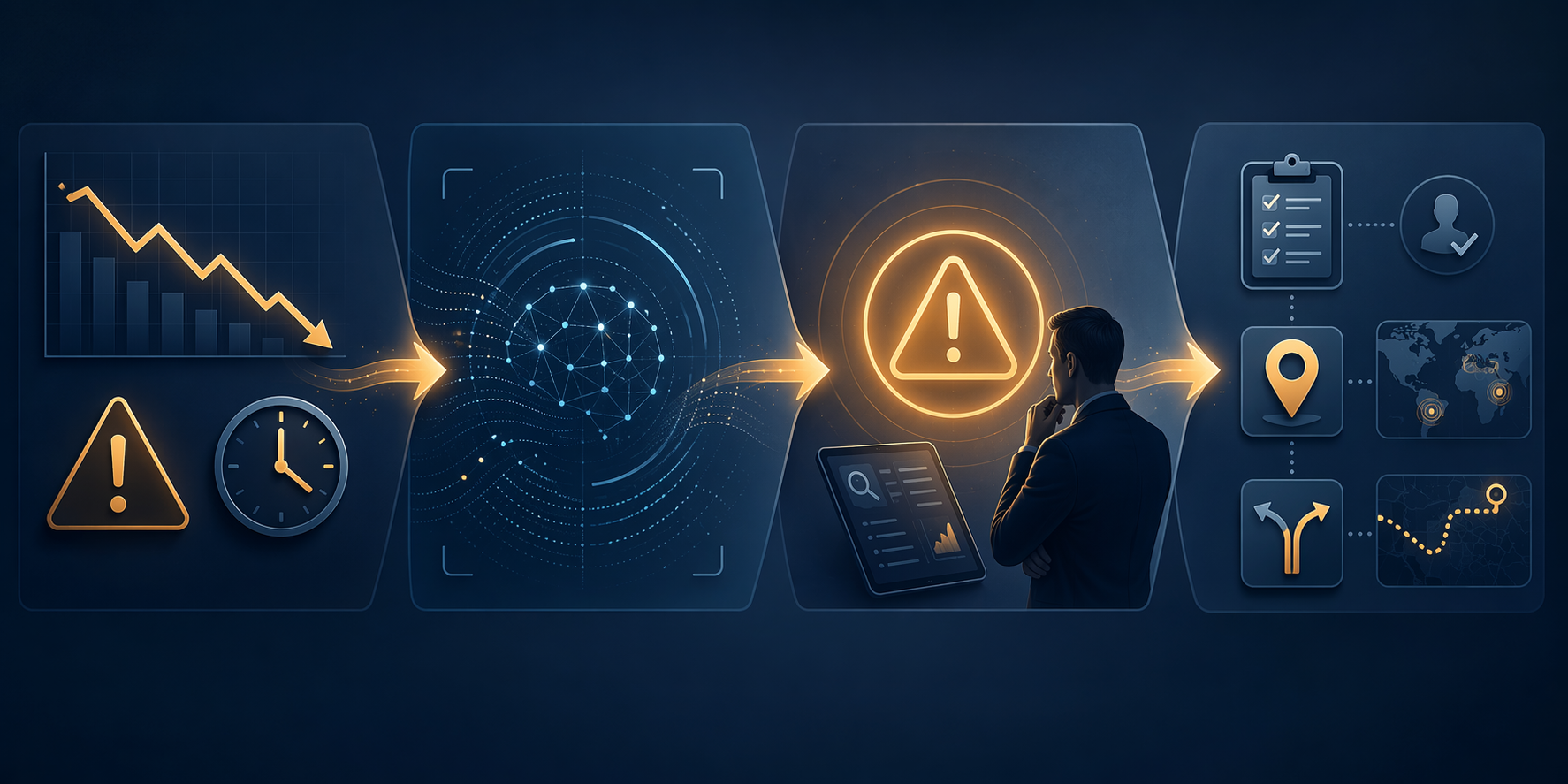
A defensible supplier distress workflow has four connected parts. If one is missing, the system becomes another dashboard that looks sophisticated until the first real disruption tests it.
- Signal capture: monitor liquidity, leverage, payment behavior, credit changes, insurance signals, customer stress, and public information continuously rather than waiting for a quarterly review.
- Alert explanation: show which indicators changed, when they changed, how severe they are, and whether the supplier matters to critical products or plants.
- Exposure mapping: connect the supplier to spend, open orders, revenue dependency, inventory coverage, alternate sources, and contractual constraints.
- Procurement action: assign an owner to supplier review, contingency sourcing, executive escalation, commercial intervention, or disruption impact assessment.
The trade credit insurance signal deserves a place in that chain because it reflects someone else’s willingness to carry counterparty risk. JAGGAER notes that Allianz Trade, Atradius, and Coface cover more than 65% of global trade credit insurance capacity, making withdrawal or reduction of coverage a meaningful distress indicator.[2] A procurement team does not need to know every detail of an insurer’s model to treat a coverage change as a reason to recheck exposure.
The same logic applies to customer stress. If a supplier depends heavily on a weakened customer, that weakness may move through receivables, volume forecasts, covenant pressure, or inventory decisions before the supplier misses a shipment. Dai, Ng, and Zaiats show that short sellers paid attention to these customer-supplier links in the market.[1] Procurement can use the same network idea defensively by asking whether a supplier’s financial change is isolated or connected to stress elsewhere in the chain.
How to read the alert without overreading it
A useful AI alert should separate evidence from interpretation. Evidence might show that DSO crossed 60 days, interest coverage fell below 2.0x, and a credit downgrade moved the supplier below investment grade.[2] Interpretation should explain why that combination matters for the buyer’s exposure: perhaps the supplier supports a high-revenue product, has long qualification lead times, and already carries limited buffer inventory.
That distinction matters because financial distress indicators are probabilistic. A supplier can breach a threshold and recover. Another can look acceptable on a single ratio while deteriorating across less visible measures. Procurement should resist both bad habits: ignoring the signal because it is not certain, and treating the signal as certain because it is quantified.
The better test is whether the alert changes the next operating decision. If it does not affect supplier review cadence, exposure reduction, dual-source planning, payment strategy, or disruption modeling, it is only surveillance. If it moves a named owner to make a timely decision, it becomes risk management.
A defensive operating system, not a trading strategy
AI-powered supplier monitoring will not turn procurement into a prediction desk, and it should not be sold as a crystal ball. The value is more practical. It can take the distress signals markets already exploit — liquidity deterioration, weakening coverage, receivables pressure, credit downgrades, insurance withdrawal, and customer-supplier stress — and turn them into earlier procurement decisions.
The hard part is organizational, not mathematical. Someone has to receive the alert, trust enough of the evidence to investigate, and have authority to change sourcing behavior before the bankruptcy filing confirms what the data had already started to show.
References
- Short Seller Attention, ScienceDirect / Journal of Corporate Finance, 2022.
- Supplier Financial Risk Signals to Monitor in 2026, JAGGAER, June 2026.
- Atradius Payment Practices Barometer North America 2025, Atradius, 2025.
- Debt to Earnings Ratio by Industry, The Kaplan Group, February 2026.
- The Red Flags That a Supplier Might Be Having Financial Challenges, SupplyChainBrain.
- Artificial Intelligence's Role in Supply Chain Risk Management, Everstream Analytics.
Comments
Join the discussion with an anonymous comment.