
Alaska Airlines is the cleanest place to start because its Flyways AI deployment looks less like a slideware promise and more like an operations desk decision. The system scans day-of-flight conditions, identifies route changes that could save fuel or avoid congestion, and presents opportunities to dispatchers. In a six-month trial, Alaska reported 480,000 gallons of fuel saved. In 2023, the airline reported 1.2 million gallons saved and 11,958 metric tons of CO2 avoided through Flyways AI.[1][2]
That is why AI route planning for airlines deserves a more serious discussion in 2026 than it did a few years ago. The useful claim is not that an algorithm now “flies the route.” It is narrower and stronger: tactical AI route optimization has reached production use where the model recommends, the dispatcher decides, and the software improves as it learns which suggestions experienced operators accept or reject.
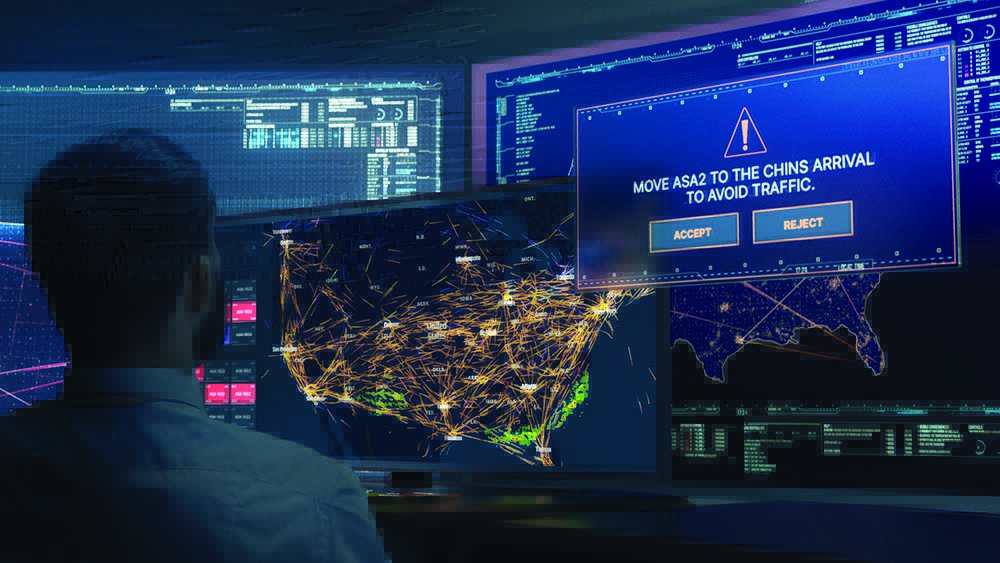
The Alaska Pattern: AI Finds the Option, Dispatch Decides
Flyways AI is valuable because it sits inside a real constraint system. A route suggestion has to contend with weather, air traffic control flow, restricted airspace, aircraft performance, fuel policy, crew timing, downstream schedule effects, and the dispatcher’s legal and operational responsibility for the release. A fuel-saving shortcut that creates a new operational mess is not optimization; it is just a better-looking line on a map.
The adoption numbers are as important as the fuel numbers. During the Alaska deployment, Flyways AI identified optimization opportunities for 55% of flights, and dispatchers accepted 32% of the recommendations.[1] That acceptance rate is not a disappointment. It is the mechanism. The model is being exposed to operational judgment instead of being protected from it.
A 32% acceptance rate says several things at once. First, the system is finding enough opportunities to matter. Second, many mathematically attractive recommendations still do not survive the dispatcher’s read of the operation. Third, the learning loop has something useful to learn: not only which route is shorter, but which suggestions are credible under the airline’s actual decision rules.
For supply chain leaders, that distinction matters. Truck routing, last-mile sequencing, port drayage, airline flight planning, and warehouse-to-store replenishment all produce plans that look cleaner before the operation starts. The hard part is the middle of the day, when the bridge is closed, the gate is unavailable, a driver is close to hours-of-service limits, or the receiving dock cannot take the load. The aviation lesson is that route optimization earns credibility when the system is allowed to recommend inside the workflow and then absorb the reasons humans say no.
What the Fuel Savings Actually Prove
The documented airline results support a practical range rather than a universal guarantee. The research base for this use case points to fuel reductions of 3–8% per flight in validated deployments, with Alaska’s public numbers giving the strongest production evidence: 480,000 gallons saved during a six-month trial, then 1.2 million gallons and 11,958 metric tons of CO2 avoided in 2023.[1][2]
Those figures should not be flattened into a single ROI promise. A gallon saved through tactical en-route optimization is different from a gallon saved by reducing taxi time. A model that improves wind forecast accuracy is not the same thing as a flight-path recommender. The investment case gets stronger when these layers work together, but they measure different parts of the operation.
| Evidence | What It Measures | How to Use It in an AI Route Planning Business Case |
|---|---|---|
| Alaska Airlines Flyways AI | Day-of-flight route opportunities, dispatcher acceptance, fuel saved, CO2 avoided | Core evidence for tactical en-route optimization |
| American Airlines DFW gate-assignment AI | Taxi-time reduction and airport surface fuel savings | Route-adjacent evidence for operational optimization, not proof of en-route planning ROI |
| Lufthansa and Google Cloud wind forecasting | Forecast accuracy improvement for weather inputs | Evidence that better prediction quality can strengthen the routing input stack |
| Fygurs implementation benchmarks | Budget and time-to-value ranges | Planning input for implementation scope, not a guaranteed payback result |
This is where aviation evidence is useful for logistics without being overextended. A parcel carrier, food distributor, or industrial shipper should not copy Alaska’s numbers into a ground-transport model. But they can copy the structure of proof: baseline the current plan, surface constrained recommendations, record human acceptances and overrides, measure fuel or miles avoided, and separate operational savings from forecast-quality improvements.
The Workflow Is the Product
The most transferable part of Alaska’s deployment is not the algorithm category. It is the relationship among data, recommendation, review, execution, and learning. A useful route optimization system does not simply output a path. It has to know what the operation will recognize as a feasible path.

In airline dispatch, the recommendation has to arrive while there is still time to use it. It has to be specific enough for a dispatcher to evaluate quickly. It must show a plausible operational benefit. It must respect regulatory and company policy constraints. And when the dispatcher rejects it, that rejection should not disappear into a log file no one studies.
The same pattern applies outside aviation. In last-mile delivery, the planner may reject a route because a customer routinely misses the first delivery window. In middle-mile freight, a dispatcher may override a theoretically efficient sequence because a yard becomes congested after a certain hour. In network planning, an analyst may reject an elegant lane change because the carrier capacity behind it is too brittle. Those are not edge cases to be swept away; they are the operating knowledge the model needs.
This is also why human-in-the-loop design is not a cosmetic reassurance for nervous employees. It is a data strategy. If the system captures recommendation context, acceptance, rejection, and the reason for override, the optimization model gets closer to the operation’s true constraints. If it only measures whether the operator obeyed the recommendation, it learns very little.
A Practical Decision Loop
- The model ingests operational data: flight plan, weather, traffic constraints, aircraft performance, fuel policy, schedule context, and relevant restriction data.
- It proposes a constrained route change only when the expected benefit is large enough to justify review.
- The dispatcher accepts, modifies, or rejects the recommendation based on accountable operational judgment.
- The system records the decision pattern so future recommendations better match what the operation can actually use.
That loop is less glamorous than a fully autonomous planning story. It is also more likely to survive contact with a Tuesday afternoon operation.
American’s DFW Result Belongs Near the Route Case, Not Inside It
American Airlines’ AI gate-assignment work at Dallas Fort Worth is often discussed with route optimization because it attacks the same cost pool: fuel burned while aircraft are moving inefficiently. The reported result is meaningful. AI-supported gate assignment at DFW cut taxi time by more than a minute per flight and eliminated up to 10 hours of taxi time per day, with estimated annual fuel savings of 870,000 to 1.4 million gallons.[3]
That is not en-route AI planning. It does not prove that a model can choose a better airborne trajectory around weather or traffic. It does prove that airlines can deploy AI against messy, time-sensitive operational decisions and turn small per-flight improvements into large annual savings.
For supply chain readers, this is the bridge from flight routing to broader movement optimization. A minute saved on the taxiway resembles a few miles avoided in delivery sequencing or a dwell-time reduction at a cross-dock. The unit improvement looks modest until it repeats across a dense network. The business case should keep those categories separate, but it should not ignore the compounding effect.
Better Forecasts Are Part of the Routing Stack
Lufthansa’s work with Google Cloud sits one layer upstream from route recommendation. The reported result was a 40% improvement in wind forecast accuracy at Zurich Airport, with the goal of reducing weather-related delays.[4] That matters because wind is one of the inputs that decides whether a route is efficient, whether fuel assumptions hold, and whether delay risk moves from acceptable to costly.
This evidence should be used carefully. A forecast model that improves wind accuracy is not, by itself, a documented fuel-savings deployment. It strengthens the input layer behind better planning. In operational terms, that is still important. Bad input data makes even a good optimizer untrustworthy, and planners learn very quickly when a system’s recommendations are built on stale or weak assumptions.
The logistics equivalent is familiar. A route optimizer using inaccurate service times, outdated road restrictions, weak demand forecasts, or unreliable dock calendars will eventually be treated as advisory noise. Better prediction does not replace optimization, but poor prediction can sink it.
Implementation Costs Need an Operations Assumption, Not Just a Software Line Item
Budget benchmarks help, as long as they are treated as planning ranges rather than promises. Fygurs’ implementation data puts AI route optimization projects in a €150,000–600,000 budget range, with a 20-week time-to-value benchmark.[5] Those numbers are useful because they force the business case out of abstraction. They do not mean every airline or logistics network will reach measurable savings in 20 weeks.
The timeline depends on how much operational plumbing already exists. Clean route history, reliable fuel or mileage baselines, dispatcher or planner decision logs, constraint data, and integration with planning systems all affect whether the first deployment can focus on optimization or must begin with data repair. In airlines, FAA compliance and dispatch authority are not optional design considerations. In ground logistics, the equivalents may be driver rules, customer delivery commitments, union rules, safety policy, or carrier contracts.
Trust-building also belongs in the implementation plan. Alaska’s 55% opportunity rate and 32% acceptance rate show why. If a project team only celebrates generated recommendations, it may miss the real adoption question: which recommendations were operationally persuasive enough for accountable humans to use?[1]
What Supply Chain Teams Should Baseline Before Buying
- Current fuel, mileage, taxi, dwell, or service-time baseline by route type, not only at network average level.
- Planner or dispatcher override reasons, including constraints that are known informally but not stored cleanly.
- Decision latency: when a recommendation must arrive to be useful.
- Regulatory, contractual, labor, safety, and customer-service rules that cannot be violated for efficiency.
- A measurement plan that separates adopted recommendations, rejected recommendations, and savings actually realized.
The uncomfortable part is that some companies discover they are not ready for optimization because they cannot yet explain their own exceptions. That is not a reason to abandon the project. It is a reason to scope the first phase around the routes, lanes, or operating windows where data quality and planner trust are strong enough to produce a fair test.
How This Translates Beyond Airlines
Airline operations make the human-in-the-loop requirement visible because accountability is formal and immediate. Dispatchers do not get to hide behind a model when a bad release decision creates trouble. Supply chain planners may face less dramatic consequences, but the structure is similar: someone still owns the customer miss, the detention charge, the failed delivery, the excess fuel burn, or the capacity shortfall.
That is why aviation’s best evidence should push logistics leaders away from two weak positions. The first is vendor optimism that treats route planners as obstacles to automation. The second is blanket skepticism that dismisses every AI routing deployment as a lab exercise. Alaska’s production savings, American’s surface-efficiency gains, and Lufthansa’s forecast-quality improvement each show a different piece of the same operational reality: AI can improve movement decisions when it is constrained by real-world rules and connected to the people who own execution.
Readers comparing this tactical evidence with broader planning questions may also want the strategic view in How AI Unifies Airline Route Optimization and Capacity Planning and How AI optimizes airline routes for supply chain profitability. Ground logistics teams can compare the same adoption pattern with The Real ROI of AI Last-Mile Route Optimization.
The practical judgment is straightforward. AI route planning has earned a place in the operations investment conversation, but the strongest model is not replacement. It is constrained recommendation-based optimization: the system finds opportunities fast, the accountable human decides, and the model gets better by learning from the decisions made under real operating pressure.
References
- Flyways AI: The flight route optimization platform designed for dispatchers, Aerospace America.
- Alaska Airlines and Airspace Intelligence launch Flyways AI, Alaska Airlines Newsroom, May 2021.
- American Airlines uses AI to reduce taxi time and fuel use, Deloitte.
- Lufthansa Group improves flight operations with Google Cloud AI, Google Cloud.
- AI route optimization implementation cost and time-to-value benchmarks, Fygurs.
Comments
Join the discussion with an anonymous comment.