
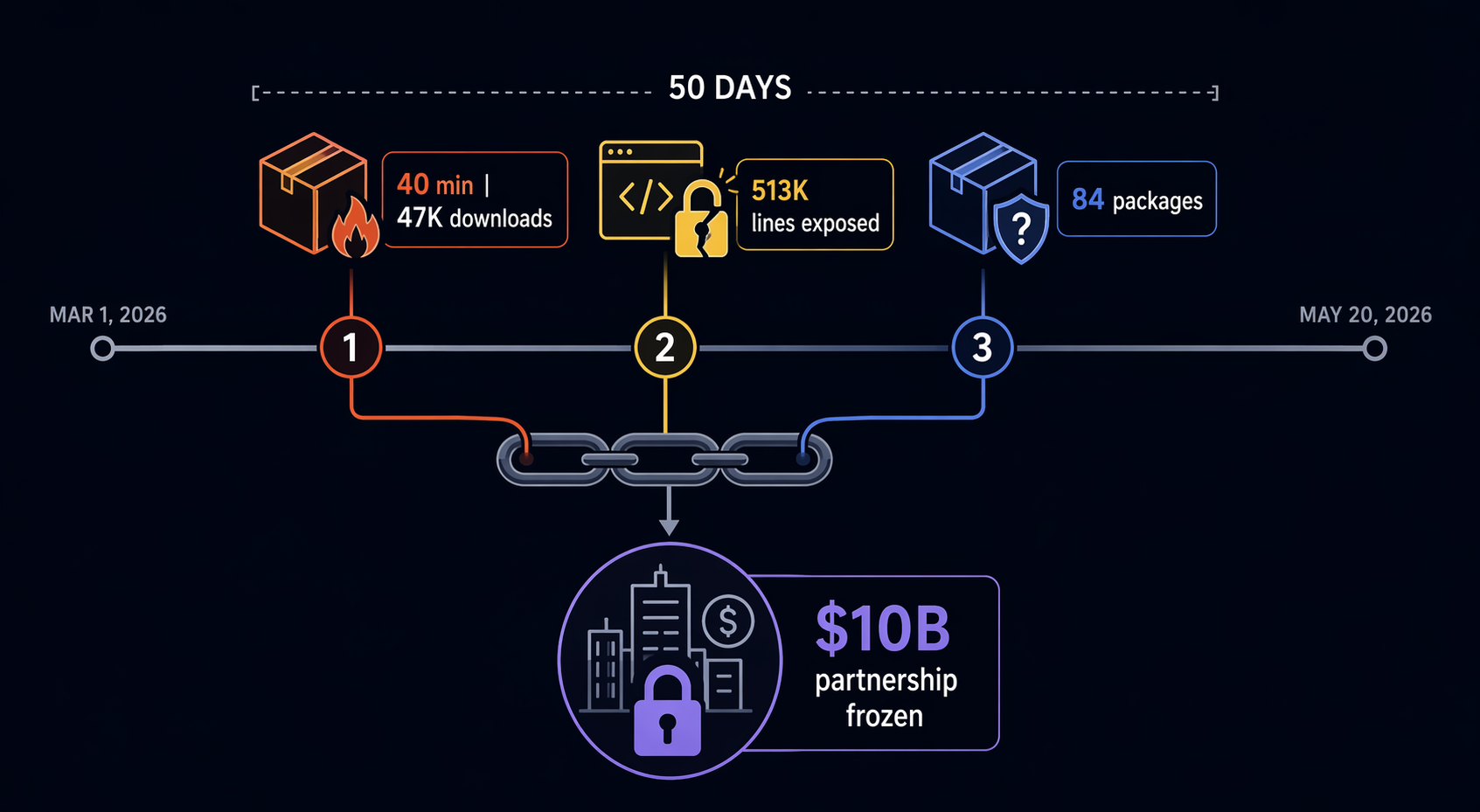
The LiteLLM/Mercor incident is the kind of AI model security incident supply chain teams can no longer file under “technical risk.” In March 2026, attackers compromised the LiteLLM PyPI package, an AI API gateway dependency used to route requests across model providers. The poisoned version reportedly remained on PyPI for roughly 40 minutes and still accumulated about 47,000 downloads before removal.[1] That short exposure window would be troubling on its own. The operational consequence was worse: Mercor, a data annotation vendor used by Meta for AI training work, suffered a breach in which 4 TB of sensitive data was reportedly exfiltrated, and Meta froze its reported $10B partnership with Mercor as a direct consequence.[1][2]
Those figures come from security reporting and incident analysis, so the download count and exfiltration volume should be treated as reported estimates rather than final court-tested facts. But procurement does not wait for perfect forensics. A vendor relationship was interrupted, an AI training supply chain was exposed, and a major commercial partnership was reportedly paused. That is enough to change the diligence conversation.
The uncomfortable part is not simply that “a package got poisoned.” Open-source package compromise is not new. What matters here is where the package sat. LiteLLM was not a forgotten utility buried in a back-office script. It functioned as part of the AI access layer: the place where applications, model providers, credentials, routing logic, observability, and enterprise usage patterns can converge. A compromised package in that position can turn a normal software dependency into a route through an AI vendor relationship.
That is why the incident reads differently from a standard vulnerability notice. The affected surface touched model access, annotation workflows, sensitive training-related data, and the commercial confidence required to keep a partnership moving. The person left explaining the damage may not be the release engineer who pushed a package. It may be the supply chain leader who approved the AI vendor because the capability was strong, the reference calls were good, and the security packet looked complete.
The 50-day cluster made the pattern harder to dismiss
VentureBeat reported that three frontier AI labs were hit by release-pipeline compromises within a 50-day window in early 2026.[2] The number is less important than the compression. In ordinary vendor risk reviews, teams are used to spacing out events: one supplier incident here, one software advisory there, one remediation plan later. The March-to-May cluster compressed the timetable enough to show a shared exposure pattern.
The Anthropic Claude Code source map leak was one marker. In March 2026, 513,000 lines of source code for Claude Code were exposed through a compromised CI/CD pipeline, and reporting described it as Anthropic’s second packaging leak in 13 months.[2][3] This was not a model refusing a prompt safely or hallucinating a wrong answer. It was a release process exposing code that customers increasingly depend on inside development and operational workflows.
The TanStack Mini Shai-Hulud worm then unsettled another comfortable assumption. In May 2026, 84 malicious npm packages were published under the TanStack namespace. The packages reportedly carried valid SLSA Build Level 3 provenance, and the downstream blast radius included OpenAI, Grafana, Mistral, and UiPath.[2] That detail matters because provenance is often treated in questionnaires as if it closes the release-security question. It does not.
Valid provenance can confirm where and how something was built. It does not prove that the thing built was safe, intended, or free from malicious logic introduced before the attested build. For procurement teams, that distinction is not semantic. A vendor can present cryptographic build attestations and still have a release process that allows an attacker to publish damaging artifacts through trusted channels.
| Incident | Reported release-surface issue | Supply chain consequence |
|---|---|---|
| LiteLLM / Mercor | Poisoned PyPI package in an AI API gateway dependency | Sensitive data reportedly exfiltrated; Meta reportedly froze a $10B partnership |
| Anthropic Claude Code | Compromised CI/CD pipeline and source map exposure | Source code exposure in tooling embedded in developer workflows |
| TanStack Mini Shai-Hulud | Malicious npm packages with valid provenance | Trusted package namespace affected downstream AI and software vendors |
Capability diligence did not ask the same questions
Most AI vendor qualification starts with capability. Can the model perform the task? What are the latency and cost profiles? How does the vendor handle uptime, privacy, retention, and support? Those questions still matter. They just do not reach the surface that failed in these incidents.
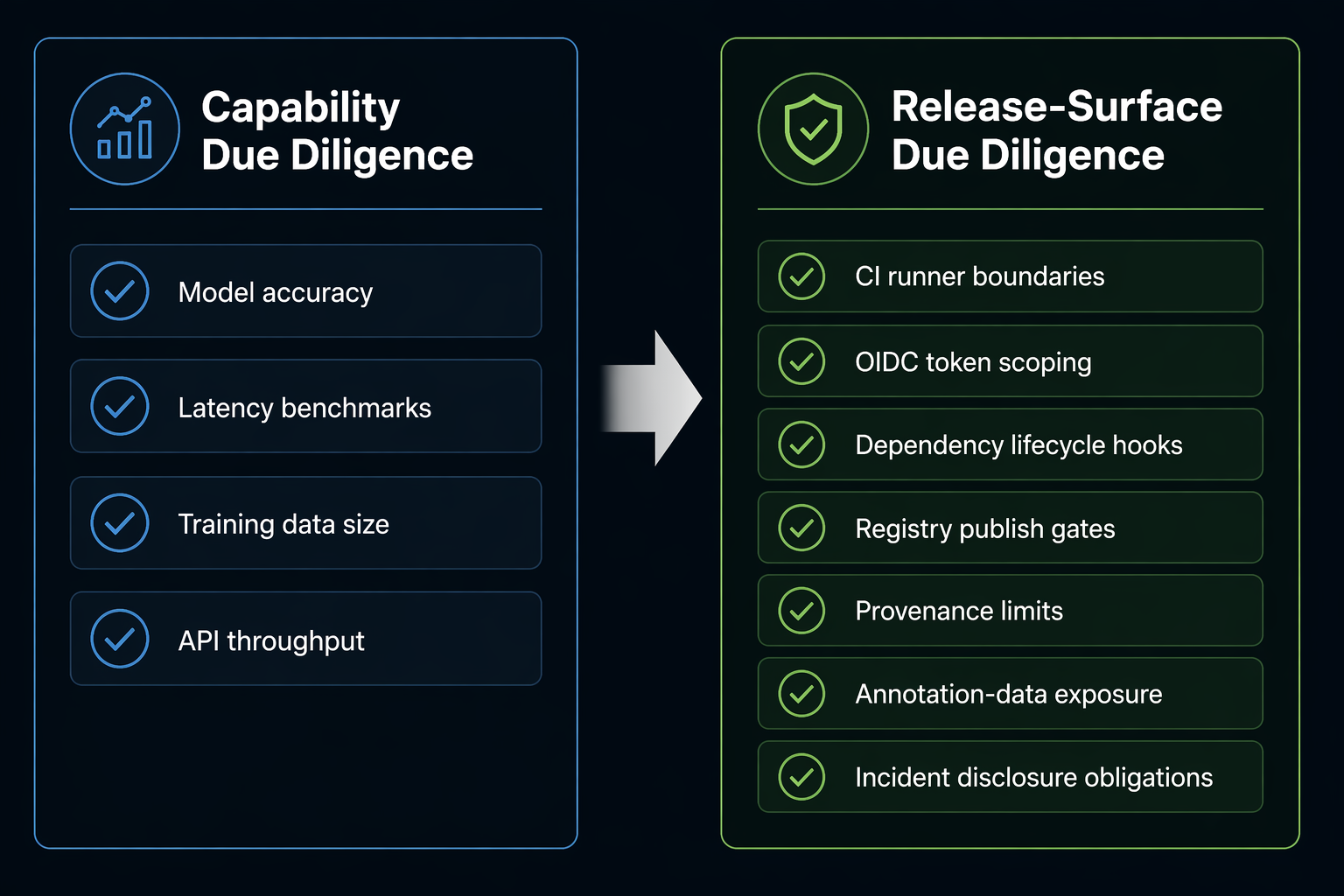
A polished SOC report, a model card, a privacy addendum, and a strong benchmark result can all coexist with weak package publishing controls. A supplier can answer questions about data retention while leaving dependency lifecycle hooks under-reviewed. A vendor can describe responsible AI practices while its CI runners, registry credentials, or OIDC token scopes quietly determine whether an attacker can turn a build system into a distribution channel.
The OWASP LLM03:2025 category gives this problem a useful home by naming supply chain risk as part of the LLM application risk landscape.[4] But the framework label is only a starting point. Supply chain leaders do not need another control family to admire from a distance. They need to know which vendor answers would have made the LiteLLM, Anthropic, and TanStack incidents look less surprising before the fact.
What was actually attacked
The common thread across the incidents was not model capability. The attacks and leaks clustered around release pipelines, package registries, CI/CD systems, build provenance, and the supporting infrastructure that moves AI software from developer intent to customer environment. That is the part of the vendor surface many procurement reviews still treat as a technical appendix.
VentureBeat’s reporting describes a prescriptive matrix of seven release-surface classes, including CI runner trust boundaries, OIDC token scoping, dependency lifecycle hooks, and registry publish gates.[2] It should not be mistaken for settled doctrine or a universal standard. It is useful because it names the messy places where AI software actually travels.
- CI runners decide which jobs can execute, which secrets they can reach, and whether untrusted code can cross into trusted build space.
- OIDC token scoping determines whether automated workflows receive narrowly bounded authority or broad access that can be abused after compromise.
- Dependency lifecycle hooks can execute during install or build steps, turning routine package handling into an execution path.
- Registry publish gates determine who or what can release packages under a trusted namespace, and what checks happen before customers can install them.
- Provenance and attestation controls document build origin, but they do not automatically validate build intent or package safety.
This is where AI adoption changes the dependency graph for supply chain teams. A model API gateway can become part of the production path. A data annotation vendor can hold material that affects training programs and partner confidence. AI packaging infrastructure can distribute code into environments where procurement teams never expected to evaluate package release controls. The operational exposure is no longer limited to whether a supplier can deliver parts, services, or software seats on time.
Foresiet separately reported six distinct AI security incidents in the 15 days from April 7 to April 21, 2026, spanning supply chain exploitation, agent failures, and multi-vector campaigns.[1] That short burst should not be stretched into a claim that every AI deployment is equally exposed. It does suggest that attacker attention is moving quickly across the connective tissue around AI systems, not only the models themselves.
The procurement consequence is partnership continuity
Supply chain teams are trained to think in consequences: delayed launch, missed delivery window, substitute supplier, contract hold, customer escalation. AI release-pipeline security belongs in that same operating vocabulary. The Mercor incident is the clearest reason. The reported freeze of Meta’s $10B partnership converted a technical compromise into a relationship-level interruption.[2]
The contractual basis and legal details of that freeze have not been independently published, so the incident should not be overread as a template for every AI vendor dispute. Its practical lesson is narrower and stronger: if an AI vendor’s upstream dependency, package process, or annotation-data environment fails, the buyer may still be the one explaining why a strategic initiative has stopped.
That explanation becomes harder when the vendor says the problem was “upstream.” Upstream may be technically accurate, but it rarely satisfies the business. If the compromised upstream package sat inside a model gateway, if the exposed data was held by an annotation partner, or if a trusted namespace delivered malicious packages, the supplier relationship is still the channel through which the risk arrived.
Questions that now belong in AI vendor review
The point is not to turn procurement leaders into release engineers. It is to stop qualifying AI vendors on model performance while leaving release security to a late-stage technical review that has no power to change the deal. The questions below are deliberately incident-derived, not a complete procurement framework.
- Which CI runners are allowed to access production signing keys, registry credentials, model deployment secrets, or customer-facing release workflows?
- How are OIDC tokens scoped for automated workflows, and what prevents a compromised job from exchanging a token for broader cloud or registry access?
- Which dependency lifecycle hooks are permitted during install, build, and packaging, and how are high-risk hooks reviewed or blocked?
- What gates exist before a package can be published under the vendor’s trusted namespace, including human approval, signing, anomaly detection, and rollback authority?
- What does the vendor’s provenance prove, and what does it not prove? Ask specifically how the vendor detects malicious but validly built artifacts.
- Where does annotation data live, which subcontractors or tooling providers can access it, and what happens to partnership obligations if that environment is compromised?
- How quickly must the vendor disclose a release-pipeline compromise, package poisoning event, source exposure, or upstream dependency incident that could affect customer operations?
These questions will not eliminate AI supply chain risk. They will, however, expose whether an AI vendor understands the difference between shipping a capable model and operating a release surface that a major customer can trust. In Q3 2026, that difference is no longer a technical footnote.
References
- 6 AI Security Incidents: Full Attack Path Analysis, Foresiet, April 2026.
- Four AI supply-chain attacks in 50 days exposed the release pipeline red teams aren't covering, VentureBeat, May 2026.
- 5 of the Biggest Supply Chain Attacks of 2026 So Far, CM-Alliance, 2026.
- LLM03:2025 Supply Chain, OWASP.
Comments
Join the discussion with an anonymous comment.