
The strongest case for AI in healthcare supply chain management is not a grand transformation story. It is a shelf-level claim: better forecasting can cut the amount of product that expires, sits idle, or gets reordered too late.
The headline numbers are strong enough to get a CFO’s attention and concrete enough for a perioperative supply lead to test against daily reality. AI-powered demand forecasting is reported at about 85% accuracy versus about 65% for traditional methods, and AI-driven inventory management is reported to reduce medical supply waste by 30-40% while maintaining 99% product availability.[1] McKinsey’s 2024 work, cited by GHX, puts AI-enabled distribution in a similar operational range: 20-30% inventory reduction and 5-20% logistics cost reduction.[2]
Those figures point to a real opportunity, but they should not be read as settled proof that any hospital can plug in a forecasting tool and take 40% waste out of the system. The 85% accuracy and 30-40% waste-reduction figures are presented in a vendor-published article citing CSCMP data, not in a direct CSCMP report available from the research set.[1] The McKinsey figures are also second-hand in this context, appearing through GHX’s discussion of AI in healthcare supply chains.[2] And the sharpest caution comes from the peer-reviewed side: a 2026 BMC systematic review found that none of the 13 included studies reported real-world deployment of AI applications in healthcare supply chain management.[3]

What the Numbers Actually Support
The useful reading is not “AI has already solved hospital inventory.” It is narrower and more practical: forecasting and inventory optimization appear to be among the more mature, higher-ROI uses of AI in healthcare supply chain operations, but the best public outcome claims still need careful provenance checks.
| Claim | Reported Result | Evidence Caveat |
|---|---|---|
| Forecasting accuracy | About 85% for AI-powered demand forecasting versus about 65% for traditional methods | Reported by TraxTech while citing CSCMP data; the research set does not include a direct CSCMP source |
| Medical supply waste | 30-40% reduction while maintaining 99% product availability | Reported by TraxTech while citing CSCMP data; best treated as vendor-adjacent evidence |
| Inventory and logistics | 20-30% inventory reduction and 5-20% logistics cost reduction from AI-enabled distribution | McKinsey 2024 figures cited by GHX; useful but not a hospital-specific peer-reviewed deployment study in the provided research |
| Peer-reviewed deployment base | Zero real-world deployment studies among 13 included studies | BMC systematic review; strong caution on the maturity of independent published evidence |
That distinction matters because healthcare inventory waste is not only a finance problem. An expired implant, a discontinued supply still living on a preference card, or a case cart missing a critical item becomes somebody’s morning fire drill. A forecast that improves availability while lowering waste is more valuable than a forecast that only lowers on-hand inventory. The 99% product-availability claim is therefore not a decorative metric; it is the part that keeps waste reduction from becoming a stockout program with better branding.[1]
The BMC review does not make the commercial claims irrelevant. It does, however, change how they should be used. They are good enough to justify investigation, pilots, and vendor diligence. They are not good enough to skip local validation, assume equivalent performance across service lines, or build a savings target without first looking at item master quality, usage capture, and replenishment behavior.
How Forecasting Changes the Inventory Conversation
Traditional replenishment is often built around thresholds: when the quantity on hand drops to a reorder point, the system tells someone to buy more. That can work for predictable, high-volume supplies. It is weaker when demand is shaped by the OR schedule, seasonal utilization, shifts in physician preference, substitutions, delayed procedures, or changes in patient volume.
AI forecasting tries to move the signal upstream. Instead of waiting for a shelf count or ERP balance to cross a line, it analyzes patient volume data, surgery schedules, seasonal utilization patterns, historical consumption, and external variables to anticipate demand before it appears in the bin. The practical value is not that the model is “intelligent” in the abstract. It is that the replenishment recommendation can see more than last month’s usage.

In a hospital setting, that difference shows up in mundane but expensive places. If scheduled orthopedic volume is rising, a static reorder point may not react until the storeroom is already behind. If a product has slow movement but high unit cost and a short expiration window, a traditional min-max setting may keep too much inventory parked on a shelf because the model does not understand upcoming demand. If a physician preference card still calls for an item that is rarely opened, usage history alone may keep buying against an outdated pattern.
This is why the waste and availability claims belong together. Waste reduction usually comes from lowering unnecessary on-hand inventory, improving rotation, and avoiding over-ordering against stale demand. Availability comes from recognizing demand early enough that the supply chain team can replenish, substitute, or escalate before a clinical team is waiting. A model that cuts inventory without protecting availability has simply moved cost into the procedure room.
The Evidence Gap Is an Implementation Risk, Not a Reason to Ignore the Use Case
The uncomfortable part of the evidence base is that the operational claims are more compelling than the independent deployment literature. Vendor and vendor-adjacent materials are closer to the market and may reflect live customer work, but they also tend to package outcomes for buying decisions. Peer-reviewed studies are slower and more conservative, but in this research set they do not yet provide much real-world deployment confirmation.
Espinosa et al.’s 2026 BMC systematic review is the reason to keep the language disciplined. The review included 13 studies of AI in healthcare supply chain management and found that none reported real-world deployment.[3] That does not disprove the 30-40% waste-reduction claim. It means the public, peer-reviewed literature is not yet strong enough to tell a supply chain VP how consistently that result appears across hospitals, what the baseline conditions were, how long implementation took, or which parts of the result came from the algorithm versus the cleanup work around it.
For a hospital leader, the resulting question is not whether AI forecasting is “real.” The better question is whether a given organization can reproduce enough of the reported value under its own conditions. A large academic medical center with standardized item data, reliable point-of-use capture, and mature perioperative supply governance is starting from a different place than a multi-hospital system still reconciling duplicate item numbers, inconsistent units of measure, and preference cards that have not been cleaned in years.
This is also where adoption projections should be kept in their lane. Gartner’s projection that 70% of large organizations will adopt AI-based supply chain forecasting by 2030 suggests that the category is moving toward mainstream evaluation.[4] It does not prove that most hospitals are ready today, and it does not say whether the first deployment will perform well in a med-surg storeroom, a cath lab, or perioperative inventory.
The Item Master Decides How Fast the Promise Becomes Real
Forecasting tools do not get to operate on the clean version of a hospital that appears in a sales deck. They inherit the item master, the ERP conventions, the point-of-use records, the charge capture gaps, the unit-of-measure conversions, and the local workarounds that kept supplies moving when the system of record was wrong.
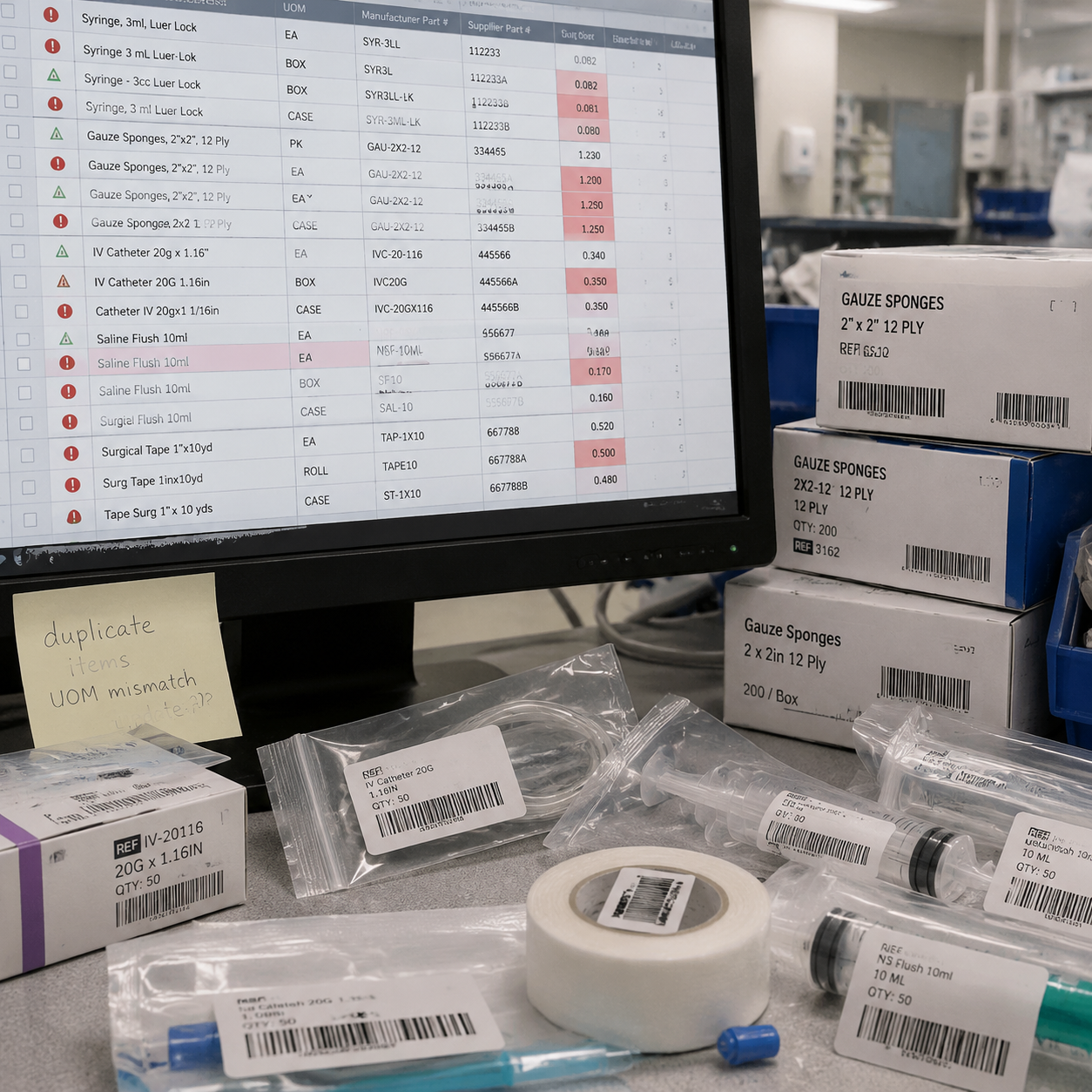
That is why the data-quality barrier matters as much as the outcome claims. In GHX’s 2026 predictions, citing an Experian 2025 survey, 41% of healthcare decision makers cite data accuracy as a barrier to AI adoption, with inaccurate item masters identified as a primary obstacle.[5] That figure will not surprise anyone who has watched an ERP say there are “12” on hand without being clear whether that means eaches, boxes, sleeves, or cases.
The item master problem is not clerical housekeeping at the edge of an AI project. It is part of the forecasting model’s operating environment. If the same product lives under multiple item numbers, demand is split. If unit conversions are wrong, consumption is distorted. If substitutes are not mapped, the model may interpret a supply disruption as a demand collapse. If preference cards are outdated, expected demand can be biased before the first prediction is generated.
A hospital does not need perfect data before evaluating AI forecasting, but it does need to know where the data is weak. Otherwise, the pilot becomes a blame-shifting exercise: the supply chain team blames the model, the vendor blames the data, and clinical users keep calling because the tray is still missing an item.
A Practical Readiness Check
Before building a savings case around 30-40% waste reduction, the health system should pressure-test the inputs that make that level of improvement plausible:
- Can the organization reliably distinguish eaches, boxes, packs, and cases across the ERP, distributor data, and storeroom practice?
- Are duplicate item records, manufacturer part changes, and substitute products mapped well enough for the model to understand true demand?
- Does point-of-use or consumption data reflect actual clinical use, or mainly replenishment transactions?
- Are surgery schedules and preference-card changes available early enough to influence replenishment?
- Is expired inventory tracked by item, location, service line, and cause, or only written off after the fact?
- Will materials management, perioperative leadership, finance, and clinical stakeholders agree on the difference between lower inventory and unsafe stock reduction?
The last point is not soft governance language. It determines whether the organization will let the forecast change buying behavior. A model can recommend lower par levels for slow-moving items, but someone still has to decide whether the risk is acceptable for a trauma service, a procedural area, or a rural facility with longer replenishment lead times.
Strategy Gaps Show Up in the Pilot
The same GHX predictions article reports that fewer than one in four organizations have a formal AI strategy to operationalize forecasting tools.[5] That matters less as a boardroom statistic than as a warning about ownership. Forecasting touches purchasing, distribution, perioperative services, nursing units, finance, IT, analytics, and vendor management. If nobody decides who can override the model, who maintains the data, and how success is measured, the project can look promising in a dashboard and still fail at the shelf.
A useful pilot does not need to cover the whole hospital. In many systems, the better starting point is a bounded, high-value inventory area where waste, stockouts, and data quality can be observed closely. Perioperative supplies, physician preference items, high-cost procedural inventory, or another controlled category can make sense if the organization can connect scheduled demand to actual consumption and expiration outcomes.
The measurement plan should separate at least four effects: forecast accuracy, inventory reduction, waste reduction, and product availability. Combining them into one ROI number hides the tradeoffs. A pilot that lowers on-hand inventory but increases urgent orders has not solved the problem. A pilot that improves forecast accuracy but leaves buyers unable to act on the recommendation has found an operational constraint, not a forecasting victory.
Where Vendors Fit
GHX ResiliencyAI, Blue Yonder, and Oracle SCM Cloud are representative of the solution category hospitals may encounter when evaluating AI forecasting and inventory optimization. The more important comparison is not which vendor has the broadest AI language. It is which one can work with the hospital’s actual data model, replenishment workflows, distributor relationships, and clinical constraints.
Vendor due diligence should press for deployment-specific evidence. Ask for the baseline waste rate, the definition of product availability, the time period measured, the inventory categories included, the data cleanup required before go-live, and whether savings came from reduced purchasing, reduced expiration, lower safety stock, fewer expedites, or some combination. A quoted accuracy rate is easier to understand when the denominator is visible.
Hospitals should also ask how the model handles substitutions, backorders, preference-card changes, new physician onboarding, manufacturer part updates, and seasonal utilization changes. These are not edge cases in healthcare supply chain work. They are normal operating conditions.
The Calibrated Decision
AI demand forecasting is a credible, high-value use case for healthcare supply chains. The reported outcome cluster is too operationally meaningful to ignore: higher forecast accuracy, 30-40% lower medical supply waste, 99% product availability, and meaningful inventory and logistics reductions.[1][2] Those are exactly the kinds of improvements that can free working capital while reducing the daily friction of expired product and last-minute shortages.
It is also not a plug-and-play waste-reduction guarantee. The public evidence base still leans heavily on vendor-adjacent outcome reporting, while peer-reviewed deployment evidence remains thin.[3] The practical barrier is just as important: if item data, usage history, and replenishment behavior are unreliable, the implementation path will be longer and the early forecast output will need more scrutiny.
For health systems with enough data discipline to test the model in a bounded area, the numbers justify serious pilots and vendor due diligence. For organizations still fighting basic item master accuracy, the right first move may be narrower: clean the data that determines whether the forecast can see the same supply reality that the storeroom already knows.
References
- AI in Medical Supply Chains: Predictive Forecasting to Zero Waste, TraxTech
- AI in healthcare supply chain, GHX
- Artificial intelligence in healthcare supply chain management: a systematic review, BMC Health Services Research, 2026
- Supply Chain AI Statistics, Open Sky Group
- Top 5 Healthcare Supply Chain Predictions for 2026, GHX
Comments
Join the discussion with an anonymous comment.