How AI Detects Foodborne Outbreaks Across the Supply Chain
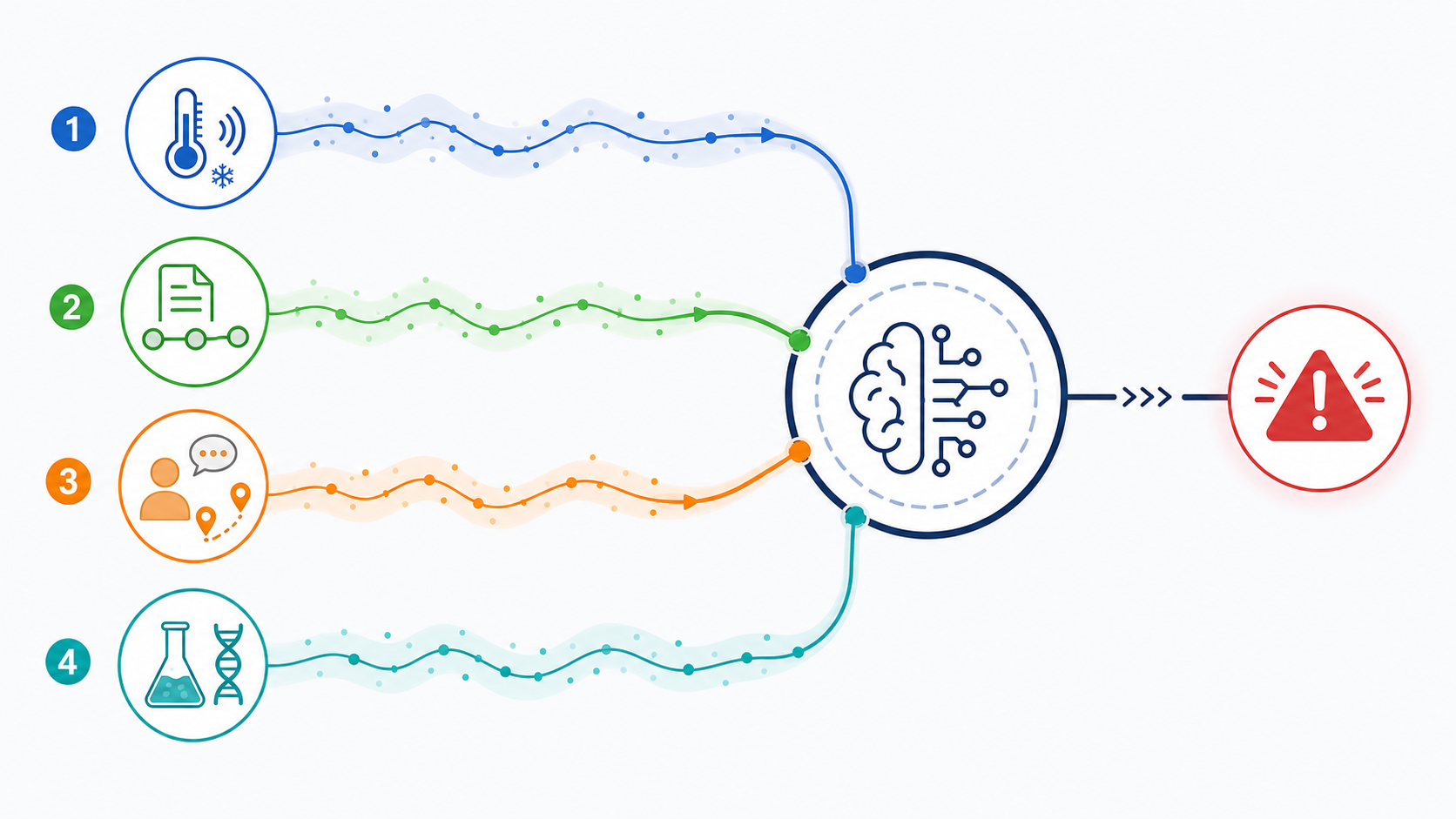
AI enables earlier foodborne outbreak detection by integrating four data streams: cold-chain telemetry, supplier traceability, consumer surveillance signals, and laboratory genomic data. This analysis examines the application pattern, documented results, and key implementation barriers for food safety leaders.
Foodborne outbreak detection usually fails first as a timing problem. A temperature excursion can tell a QA team that a pallet spent too long outside its safe range, but it cannot identify who got sick. A traceability system can locate lots and shipments, but it may not see the first illness signal. Consumer surveillance can surface complaints, but it cannot prove contamination. Genomic data can confirm that cases belong to the same cluster, but it often arrives after people have already eaten the product.
That is why the practical use case for ai for food supply chain safety outbreak detection is not a single prediction engine. It is an integrated surveillance architecture that connects four streams: cold-chain and environmental telemetry, supplier and traceability records, consumer and public-health signals, and laboratory or genomic intelligence. Each stream is incomplete. Together, they can change the operating clock from retrospective investigation toward earlier risk-informed intervention.
Why Single-Source Detection Breaks Down
Traditional traceback has always carried a painful lag. The Walmart and IBM mango traceability pilot is still cited because it made that lag visible: tracing the origin of mangoes reportedly fell from more than seven days to 2.2 seconds in the pilot environment.[1] That result matters, but not because it proves every retailer now traces food in seconds. It matters because it shows the kind of time compression possible when product identity, movement records, and searchable data structures are already in place before the alarm.
A recall coordinator does not need a beautiful dashboard after the fact. They need to know which lot is implicated, where it moved, which records are missing, who is still holding product, which illnesses may be connected, and whether laboratory evidence supports action. If one of those pieces arrives late, the organization either waits while exposure continues or intervenes broadly and absorbs the operational and reputational cost.
AI helps when it reduces that uncertainty at the interfaces between Plan, Source, Make, and Deliver. It can flag abnormal conditions, reconcile supplier records, classify weak illness signals, and support genomic interpretation. It does not remove the need for epidemiologists, food safety directors, or regulators to decide whether the evidence is strong enough to act.
The Four Streams That Make Detection Operational
The useful way to read the four-stream model is as a chain of increasing precision. Environmental data shows whether conditions became risky. Traceability data shows which product moved through those conditions. Consumer and surveillance data suggests whether people are reporting symptoms in a pattern worth examining. Laboratory and genomic data gives investigators the strongest evidence that cases or products are connected.
| Data stream | What AI looks for | What it can support | What it cannot prove alone |
|---|---|---|---|
| Cold-chain and environmental telemetry | Temperature drift, humidity anomalies, dwell-time patterns, storage deviations | Earlier risk flags before product reaches consumers | Illness causation or exact contamination source |
| Supplier and traceability records | Lot movement, missing KDEs, inconsistent CTEs, shipment links | Faster traceback, mock recall readiness, targeted holds | Whether consumers are sick or a pathogen is present |
| Consumer and surveillance signals | Symptom language, review clusters, search or location patterns | Early warning that an investigation may be needed | Definitive outbreak confirmation |
| Laboratory and genomic data | Genetic relatedness, hazard classification, contamination risk patterns | Cluster confirmation and public-health action | Immediate prevention before exposure in every case |
The order matters. Operations teams usually encounter the first two streams inside their own systems: sensors, warehouse logs, supplier portals, ERP records, transportation data, and recall files. The last two streams often sit partly outside the company: online complaints, public-health surveillance, laboratory networks, and regulatory systems. Outbreak detection improves when those boundaries are designed before the incident, not improvised during one.
Cold-chain telemetry catches risk before anyone is sick
Cold-chain AI is the earliest operational signal in many perishable supply chains. Sensors generate a continuous record of temperature, humidity, location, and dwell time. Machine learning models can then flag patterns that look different from normal handling: a reefer unit that recovers too slowly, repeated short excursions at a cross-dock, or a lane whose temperature profile deteriorates under specific weather and loading conditions.
This stream is most valuable when it changes disposition decisions. A QA manager can hold a lot for review, prioritize inspection, redirect inventory, or trigger supplier follow-up before the product spreads further. For a deeper treatment of this specific layer, ChainSignal’s AI cold-chain food safety analysis covers the sensor and optimization side in more detail.
The limitation is equally important: telemetry describes conditions, not contamination. A temperature excursion may increase risk for a susceptible product, but it does not identify a pathogen, confirm illness, or establish the original source. Treating telemetry as a trigger rather than proof keeps the system useful and defensible.
Traceability records turn a warning into a product map
Once a risk signal appears, the next question is brutally practical: which product is involved? Supplier and traceability records connect farms, processors, distribution centers, carriers, retail locations, and lots. AI does not make those records magically trustworthy. It becomes useful when it can normalize messy data, detect missing fields, match entities, and surface inconsistencies before a recall team has to defend them.
The Walmart/IBM mango pilot remains the cleanest speed example. In that test, origin tracing reportedly moved from a manual process taking more than seven days to a query returning results in 2.2 seconds.[1] The careful reading is that the pilot demonstrated what structured, shared, queryable traceability can do under favorable conditions. It should not be treated as proof that blockchain, by itself, detects outbreaks or that every production environment can reproduce the same timing.
FSMA 204 has made this layer harder to ignore. As of Q3 2026, the operative context is the proposed extension of the compliance deadline from January 2026 to July 2028, which gives companies more time but does not change the underlying direction: high-risk foods need stronger digital traceability built around Critical Tracking Events and Key Data Elements. FoodReady reports that AI-native traceability workflows can reduce mock recall time from 4-8 hours to 10-30 minutes and reduce data errors by 85-95%.[2]
Those are vendor-disclosed workflow metrics, not independent outbreak outcome studies. They are still relevant because outbreak response depends on the quality and speed of routine records. A platform that captures CTEs and KDEs automatically, validates fields, and exposes gaps before an incident can spare a recall coordinator from discovering during a crisis that a supplier lot code was entered three different ways.
For produce, the traceability problem is especially unforgiving because product moves quickly and commingles easily. ChainSignal’s related analyses on AI produce contamination traceability, romaine outbreak traceability, and FSMA 204 digitization sit in this same operating reality: the best model is only as useful as the records it can reconcile.
Consumer signals widen the listening field
Consumer surveillance is where AI feels newest, and where the evidence needs the most care. The UK Health Security Agency announced in March 2025 that it was evaluating large language models to classify online restaurant reviews for possible gastrointestinal symptom signals.[3] The appeal is obvious: diners may post about vomiting, diarrhea, or suspected food poisoning before they call a health department or before cases are linked through formal channels.
That does not make a restaurant review an outbreak. Reviews are noisy, biased toward people who post, inconsistent in timing, and often vague about what was eaten. An LLM can help triage language at scale, but a food safety team should treat the result as a lead for investigation, not a finding. The human review step is not bureaucratic drag here; it is the control that prevents weak signals from becoming false accusations.
A 2026 review summarized by News-Medical reported that smartphone search and location data outperformed traditional investigation methods by more than three times for early outbreak detection.[4] That points to real promise for digital epidemiology, especially when signals are aggregated and privacy-preserving. It should still be read as early-warning evidence. Search and location patterns may indicate where investigators should look; they do not replace case interviews, lab confirmation, or product traceback.
Genomic and lab data provide the strongest confirmation
Laboratory and genomic data sit at the precise end of the detection chain. Whole-genome sequencing can show whether isolates from patients, foods, or environments are closely related enough genetically to support a cluster investigation. AI can assist by classifying risk, comparing patterns, and helping investigators prioritize signals across large datasets.
The FDA’s GenomeTrakr network is the strongest operational evidence in this group. Since 2013, GenomeTrakr has supported more than 1,643 public health actions, showing that genomic surveillance is not merely a lab demonstration but an institutional capability used in real public-health work.[5]
Machine learning studies add a second layer of evidence, though often in research settings rather than broad commercial deployment. A 2025 review reported Salmonella contamination risk models achieving 85-100% accuracy in research contexts.[6] Nogales and co-authors reported neural network models trained on EU Rapid Alert System for Food and Feed data that predicted product categories, hazard types, and treatment measures with 86-89% accuracy.[7]
The distinction matters. GenomeTrakr demonstrates scale in public-health surveillance. The machine learning studies show technical feasibility for classification and risk prediction under defined datasets. Neither should be casually converted into a promise that a manufacturer can buy a model and predict every outbreak before it happens.
What the Evidence Actually Supports
The evidence base is uneven, which is normal for a use case that spans operations, public health, and laboratory science. Traceability has the clearest speed story. Genomic surveillance has the strongest institutional maturity. Consumer-signal AI is promising but still an early-warning supplement. Cold-chain AI is operationally useful for risk flagging, but it must be connected to product and lot identity to matter during an outbreak.
| Evidence area | Supported conclusion | Evidence quality |
|---|---|---|
| Traceback speed | Structured digital traceability can compress origin tracing and mock recall workflows dramatically | Strong for pilots and vendor workflow metrics; production transfer depends on data readiness |
| Consumer surveillance | LLMs and smartphone-derived signals can expand early-warning surveillance | Promising, but not confirmatory |
| Genomic surveillance | Whole-genome sequencing networks support public-health action at scale | Operationally established |
| ML risk classification | Models can classify hazards, product categories, or contamination risk in defined datasets | Technically promising; rare-event deployment remains difficult |
Market activity is accelerating around these capabilities. BCC Research, cited by IFT, estimated the AI in food safety and quality control market at $2.7 billion in 2024 and projected it to reach $13.7 billion by 2030, a 30.9% compound annual growth rate.[8] The same research context reported that more than 60% of AI adoption in food manufacturing focused on real-time quality inspection and contamination detection as of 2025.[8]
Adoption momentum is not the same as outbreak-prevention proof. A plant may use AI vision for foreign material detection, a distributor may use temperature analytics, and a retailer may improve recall records; those are valuable deployments, but they become outbreak detection only when signals can be joined across product movement, exposure, illness, and confirmation.
The Rare-Event Problem
Food safety AI is technically hard because most of the data is normal. Most shipments do not cause illness. Most temperature readings stay within range. Most consumer complaints are unrelated to a verified outbreak. Most lots are not contaminated. The rare event is the one that matters, and that imbalance makes simple accuracy claims slippery.
A model can look accurate by learning normal operations well while missing the few signals that matter. It can also become too sensitive and bury QA teams in false positives. In outbreak detection, the cost of each error is asymmetric: a false negative can leave contaminated product in the market, while a false positive can trigger unnecessary holds, waste, supplier conflict, and consumer alarm.
This is where multi-stream design earns its keep. A temperature anomaly alone may not justify a recall. A cluster of gastrointestinal review language alone may not justify naming a source. A genomic match without distribution context may not identify where product moved. But when environmental risk, lot movement, consumer signals, and lab data begin pointing toward the same corridor of products, facilities, or dates, investigators have a narrower and better-supported field of action.
Implementation Barriers That Decide Whether It Works
The four-stream model is not equally reachable for every company. Large retailers and vertically integrated manufacturers can standardize more data than a small processor buying from many suppliers and selling through multiple distributors. The gap is not only technical; it is financial, contractual, and organizational.
- SME cost constraints: A 2025 review reported that AI inspection equipment can cost 5-8 times more than traditional alternatives; it also projected that edge computing and lightweight models could reduce device costs to under $1,500, but that is a projection rather than the current baseline.[6]
- HACCP and ERP integration: Risk signals need to land inside existing food safety workflows, not in a separate tool that QA teams check after production decisions are made.
- Explainability: Auditors and regulators need to understand why a lot was held, why a supplier was escalated, or why an alert was dismissed. Black-box scoring is weak support for high-consequence decisions.
- Cross-organization data sharing: Outbreaks do not respect company boundaries. Suppliers, processors, carriers, retailers, laboratories, and public-health agencies each hold partial evidence.
- FSMA 204 timing: The proposed extension to July 2028 gives companies breathing room, but it also makes 2026 a design window for traceability architecture rather than a reason to defer it.[2]
Federated learning is one possible answer to the data-sharing problem because it allows models to learn across distributed datasets without exposing all proprietary supplier data. That is a promising direction, especially for supply chains where no single party sees enough events to train robust models. It does not eliminate governance questions about consent, model accountability, audit rights, or how an alert is communicated when the underlying data remains distributed.
The practical implementation sequence should start with control, not aspiration. A food safety leader can ask which streams the organization already owns, which partners must contribute data, which fields are missing during mock recalls, where alerts would interrupt operations, and who has authority to hold product. Those questions reveal more about readiness than a vendor demo of anomaly detection.
The Decision Standard
AI can materially improve foodborne outbreak detection when it changes the operating clock: earlier risk flags, faster traceback, narrower holds, better triage of public signals, and stronger linkage to laboratory confirmation. The case is weakest when AI is sold as a standalone predictor. It is strongest when models sit inside a traceable, reviewable, multi-party system that already knows what product moved, under what conditions, to which destination, and with which evidence gaps.
The useful test is straightforward. If a signal fires tomorrow, can the team connect conditions, lots, suppliers, distribution, complaints, and lab evidence quickly enough to make a defensible decision? If not, the next investment is not another model in isolation. It is the missing stream, the missing integration, or the missing human review point that keeps an alert from becoming action.
References
- Walmart Food Traceability Initiative, LF Decentralized Trust
- FSMA 204 Compliance: Complete Guide to FDA Food Traceability Requirements, FoodReady
- UKHSA trials AI to detect foodborne disease outbreaks from restaurant reviews, GOV.UK, March 2025
- AI and smartphone data could revolutionize foodborne outbreak detection, News-Medical, June 2026
- GenomeTrakr Network, U.S. Food and Drug Administration
- Artificial Intelligence in Food Safety: A Review, Foods, 2025
- Artificial intelligence for the classification of food alerts: The case of the Rapid Alert System for Food and Feed, Food Control, 2022
- AI in Food Safety and Quality Control Market to Reach $13.7 Billion by 2030, BCC Research, August 2025
Cited evidence
- Can AI outbreak detection make supply chains more resilient?
This article examines whether AI-powered epidemic intelligence platforms can detect outbreaks early enough for supply chain teams to take preventive action, and what the current evidence reveals about lead time, accuracy, and the gap between detection and response.
- AI drone attacks create a new risk category for oil supply chains
AI-powered drone strikes on oil infrastructure represent a distinct supply chain disruption vector with precision targeting, extreme cost asymmetry, and sustained campaign capability. This article translates documented strike data into actionable risk assessment and mitigation strategies for supply chain leaders.
- How AI Helps Food Supply Chains Navigate the Iran Crisis
The Iran war and Strait of Hormuz closure have created cascading crises for food supply chains. This article examines which AI capabilities—from demand sensing to supplier risk monitoring—deliver measurable advantages during these disruptions and how supply chain leaders can prioritize them in the next 90 days.
Spotted something inaccurate or incomplete in this entry? ChainSignal reviews corrections and additional evidence before publishing an update — this is not a public comment thread.
Flag an inaccuracy / submit evidence for this entry →