
The wrong lesson from Tesla’s 2026 supply chain is that the company wants to own everything. That version is easy to repeat and usually useless. The more practical reading is narrower: Tesla is trying to own the nodes where dependency would slow product decisions, expose cost, weaken differentiation, or put a bottleneck outside its reach.
That distinction matters because the useful prediction is not “more vertical integration” in the abstract. It is a more selective kind of integration, where AI changes both sides of the make-vs-buy question: it makes some dependencies more strategic, especially compute and chips, while also making tighter coordination across owned assets more manageable.
Start With the Lithium Refinery, Not the Myth
Tesla’s Texas lithium refinery is the cleanest place to see the difference between control and ownership-for-its-own-sake. The facility became operational in January 2026, according to Tesla’s 2025 annual report as cited by Logistics Viewpoints.[1] The point is not that Tesla has replaced the lithium market. The point is that Tesla is moving into a constrained upstream processing node while still operating inside a broader supplier ecosystem.
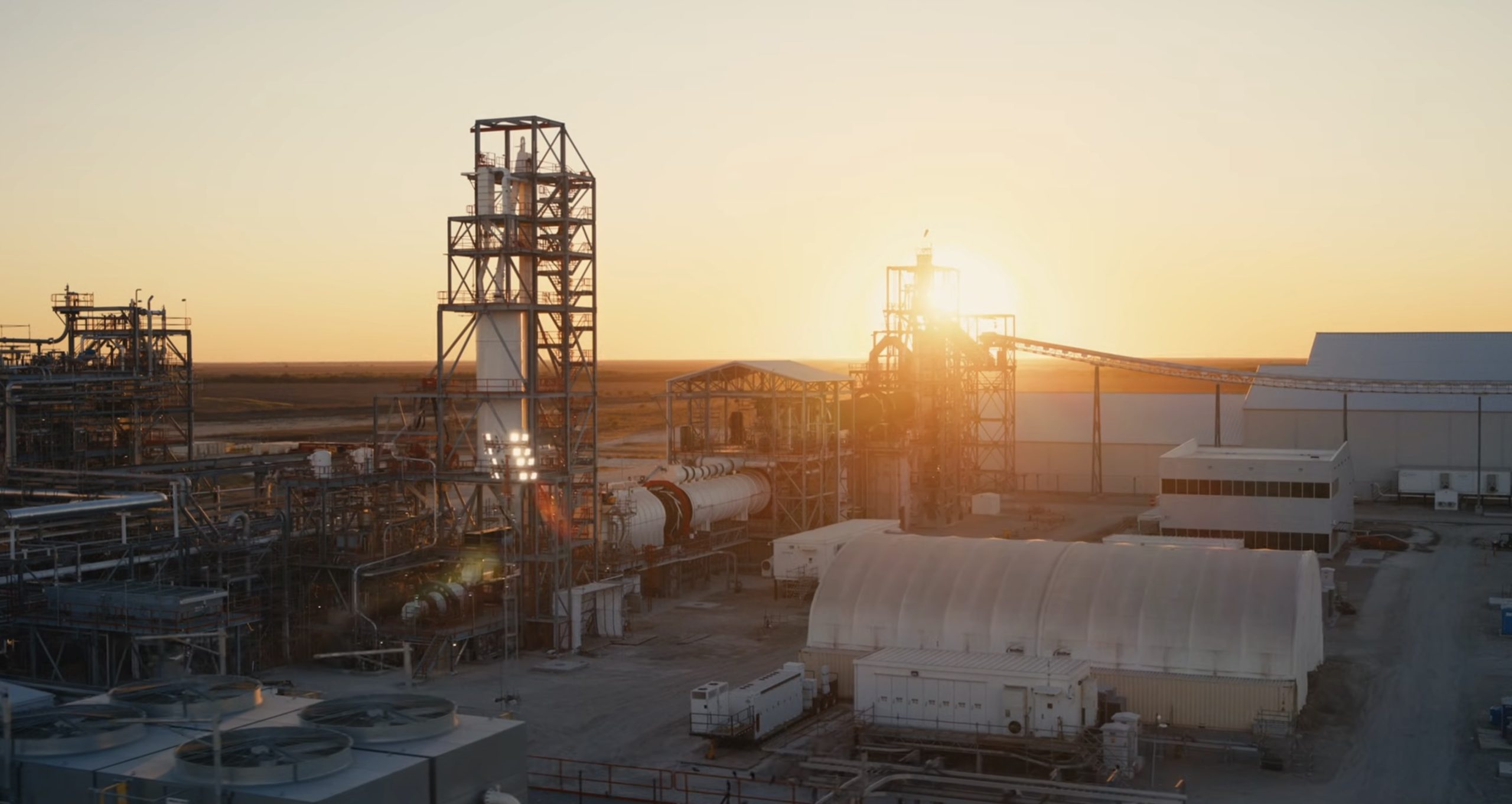
That is a more disciplined signal than the usual “Tesla is vertically integrated” shorthand. Lithium processing sits close to battery cost, supply assurance, qualification cycles, and manufacturing continuity. If a company believes a material input can determine factory utilization or product economics, it has a reason to ask whether procurement alone is enough. It still has to prove that operating the asset beats market access, but the dependency is real enough to deserve the question.
This is also where a popular coverage habit gets in the way. The often-repeated claim that Tesla is “87% vertically integrated” could not be independently verified against the 2025 annual report in the research available here. Treating that kind of figure as precision gives executives the wrong tool. A percentage sounds analytical, but it does not say which dependency matters, what performance gap ownership solves, or whether the owned activity is governed well after the ribbon-cutting.
The 2026 Pattern: Own the Control Points
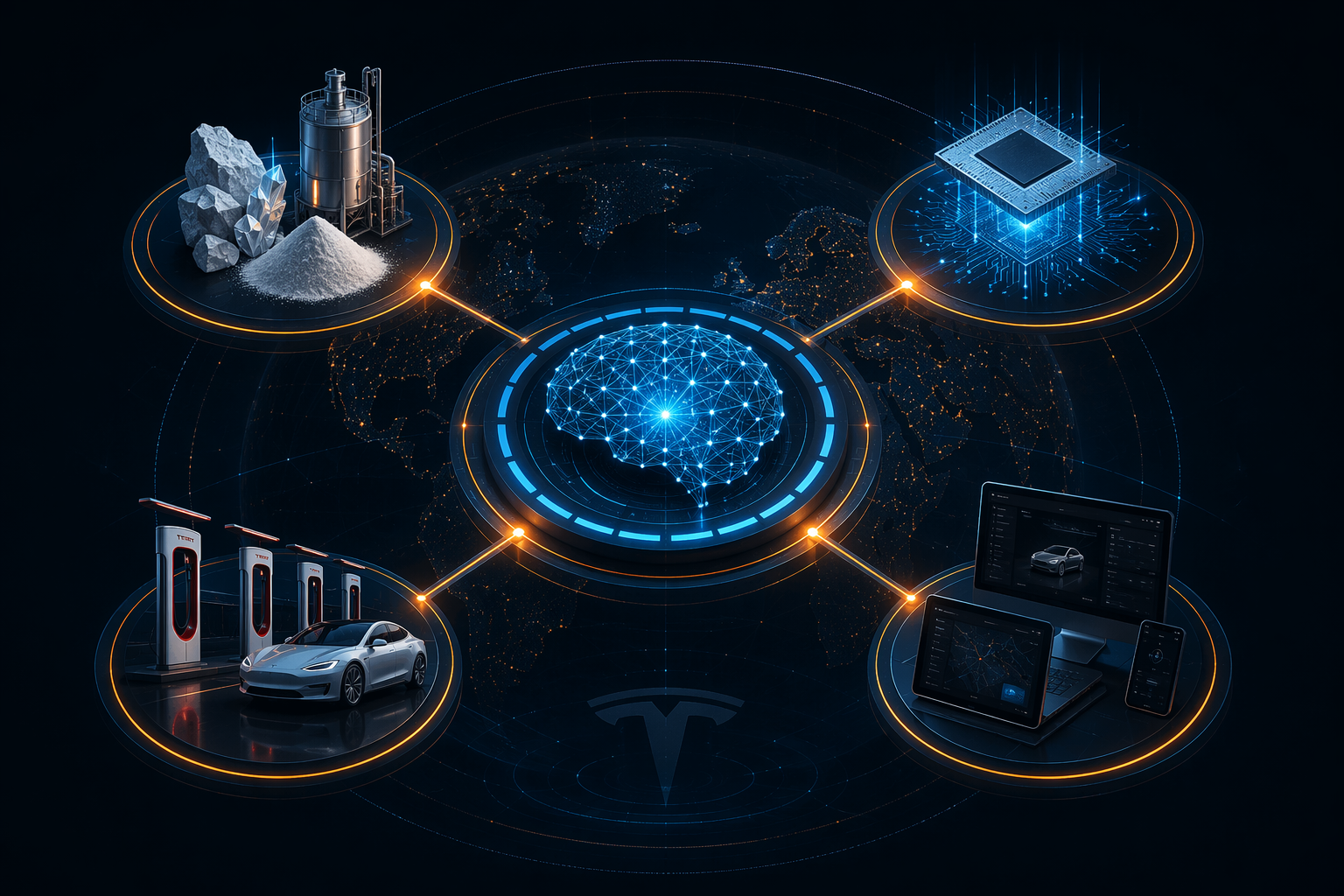
Tesla’s 2026 control-point pattern runs from materials to chips, compute, software, charging, and manufacturing coordination. These are not equivalent activities. They do not all require the same capital, talent, or operating model. What they share is a position near a strategic constraint: cost, quality, speed, resilience, or differentiation.
| Control point | Why it matters | What ownership may change |
|---|---|---|
| Lithium processing | Battery input cost, supply assurance, qualification timing | More direct control over a constrained upstream node |
| Semiconductors | Hardware performance, product timing, supplier scarcity exposure | Potentially faster design iteration and less dependence on external chip roadmaps |
| AI compute | Training and inference capacity for autonomy, robotics, and internal systems | Priority access to infrastructure that may become a strategic bottleneck |
| Software and charging | Customer experience, data loops, uptime, product differentiation | Tighter integration between product behavior, service, and infrastructure |
| Manufacturing coordination | Factory ramp speed, exception handling, planning discipline | Better synchronization if data, workflows, and governance are strong enough |
The table is not a claim that every company should copy Tesla’s asset map. Most should not. A retailer, medical device manufacturer, industrial distributor, or consumer electronics firm will have different control points. The transferable move is the sequence of questions: which dependency governs strategic performance, whether the outside market can meet the required pace, and whether ownership changes the economics or speed enough to compensate for the added complexity.
Terafab Is the Boldest Claim and the One That Needs the Most Restraint
The Terafab semiconductor megafactory announcement is much more aggressive than the lithium refinery example. Forbes/Tirias Research reported an announced initial capital expenditure of $20 billion to $25 billion, with a potential total of $60 billion, and cited Elon Musk’s claim that the project could support seven-day design-to-test cycles.[2] If that ambition were realized at meaningful production scale, it would be a serious change in the semiconductor dependency model.
The caveat belongs in the same breath. Terafab is an announced project, not independently verified operating performance. Timeline, cost, yield, talent depth, equipment access, and the ability to produce meaningful output remain unproven in the material available as of July 2026. Sources discussing the project note that it could take years to achieve meaningful output.[2]
Still, the strategic logic is not hard to understand. Semiconductors are not just another purchased input when product differentiation depends on inference performance, latency, power consumption, onboard intelligence, robotics capability, and autonomy roadmaps. If external chip suppliers cannot match the iteration speed a company believes its product cycle requires, the make-vs-buy discussion moves from procurement savings to architectural control.
That does not make insourcing automatically right. A semiconductor supply chain is not a heroic engineering deck; it is a dense operating system of process technology, equipment vendors, packaging, testing, materials, talent, and yield learning. The fact that a node is strategically important only earns it a place on the make-vs-buy agenda. It does not settle the decision.
Compute Has Become a Supply Chain Control Point
The older vertical integration story was usually about factories, parts, and logistics capacity. Tesla’s 2026 version adds compute as a supply chain dependency. Dojo, AI5 inference chip development, and Terafab all point to the same pressure: if AI capability is central to product behavior and manufacturing coordination, then compute access is no longer an IT line item. It becomes part of the operating architecture.
This is where AI changes the boundary of the firm in two directions. First, it creates new bottlenecks. A company that depends on model training, simulation, perception, forecasting, planning agents, or real-time inference may find that external compute availability shapes product speed. Second, AI can reduce some of the coordination burden that used to make vertical integration unwieldy, especially through forecasting systems, control towers, exception management, agentic workflows, and automated planning support.
Tesla’s capital plan reinforces that this is not a side issue. Reuters reported, based on Tesla’s SEC filing, that Tesla’s capital expenditures were $8.5 billion in 2025 and that planned 2026 spending exceeded $20 billion across AI, robotics, energy, and manufacturing.[3] That spending profile does not prove execution quality, but it does show where management is placing the control-point bet.
The Market Is Moving in the Same Direction, Just With Less Drama
Tesla is not the only company trying to shorten, localize, or automate parts of the supply chain decision loop. A Prologis/Harris Poll survey of 1,800 executives found that 58% expected more localized supply chains by 2030, 75% identified AI as a top capital investment priority, and leaders reported a 77% return on AI investments within 12 months.[4] Those figures are useful as directional evidence, not as a blank check for integration.
The adoption mood is also not the same as decision autonomy. RELEX’s State of the Supply Chain 2026 report, based on more than 500 supply chain leaders, found that 67% were more confident in AI than in 2025, but only 10% trusted AI for critical decisions without human review.[5] That gap is exactly where many make-vs-buy committees should spend time. AI may help coordinate owned nodes, but it does not remove accountability for the judgment to own them.
Accenture’s 2024 study of 1,148 companies adds another useful boundary. It found that companies with AI-mature supply chains were 23% more profitable than peers and six times as likely to use AI and generative AI widely.[6] That is not proof that AI causes every profitability difference, and it is not a Tesla-specific result. It does suggest that AI capability increasingly separates companies that can manage complex supply chains from those merely describing them.
A Make-vs-Buy Test for 2026
The practical question for another supply chain leader is not whether to become Tesla. It is whether a specific dependency deserves to be treated as a control point. The test should begin before anyone asks for a factory, acquisition, exclusive contract, or internal platform budget.
- Name the dependency precisely. “Batteries,” “chips,” or “AI” is too broad. The useful unit may be lithium processing, advanced packaging capacity, a forecasting model, charging uptime, a test loop, or a supplier qualification step.
- Identify the performance variable it controls. The case for ownership is stronger when the node governs cost, quality, speed, resilience, customer experience, or product differentiation.
- Test the outside market honestly. If suppliers can meet the required performance, pace, confidentiality, and resilience at acceptable cost, ownership may only add managerial vanity.
- Ask what ownership actually changes. The answer has to be more than “more control.” It should specify faster iteration, lower exposure to scarcity, better data access, tighter quality loops, or improved economics over a relevant time horizon.
- Decide whether AI reduces or increases the coordination burden. AI can help with planning, sensing, exception handling, and workflow orchestration, but weak data and unclear authority can turn automation into another layer of confusion.
- Assign governance before adding assets. The company needs to know who arbitrates tradeoffs among procurement, operations, engineering, finance, legal, and product teams once the activity moves inside.
This test is deliberately less glamorous than a control tower demo or a factory announcement. It is also closer to the decision executives actually face. A company can be right that a supplier market is inadequate and still wrong that it can operate the alternative. It can be right that AI improves coordination and still underestimate the process discipline needed to make AI useful.
What AI Changes in the Test
AI does not make vertical integration cheap. It changes the cost of coordination in selected places. A planning system that can sense demand changes, flag supplier risk, propose allocation options, and route exceptions to the right human reviewers can make a more integrated architecture less brittle. That is a real advantage when the owned node sits close to product speed or customer promise.
But AI also raises the performance standard for the company doing the insourcing. Once a firm claims that AI lets it coordinate across materials, factories, chips, software, and infrastructure, it cannot manage those pieces as disconnected executive trophies. The data model, escalation rules, model governance, cybersecurity posture, and human review process become part of the supply chain design.
That is why the RELEX finding matters more than its headline confidence number. Most leaders are more comfortable with AI than they were a year earlier, but few are ready to let it make critical decisions without review.[5] A serious AI-enabled control-point strategy should assume humans remain in the loop for high-consequence tradeoffs: shutting down a line, reallocating scarce chips, changing supplier commitments, or overriding inventory policy.
Where Tesla’s Logic Transfers—and Where It Does Not
The transferable lesson is architectural, not imitative. Tesla-scale spending is irrelevant to most companies. What matters is the discipline of isolating the few dependencies that determine strategic performance and treating those differently from ordinary spend categories.
For a food manufacturer, the control point might be cold-chain sensing and regional capacity rather than ingredient ownership. For a medical device company, it might be a specialized component qualification process. For an industrial firm, it might be field-service parts visibility or a machining capability that determines lead time for strategic customers. These examples are hypothetical, but they show the same decision shape: the control point is where external dependency constrains the promise the company is trying to keep.
Tesla’s lithium refinery is a useful example because it does not require believing that every activity belongs inside the firm. It shows selective upstream control. Terafab is useful for a different reason: it forces the uncomfortable part of the discussion. The more strategic the dependency, the more tempting it is to assume ownership is the mature answer. Sometimes it is. Sometimes the market is still better, a partnership is enough, or the company should reserve capital for the capabilities it can actually govern.
The Disciplined 2026 Prediction
The strongest prediction for 2026 is not that Tesla, or anyone else, will win by owning more. It is that the make-vs-buy boundary will move toward the nodes where AI, product differentiation, and supply assurance intersect. Lithium processing, semiconductor capability, AI compute, software, charging, and manufacturing coordination are visible in Tesla’s case because those are the places where dependency can translate into slower iteration or weaker product control.
For other companies, the lesson is to own the few dependencies that set strategic performance, use AI to coordinate them where the data and governance are strong enough, and leave everything else exposed to market discipline unless the evidence says otherwise.
References
- What Tesla Reveals About Vertical Integration in Supply Chains, Logistics Viewpoints, April 20, 2026, link
- Can Musk Build His Own Semiconductor Supply Chain?, Forbes, April 8, 2026, link
- Tesla SEC filing, Reuters / Tesla SEC filing, link
- Supply Chains 2026: Less Globalization, More AI, Forbes, October 4, 2025, link
- State of the Supply Chain 2026, RELEX Solutions, link
- Accenture study on AI-mature supply chains, Accenture, 2024
Comments
Join the discussion with an anonymous comment.