
A supply chain AI agent that can recommend a supplier is useful. One that can approve a replenishment order, adjust a route, trigger a warehouse workflow, or escalate a production exception is a different class of system. At that point, the security question is no longer only whether the model leaks data or whether an endpoint has malware. The harder question is whether the organization can see the autonomous actor, the permission it is using, the asset it is touching, and the policy that should stop or redirect the action when conditions change.
That is why the ServiceNow Armis acquisition matters for AI cybersecurity in supply chain. Not because another large platform vendor bought another security company, and not because operational technology suddenly became fashionable. It matters because agentic supply chain workflows sit exactly where conventional security programs are weakest: between machine identities, business permissions, and operational assets that often live outside clean corporate IT inventories.
The imbalance is already visible before AI agents are added. Machine identities now outnumber human identities by 80:1, and nearly half carry sensitive or privileged access that many organizations cannot fully see or control, according to CyberArk’s 2025 Identity Security Landscape research.[1] Add autonomous agents that can act across procurement platforms, transportation systems, inventory tools, warehouse execution systems, and OT-adjacent devices, and the old split between “user security” and “device security” starts to look operationally thin.
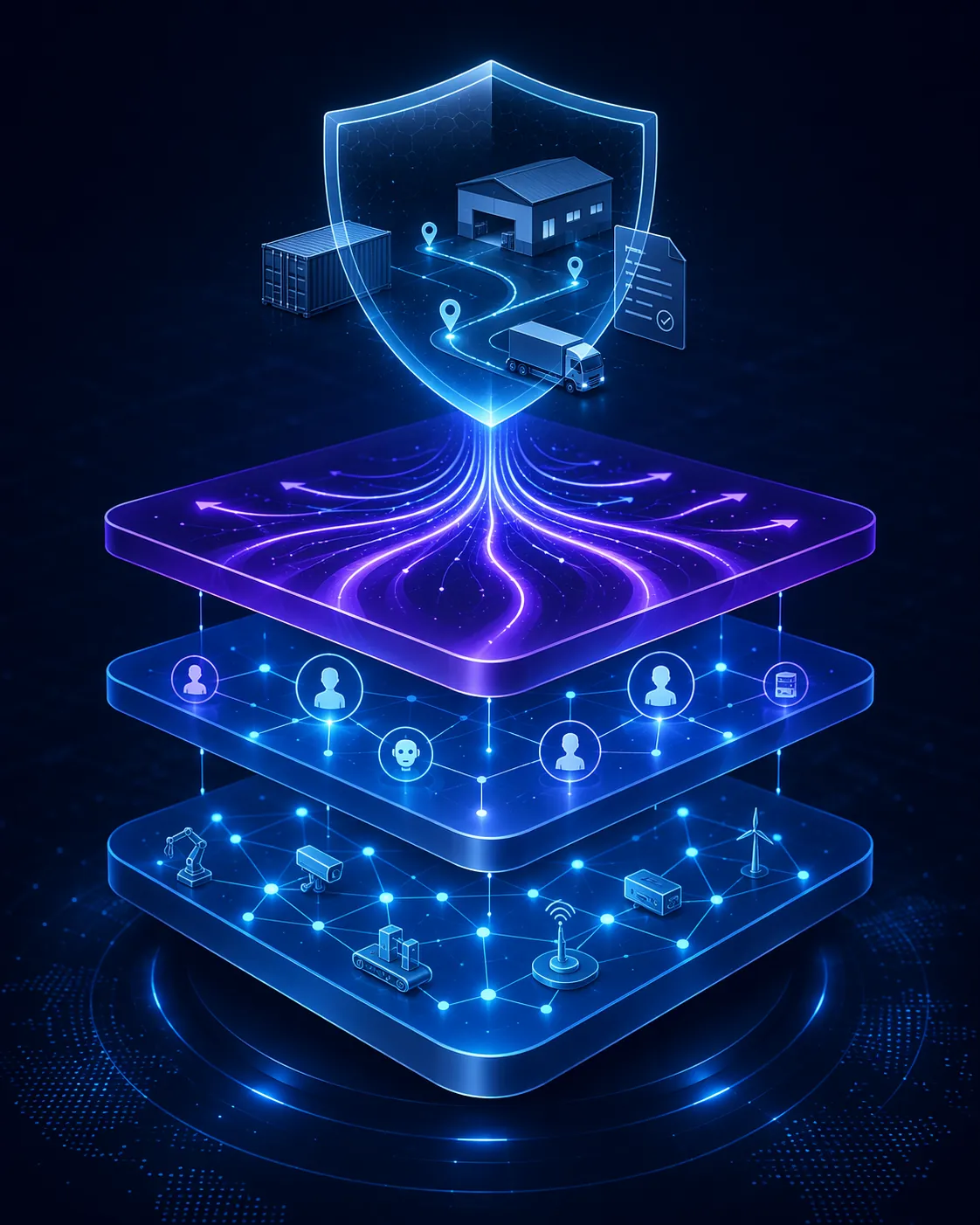
The Attack Surface Is the Intersection, Not the Endpoint
Most supply chain AI conversations still separate the layers too neatly. Procurement teams talk about autonomous sourcing recommendations. Logistics teams talk about dynamic routing. Warehouse teams talk about robot coordination and labor balancing. Security is asked to protect the environment once the workflow is already being wired together.
That sequence creates a predictable gap. A cybersecurity tool may detect exposure on a device. An identity tool may show that a service account has broad access. A workflow system may know that an exception was routed to a manager. But an autonomous operational action needs all three views at once. If an AI agent recommends moving inventory away from a delayed lane, can it also update the transportation plan? If it can update the plan, which identity is used? If that change requires a warehouse automation system to reprioritize picks, which OT or IoT assets are affected? If risk changes midstream, who pauses the action?
This is where breach-cost statistics are useful, but only as context. IBM’s 2025 reporting puts the average cost of a supply chain compromise at $4.91 million and its mean lifecycle at 267 days, the longest among breach vectors in that report.[2] The more important point for agentic AI is mechanical: long-lived compromises thrive where ownership is fragmented. Autonomous workflows can amplify that fragmentation if the organization cannot connect identities, permissions, assets, and actions into one governed path.
That is also why the relevant question is not simply whether an AI agent is “secure.” It is whether the operating model around the agent can answer a few unglamorous questions every time the agent acts: what asset exists, what identity can act on it, what policy applies, what exception path is available, and what audit trail proves the decision later.
Why Armis Changes the ServiceNow AI Security Story
ServiceNow completed its acquisition of Armis on April 20, 2026, describing the deal as a move to close the gap between asset visibility and cyber risk and to create what it called “the world’s first unified, end-to-end security exposure management and operations stack.”[3] Dark Reading reported the transaction value at $7.75 billion and tied the acquisition directly to ServiceNow’s AI Control Tower ambitions.[4]
The price tag is less interesting than the layer Armis supplies. Armis gives ServiceNow an asset intelligence foundation across IT, OT, IoT, medical devices, physical AI, code, and cloud environments. ServiceNow said Armis tracks nearly 7 billion devices in real time; Armis separately describes a 6.5 billion-plus asset knowledge base.[3][5] Those figures should be treated as scale signals rather than a precision contest. The strategic point is that Armis specializes in seeing assets that ordinary IT inventories often miss, including the operational devices that matter when supply chain workflows leave the screen and touch the floor.
For a warehouse or manufacturing-adjacent supply chain environment, that distinction matters. The agent does not need to “hack a robot” in cinematic fashion to create risk. It may only need to trigger a workflow that depends on a misclassified device, an unmanaged sensor, an exposed controller, or a warehouse automation endpoint with unclear ownership. If the platform governing the workflow cannot see the asset, it cannot reliably judge whether the requested action is safe.
The Three-Acquisition Architecture
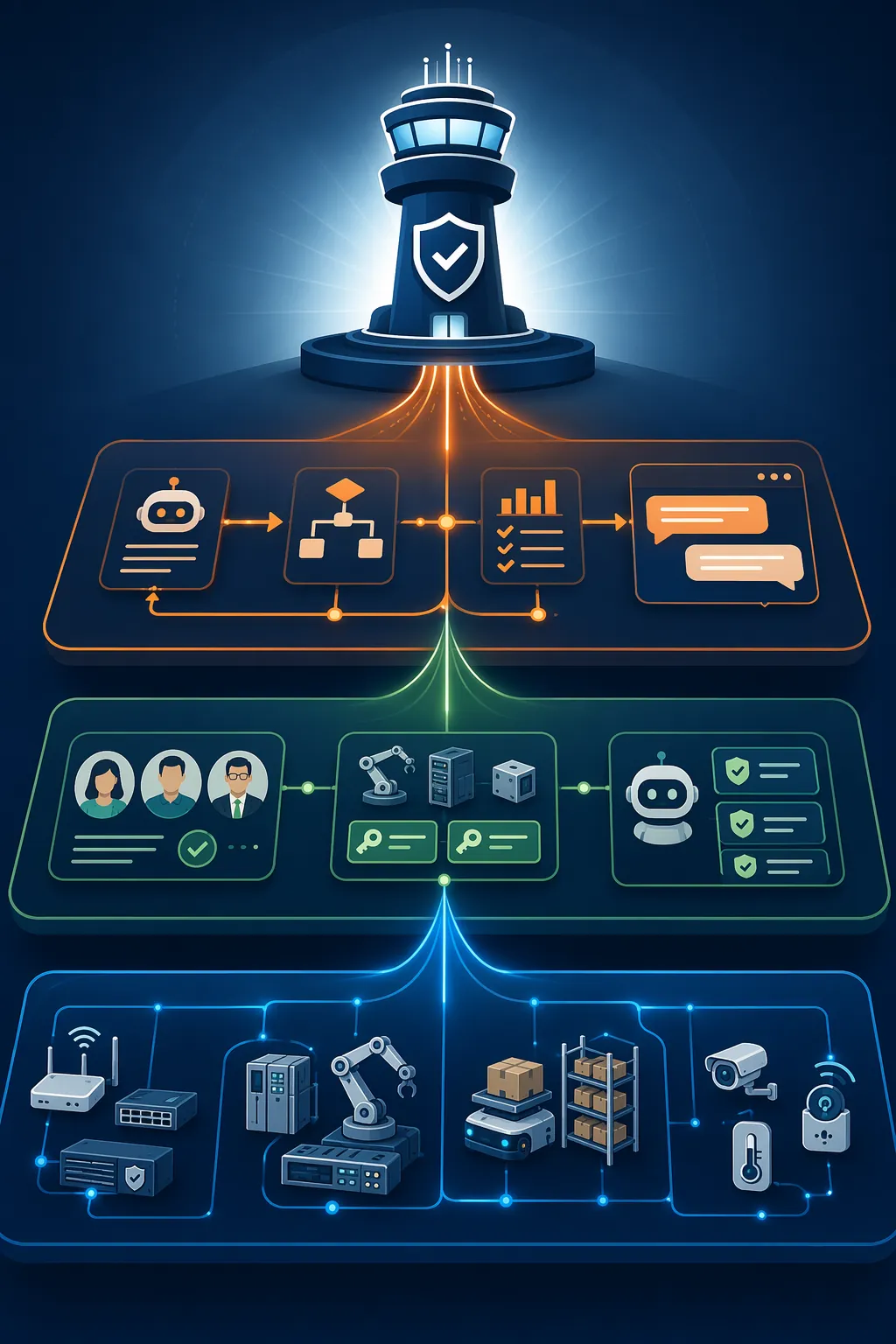
Armis is not the whole architecture. It is the visibility layer in a sequence that also includes Moveworks and Veza. ServiceNow acquired Moveworks for $2.85 billion in March 2025, adding an AI assistant and orchestration layer for enterprise workflows.[6] It completed the Veza acquisition in March 2026, adding identity security capabilities that ServiceNow describes as cross-system visibility into every permission held by every human, machine, and AI agent identity.[3]
| Layer | Acquisition | Operational Question It Helps Answer |
|---|---|---|
| Asset visibility | Armis | What devices, systems, OT assets, IoT endpoints, cloud resources, and operational assets exist? |
| Identity intelligence | Veza | Which human, machine, and AI agent identities have permission to act, and what can they do? |
| AI orchestration | Moveworks | How does workflow intent become an AI-mediated action across enterprise systems? |
Put together, the logic is clear. Armis tells the platform what exists. Veza tells it who or what can act. Moveworks supplies an AI interface and orchestration layer that can translate intent into workflow execution. ServiceNow’s own framing puts these graphs into its Context Engine, described as the organizational intelligence that grounds AI actions in business reality.[3]
That is the part worth watching. A generic AI assistant can generate a recommendation. A workflow platform with asset context, identity context, and policy context can decide whether the recommendation should become an action, whether it should be constrained, or whether it should be routed to a human approver. For supply chain organizations, that moves AI governance from a document exercise into the operational path.
This is also the difference between an AI control tower that observes and one that can govern. Earlier supply chain control tower discussions focused heavily on visibility, prediction, and exception management. The next version has to deal with autonomous remediation: when the system recommends a response, requests approval, initiates a workflow, or adjusts an operating plan. That shift is already visible in how companies discuss AI-powered supply chain control towers, but the security architecture has to catch up.
What This Means in Supply Chain Operations
The useful way to evaluate the ServiceNow-Armis-Veza-Moveworks combination is to follow an autonomous action through a supply chain workflow.
Start with procurement. An AI agent flags a supplier risk and recommends shifting an order to an alternate vendor. That recommendation may touch supplier master data, contract terms, spend thresholds, approval hierarchies, purchase order creation, and finance controls. Veza’s relevance is not abstract identity hygiene; it is the ability to show which identities, including machine and AI agent identities, can read, change, approve, or escalate each step. Without that, the organization may know what the agent suggested but not whether the agent had excessive authority when it acted.
Move to logistics. An agent sees a disruption and proposes rerouting freight. That workflow may call a transportation management system, notify a carrier, adjust delivery promises, and update downstream inventory expectations. The risk is not only that the route is wrong. The risk is that the agent’s action crosses from recommendation into execution without policy checks that reflect shipment value, customer priority, regulated goods, lane risk, or carrier authorization.
Then move into the warehouse. An agent reprioritizes waves, changes replenishment tasks, or coordinates with automation. This is where Armis becomes especially relevant. Warehouse technology stacks commonly include scanners, printers, cameras, sensors, conveyors, robots, access systems, and industrial control components that do not behave like standard laptops or cloud workloads. If a workflow depends on those assets, visibility has to include them. Otherwise the AI agent is operating over a partial map.
The governance requirement is not to block automation until every edge case is solved. Supply chain teams will not accept that, and they should not have to. The requirement is to put the agent inside a policy-enforced path where authority is explicit, exceptions are routed, assets are known, and the audit trail shows what happened. That is the practical promise of combining asset intelligence, identity intelligence, and workflow orchestration in one platform.
The Audit Trail Becomes an Operating Requirement
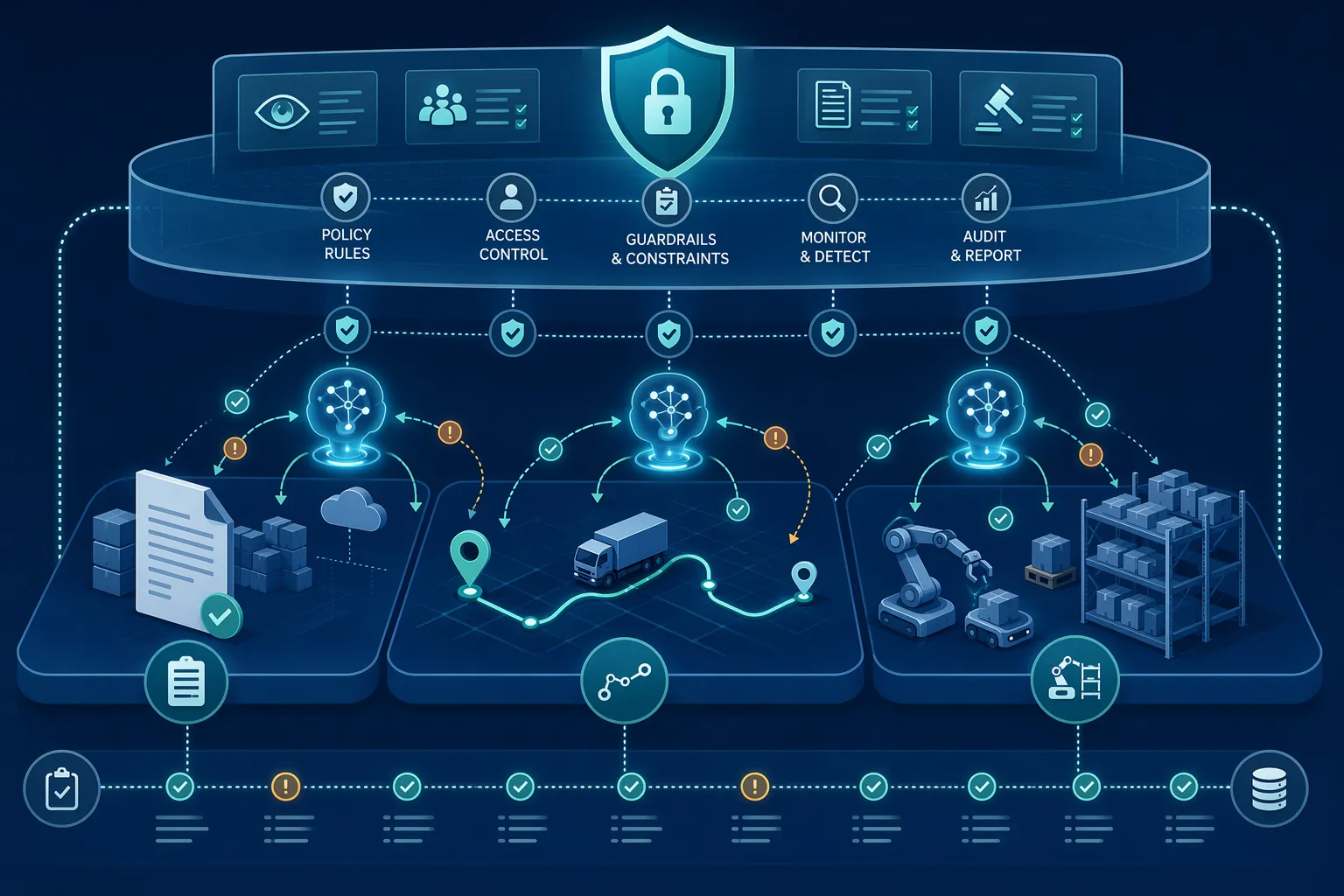
Auditability is often treated as a compliance afterthought. In agentic supply chain operations, it becomes part of the control design. A procurement systems owner needs to prove why an agent approved one action and escalated another. A logistics leader needs to know whether an autonomous route adjustment followed policy or bypassed it. A warehouse technology lead needs to see which device, system, or automation endpoint was involved when an exception occurred.
That is where a workflow-native security stack has an advantage over a pile of disconnected tools. If the same environment can capture the request, the identity, the asset, the policy decision, the remediation action, and the approval trail, the organization can govern the action while it happens instead of reconstructing it weeks later from logs. This is the same reason AI governance for supply chain decisions has to be designed before autonomous workflows scale, not appended after pilots spread across functions.
The rogue-AI problem fits here as well. Unauthorized or poorly governed AI use in supply chain is not only a data leakage issue; it is an action-control issue. A model that can summarize supplier records is one level of exposure. An agent that can initiate, alter, or escalate operational workflows is another. The concern explored in rogue AI supply chain data risk becomes more serious when the tool has permissions, not just text inputs.
Armis Has Operational Proof Points, but Not Yet the Whole Agentic Story
There is a grounded reason supply chain leaders should pay attention to Armis specifically. In a Takeda case study, Armis described supporting visibility and security for environments tied to the ongoing delivery of critical therapeutics to patients.[7] That is not a generic office IT setting; it is a continuity-sensitive environment where operational disruption has consequences beyond ticket queues.
The case should not be stretched into proof that the combined ServiceNow stack is already securing autonomous supply chain agents in production. The research material does not show that. What it does show is that Armis has been applied in environments where asset visibility and operational continuity matter, and ServiceNow is now positioning that visibility inside a broader AI and security workflow architecture.
That distinction matters for buyers. The acquisition sequence is strategically coherent, but coherence is not the same as deployment maturity. A supply chain organization evaluating the combined stack should press for integration depth: whether Armis asset context, Veza permission context, and Moveworks-driven workflow actions are visible in the same policy and audit model, not merely available as adjacent products under one vendor logo.
What Buyers Should Test Before Believing the Platform Story
ServiceNow’s security and risk business crossed $1 billion in annual contract value in Q3 2025, and its OT business had its largest quarter in Q4 2025, according to the company’s Armis acquisition announcement.[3] That provides market context, but it does not answer the operational questions that matter in a supply chain AI program.
The useful evaluation is more specific:
- Can the platform show every identity involved in an AI-triggered supply chain workflow, including service accounts, machine identities, and AI agent identities?
- Can it map those identities to the exact systems, devices, OT assets, and workflow records they can affect?
- Can policy distinguish between recommendation, approval, execution, exception handling, and remediation?
- Can risk changes alter the agent’s allowed actions in real time, or does the system only report exposure after the fact?
- Can an auditor reconstruct what the agent did, under whose policy, with which permissions, against which assets, and who approved or overrode the action?
Those tests are more useful than asking whether the stack is “AI-native.” The phrase is now too easy to apply to any product with a model interface. In supply chain operations, AI-native security has to mean that the control plane understands autonomous action: intent, authority, asset exposure, exception routing, remediation, and evidence.
The Measured Bet
The ServiceNow Armis acquisition is best understood as the missing operational visibility layer in a larger AI cybersecurity architecture for supply chain. Moveworks gives ServiceNow a stronger AI orchestration interface. Veza adds the permission graph across human, machine, and AI identities. Armis adds the asset graph across IT, OT, IoT, cloud, and operational environments. The Context Engine is the place ServiceNow wants those signals to meet.
If the integrations work at policy depth, the result changes security from monitoring separate tools to governing autonomous operational actions. That is the right direction for supply chains moving from AI recommendations to AI agents. The remaining question is execution: whether buyers can see granular permissions, operational assets, workflow decisions, remediation paths, and audit trails in one governed model. The acquisition headlines make the strategy credible. They do not, by themselves, prove the agentic supply chain outcome.
References
- 2025 Identity Security Landscape, CyberArk
- Cost of a Data Breach Report 2025, IBM
- ServiceNow completes Armis acquisition, closing the gap between asset visibility and cyber risk, ServiceNow, April 20, 2026
- ServiceNow Buys Armis for $7.75B, Boosts 'AI Control Tower', Dark Reading
- Welcoming the Next Chapter: ServiceNow Completes Armis Acquisition, Armis
- ServiceNow Expands AI Control Towers into Operational Command, SupplyChain360
- Armis Helps Ensure Ongoing Delivery of Critical Therapeutics to Patients, Armis
Comments
Join the discussion with an anonymous comment.