
The hard part of a Salmonella egg recall in the supply chain is not writing the recall notice. It is the time before the notice, when eggs have already left the plant, lab work is still running, illness reports are still being matched, and the people responsible for food safety are trying to decide whether a weak signal is enough to stop commerce.
FDA’s culture-based Salmonella method, as summarized in the recall analysis tied to BAM Chapter 5, requires about 4–5 days for a presumptive result.[1] That timeline matters because shell eggs do not wait quietly in one place for four or five days. They move from barns and processing rooms into coolers, trucks, distribution centers, retail back rooms, restaurants, and kitchens.
ChainSignal has already covered the broader question of AI food safety recall prevention across supply chains. This article is narrower: egg operations, Salmonella, and the structural lag between contamination risk becoming visible inside an operation and confirmation arriving late enough that recall execution becomes the main control.
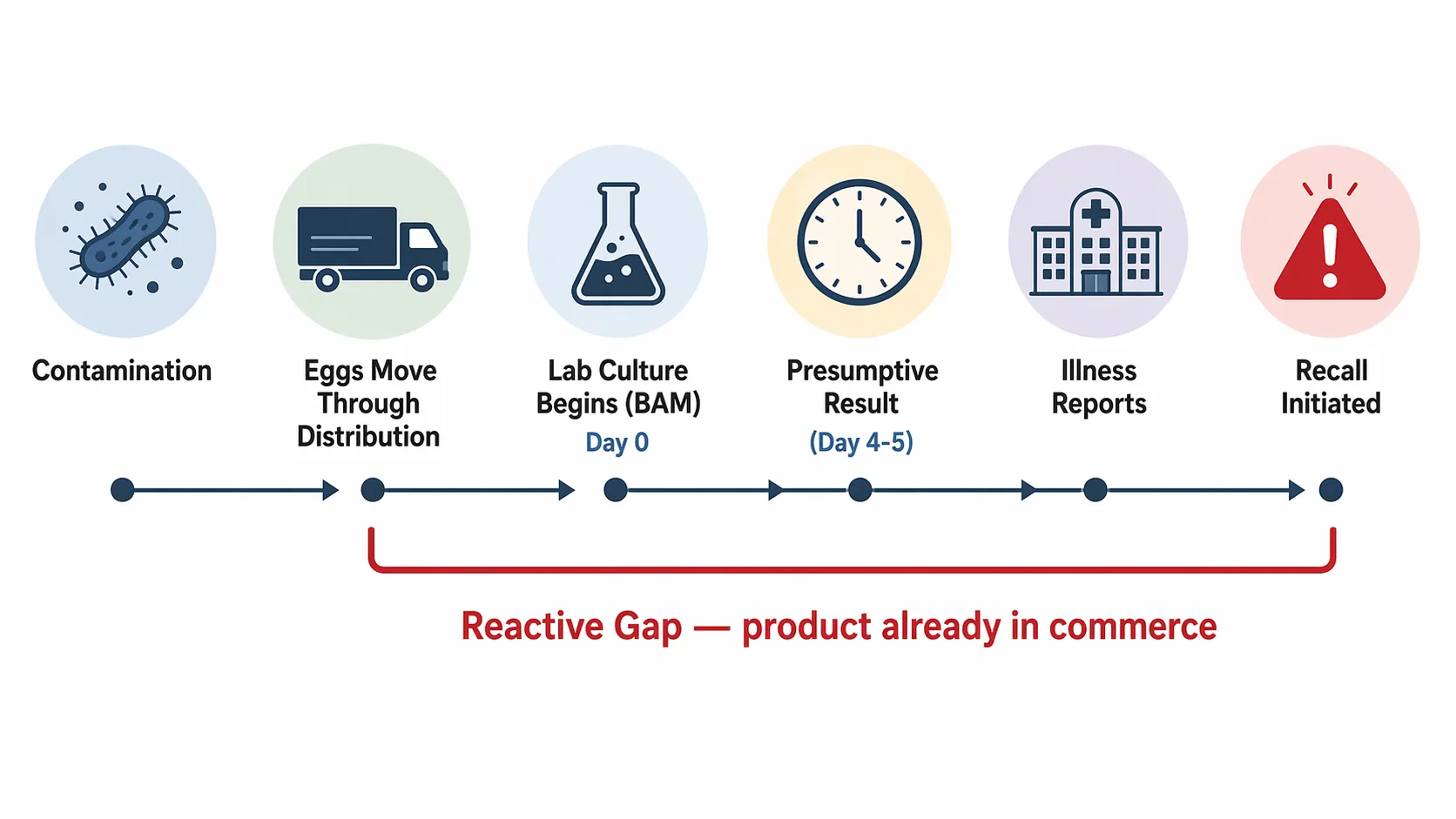
The August Egg Company Sequence Shows the Delay
The August Egg Company outbreak is the case that makes the timing problem hard to dismiss. CDC reported 134 confirmed cases, 38 hospitalizations, and one death, while also noting that the true number of sick people was likely much higher than the confirmed count.[2] Those numbers are not just an outbreak summary. They are a measurement of how long the system had already been losing ground before control actions caught up.
FDA’s outbreak materials reported environmental Salmonella positives connected to the August Egg Company investigation after dozens of illnesses had already occurred.[3] By that point, the work facing the company, regulators, customers, and downstream buyers was no longer prevention in the clean sense. It was reconstruction: which lots moved, where they moved, which customers received them, which labels and pack dates mattered, which inventory could still be held, and which product had already been consumed.
That is the recall cycle in its most uncomfortable form. The contamination signal is real before the public-health signal becomes visible. The facility may have environmental data, flock observations, sanitation records, pest-control notes, cooler temperatures, supplier information, and customer complaints, but none of those streams automatically becomes a hold decision. Confirmation arrives through slower channels, and the distribution system has been doing exactly what it was built to do: moving product.
The 2025 egg events should also be kept distinct. August Egg Company’s June 2025 recall carried the central illness and inspection sequence. Country Eggs followed as a separate August 2025 recall event. Black Sheep Egg Company became a separate September–October 2025 event. Vega Farms appeared as a separate December 2025 event. The pattern matters, but the events should not be blended into one generic “egg recall wave.”
Fast Company’s 2025 analysis framed the wave as structural rather than anomalous, a useful way to read the year: not as four identical incidents, and not as proof that every egg operation had the same failure, but as evidence that reactive-only food safety systems struggle when biological risk, test timing, and distribution velocity are misaligned.[4]
What Actually Lags in a Recall
In a plant or egg operation, “waiting on results” is rarely passive. Someone is deciding whether to release, whether to hold, whether to intensify sanitation, whether to resample, whether to call a customer, whether to stop a line, or whether to keep watching. The official result may not be ready, but the commercial clock is already running.
| Operating Signal | Typical Question | Recall-Cycle Problem |
|---|---|---|
| Environmental monitoring | Are Salmonella indicators appearing repeatedly by zone, drain, equipment, or room? | A positive result may be treated as isolated unless the pattern is visible across time and location. |
| Flock and facility records | Are bird health, feed, water, pest, sanitation, or traffic patterns changing? | Records often sit in separate systems and are reviewed after a trigger, not continuously. |
| Culture testing | Is there laboratory confirmation? | Presumptive results can take days, while product continues moving. |
| Distribution data | Where did suspect product go? | Traceback and trace-forward work starts under pressure after risk has already entered commerce. |
| Public-health investigation | Are illnesses linked by organism, exposure, and product? | Illness data is powerful but inherently lagging. |
The cultural habit that needs changing is the idea that recall execution proves control. A clean recall tree, a fast customer notification, and a complete effectiveness check all matter. But if the first decisive signal is illness or a late environmental positive, the supply chain is already operating from behind.
Synexis’ 2025 egg recall analysis summarized several Salmonella transmission pathways relevant to egg operations, including flock environment, feed, water, pest vectors, and processing equipment.[1] Those pathways are operationally important because they generate data before they generate a confirmed outbreak. They show up as recurring sanitation issues, changing pest pressure, abnormal environmental swab geography, maintenance events, or cold-room and traffic-pattern anomalies.
None of that means every weak signal should trigger a recall. It means the industry needs better ways to rank weak signals before confirmation, while there is still time to hold product, narrow distribution, resample intelligently, or clean aggressively.
Black Sheep Was Not a Single Surprise Positive
The Black Sheep Egg Company findings are irritating in a different way from the August Egg Company sequence. Food Safety News reported that FDA inspection findings included 40 environmental samples positive for Salmonella and seven different strains before the recall was issued.[5] That is pattern-rich information. It is not the same as one unexpected swab in one corner of a facility.
A competent food safety team can still be trapped by slow tools and fragmented records. Environmental positives may live in one system, sanitation corrective actions in another, maintenance work orders in another, and distribution release decisions somewhere else entirely. But repeated environmental positives across strains should raise the standard for action. At that point, the question is not whether the operation can explain one result. It is whether the operation can see accumulation before the regulator or outbreak file does.
This is where predictive AI becomes interesting, provided it is not sold as magic. The useful version does not promise to “prevent Salmonella” in a deterministic sense. It shortens the time between signal, investigation, decision, and proof.
From Passive Sensing to Earlier Action
The Institute of Food Technologists’ 2026 Food Technology Magazine article described five AI functions for food systems: Sense, Detect, Predict, Decide, and Prove. Its most useful caution was that many deployed systems sense, fewer truly detect, and even fewer predict.[6] That distinction is essential in egg safety because dashboards alone do not break the recall cycle.
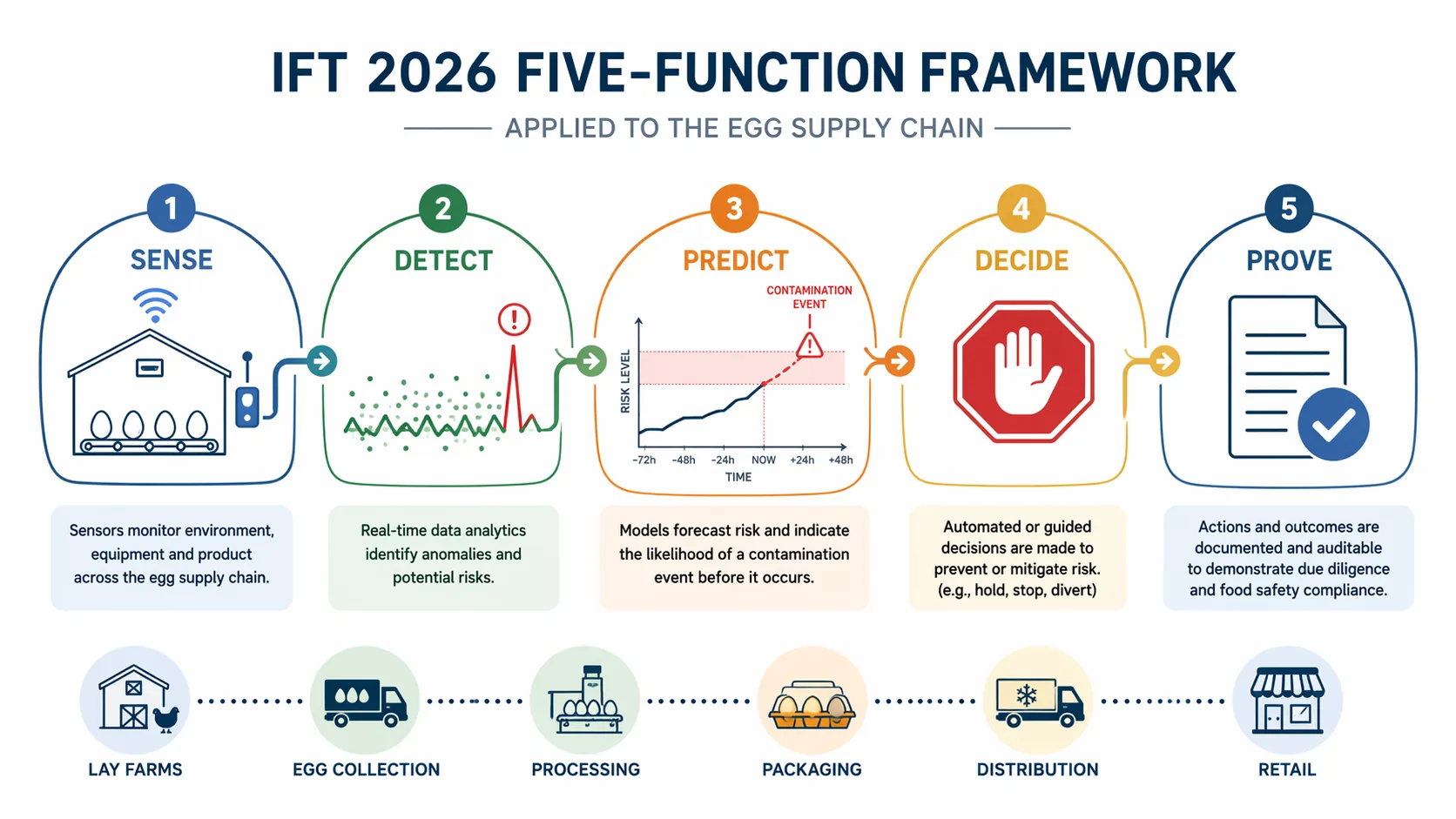
| IFT Function | Egg-Supply-Chain Meaning | What Changes Operationally |
|---|---|---|
| Sense | Collect environmental swabs, equipment readings, flock records, cold-chain telemetry, supplier information, and inspection observations. | The operation has more signals, but not necessarily better decisions. |
| Detect | Find abnormal clusters by facility zone, time window, strain history, flock source, sanitation cycle, or route. | QA and food safety teams can investigate before confirmation becomes the first trigger. |
| Predict | Estimate which combinations of signals increase the likelihood of contamination or distribution exposure. | Hold, resampling, sanitation, and supplier-review decisions can be made earlier and with clearer thresholds. |
| Decide | Translate model output into release rules, escalation paths, product holds, flock segregation, cleaning, or customer notification. | Risk scoring becomes part of operating control, not a report reviewed after shipment. |
| Prove | Preserve audit trails showing the signal, model output, human review, decision, corrective action, and verification result. | The company can defend why it held, released, cleaned, escalated, or changed supplier handling. |
Sense is the easiest layer to buy. Put sensors in coolers. Digitize environmental monitoring. Pull flock records into a platform. Add supplier risk feeds. Connect transportation data. These are useful moves, especially when cold-chain telemetry is part of the risk picture; ChainSignal’s article on AI-driven food safety optimization for the cold chain goes deeper on that architecture.
Detect is where the system begins to earn its place in egg safety. A detection layer should notice that environmental positives are recurring near the same traffic path after washdown, or that pest-control notes, sanitation deviations, and flock-origin data are converging around a higher-risk production window. That is different from storing each record until someone manually reconstructs the pattern after an inspection.
Predict is narrower still. It should not be a vendor slide that turns every sensor into a guarantee. A useful predictive model produces an earlier probability-weighted warning tied to specific actions: hold this lot family, resample these zones, review this flock source, delay release pending additional results, intensify sanitation before the next run, or narrow the distribution window until evidence improves.
Cold-chain AI can contribute to this model, but it should not be treated as a substitute for Salmonella control. Temperature abuse is one risk stream, not the whole organism story. Where temperature, dwell time, route history, and cooler performance affect exposure management, predictive cold-chain monitoring can help prioritize attention; ChainSignal’s piece on AI sensors for predictive cold chain monitoring is the better place for the detailed cold-chain performance discussion.
The AI Workflow Has to Touch Hold Decisions
The alternative workflow is not simply “test plus AI.” It is a different operating rhythm around uncertainty.
- Continuously collect environmental, flock, facility, sanitation, pest-control, supplier, and cold-chain signals.
- Detect abnormal combinations, not only single out-of-spec records.
- Predict which lots, zones, routes, or suppliers deserve escalation before culture confirmation.
- Decide through preapproved thresholds: hold, release, resample, clean, segregate, notify, or restrict distribution.
- Prove the decision with retained evidence, model output, reviewer signoff, corrective action, and verification.
That fourth step is the one that separates useful AI from expensive instrumentation. If a model raises risk but no one has authority to hold product, adjust release rules, change sanitation sequencing, or limit shipments, the model is just documenting discomfort. It may help the postmortem, but it does not meaningfully change the recall cycle.
The decision layer also needs commercial realism. A food safety manager cannot hold every lot attached to a weak anomaly without evidence and governance. A distributor cannot explain vague “AI concern” to customers. A QA director needs thresholds that were agreed before the emergency: what signal combination triggers a precautionary hold, who reviews it, what additional sampling is required, when product can be released, and how the decision is documented.
Traceability is part of this, but traceability alone is still often reactive. FSMA 204 and related traceability pressures may motivate investment in cleaner event data; ChainSignal’s article on AI traceability and agricultural policy changes covers that broader regulatory context. In egg recall prevention, traceability becomes more powerful when it is connected to risk scoring early enough to narrow a hold before product fans out through the market.
Where Computer Vision and Quality Testing Fit
Computer vision can help inspect egg quality, packaging integrity, labeling, visible defects, and process consistency. Those are valuable controls, and ChainSignal’s article on AI food quality testing gives that topic more room. But vision systems should not be oversold as Salmonella detectors unless the claim is supported by validated microbiological evidence.
The same caution applies to borrowing examples from produce inspection. Computer vision can be impressive in produce applications, and ChainSignal has separately covered AI computer vision for food safety inspection. For shell eggs and Salmonella, the stronger use case is not visual detection of the organism. It is combining visual process observations with environmental, flock, sanitation, and distribution data so the risk model has more context.
What Earlier Warning Should Change
Earlier warning is only valuable if it changes something before the recall notice. In an egg operation, the practical outputs are familiar:
- A targeted product hold while confirmatory testing continues.
- Expanded environmental sampling in specific zones rather than broad, unfocused resampling.
- Sanitation escalation before the next production window.
- Flock, feed, water, pest-control, or supplier review when upstream signals align.
- Distribution restriction so suspect product does not move farther while uncertainty is unresolved.
- A documented rationale for release when the risk signal is investigated and not supported.
This is also where broader supply chain risk management matters. A producer may see the environmental signal first, but the distributor bears part of the execution burden when a hold comes late. Customers want lot clarity, not a theory. The article on AI-driven supply chain risk management for food recalls is useful background for that wider recall-risk operating model.
The economic case for prevention is real, but it should be stated carefully. General food-recall research has estimated an average direct recall cost of about $10 million and a shareholder-wealth impact of roughly $109 million within five trading days for serious recalls.[7][8] Those figures should not be assigned to August Egg Company, Country Eggs, Black Sheep Egg Company, or Vega Farms without company-specific evidence. They show why earlier control is financially material; they do not price any one 2025 egg recall.
The Discipline Is Proof
Food safety teams do not need another platform that creates beautiful hindsight. They need systems that can show what was known at the time, how the model interpreted it, who reviewed it, what threshold applied, what action followed, and whether verification supported the action.
That proof layer protects against two opposite failures. One is underreaction: repeated environmental or operational signals are treated as isolated events until illness data forces the issue. The other is uncontrolled overreaction: vague risk scores create holds and customer disruption without a defensible basis. Both failures erode trust.
A mature predictive system should leave an audit trail that a regulator, customer, or internal review team can follow. It should connect the environmental swab, the sanitation record, the flock or supplier context, the cold-chain telemetry, the prediction, the human decision, and the verification result. If the company holds product, the record should explain why. If it releases product, the record should explain why that was reasonable given the evidence available then.
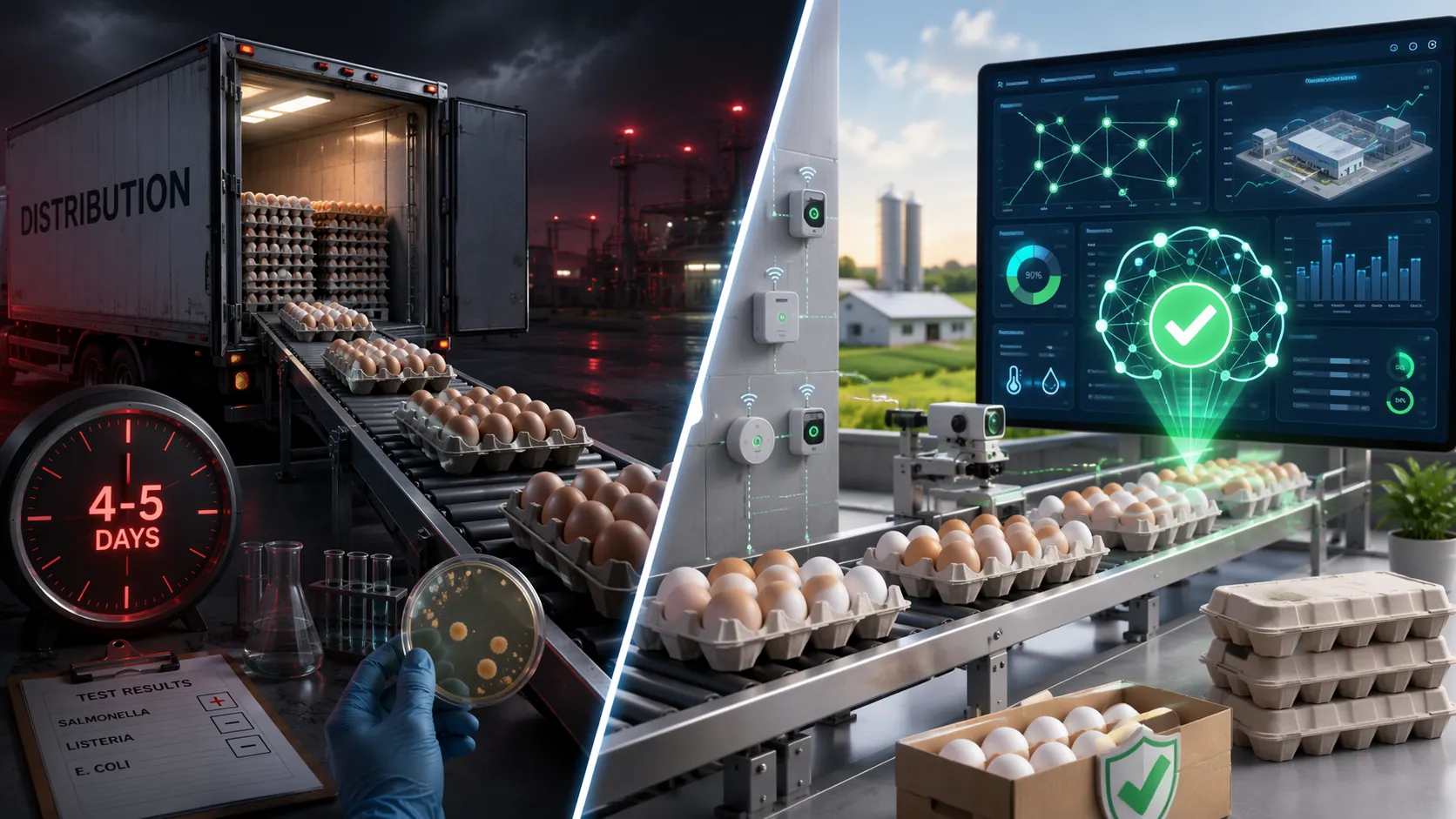
Predictive AI can break the Salmonella egg recall cycle only when it moves beyond passive sensing into detection, prediction, decision support, and proof. Otherwise, it becomes another dashboard showing risk after the window for prevention has already narrowed.
References
- 2025 Salmonella Egg Recall, Synexis
- Salmonella Outbreak Linked to Eggs, CDC
- Outbreaks of Foodborne Illness, FDA
- Why the 2025 egg recall wave is structural, not anomalous, Fast Company
- FDA finds Salmonella throughout Black Sheep Egg Company facility, Food Safety News, Oct 2025
- Food Technology Magazine, June 2026, Institute of Food Technologists, June 2026
- Food recalls average $10M in direct costs, Spectacular Labs
- Serious recalls erase shareholder wealth within five trading days, Pozo & Schroeder, 2016
Comments
Join the discussion with an anonymous comment.