
The most useful signal in Costco's gas supply chain changes is not a pricing headline. It is the physical stress test that showed up in Q3 2026: five consecutive weeks of record-breaking fuel sales during Middle East supply disruptions, with CEO Ron Vachris saying Costco was making “multiple daily gas deliveries to many locations.”[1] That is not a merchandising anecdote. It is a live replenishment, traffic, and site-capacity event.
Fuel demand at that level does not stay in the fuel lane. Cars queue, parking turns over faster, warehouse doors receive more arrivals, checkout lanes absorb more baskets, and depots have to keep merchandise flowing behind the scenes. Costco can afford to think about fuel this way because the gas station is not isolated from the warehouse. CFO Gary Millerchip said “about half of the members who will shop at the gas station will also cross-shop at the warehouse.”[1] That one operating link changes the interpretation of the whole system.
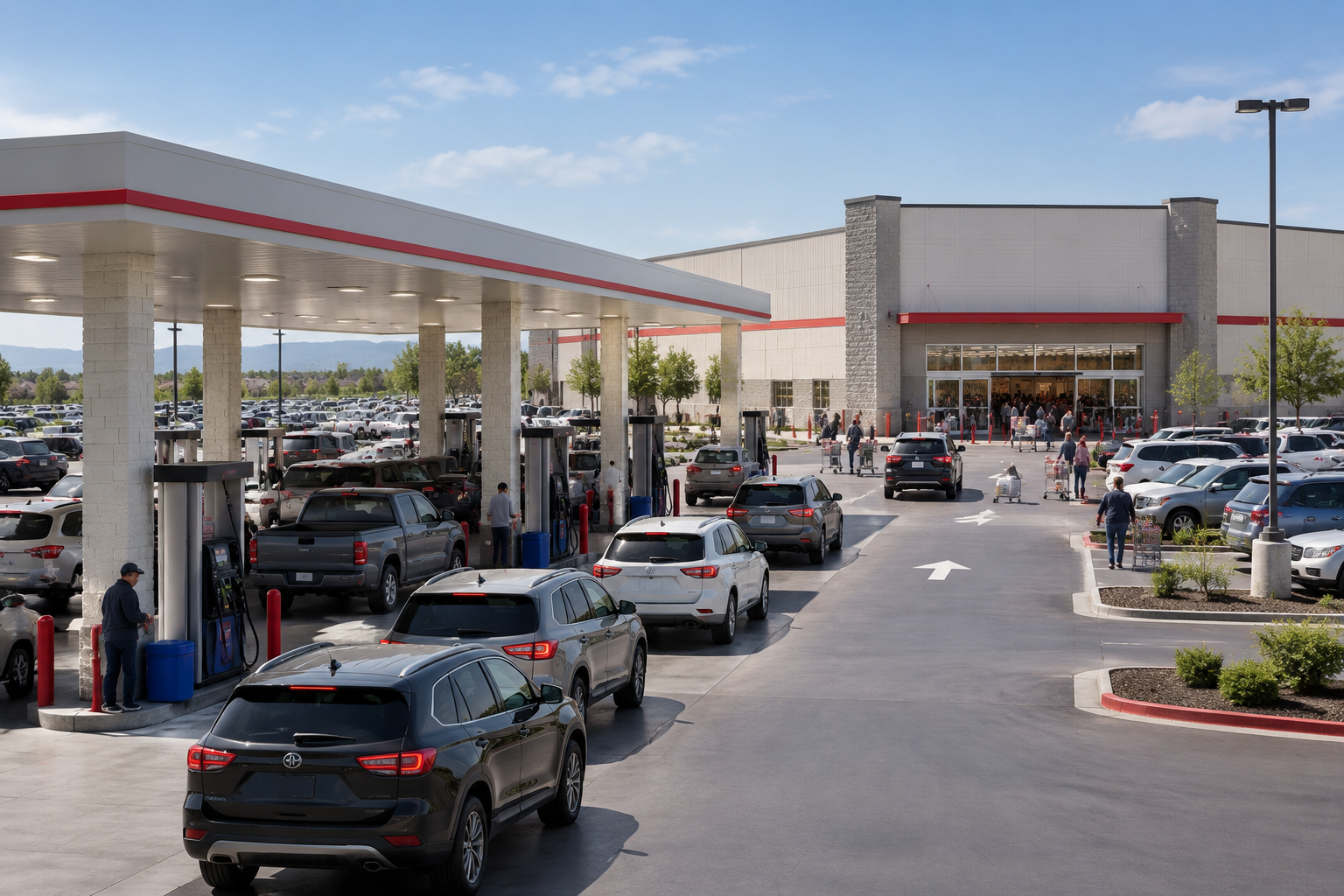
If half the fuel buyers also enter the warehouse, then fuel pricing is not just a category decision. It is a demand-shaping tool for the larger box. A few cents at the pump can become more cars on the lot, more carts through the entrance, more pressure on front-end labor, and more merchandise velocity. The question is not whether gas earned a higher margin. The better question is whether gas helped the rest of the network run at higher useful throughput.
Fuel As A Throughput Lever
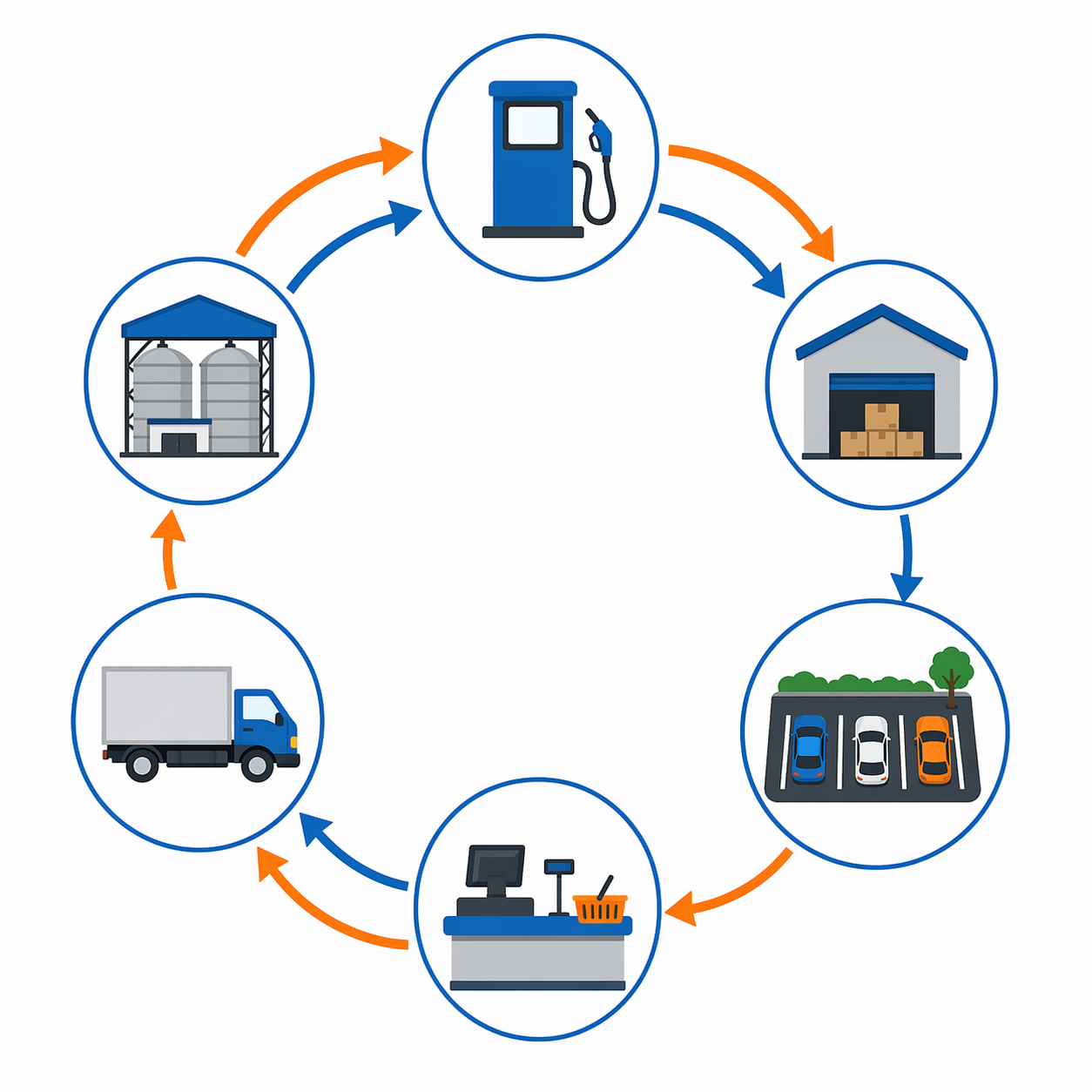
Supply Chain 360’s June 2026 analysis gives the cleanest frame for what appears to be happening: Costco manages fuel, pricing, parking, depots, checkout, inventory, and delivery as “interconnected parts of a single capacity system.”[2] That should be treated as an analytical reading, not a disclosed Costco operating manual. But it fits the public signals better than the simpler story that Costco is merely chasing gas volume.
The margin pattern is the tell. In Q3 2026, Costco widened its fuel price advantage while fuel margin rates significantly decreased, yet fuel profit dollars increased because volume rose.[1][2] A retailer trying to maximize the fuel category in isolation would be uncomfortable with that trade for long. A retailer using fuel to load the warehouse network can make a different calculation: lower percentage margin at the pump may be acceptable if it increases member trips, merchandise sales opportunities, and asset utilization across the club.
This is where many margin stories get too tidy. Lower gas prices do not magically create warehouse throughput unless the rest of the site can absorb the demand. The pump island can generate arrivals faster than the parking lot can turn, faster than checkout can clear baskets, or faster than replenishment can recover key items. In that case, the cheap-gas decision simply moves the bottleneck and hands the mess to operators.
Costco’s advantage is that the company appears to be solving the adjacent bottlenecks, not just celebrating the traffic. Supply Chain 360 connects the fuel posture with checkout technology, mobile wallet, prescan, parking expansion, depot capacity, and inventory flow.[2] Those are not cosmetic improvements. They are the mechanisms that decide whether incremental fuel traffic becomes warehouse productivity or just congestion.
| Operating decision | Immediate effect | Capacity question it creates |
|---|---|---|
| Wider fuel price gap | More fuel demand and more member visits | Can stations, parking, and warehouse entrances absorb the arrival rate? |
| Multiple daily fuel deliveries | Higher station availability during demand spikes | Can inbound fuel logistics keep pumps open without disrupting site flow? |
| Checkout and prescan investment | Faster basket processing | Can the front end clear the extra warehouse trips created by fuel traffic? |
| Depot expansion and inventory flow | More resilient merchandise replenishment | Can back-end capacity support the higher trip conversion? |
| Parking and land acquisition | More room for vehicle churn | Can the site prevent fuel demand from choking store access? |
The Cross-Shop Math Changes The Fuel P&L
Gas accounts for about 10% of Costco’s total revenue, and the company reported roughly $70.5 billion in quarterly revenue in Q3 2026.[1] That makes fuel too large to dismiss as a perk, but still incomplete as a standalone explanation. The category matters because of its own scale and because it changes the traffic pattern feeding the rest of the warehouse.
The CFO’s cross-shop comment is the hinge. If about half of gas-shopping members also enter the warehouse, then a fuel supply decision has a second-order merchandise consequence.[1] A stockout at the pumps does not only lose gallons. It can also reduce warehouse visits. A sharper fuel price does not only pressure pump margin. It can increase the number of members arriving with a reason to add a merchandise trip.
That does not prove every extra gallon causes an extra basket. The public data does not support that kind of clean causal claim. What it does support is narrower and more useful: Costco has a disclosed cross-shop relationship, a Q3 pattern of lower fuel margin rates and higher fuel profit dollars, and a concurrent focus on site and network capacity. Together, those signals make fuel look less like an isolated profit pool and more like one of the dials Costco uses to regulate total throughput.
Where The Bottlenecks Move
Once fuel is treated as an arrival engine, the operating burden spreads quickly. A station with record demand needs reliable inbound fuel supply. The parking lot needs enough circulation capacity that gas traffic does not block warehouse access. The entrance and front end need to keep members moving. The depot network needs to refill merchandise fast enough that the incremental visits do not turn into empty-shelf disappointment.
This is why the capital-priority list matters. Costco’s stated priorities include depot expansion, warehouse remodeling, site relocations, larger fuel stations, and adjacent land acquisition for parking.[2] Each item answers a different version of the same capacity problem. Depot expansion works on back-end replenishment. Remodeling works on in-club flow. Site relocation can reset bad physical constraints. Larger fuel stations expand pump throughput. Adjacent land acquisition gives the site more room to handle vehicles.
Those investments are easy to describe separately and hard to manage separately. A larger fuel station without better parking can make the lot worse. Faster checkout without enough replenishment can simply move the failure point to inventory. Depot capacity without site flow can leave the warehouse ready for demand the parking lot cannot physically admit. The value is in the synchronization, not the individual project list.
That is also the practical reading of Q3’s margin compression. Accepting lower percentage margins in fuel only makes sense if the added volume can be served and converted. Otherwise the company has simply bought congestion. The record weeks during supply disruption were therefore a test of more than fuel procurement. They tested whether the replenishment cadence, station labor, traffic design, and warehouse operations could stay aligned while demand rose.
AI Helps, But It Is Not The Story
Costco has put technology behind this system, but the AI claim should stay in its proper place. On the Q1 2026 earnings call, Vachris said, “We’re now in the process of deploying AI tools in our gas business, which we expect will improve inventory management and drive incremental sales.”[3] That is a concrete statement about deployment and expected benefits. It is not a public specification of Costco’s forecasting models, vendor stack, or decision rules.
In a fuel network, better inventory management can matter because demand shocks are operationally unforgiving. If a station runs dry, the lost sale is visible immediately, and the member’s warehouse trip may disappear with it. If deliveries arrive too aggressively, the site and supplier network carry unnecessary strain. The useful AI role is not glamour; it is helping planners see demand, inventory, and replenishment timing early enough to keep pumps available without creating new waste.
That makes Costco’s gas AI closer to a capacity-control tool than a futuristic retail showcase. It belongs in the same family of operating problems covered by AI-based inventory management and fuel-shortage planning, where the work is less about replacing operators and more about giving them earlier, cleaner signals. During disruption, that distinction matters. The people scheduling deliveries and managing station availability still bear the consequence when a forecast becomes a line of cars.
Mission Viejo Tests The Model Away From The Warehouse Wall
The standalone Mission Viejo, California, station is a useful stress test because it separates fuel capacity from the normal warehouse adjacency. The site opened in June 2026 as Costco’s first standalone station, with 40 pumps and 17,185 square feet.[4][5] That creates a different operating question: what happens when the fuel node can generate member value and traffic without sitting directly beside the warehouse entrance?
A standalone station may solve one bottleneck by removing fuel queues from a constrained warehouse parcel. It may also create new logistics complexity because the node still needs fuel replenishment, pricing discipline, member access control, and traffic management, but with a weaker immediate path into warehouse baskets. The cross-shop mechanism does not disappear, but it becomes less physically automatic.
That is why Mission Viejo should not be treated as proof that Costco is turning gas into an independent retail format. The safer conclusion is narrower: Costco is willing to experiment with fuel capacity at a new node when the local real-estate and traffic problem may justify decoupling the pump island from the warehouse box. Whether that improves total network throughput depends on the demand it captures, the congestion it avoids, and the merchandise trips it still influences.
What Other Supply Chain Leaders Can Actually Take From This
The lesson is not that every retailer should add fuel or cut margins in an adjacent category. Costco’s model works because the traffic is dense, the membership relationship is strong, the warehouse format can monetize trips, and the cross-flow between gas and merchandise is real. Without those conditions, a cheap adjacent service can become a subsidy with no throughput payoff.
The transferable part is the operating discipline. When one function reliably changes demand in another function, it should not be managed as a separate P&L island. Pricing, replenishment, labor, parking, checkout, depot capacity, and delivery need to be modeled as connected constraints. The right margin target for one node may be lower than its standalone optimum if that unlocks more profitable or more strategic flow elsewhere.
That standard also keeps the AI discussion honest. A tool is useful only if it changes an operating decision: when to replenish, where to stage capacity, which site is at risk, which bottleneck will inherit the next wave of demand. If the model cannot be tied to those decisions, it is not capacity synchronization. It is reporting with better vocabulary.
Costco’s fuel system is instructive because it shows an adjacent function being used to shape total network throughput. The company appears willing to accept thinner fuel margins when volume, cross-shopping, and site capacity support the broader economics. That is a harder play to copy than it is to admire, and that is the point: the fuel strategy only works when the rest of the machine is built to absorb what the pumps send it.
References
- Yahoo Finance, Jul 2026
- Costco’s Real Advantage Is Capacity Strategy, Not Just Delivery Speed - Supply Chain 360 - Jun 2026
- Costco Q1 2026 earnings call
- Motley Fool, Mar 2026
- Mojo Sales & Branding
Comments
Join the discussion with an anonymous comment.