
The practical question around AI supply chain security and homeland security’s role is no longer whether the Department of Homeland Security has issued a binding AI rule for every contractor. It has not. The harder question is when voluntary homeland security guidance starts behaving like a purchasing condition because federal buyers, cyber reviewers, and critical infrastructure partners all begin using the same documents as their reference set.
That is where the market is moving in 2026. DHS has a voluntary framework for AI in critical infrastructure. CISA has joint guidance with NSA, the FBI, and the UK National Cyber Security Centre that names concrete AI data and model risks. A June 2026 Executive Order assigns new AI cybersecurity duties to federal actors, including CISA. DLA has already described its use of AI models to screen supplier risk at scale. None of that turns every commercial AI workflow into a regulated system overnight. It does, however, give federal procurement and critical infrastructure reviewers a vocabulary they can put into questionnaires, supplier attestations, contract language, and remediation plans.
What homeland security is actually doing in the AI supply chain
The homeland security role is not one office writing one rule. It is a set of agencies and functions converging around the same operating problem: AI systems now sit inside the software, data, logistics, cyber defense, and decision-support layers that critical infrastructure and federal suppliers depend on. DHS and CISA shape security expectations. DLA, within the Department of Defense, shows how federal supply chain organizations can use AI to evaluate suppliers. DHS supply chain teams are also applying AI to model disruption risk.
The DHS Roles and Responsibilities Framework for Artificial Intelligence in Critical Infrastructure, released in November 2024, is the cleanest map of that role. It identifies five stakeholder layers in the AI ecosystem: cloud and compute providers, AI developers, critical infrastructure owners and operators, civil society, and the public sector. It also organizes responsibilities around five areas: securing environments, driving responsible model and system design, implementing data governance, ensuring safe and secure deployment, and maintaining performance and impact monitoring.[1]
That structure matters because AI supply chain security rarely fails in a single owner’s lane. A model developer can inherit poisoned or poorly governed data. A critical infrastructure operator can deploy a vendor tool without understanding its dependency on a particular cloud service or third-party model. A cloud or compute provider can become the control point for access, isolation, logging, and abuse monitoring. Public-sector actors may not operate the system, but they influence what gets treated as adequate due diligence.
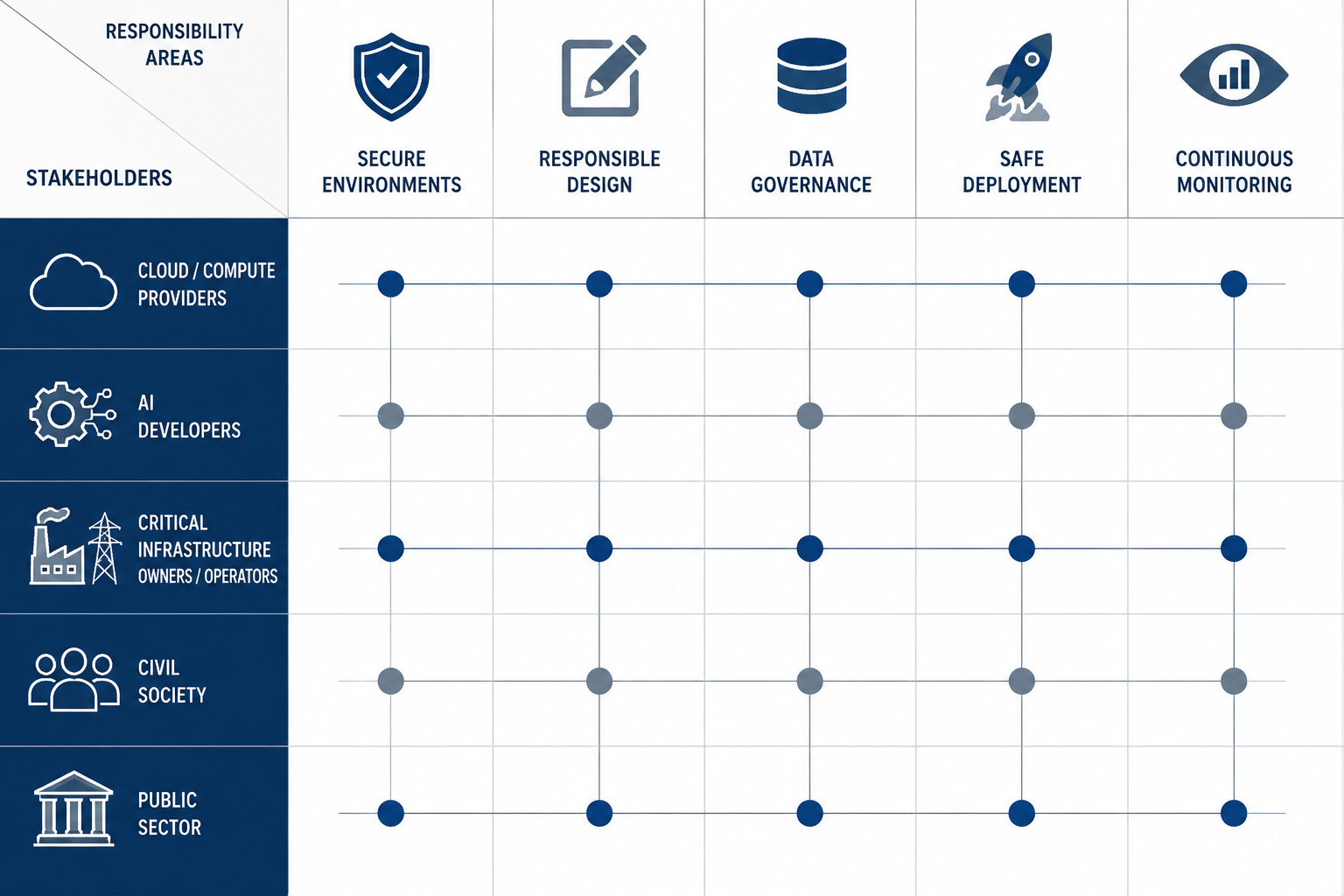
| DHS stakeholder layer | Procurement question it creates |
|---|---|
| Cloud and compute providers | Can the supplier explain where models run, how access is controlled, and how tenant or workload isolation is monitored? |
| AI developers | Can the supplier document training data, model updates, testing, misuse controls, and downstream limitations? |
| Critical infrastructure owners and operators | Can the buyer show which AI systems affect operational decisions, resilience, safety, or service continuity? |
| Civil society | Are impacts on affected communities, users, and public trust considered where AI affects essential services? |
| Public sector | Are agency expectations, reporting channels, and security guidance reflected in supplier oversight? |
The framework is voluntary. That point should not be blurred. A voluntary framework is not a contract clause, a statute, or a binding operational directive. But procurement people do not need a final rule before they start borrowing language from a well-structured federal framework. Once the same categories appear in security reviews and supplier risk discussions, the practical burden shifts: a company may still be able to say the framework is not mandatory, but it will be less persuasive if it cannot map its AI suppliers, controls, and monitoring to the framework at all.
The June 2026 Executive Order adds momentum, not full certainty
Executive Order 14409, issued June 2, 2026, pushes federal AI security activity further into operational channels. The order directs CISA to release Binding Operational Directives expanding AI-enabled defensive tools, establishes an AI cybersecurity clearinghouse, calls for covered frontier model benchmarking, and requires the Attorney General to prioritize enforcement against AI-driven cybercrime.[2]
For contractors, the important signal is not that the order instantly creates a universal AI supply chain compliance mandate. The order’s terms, including “advanced AI” and “covered frontier models,” remain scope-dependent, and the research record here does not support treating every ordinary AI-enabled workflow as covered. The stronger signal is institutional: CISA and other federal actors are being told to turn AI cybersecurity from policy language into tools, benchmarks, clearinghouse functions, and enforcement priorities.
That is how purchasing pressure usually arrives. First, agencies need a defensible reference. Then reviewers need questions they can ask repeatedly. Then suppliers are asked to provide inventories, attestations, test results, incident history, or control mappings. The formal legal status of each document still matters, but it is not the only thing that determines whether a supplier has work to do.
CISA’s guidance turns “AI risk” into supply chain work
Generic warnings about AI risk do not help a procurement team decide what to ask a supplier. The CISA AI Data Security Guidance, issued in May 2025 jointly with NSA, the FBI, and the UK NCSC, is more useful because it names operational risks across the AI lifecycle. The guidance identifies three primary AI supply chain risks: data supply chain vulnerabilities, maliciously crafted inputs, and model manipulation.[3]
Those categories pull the review upstream. A buyer cannot evaluate an AI-enabled supplier only by asking whether the final application has a login screen and an incident response policy. The buyer needs to understand where the data came from, who can alter it, how it is validated, how prompts or inputs can change outputs, whether models can be tampered with, and how model behavior is monitored after deployment.
This is where AI supply chain security starts to look less like a special project and more like an extension of vendor risk management, software assurance, data governance, and cyber monitoring. The same supplier can create risk through a hosted model, an embedded AI feature, a data labeling subcontractor, a vector database, a fine-tuning workflow, or a customer-support automation tool. If those uses are not inventoried, the organization cannot make a credible statement about exposure.
The Coalition for Secure AI, an industry group rather than a government authority, makes a similar point from the implementation side. Its “Six Critical Controls” article says organizations typically discover three to five times more AI deployments than initially estimated, and it highlights risks such as invisible backdoors and cross-tenant data leaks in vector databases that conventional tools may not detect.[4] That should not be cited as a federal requirement. It is still a useful warning about the first unpleasant surprise in most AI governance programs: the inventory is usually wrong.
DLA shows the other side of the equation: agencies are using AI to evaluate suppliers
The DLA example is worth treating carefully. It is not an independent audit of federal AI effectiveness, and it comes from an agency-authored account that may present the program at its best. Still, it shows how supplier risk review is changing inside government supply chain operations.
DLA established an AI Center of Excellence in June 2024. In a May 2025 article, the agency described BDA Supplier Risk models that analyzed 43,000 vendors and flagged more than 19,000 high-risk suppliers. The same account says one investigation led to a guilty plea involving a supplier that falsely claimed U.S. manufacturing.[5]

The takeaway is not that DLA’s model is automatically correct, or that every flagged supplier committed wrongdoing. A risk flag is a triage signal, not a conviction. The useful point is narrower: federal agencies are not only asking suppliers to secure AI. They are also using AI-assisted methods to illuminate supplier networks, detect anomalies, and prioritize investigations.
That changes the contractor’s burden in a practical way. If a federal buyer or logistics agency can cross-check supplier claims, ownership patterns, production assertions, delivery history, or other risk indicators at scale, then weak documentation becomes more expensive. A supplier that cannot explain where work is performed, which subcontractors touch sensitive processes, or how AI tools affect its representations to the government is exposed even before a new AI-specific clause appears.
This is the intersection many commercial teams miss. AI is both the thing that must be governed and the thing the government may use to assess whether the supplier is governable. The contractor has to prepare for both directions: secure the AI systems in its own supply chain, and assume federal evaluators will have better tooling for finding inconsistencies in supplier risk data.
DHS supply chain modeling points to resilience, not just cybersecurity
The homeland security role is also broader than cyber controls around models. DHS’s Supply Chain Resilience Center and AI Corps are building a tool intended to break down critical product supply chains, forecast black-swan event impacts in real time, and recommend mitigations.[6] That matters for companies in energy, transportation, communications, healthcare, and other critical infrastructure sectors because AI supply chain security is becoming tied to continuity and resilience, not just data protection.
A supplier that provides an AI-enabled forecasting system, maintenance tool, routing platform, identity service, or operational analytics layer may affect service continuity even if it never trains a frontier model. The relevant review question becomes less glamorous and more uncomfortable: if this AI dependency fails, is manipulated, is withdrawn by a vendor, or produces unreliable outputs during a disruption, who notices and what happens next?
Where voluntary guidance becomes a procurement condition
There is no need to pretend the DHS framework has already become a universal mandate. The real pressure point is more ordinary. Procurement teams tend to turn shared federal guidance into repeatable evidence requests. Security teams turn it into control mappings. Program offices turn it into evaluation criteria. Auditors turn it into a gap list.
For a company selling into federal or critical infrastructure markets, that means the DHS framework is useful now even where it is not compulsory. It gives the company a way to organize AI supplier questions before a customer asks them under time pressure.
| If the reviewer asks... | The company should be able to show... |
|---|---|
| Which AI systems support the contracted service? | An inventory of internal, vendor, embedded, and subcontractor AI uses tied to business processes. |
| Who provides the model, compute, data, or integration layer? | A supplier and dependency map that separates cloud, model, application, data, and operational owners. |
| How is training, tuning, or operational data governed? | Data provenance, access controls, validation steps, retention rules, and approved use boundaries. |
| How are model outputs monitored after deployment? | Performance monitoring, drift or anomaly review, incident escalation, and human oversight points. |
| What happens if the AI component fails or is manipulated? | Fallback procedures, continuity plans, manual review triggers, and supplier notification obligations. |
The uncomfortable part is that many organizations cannot answer the first question cleanly. They know about the major AI platform purchases. They often know less about AI features added to existing SaaS tools, analytics vendors using third-party models, subcontractors using AI for quality checks, or business teams feeding sensitive operational data into approved tools in ways the original review did not anticipate.
What companies should do before the timeline compresses
The Monday-morning work is not to declare a new compliance regime. It is to make the AI supply chain legible enough that legal, procurement, cyber, and operations teams can respond when federal customers start asking sharper questions.
- Build an AI use inventory that includes vendor products, embedded AI features, internally developed models, subcontractor workflows, analytics tools, and AI-supported operational decisions.
- Map each AI use to the DHS stakeholder layers: cloud or compute provider, AI developer, infrastructure operator, public-sector touchpoint, and affected external stakeholders where relevant.
- Classify supplier obligations around the five DHS responsibility areas: secure environments, responsible design, data governance, safe deployment, and continuous monitoring.
- Add CISA’s AI data security risk categories to vendor reviews, especially questions about data supply chain vulnerabilities, malicious inputs, and model manipulation.
- Update contract templates so AI vendors and subcontractors must disclose material model, data, hosting, monitoring, and incident-response dependencies.
- Prepare evidence, not just policy language: inventories, diagrams, test records, access reviews, monitoring logs, exception approvals, and remediation timelines.
The sequencing matters. Starting with policy language is tempting because it is faster. Starting with the inventory is less elegant, but it exposes the real budget problem: unreviewed tools, unclear data flows, missing supplier clauses, and monitoring controls that were never designed for model behavior.
Companies should also separate three categories that often get blurred in internal conversations. Some obligations are contractual because a federal customer or prime contractor has already required them. Some are regulatory or directive-driven because they apply to a covered agency or system. Others are readiness expectations drawn from voluntary guidance. Treating all three as identical creates compliance theater. Treating the third category as irrelevant creates avoidable scramble.
The baseline to inventory against now
The DHS framework’s value is not that it predicts every future clause. Its value is that it gives organizations a practical baseline for explaining who does what in the AI supply chain before a contracting officer, agency cyber team, prime contractor, or critical infrastructure partner asks for the explanation.
Waiting for mandatory directives may feel disciplined, especially for teams tired of speculative AI compliance work. But the work likely will not disappear. Supplier inventories, AI dependency maps, data governance evidence, model monitoring, and incident procedures are the same materials companies will need once the questions become formal. The difference is timing: doing that work now allows prioritization; doing it later usually means remediation under customer pressure.
For federal contractors and critical infrastructure operators, the safest interpretation is also the most practical one: the DHS framework is voluntary in legal status, but increasingly relevant as a procurement and assurance baseline. That is enough to justify inventorying against it now.
References
- Roles and Responsibilities Framework for Artificial Intelligence in Critical Infrastructure, Department of Homeland Security, November 2024.
- Promoting Advanced Artificial Intelligence Innovation and Security, The White House, June 2, 2026.
- AI Data Security Guidance, Cybersecurity and Infrastructure Security Agency, May 2025.
- The AI Supply Chain Security Imperative: 6 Critical Controls Every Executive Must Implement Now, Coalition for Secure AI.
- Utilization of Artificial Intelligence (AI) to Illuminate Supply Chain Risk, Defense Logistics Agency, May 2025.
- Supply Chain Resilience Center, Department of Homeland Security.
Comments
Join the discussion with an anonymous comment.